
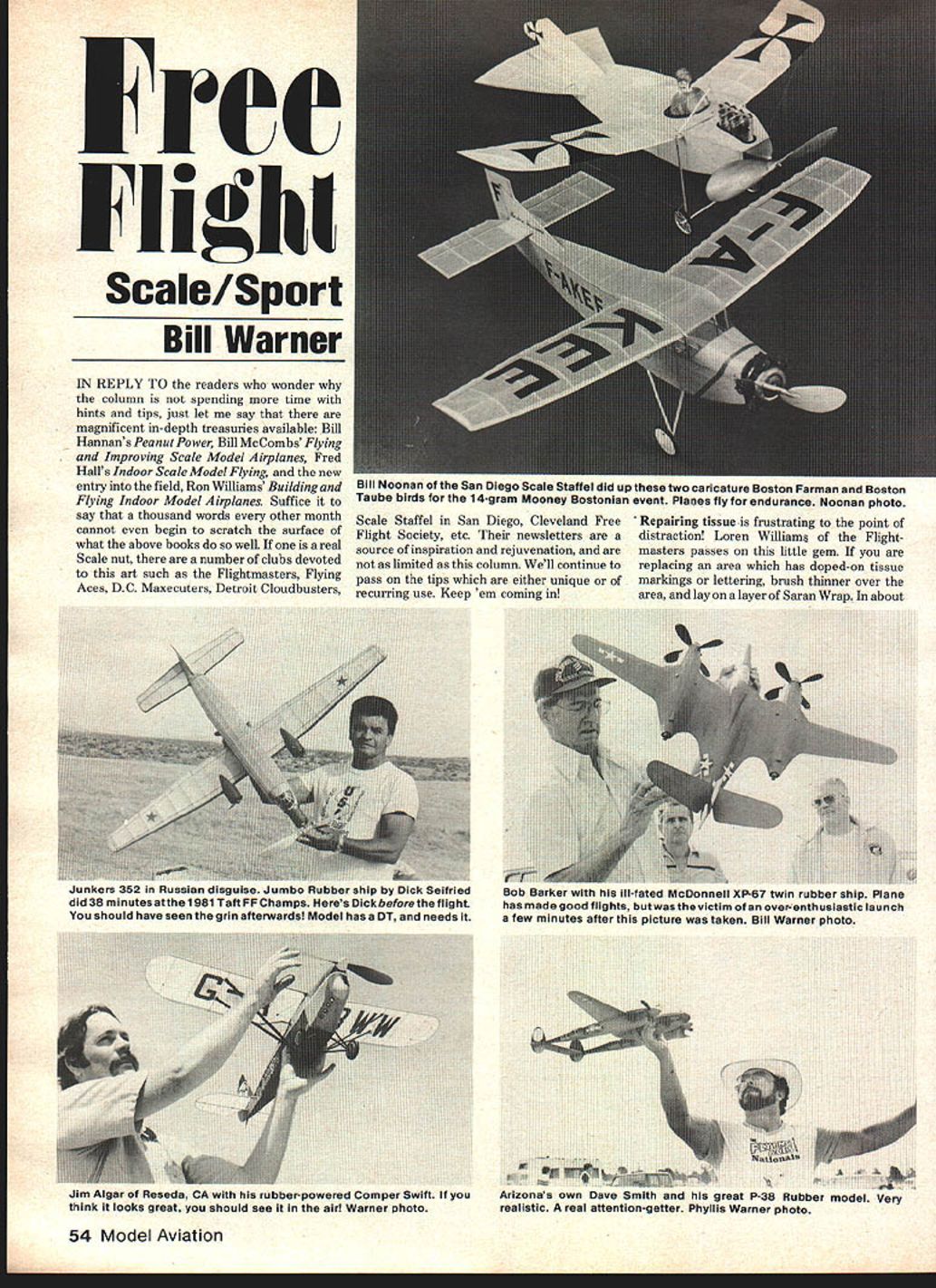
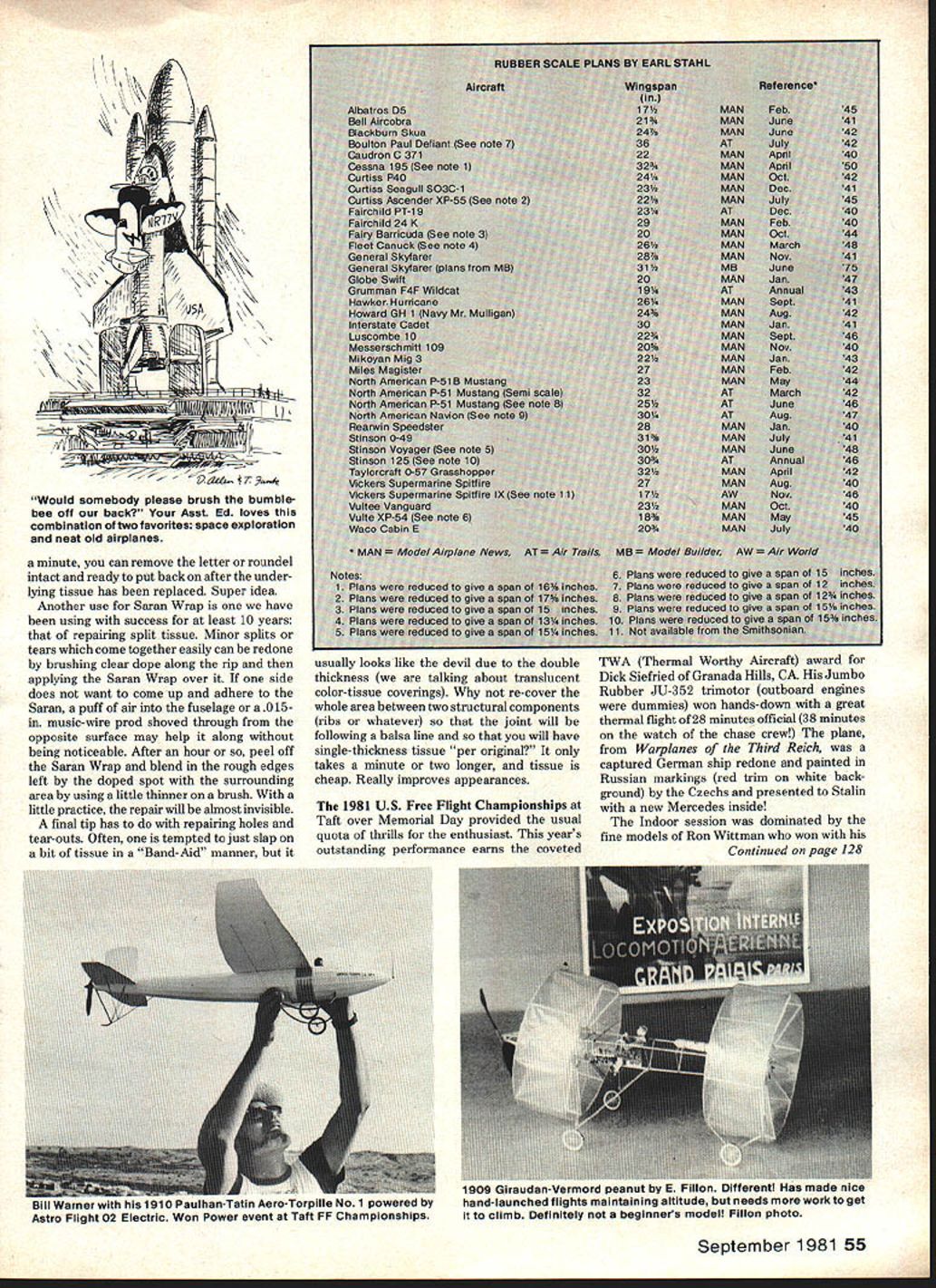
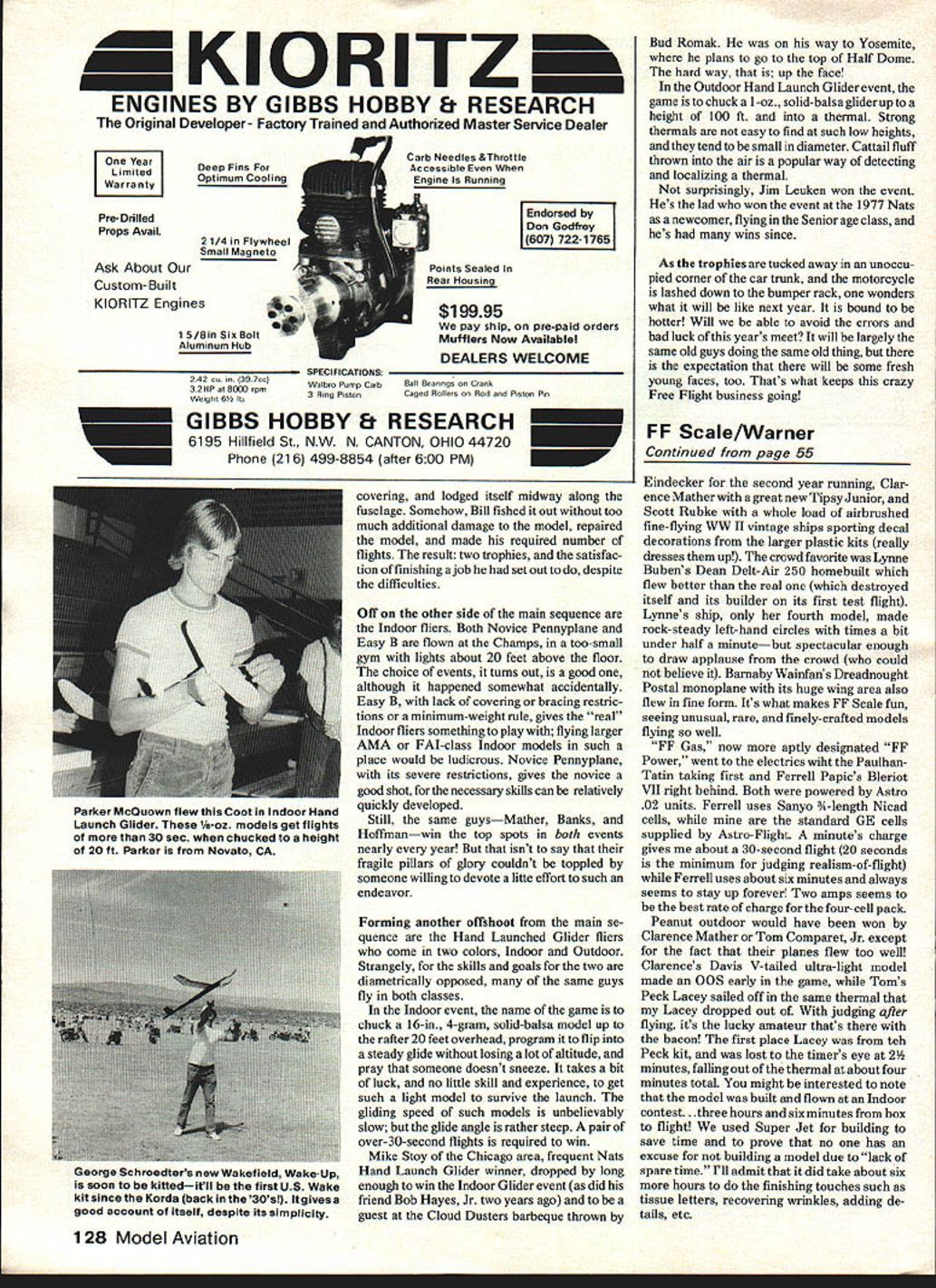
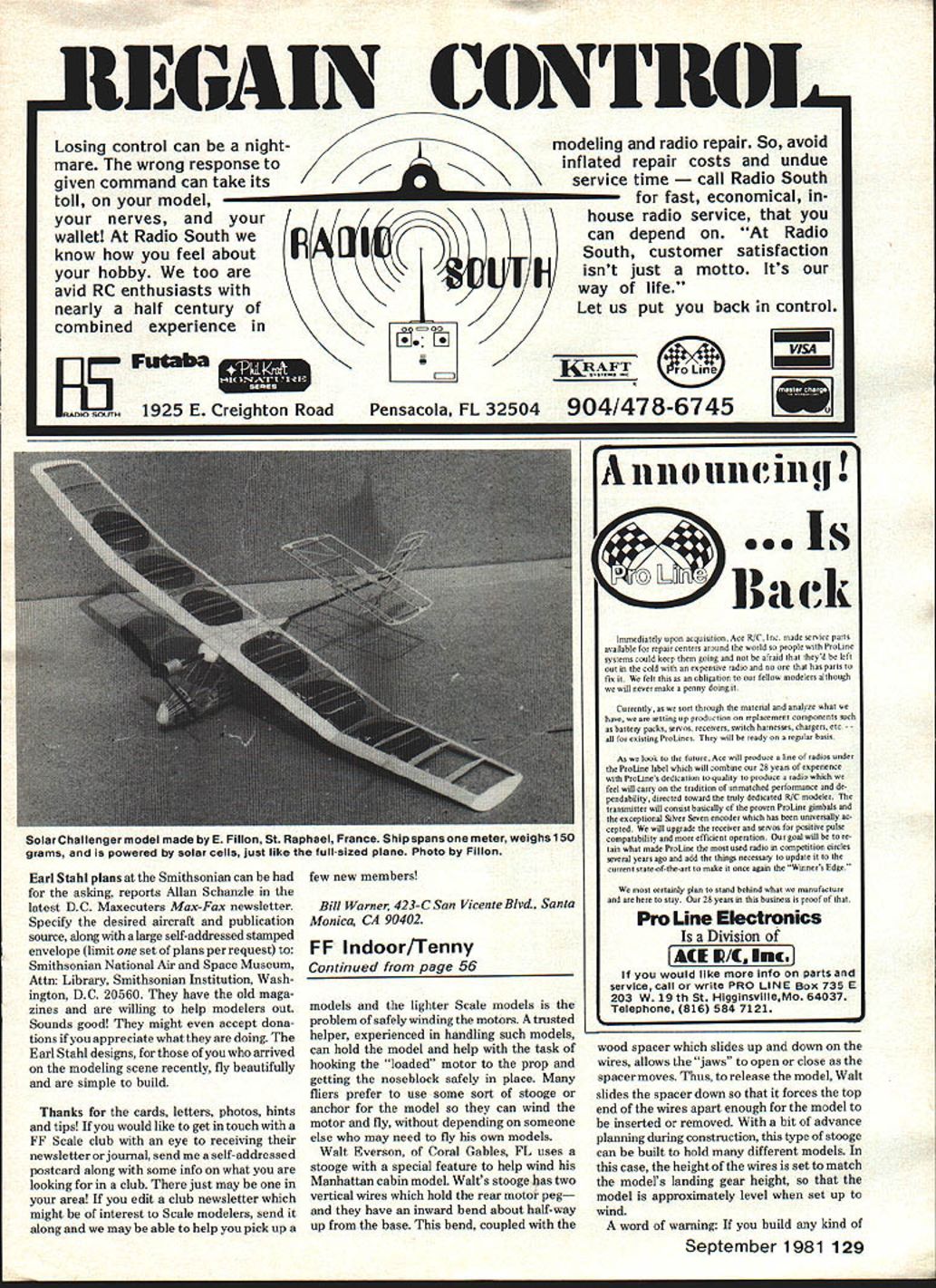
Free Flight: Scale/Sport
Bill Warner
IN REPLY TO the readers who wonder why the column is not spending more time with hints and tips, just let me say that there are magnificent in-depth treasuries available:
- Bill Hannan — Peanut Power
- Bill McCombs — Flying and Improving Scale Model Airplanes
- Fred Hall — Indoor Scale Model Flying
- Ron Williams — Building and Flying Indoor Model Airplanes
A thousand words every other month cannot begin to scratch the surface of what these books do so well. If one is a real scale nut, there are a number of clubs devoted to this art whose newsletters are a source of inspiration and rejuvenation:
- Flightmasters
- Flying Aces
- D.C. Maxecuters
- Detroit Cloudbusters
- Scale Staffel (San Diego)
- Cleveland Free Flight Society
We'll continue to pass on tips that are either unique or of recurring use. Keep 'em coming in!
Repairing tissue is frustrating to the point of distraction. Loren Williams of the Flightmasters passes on this little gem: if you are replacing an area which has doped-on tissue markings or lettering, brush thinner over the area and lay on a layer of Saran Wrap. In about one minute you should be able to remove the letter or roundel intact, ready to put back after the underlying tissue has been replaced. Super idea.
Another use for Saran Wrap: I've been using it with success for at least 10 years repairing split tissue. Minor splits and tears come together easily. Brush clear dope along the rip, apply Saran Wrap over the side that does not want to come up, and puff air into the fuselage; a music-wire prod shoved through the opposite surface may help. After an hour, peel off the Saran Wrap and blend the rough edges left at the doped spot and the surrounding area using a little thinner on a brush. With a little practice the repair will be almost invisible.
A final tip has to do with repairing holes and tear-outs. Often one is tempted to just slap on a bit of tissue in a "Band‑Aid" manner, but it usually looks like the devil due to the double thickness (we are talking about translucent color‑tissue coverings). Why not re-cover the whole area between two structural components (ribs or whatever) so that the joint will follow a balsa line and so that you will have single‑thickness tissue "per original"? It only takes a minute or two longer, and tissue is cheap. It really improves appearances.
The 1981 U.S. Free Flight Championships at Taft over Memorial Day provided the usual quota of thrills for the enthusiast. This year's outstanding performance earns the coveted TWA (Thermal Worthy Aircraft) award for Dick Siefried of Granada Hills, CA. His Jumbo Rubber JU-352 trimotor (outboard engines were dummies) won hands‑down with a great thermal flight of 28 minutes official (38 minutes on the watch of the chase crew!). The plane, from Warplanes of the Third Reich, was a captured German ship redone and painted in Russian markings (red trim on white background) by the Czechs and presented to Stalin with a new Mercedes inside!
The indoor session was dominated by the fine models of Ron Wittman, who won with his Eindecker for the second year running; Clarence Mather with a great new Tipsy Junior; and Scott Rubke with a whole load of airbrushed, fine-flying WWII vintage ships sporting decal decorations from the larger plastic kits (they really dress them up!). The crowd favorite was Lynne Bubens's Dean Belt-Air 250 homebuilt, which flew better than the real one (the real aircraft destroyed itself and its builder on its first test flight). Lynne's ship, only her fourth model, made rock-steady left-hand circles with times a bit under half a minute — spectacular enough to draw applause from the crowd. Barnaby Wainfan's Dreadnought Postal monoplane, with its huge wing area, also flew in fine form. It's what makes free-flight scale fun: seeing unusual, rare, and finely crafted models flying so well.
"FF Gas," now more aptly designated "FF Power," went to the electrics with the Paulhan-Tatin taking first and Ferrell Papic's Bleriot VII right behind. Both were powered by Astro .02 units. Ferrell uses Sanyo 3-cell NiCad cells, while mine are the standard GE cells supplied by Astro-Flight. A minute's charge gives me about a 30-second flight (20 seconds is the minimum for judging realism of flight), while Ferrell uses about six minutes and always seems to stay up forever! Two amps seems to be the best rate of charge for the four-cell pack.
Peanut outdoor would have been won by Clarence Mather or Tom Comparra, Jr., except for the fact that their planes flew too well. Clarence's Davis V‑tailed ultralight model made an OOS early in the game, while Tom's Peck Lacey sailed off in the same thermal that my Lacey dropped out of. With judging after flying, it's the luckiest amateur that's there with the bacon! The first-place Lacey was from the Peck kit, and was lost to the timer's eye at 2½ minutes, falling out of the thermal at about four minutes total. You might be interested to note that the model was built and flown as an indoor contest—three hours and six minutes from box to flight! We used Super Jet for building to save time and to prove that no one has an excuse for not building a model due to "lack of spare time." I'll admit that it did take about six more hours to do finishing touches such as tissue letters, recovering wrinkles, adding details, etc.
Earl Stahl plans at the Smithsonian can be had for the asking, reports Allan Schanzle in the latest D.C. Maxecuters Max-Fax newsletter. Specify the desired aircraft and publication source, along with a large self-addressed stamped envelope (limit one set of plans per request) to: Smithsonian National Air and Space Museum, Attn: Library, Smithsonian Institution, Washington, D.C. 20560. They have the old magazines and are willing to help modelers out. Sounds good! They might even accept donations if you appreciate what they are doing. The Earl Stahl designs, for those who arrived on the modeling scene recently, fly beautifully and are simple to build.
Thanks for the cards, letters, photos, hints and tips! If you would like to get in touch with an FF Scale club with an eye to receiving their newsletter or journal, send me a self-addressed postcard along with some info on what you are looking for in a club. There just may be one in your area! If you edit a club newsletter which might be of interest to scale modelers, send it along and we may be able to help you pick up a few new members!
Bill Warner 423-C San Vicente Blvd. Santa Monica, CA 90402
FF Indoor/Tenny
Continued from page 56
One problem with lighter scale models is safely winding the motors. A trusted helper, experienced in handling such models, can hold the model and help with the task of hooking the "loaded" motor to the prop and getting the noseblock safely in place. Many fliers prefer to use some sort of stooge or anchor for the model so they can wind the motor and fly without depending on someone else who may need to fly his own models.
Walt Everson, of Coral Gables, FL, uses a stooge with a special feature to help wind his Manhattan cabin model. Walt's stooge has two vertical wires which hold the rear motor peg — they have an inward bend about halfway up from the base. This bend, coupled with a wood spacer that slides up and down on the wires, allows the "jaws" to open or close as the spacer moves. To release the model, Walt slides the spacer down so that it forces the top ends of the wires apart enough for the model to be inserted or removed. With a bit of advance planning during construction, this type of stooge can be built to hold many different models. In this case, the height of the wires is set to match the model's landing gear height, so the model is approximately level when set up to wind.
Transcribed from original scans by AI. Minor OCR errors may remain.

