
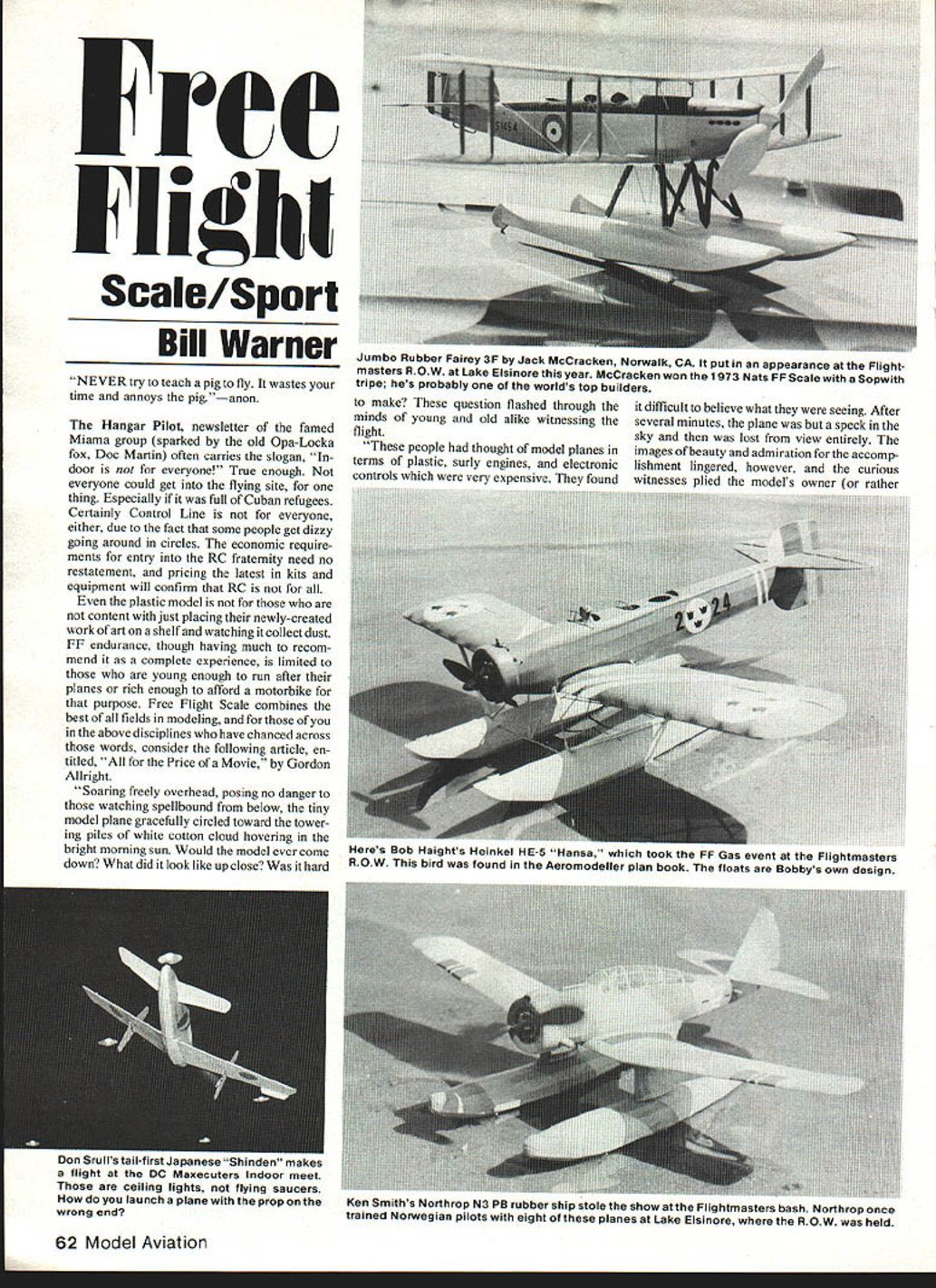
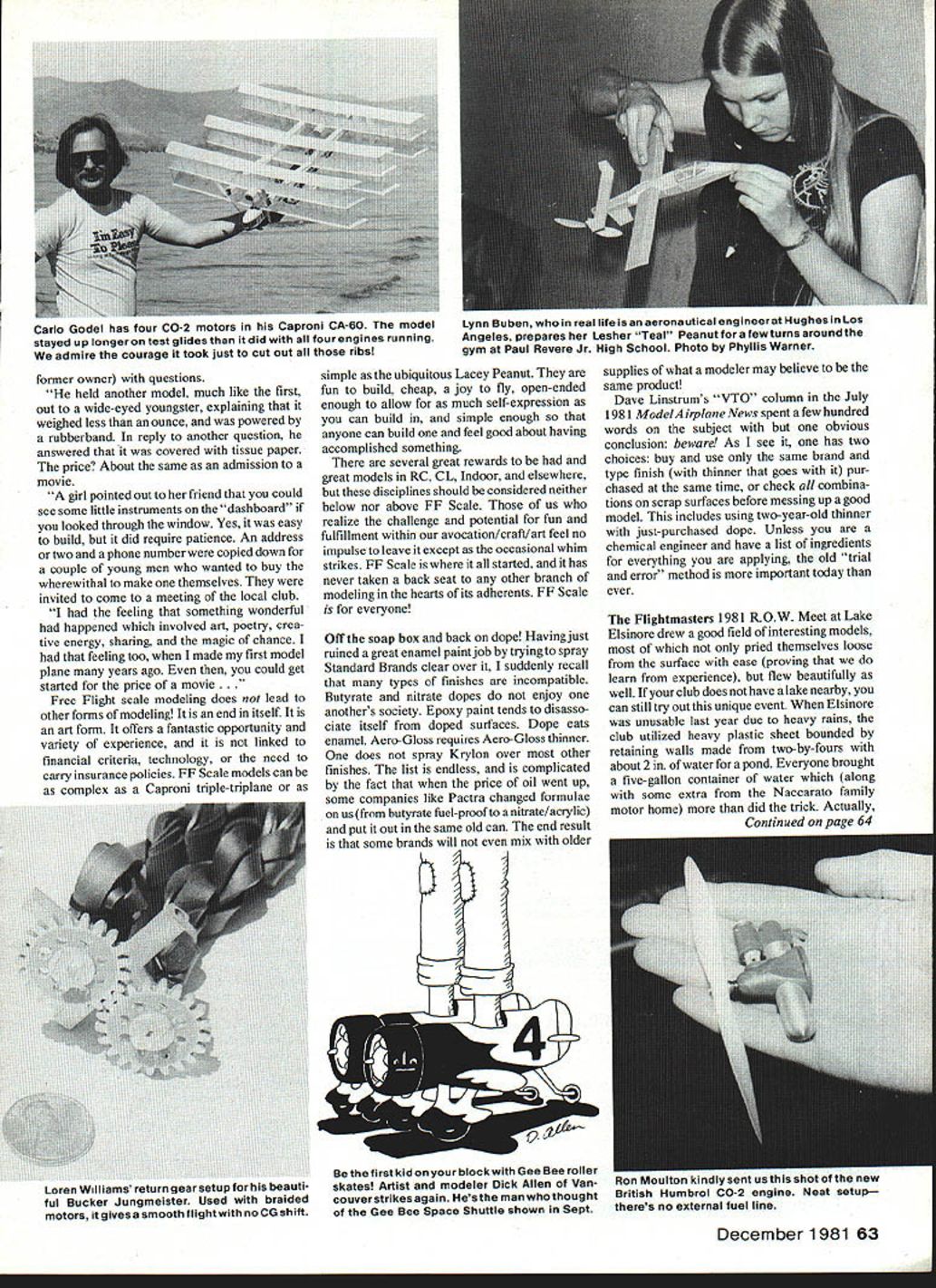
Free Flight: Scale/Sport
Bill Warner
"NEVER try to teach a pig to fly. It wastes your time and annoys the pig." — anon
The Hangar Pilot, newsletter of the famed Miami group (sparked by the old Opa-Locka fox, Doc Martin) often carries the slogan, "Indoor is not for everyone!" True enough. Not everyone could get into the flying site, for one thing. Especially if it was full of Cuban refugees. Certainly Control Line is not for everyone, either, due to the fact that some people get dizzy going around in circles. The economic requirements for entry into the RC fraternity need no restatement, and pricing the latest in kits and equipment will confirm that RC is not for all.
Even the plastic model is not for those who are not content with just placing their newly created work of art on a shelf and watching it collect dust. FF endurance, though having much to recommend it as a complete experience, is limited to those who are young enough to run after their planes or rich enough to afford a motorbike for that purpose. Free Flight Scale combines the best of all fields in modeling, and for those of you in the above disciplines who have chanced across those words, consider the following article, entitled, "All for the Price of a Movie," by Gordon Allright.
"Soaring freely overhead, posing no danger to those watching spellbound from below, the tiny model plane gracefully circled toward the towering piles of white cotton cloud hovering in the bright morning sun. Would the model ever come down? What did it look like up close? Was it hard to make?" The question flashed through the minds of young and old alike witnessing the flight.
These people had thought of model planes in terms of plastic, surly engines, and electronic controls which were very expensive. They found it difficult to believe what they were seeing. After several minutes, the plane was but a speck in the sky and then was lost from view entirely. The images of beauty and admiration for the accomplishment lingered, however, and the curious witnesses plied the model's owner with questions.
He held another model, much like the first, out to a wide-eyed youngster, explaining that it weighed less than an ounce, and was powered by a rubber band. In reply to another question, he answered that it was covered with tissue paper. The price? About the same as an admission to a movie.
"A girl pointed out to her friend that you could see some little instruments on the 'dashboard' if you looked through the window. Yes, it was easy to build, but it did require patience. An address or two and a phone number were copied down for a couple of young men who wanted to buy the wherewithal to make one themselves. They were invited to come to a meeting of the local club.
"I had the feeling that something wonderful had happened which involved art, poetry, creative energy, sharing, and the magic of chance. I had that feeling too, when I made my first model plane many years ago. Even then, you could get started for the price of a movie . . ."
Free Flight scale modeling does not lead to other forms of modeling. It is an end in itself. It is an art form. It offers a fantastic opportunity and variety of experience, and it is not linked to financial criteria, technology, or the need to carry insurance policies. FF Scale models can be as complex as a Caproni triple-triplane or as simple as the ubiquitous Lacey Peanut. They are fun to build, cheap, a joy to fly, open-ended enough to allow for as much self-expression as you can build in, and simple enough so that anyone can build one and feel good about having accomplished something.
There are several great rewards to be had and great models in RC, CL, Indoor, and elsewhere, but these disciplines should be considered neither below nor above FF Scale. Those of us who realize the challenge and potential for fun and fulfillment within our avocation/craft/art feel no impulse to leave it except as the occasional whim strikes. FF Scale is where it all started, and it has never taken a back seat to any other branch of modeling in the hearts of its adherents. FF Scale is for everyone!
Off the soap box and back on dope!
Having just ruined a great enamel paint job by trying to spray Standard Brands clear over it, I suddenly recall that many types of finishes are incompatible. Butyrate and nitrate dopes do not enjoy one another's society. Epoxy paint tends to disassociate itself from doped surfaces. Dope eats enamel. Aero-Gloss requires Aero-Gloss thinner. One does not spray Krylon over most other finishes. The list is endless, and is complicated by the fact that when the price of oil went up, some companies like Pactra changed formulae on us (from butyrate fuel-proof to a nitrate/acrylic) and put it out in the same old can. The end result is that some brands will not even mix with older supplies of what a modeler may believe to be the same product!
Dave Linstrum's "VTO" column in the July 1981 Model Airplane News spent a few hundred words on the subject with but one obvious conclusion: beware! As I see it, one has two choices:
- Buy and use only the same brand and type finish (with the thinner that goes with it) purchased at the same time.
- Check all combinations on scrap surfaces before messing up a good model. This includes using two-year-old thinner with just-purchased dope.
Unless you are a chemical engineer and have a list of ingredients for everything you are applying, the old "trial and error" method is more important today than ever.
The Flightmasters 1981 R.O.W. Meet at Lake Elsinore drew a good field of interesting models, most of which not only pried themselves loose from the surface with ease (proving that we do learn from experience), but flew beautifully as well. If your club does not have a lake nearby, you can still try out this unique event. When Elsinore was unusable last year due to heavy rains, the club utilized heavy plastic sheet bounded by retaining walls made from two-by-fours with about 2 in. of water for a pond. Everyone brought a five-gallon container of water which (along with some extra from the Nacarato family motor home) more than did the trick. Actually, some models used the "bump" at the end of the pond to bounce into flight!
About dyeing condenser paper: I would like to suggest two methods which I have used. One easy way is to overlap strokes on a yellow Magic Marker before the tissue is applied. Seems to work great in yellow but not in other colors. Others prefer a Dri-Mark spray dye from artists' supply stores. On my Indoor 1911 Caudron, I made a frame from a large piece of cardboard box side with a cutout square hole a bit smaller than the piece of condenser paper. I glued the paper in like a window, and then sprayed it with a mixture of rubbing alcohol and Dr. Martin's dye (which is water-soluble and comes in little bottles at art supply stores). About 12 applications, done with the light from a window shining through to get evenness while spraying, did the job. A hair drier speeded the drying process between coats. The water content of the rubbing alcohol and the heat from the drier did a great job of shrinking the tissue.
I am finding that my model building time is getting harder to come by each year. Anything which speeds up the process a bit is welcome, and I must admit I have become addicted to Carl Goldberg's Super Jet cyanoacrylate glue. The old bit of dusting everything with baking soda is not even necessary, as the thicker glue fills slightly, even on end grain. As one becomes more and more familiar with its use, it may be possible to become careless.
If you are becoming an addict, too, just remember to wear those glasses! A drop in the eye is a pain in the neck, as they say. Make a "socket" out of heavy material and replace the bottle there every time you use it, keeping the stuff well back on your building table where you won't lean over to pick up a dropped part and jam it in your eye. Mainly, keep it in a locked cupboard with your .357 Magnum when kids are present.
A model-mad Miss in pre-med To a suitor's proposal once said, "Please don't give me a ring; I'll be yours if you bring Me an armful of balsa instead."
Thanks for the cards, letters and the great 5 x 7 contrasty black-and-white pix for future columns!
Bill Warner 423-C San Vicente Blvd. Santa Monica, CA 90402.
Transcribed from original scans by AI. Minor OCR errors may remain.

