
Free Flight
Scale/Sport
Bill Warner
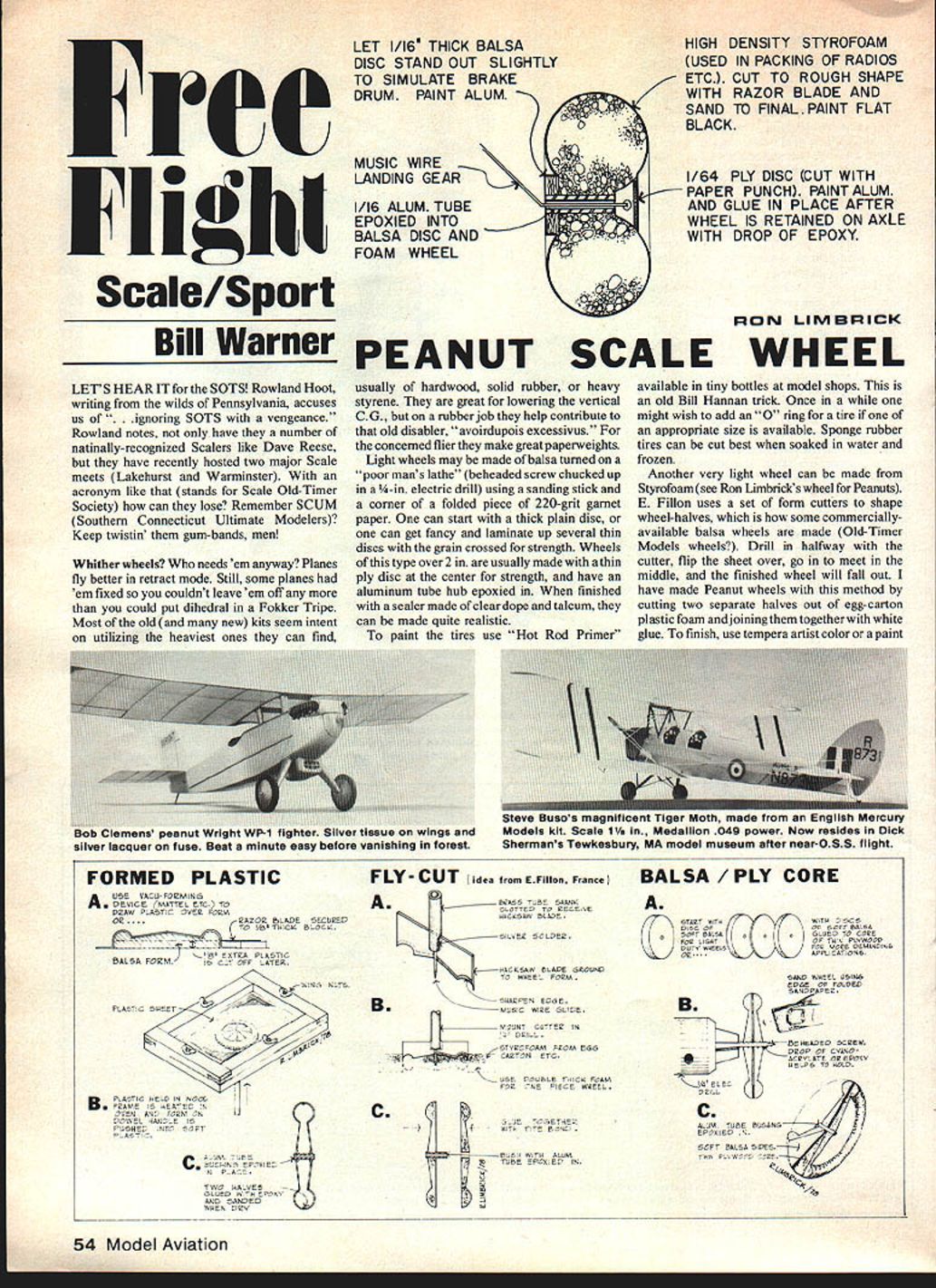
Peanut Scale Wheel
Ron Limbrick
Let's hear it for the SOTS! Rowland Hoot, writing from the wilds of Pennsylvania, accuses us of "...ignoring SOTS with a vengeance." Rowland notes that not only do they have a number of nationally recognized scalers like Dave Reese, but they have recently hosted two major scale meets (Lakehurst and Warminster). With an acronym like that (Scale Old-Timer Society), how can they lose? Remember SCUM (Southern Connecticut Ultimate Modelers)? Keep twistin' them gum-bands, men!
Whither wheels? Who needs 'em anyway? Planes fly better in retract mode. Still, some planes had them fixed so you couldn't leave them off any more than you could put dihedral in a Fokker triplane. Most of the old (and many new) kits seem intent on utilizing the heaviest wheels they can find, usually of hardwood, solid rubber, or heavy styrene. They are great for lowering the vertical C.G., but on a rubber job they help contribute to that old adage, "avoirdupois excessivus." For the concerned flier they make great paperweights.
Light wheels may be made of balsa turned on a "poor man's lathe" (a beheaded screw chucked up in a 1/4-in. electric drill) using a sanding stick and a corner of a folded piece of 220-grit garnet paper. One can start with a thick plain disc, or get fancy and laminate several thin discs with the grain crossed for strength. Wheels of this type over 2 in. are usually made with a thin ply disc at the center for strength, and have an aluminum tube hub epoxied in. When finished with a sealer made of clear dope and talcum, they can be made quite realistic.
To paint the tires use "Hot Rod Primer" available in tiny bottles at model shops — an old Bill Hannan trick. Once in a while one might wish to add an "O" ring for a tire if one of an appropriate size is available. Sponge rubber tires can be cut best when soaked in water and then frozen.
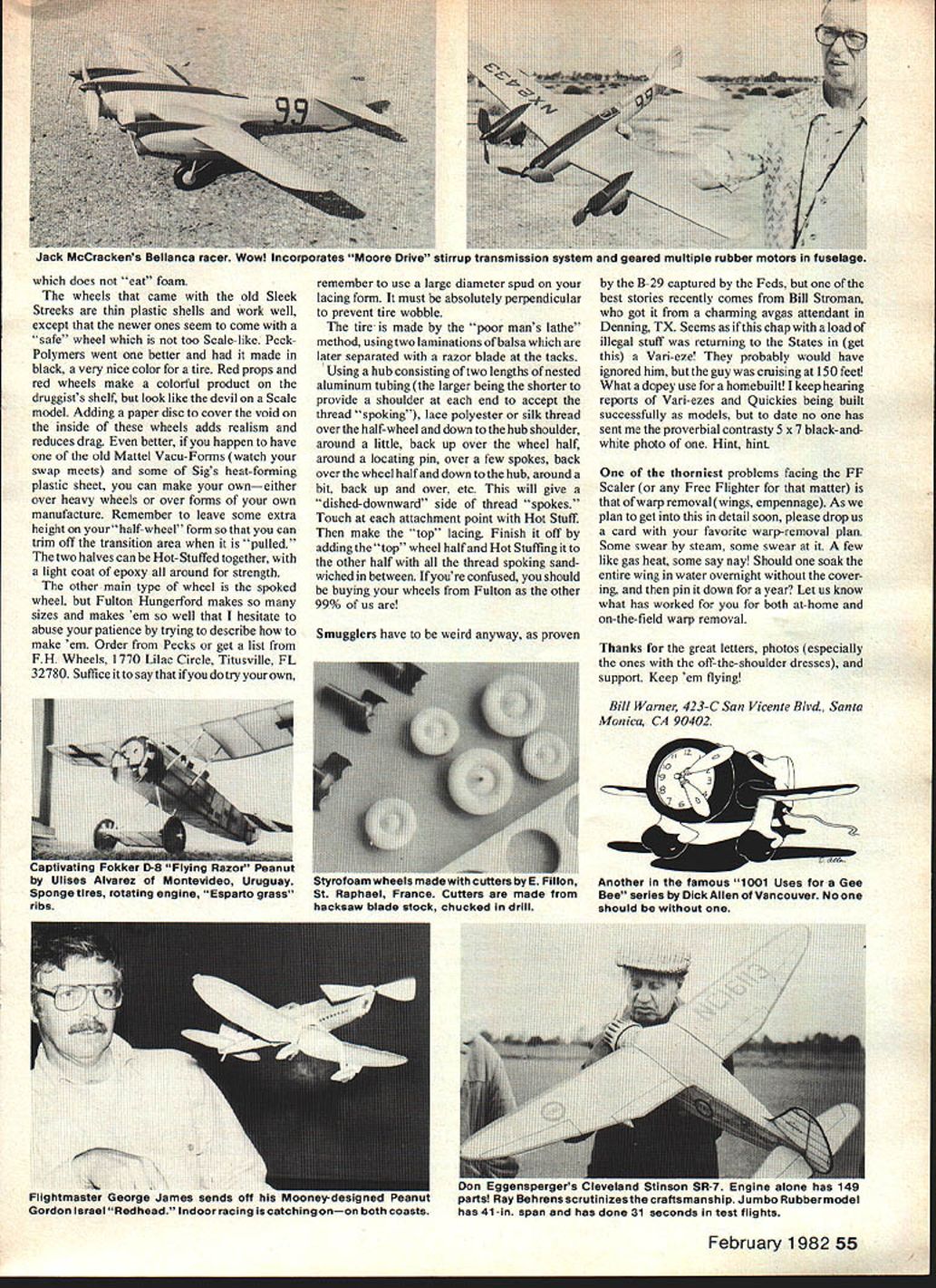
Another very light wheel can be made from Styrofoam (see Ron Limbrick's wheel for Peanuts). E. Fillon uses a set of form cutters to shape wheel-halves, which is how some commercially available balsa wheels are made (Old-Timer Models wheels?). Drill in halfway with the cutter, flip the sheet over, go in to meet in the middle, and the finished wheel will fall out. I have made peanut wheels with this method by cutting two separate halves out of egg-carton plastic foam and joining them together with white glue. To finish, use tempera artist color or a paint which does not "eat" foam.
The wheels that came with the old Sleek Streeks are thin plastic shells and work well, except that the newer ones seem to come with a "safe" wheel that is not very scale-like. Peck-Polymers went one better and had it made in black, a very nice color for a tire. Red props and red wheels make a colorful product on the druggist's shelf, but look awful on a scale model. Adding a paper disc to cover the void on the inside of these wheels adds realism and reduces drag.
Even better, if you happen to have one of the old Mattel Vacu-Forms (watch your swap meets) and some of Sig's heat-forming plastic sheet, you can make your own—either over heavy wheels or over forms of your own manufacture. Remember to leave some extra height on your "half-wheel" form so that you can trim off the transition area when it is "pulled." The two halves can be Hot-Stuffed together, with a light coat of epoxy all around for strength.
The other main type of wheel is the spoked wheel, but Fulton Hungerford makes so many sizes and makes them so well that I hesitate to abuse your patience by trying to describe how to make them. Order from Peck's or get a list from F.H. Wheels, 1770 Lilac Circle, Titusville, FL 32780. Suffice it to say that if you do try your own, remember to use a large-diameter spud on your lacing form. It must be absolutely perpendicular to prevent tire wobble.
The tire is made by the "poor man's lathe" method, using two laminations of balsa which are later separated with a razor blade at the tacks.
Using a hub consisting of two lengths of nested aluminum tubing (the larger being the shorter to provide a shoulder at each end to accept the thread "spoking"), lace polyester or silk thread over the half-wheel and down to the hub shoulder, around a little, back up over the wheel half, around a locating pin, over a few spokes, back over the wheel half and down to the hub, around a bit, back up and over, etc. This will give a "dished-downward" side of thread "spokes." Touch at each attachment point with Hot Stuff. Then make the "top" lacing. Finish it off by adding the "top" wheel half and Hot Stuffing it to the other half with all the thread spoking sandwiched in between. If you're re-using wheels, you should be buying your wheels from Fulton as the other 99% of us are!
Smugglers have to be weird anyway, as proven by the B-29 captured by the Feds, but one of the best stories recently comes from Bill Stroman, who got it from a charming avgas attendant in Denning, TX. Seems this chap with a load of illegal stuff was returning to the States in (get this) a Vari-Eze! They probably would have ignored him, but the guy was cruising at 150 feet! What a dopey use for a homebuilt. I keep hearing reports of Vari-Ezes and Quickies being built successfully as models, but to date no one has sent me the proverbial contrasting 3 x 5 black-and-white photo of one. Hint, hint.
One of the thorniest problems facing the free-flight scaler (or any free flighter for that matter) is that of warp removal (wings, empennage). As we plan to get into this in detail soon, please drop us a card with your favorite warp-removal plan. Some swear by steam, some swear at it. A few like gas heat, some say nay! Should one soak the entire wing in water overnight without the covering, and then pin it down for a year? Let us know what has worked for you both at home and on the field.
Thanks for the great letters, photos (especially the ones with the off-the-shoulder dresses), and support. Keep 'em flying!
Bill Warner 423-C San Vicente Blvd. Santa Monica, CA 90402
Transcribed from original scans by AI. Minor OCR errors may remain.

