
FREE FLIGHT SPORT
Gene Smith, 1401 N. Husband St., Stillwater OK 74075; E-mail: grwhiskey@cox.net
FREE FLIGHT SPORT: Flight is the endgame in this hobby. I was reading a Flying Aces Club (FAC) newsletter and saw a flight-trimming article by Al Likely. Al believes that in addition to science, there is a "feel," a "touch," and an "art" involved in trimming. I hope it is not an art. My high-school English teacher told me she thought there was a little poetry in everyone until she read my poem. My artistic ability is on roughly the same level as my poetry.
I like to think that trimming involves skill; skill can be developed. Maybe "touch" and "feel" are a part of skill. Al's article is informative. You would do well to check out some of his advice:
- Build often.
- Build light.
- Build straight.
- Make notes for each model.
- Create and use a checklist.
- Take advice only from someone who is flying.
- Don't give advice unless asked.
I like the advice to build often. If you build often, you will trim often, and that is one of the ways you learn. Many experienced modelers will not give advice unless asked. Ask them preferably when they are not winding a rubber motor or about to put up an official flight. Then listen.
Embryos I Have Known
Dave Stott and/or Bob Thompson created the Embryo event in the early days of the FAC organization. The fuselage must be able to enclose a 1.25 x 1.50 x 3.00-inch space, and the maximum wing area is 50 square inches. Bonus points are added for wheel pants, simulated exhausts, and a cabin or windshield/cockpit. See the FAC rules book for other details.
To join the FAC and get six issues of its bimonthly newsletter, send $15 to FAC-GHQ, 3301 Cindy Ln., Erie PA 16506. There are usually four or five scale stick-and-tissue-model plans per newsletter, as well as club news and modeling tips.
One of the first models I built for indoor flying was the Hornet Embryo kitted by Micro X. Although it was designed to fly outdoors, it was easy to adjust to fly in the confines of the Oklahoma City Armory with its stock plastic propeller. Endurance was not the goal. The Hornet made neat ROGs (rise-off-grounds) and smooth landings. A great training model, it gave me a lot of enjoyment. Once I figured out the correct rubber motor and number of turns, the Hornet would make flight after dependable flight. Make no mistake; Embryos are capable of out-of-sight flights. But they can also be used for small-field flying if you downsize the rubber motor. The Hornet plans include the rules for the Embryo event and good tips for trimming the model for flight.
I know of three other Embryo kits: the Prairie Bird by Peck-Polymers, the Debut by EZ Built Models, and the unique Scimitar by Campbell's Kits. A neat thing about models this size is how easy it is to "design" your own. Take a wing from one model, make a slight change in the fuselage and tail from another model, and presto! You have your personal design with little effort.
Bob Schlosberg sent me photos of three Embryos that he and his wife Jane built, all from different designers. Resplendent in red and white, the Saguaro Speedster is one of the cutest Embryos I have seen. It needs exhaust stacks for maximum bonus points.
Dick Howard has been a prolific designer, and the El Coyote is one of his many great-flying Embryo designs. Ross Mayo designed the Mis-Adventure many years ago. It would not be legal under current rules, which require at least a 30° slant of the windshield on cabin designs. The model needs wheel pants for maximum bonus points.
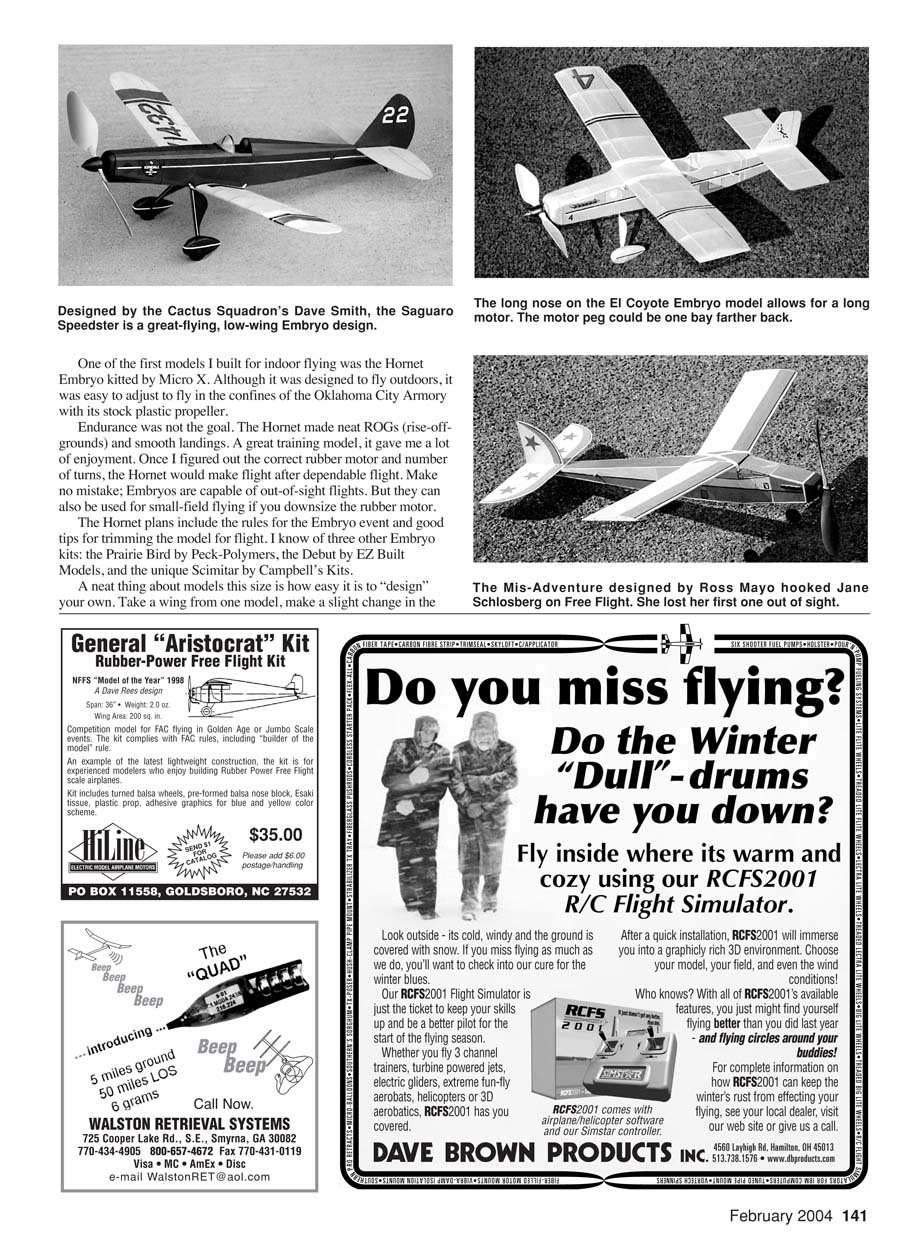
Don DeLoach designed a high-aspect-ratio Embryo that he dubbed the "Embryomatic." It was published in the August 1990 Model Aviation. If you don't save your Model Aviation magazines, find a friend who does and read the article. It is informative.
(Editor's note: You can also use the Model Aviation Digital Archives at http://modelercraft.org/mag/index.htm to find this piece.)
Don flew the Embryomatic to a tie for first place in the 2002 FAC Nationals but came in second in the flyoff. The plans—number 661—are available from AMA for $3.75 plus $3.95 shipping and handling.
Memories
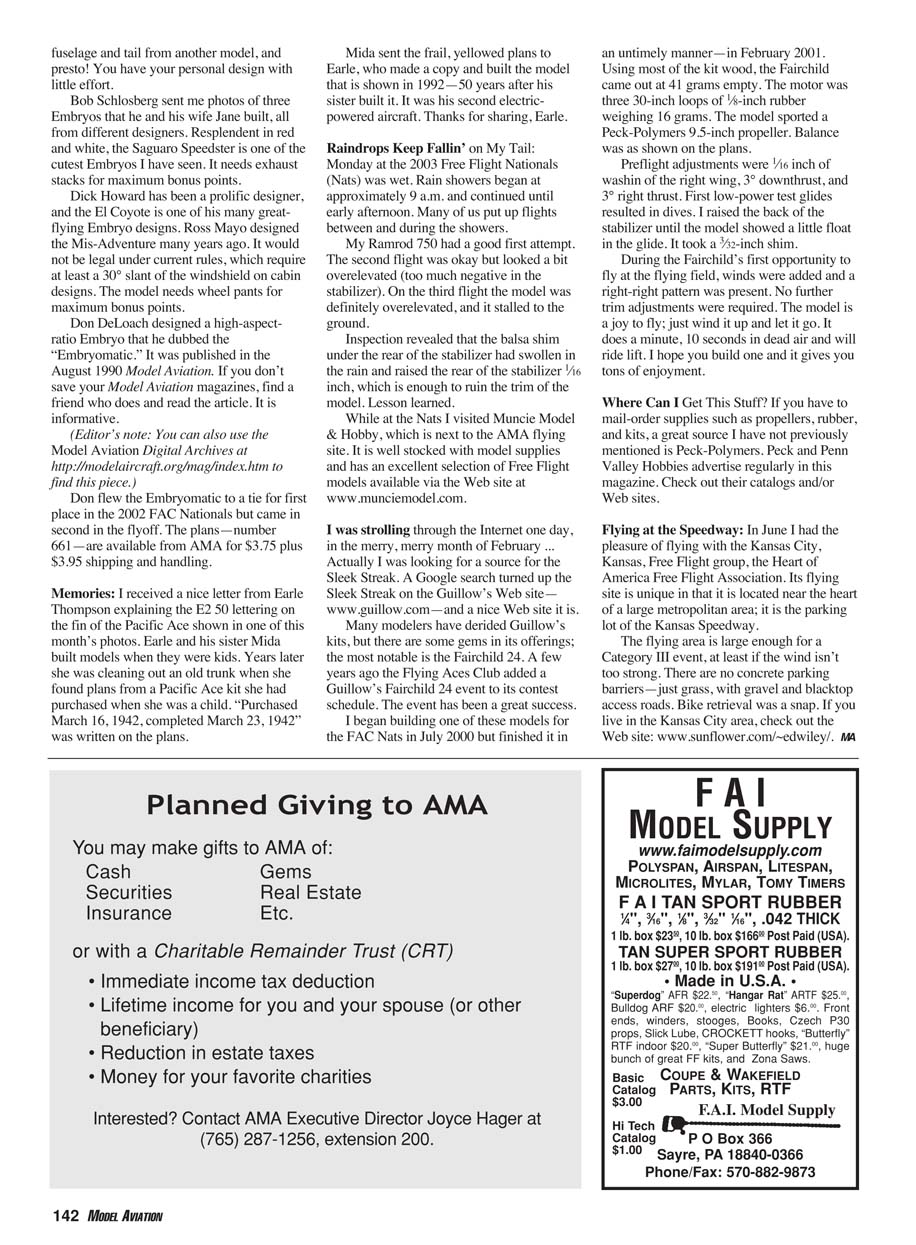
I received a nice letter from Earle Thompson explaining the E2 50 lettering on the fin of the Pacific Ace shown in one of this month's photos. Earle and his sister Mida built models when they were kids. Years later she was cleaning out an old trunk when she found plans from a Pacific Ace kit she had purchased when she was a child. "Purchased March 16, 1942, completed March 23, 1942" was written on the plans.
Mida sent the frail, yellowed plans to Earle, who made a copy and built the model that is shown in 1992—50 years after his sister built it. It was his second electric-powered aircraft. Thanks for sharing, Earle.
Raindrops Keep Fallin' on My Tail
Monday at the 2003 Free Flight Nationals (Nats) was wet. Rain showers began at approximately 9 a.m. and continued until early afternoon. Many of us put up flights between and during the showers.
My Mardro 750 had a good first attempt. The second flight was okay but looked a bit over-elevated (too much negative in the stabilizer). On the third flight the model was definitely over-elevated, and it stalled to the ground.
Inspection revealed that the balsa shim under the rear of the stabilizer had swollen in the rain and raised the rear of the stabilizer 1/16 inch, which is enough to ruin the trim of the model. Lesson learned.
While at the Nats I visited Muncie Model & Hobby, which is next to the AMA flying site. It is well stocked with model supplies and has an excellent selection of Free Flight models available via the Web site at www.munciemodel.com.
I was strolling through the Internet one day, in the merry, merry month of February ... Actually I was looking for a source for the Sleek Streak. A Google search turned up the Sleek Streak on the Guillows' Web site—www.guillow.com—and a nice Web site it is.
Many modelers have derided Guillows' kits, but there are some gems in its offerings; the most notable is the Fairchild 24. A few years ago the Flying Aces Club added a Guillows' Fairchild 24 event to its contest schedule. The event has been a great success.
I began building one of these models for the FAC Nats in July 2000 but finished it in an untimely manner—in February 2001. Using most of the kit wood, the Fairchild came out at 41 grams empty. The motor was three 30-inch loops of 1/8-inch rubber weighing 16 grams. The model sported a Peck-Polymers 9.5-inch propeller. Balance was as shown on the plans.
Preflight adjustments were 1/16 inch of wash-in of the right wing, 3° downthrust, and 3° right thrust. First low-power test glides resulted in dives. I raised the back of the stabilizer until the model showed a little float in the glide. It took a 3/32-inch shim.
During the Fairchild's first opportunity to fly at the flying field, winds were light and a right-right pattern was present. No further trim adjustments were required. The model is a joy to fly; just wind it up and let it go. It does a minute, 10 seconds in dead air and will ride lift. I hope you build one and it gives you tons of enjoyment.
Where Can I Get This Stuff?
If you have to mail-order supplies such as propellers, rubber, and kits, a great source I have not previously mentioned is Peck-Polymers. Peck and Penn Valley Hobbies advertise regularly in this magazine. Check out their catalogs and/or Web sites.
Flying at the Speedway
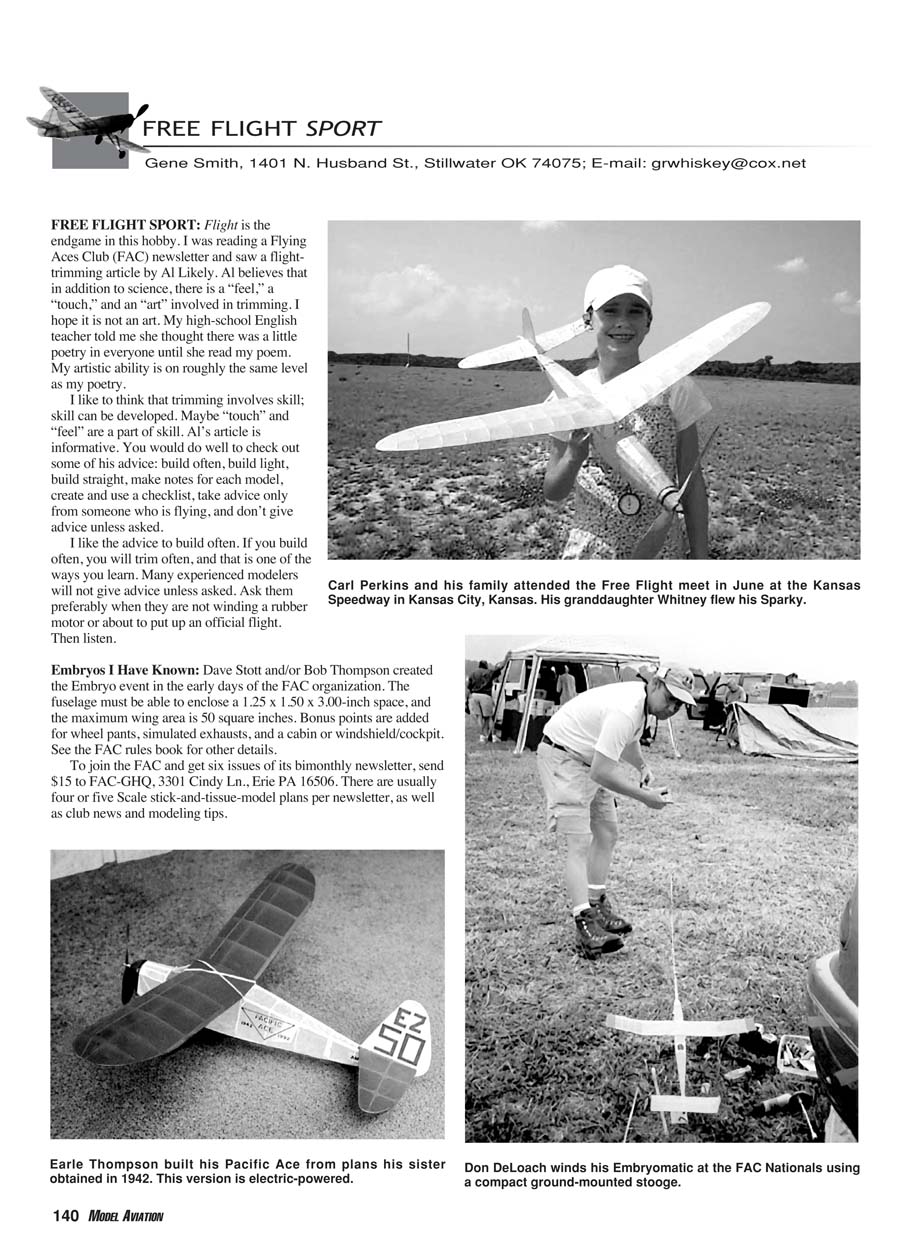
In June I had the pleasure of flying with the Kansas City, Kansas, Free Flight group, the Heart of America Free Flight Association. Its flying site is unique in that it is located near the heart of a large metropolitan area; it is the parking lot of the Kansas Speedway.
The flying area is large enough for a Category III event, at least if the wind isn't too strong. There are no concrete parking barriers—just grass, with gravel and blacktop access roads. Bike retrieval was a snap. If you live in the Kansas City area, check out the Web site: www.sunflower.com/~edwiley/.
Transcribed from original scans by AI. Minor OCR errors may remain.

