
Ramrods without wheels will hit the skids in competition
Gene Smith [grwhiskey@cox.net]
ALL RAMRODS must have wheels for competition. Last January at the Southwest Regionals I saw a Ramrod flown in Nostalgia Gas using a skid but no wheel. There was another skid-equipped Ramrod at last summer’s Nats in Muncie.
It had been my understanding that Ramrods had to have a wheel. I began to wonder if it was legal to enter a Ramrod in Nostalgia Gas competitions without a wheel. I asked the Nostalgia Rules Committee for an opinion. I learned that the documentation for the skids was the Berkeley Ramrod 600 kit plans, which was listed in the Nostalgia rules book. However, the kit and plans were released after the Nostalgia Rules cutoff date. The unanimous opinion of the Nostalgia Rules Committee was that because the kit plans were published after the Nostalgia Rules cutoff date, skids would not be allowed on Ramrods in competition.
Ebeneezer event at Old Warden
Lindsey Smith sent the photo of an Ebeneezer event at Old Warden in England. Derek Knight won the event with a four-engine (actually eight KP-01s coupled) B-52 that flew very well. There were more than 70 entries.
The basic concept is to use sheet balsa to create a semiscale or whimsical model. The wing and stabilizer must be flat sheets with no airfoil. The fuselage is also sheet profile, and power is an .020 engine, a small diesel, or an electric motor.
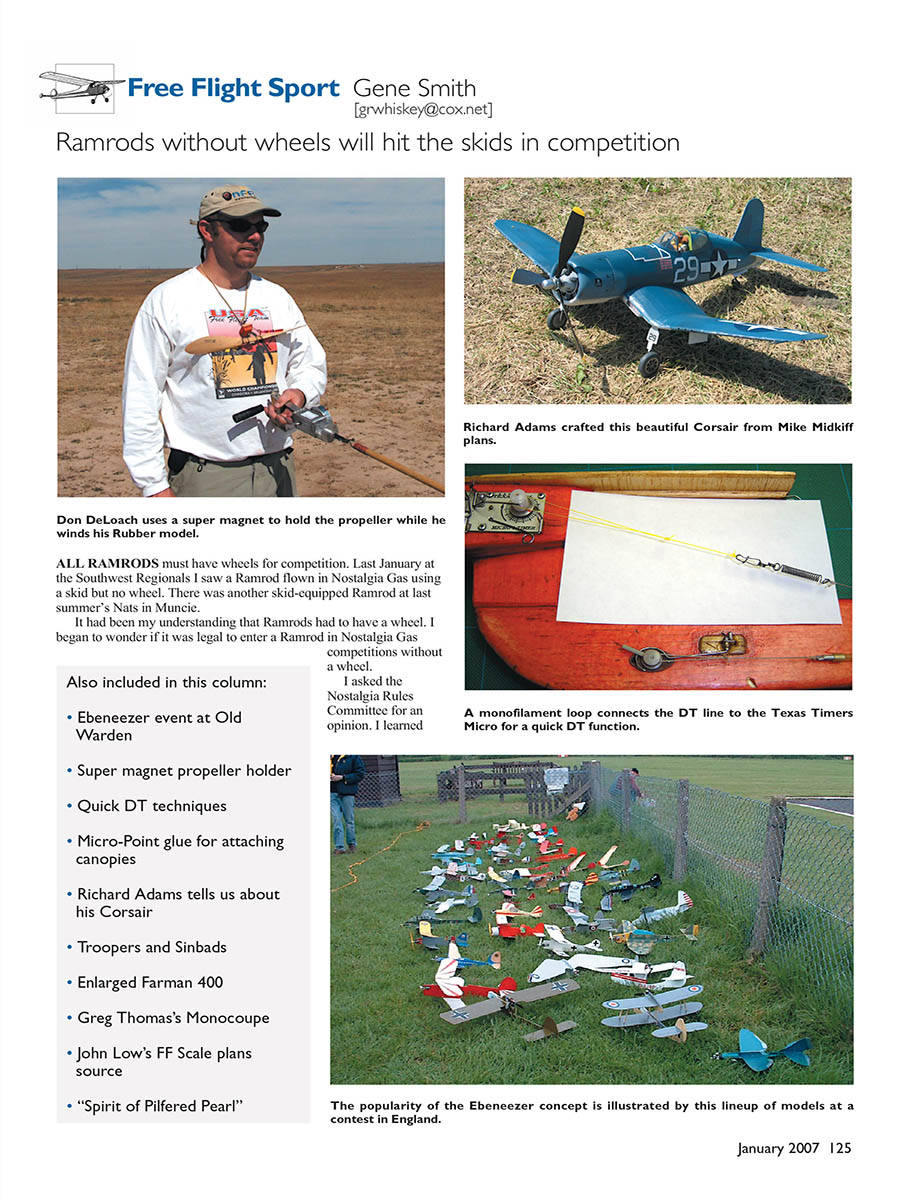
Missing propeller solution
What do you do with the propeller for your rubber-powered model while you are winding? Do you find that it’s in the back of the car, just out of reach? Did it fall out of your pocket and into the deep grass? Did the wind blow it off your stooge? Don DeLoach solved the missing-propeller problem with a super-magnet propeller holder.
He uses a 1/4 x 1/4-inch cylinder magnet for the Peanut through roughly P-30. For larger propellers, especially bigger and heavier folders, he uses the RH375 magnet—which is approximately 1/2 inch in diameter. Don has several of the larger magnets for sale, complete with a leather cord, for $5 each postpaid. His address is 831 E. Willamette, Colorado Springs, CO 80903. If you can’t find the magnets locally, visit www.amazingmagnets.com.
Quick DT technique
A technique that has saved hundreds, if not thousands, of new contest FF models from an early demise is the use of the quick DT. A gas-powered FF airplane’s first flights can put the model at high risk. You want a short engine run in case the power pattern is bad, but a short run can leave the airplane in a bad position from which it can stall straight into the ground. With a quick DT the dethermalizer is triggered approximately three seconds after the engine quits. This allows time for the model to slow after the engine quits, but it triggers the DT before the model can get into trouble from a bad transition.
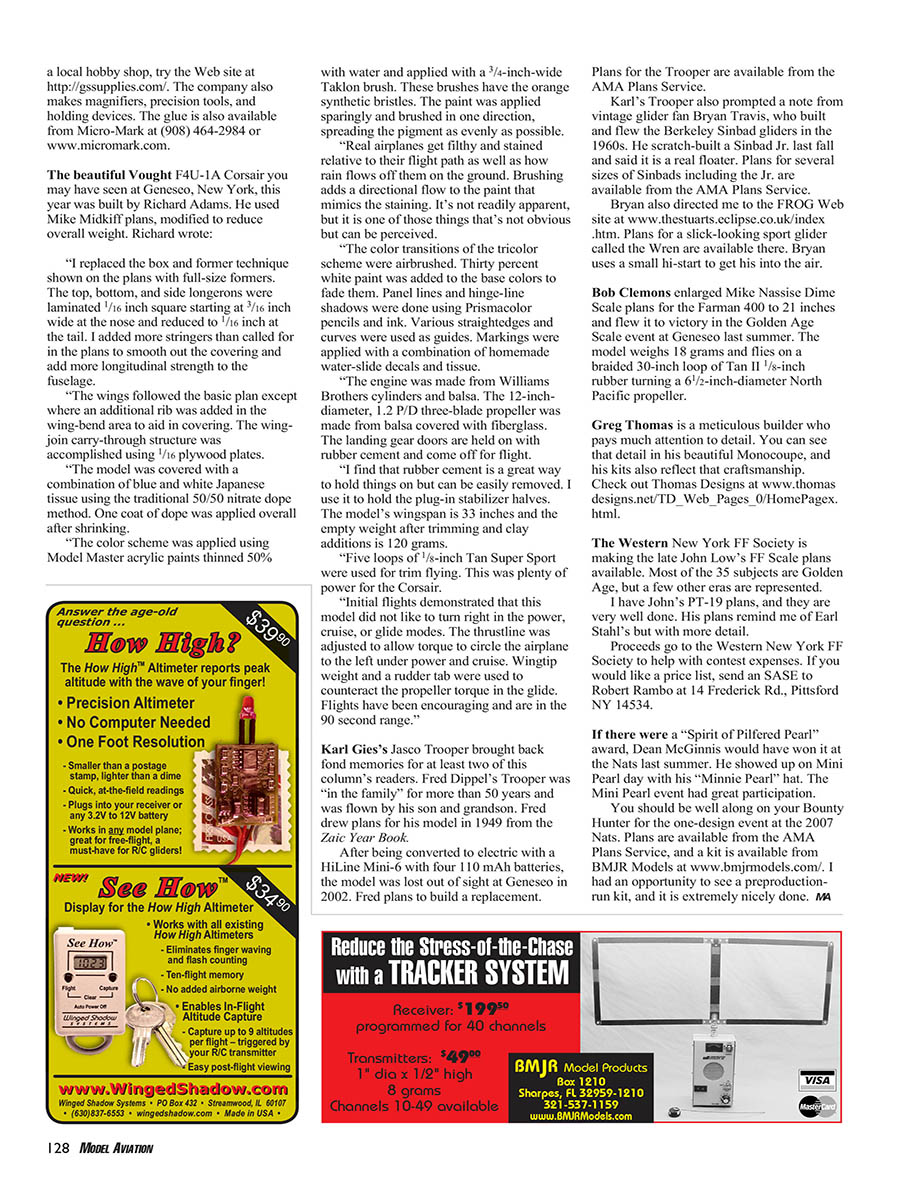
It is relatively simple to set a quick DT with a dual-function timer, but they are a bit heavy for most small Gas models. Joel Swartzman of Tucson, Arizona, came up with a neat idea that allows a quick DT function with the lightweight Micro timer from Texas Timers. To use the quick DT the model should be equipped with a DT system in which the fuse or viscous DT timer is located below the pylon.
To rig for a quick DT, the DT line is extended to the Texas Micro using a loop of monofilament line. The arm on the Micro timer should normally go on the bottom of the scroll. Place the DT line loop on the next groove down or it will trigger before the engine quits.
If you want a faster "quick DT," you can place the DT line on the same groove as the DT arm if you put the arm on top of the scroll. Be sure to test the timer sequence before flying the model.
You can see the setup on the Texas Timers Web site at www.texastimers.com. Click the "Helpful Hints" button. Gil Morris's VIT setup with the Micro is also there.
Adhesive for canopies
There is yet another adhesive for attaching canopies. Howard Littman has settled on Micro-Point glue, so called because the tube is in a fine, needlelike nozzle. The cap has a fine wire that must be put down the nozzle when closing it to keep it clean. It is watch-crystal glue.
The brand Howard uses is G-S Hypo Cement. If you can't get it at a local hobby shop, try the website at http://gssupplies.com/. The company also makes magnifiers, precision tools, and holding devices. The glue is also available from Micro-Mark at (908) 464-2984 or www.micromark.com.
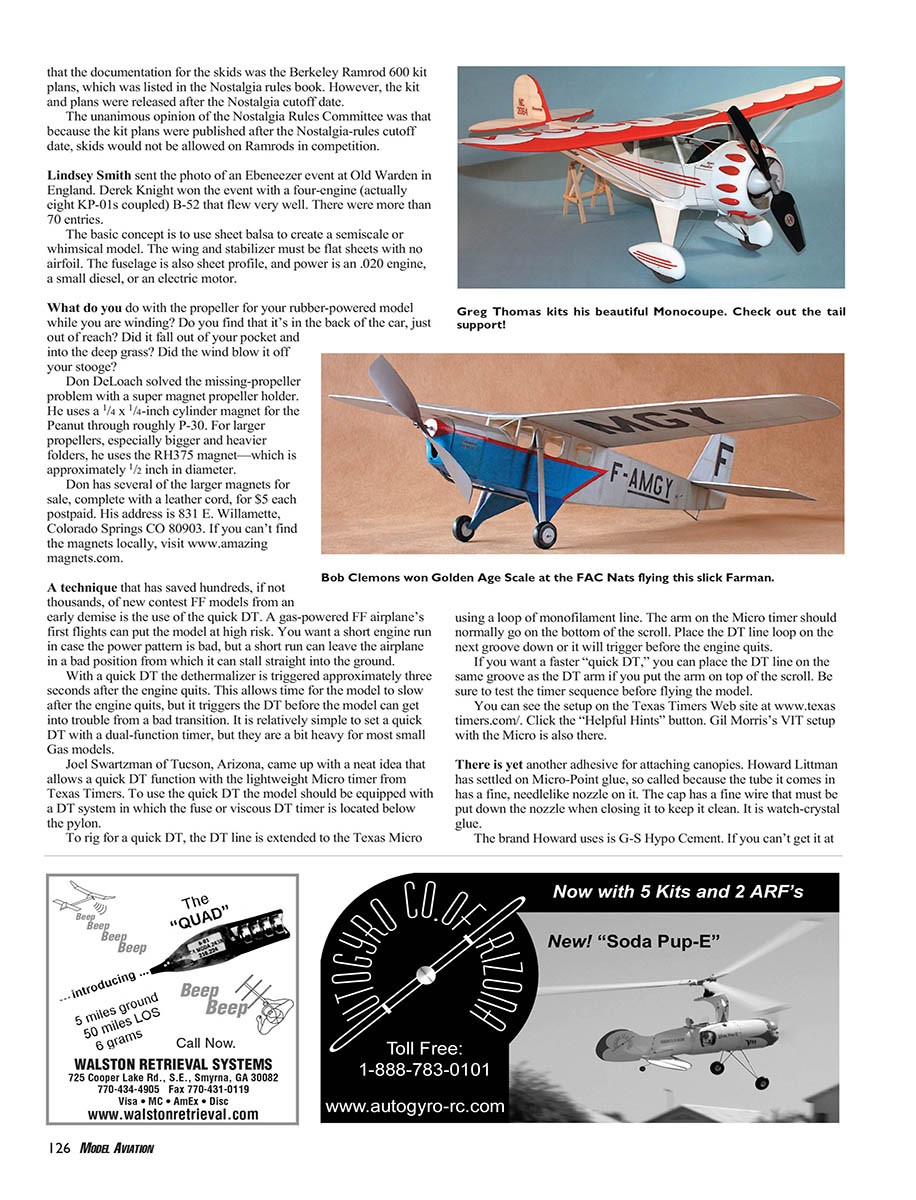
Richard Adams' Vought F4U-1A Corsair
The beautiful Vought F4U-1A Corsair you may have seen at Geneseo, New York, this year was built by Richard Adams. He used Mike Midkiff plans, modified to reduce overall weight. Richard wrote:
I replaced the box and former technique shown on the plans with full-size formers. The top, bottom, and side longerons were laminated 1/16 inch square starting at 3/16 inch wide at the nose and reduced to 1/16 inch at the tail. I added more stringers than called for in the plans to smooth out the covering and add more longitudinal strength to the fuselage.
The wings followed the basic plan except where an additional rib was added in the wing-bend area to aid in covering. The wing-join carry-through structure was accomplished using 1/16 plywood plates.
The model was covered with a combination of blue and white Japanese tissue using the traditional 50/50 nitrate dope method. One coat of dope was applied overall after shrinking.
The color scheme was applied using Model Master acrylic paints thinned 50% with water and applied with a 3/4-inch-wide Taklon brush. These brushes have the orange synthetic bristles. The paint was applied sparingly and brushed in one direction, spreading the pigment as evenly as possible.
Real airplanes get filthy and stained relative to their flight path as well as how rain flows off them on the ground. Brushing adds a directional flow to the paint that mimics the staining. It's not readily apparent, but it's one of those things that's not obvious but can be perceived.
The color transitions of the tricolor scheme were airbrushed. Thirty percent white paint was added to the base colors to fade them. Panel lines and hinge-line shadows were done using Prismacolor pencils and ink. Various straightedges and curves were used as guides. Markings were applied with a combination of homemade water-slide decals and tissue.
The engine was made from Williams Brothers cylinders and balsa. The 12-inch-diameter, 1.2 P/D three-blade propeller was carved from balsa covered with fiberglass. The landing gear doors are held on with rubber cement and come off for flight.
I find that rubber cement is a great way to hold things on but can be easily removed. I use it to hold the plug-in stabilizer halves. The model's wingspan is 33 inches and the empty weight after trimming and clay additions is 120 grams.
Five loops of 5/8-inch Tan Super Sport were used for trim flying. This was plenty of power for the Corsair.
Initial flights demonstrated that this model did not like to turn right in the power, cruise, or glide modes. The thrustline was adjusted to allow the model to circle to the left under power and cruise. Wingtip weight and a rudder tab were used to counteract the propeller torque in the glide. Flights have been encouraging and are in the 90 second range.
Vintage models and plans
Karl Gies's Jasco Trooper brought back fond memories for at least two of this column's readers. Fred Dippel's Trooper was "in the family" for more than 50 years and was flown by his son and grandson. Fred drew plans for his model in 1949 from the ZAC Year Book. After being converted to electric with a HiLine Mini-6 with four 110 mAh batteries, the model was lost out of sight at Geneseo in 2002. Fred plans to build a replacement.
Plans for the Trooper are available from the AMA Plans Service.
Karl's Trooper also prompted a note from vintage glider fan Bryan Travis, who built and flew the Berkeley Sinbad Jr. last fall and said it is a real floater. Plans for several sizes of Sinbads including the Jr. are available from the AMA Plans Service.
Bryan also directed me to the FROG web site at www.thestuartseclipse.co.uk/index.htm. Plans for a slick-looking sport glider called the Wren are available there. Bryan uses a small hi-start to get his into the air.
Bob Clemons enlarged Mike Nassise Dime Scale plans for the Farman 400 to 21 inches and flew it to victory in the Golden Age Scale event at Geneseo last summer. The model weighs 18 grams and flies on a braided 30-inch loop of Tan II 1/8-inch rubber turning a 6-1/2-inch-diameter North Pacific propeller.
Greg Thomas is a meticulous builder who pays much attention to detail. You can see that detail in his beautiful Monocoupe, and his kits also reflect that craftsmanship. Check out Thomas Designs at www.thomasdesigns.net/TD_Web_Pages_0/HomePage.html.
The Western New York FF Society is making the late John Low's FF Scale plans available. Most of the 35 subjects are Golden Age, but a few other eras are represented. I have John's PT-19 plans, and they are very well done. His plans remind me of Earl Stahl's but with more detail.
Proceeds go to the Western New York FF Society to help with contest expenses. If you would like a price list, send an SASE to Robert Rambo at 14 Frederick Rd., Pittsford, NY 14534.
Miscellaneous notes
If there were a "Spirit of Pilfered Pearl" award, Dean McGinnis would have won it at the Nats last summer. He showed up on Mini Pearl day with his "Minnie Pearl" hat. The Mini Pearl event had great participation.
You should be well along on your Bounty Hunter for the one-design event at the 2007 Nats. Plans are available from the AMA Plans Service, and a kit is available from BJMJR Models at www.bjmjrmodels.com. I had an opportunity to see a reproduction-run kit, and it is extremely nicely done.
MA
Transcribed from original scans by AI. Minor OCR errors may remain.

