
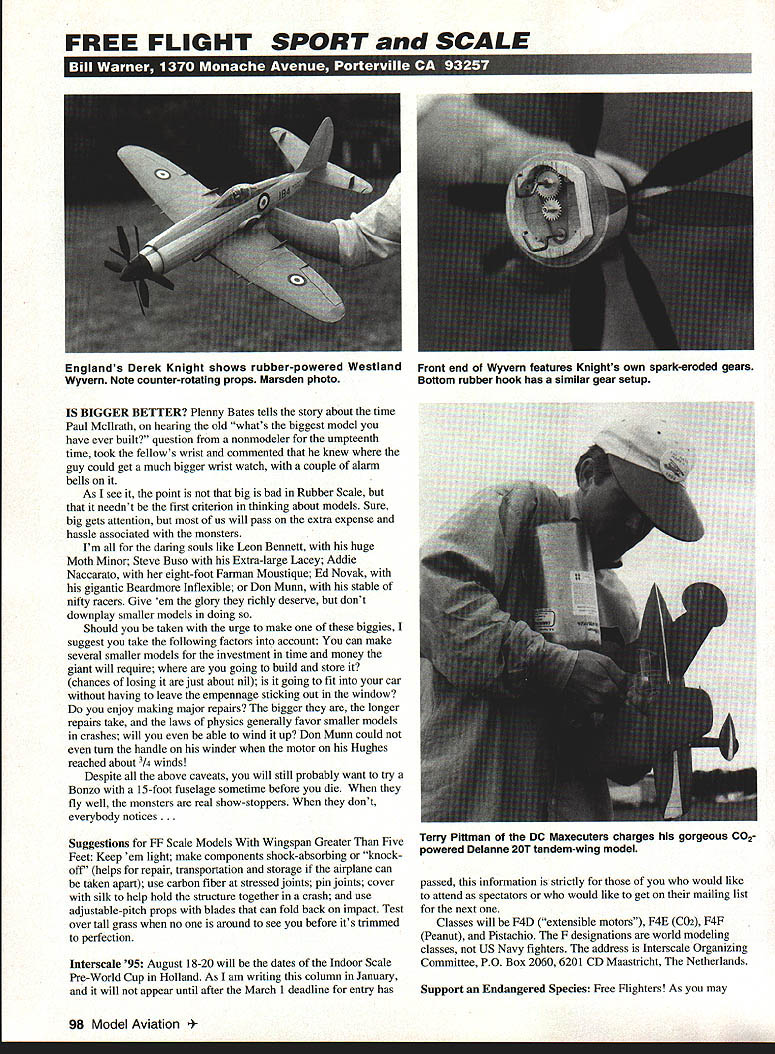
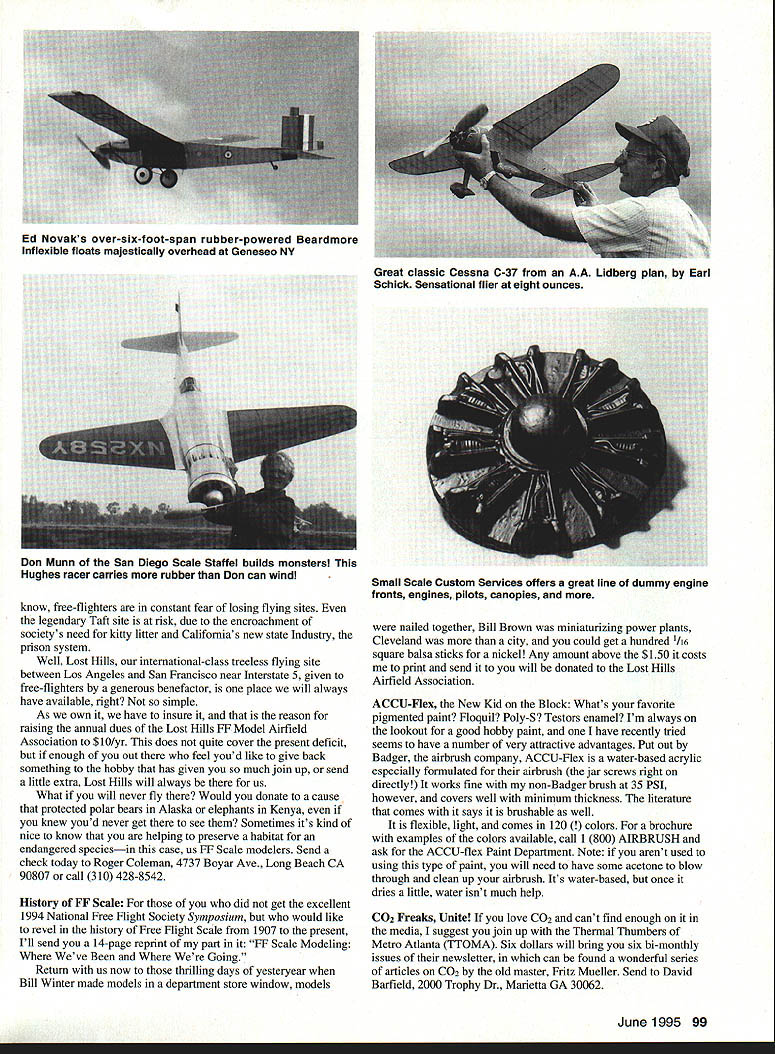
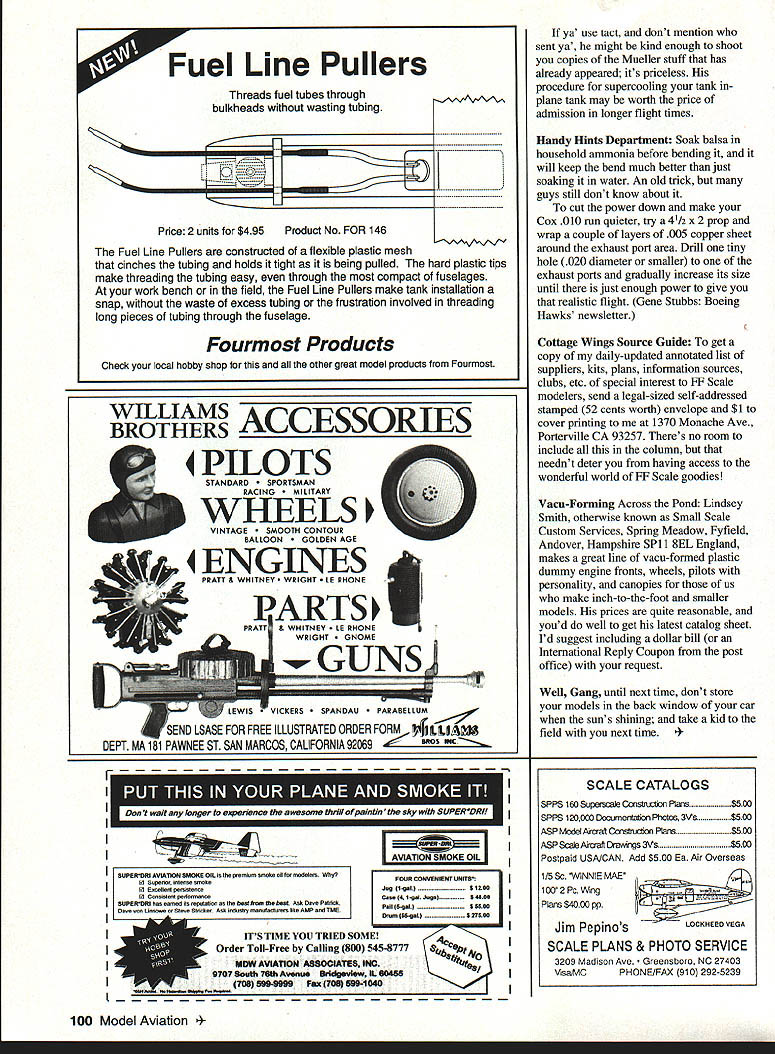
FREE FLIGHT SPORT and SCALE
Bill Warner, 1370 Monache Avenue, Porterville, CA 93257
IS BIGGER BETTER?
Plenny Bates tells the story about the time Paul McIlrath, on hearing the old "what's the biggest model you have ever built?" question from a nonmodeler for the umpteenth time, took the fellow's wrist and commented that he knew where the guy could get a much bigger wrist watch, with a couple of alarm bells on it.
As I see it, the point is not that big is bad in Rubber Scale, but that it needn't be the first criterion in thinking about models. Sure, big gets attention, but most of us will pass on the extra expense and hassle associated with the monsters.
I'm all for the daring souls like Leon Bennett, with his huge Moth Minor; Steve Buso with his extra-large Lacey; Addie Naccarato, with her eight-foot Farman Moustique; Ed Novak, with his gigantic Beardmore Inflexible; or Don Munn, with his stable of nifty racers. Give 'em the glory they richly deserve, but don't downplay smaller models in doing so.
Should you be taken with the urge to make one of these biggies, take the following factors into account:
- You can make several smaller models for the investment in time and money the giant will require.
- Where are you going to build and store it? (Chances of losing it are just about nil.)
- Will it fit into your car without having to leave the empennage sticking out the window?
- Do you enjoy making major repairs? The bigger they are, the longer repairs take, and the laws of physics generally favor smaller models in crashes.
- Will you even be able to wind it up? Don Munn could not even turn the handle on his winder when the motor on his Hughes reached about 3/4 winds!
Despite all the above caveats, you will still probably want to try a Bonzo with a 15-foot fuselage sometime before you die. When they fly well, the monsters are real show-stoppers. When they don't, everybody notices . . .
Suggestions for FF Scale Models With Wingspan Greater Than Five Feet
- Keep them light; make components shock-absorbing or "knock-off" (helps for repair, transportation and storage if the airplane can be taken apart).
- Use carbon fiber at stressed joints; pin joints; cover with silk to help hold the structure together in a crash; and use adjustable-pitch props with blades that can fold back on impact.
- Test over tall grass when no one is around to see you before it's trimmed to perfection.
Interscale '95
August 18–20 will be the dates of the Indoor Scale Pre-World Cup in Holland. As I am writing this column in January, and it will not appear until after the March 1 deadline for entry has passed, this information is strictly for those of you who would like to attend as spectators or who would like to get on their mailing list for the next one.
Classes will be F4D ("extensible motors"), F4E (CO2), F4F (Peanut), and Pistachio. The F designations are world modeling classes, not U.S. Navy fighters.
Mailing address: Interscale Organizing Committee P.O. Box 2060, 6201 CD Maastricht, The Netherlands
Support Endangered Species — Free Flighters
Free‑flighters are in constant fear of losing flying sites. Even the legendary Taft site is at risk due to encroachment and development. Lost Hills, our international‑class treeless flying site between Los Angeles and San Francisco near Interstate 5, was given to free‑flighters by a generous benefactor — but ownership brings insurance and maintenance responsibilities.
To help cover expenses the Lost Hills FF Model Airfield Association has raised annual dues to $10/year. This does not quite cover the present deficit. If enough of you who feel you'd like to give back something to the hobby that has given you so much join up, or send a little extra, Lost Hills will always be there for us.
What if you'll never fly there? Would you donate to a cause that protected polar bears in Alaska or elephants in Kenya, even if you knew you'd never get there to see them? Sometimes it's nice to know you're helping preserve a habitat for an endangered species — in this case, FF Scale modelers.
Send a check to: Roger Coleman 4737 Boyar Ave., Long Beach, CA 90807 Call: (310) 428-8542
History of FF Scale
For those of you who did not get the excellent 1994 National Free Flight Society Symposium reprint, but who would like to revel in the history of Free Flight Scale from 1907 to the present, I'll send you a 14-page reprint of my part in it: "FF Scale Modeling: Where We've Been and Where We're Going."
Return with us now to those thrilling days of yesteryear when Bill Winter made models in a department store window, models nailed together, Bill Brown was miniaturizing power plants, Cleveland was more than a city, and you could get a hundred 1/16 square balsa sticks for a nickel! Any amount above the $1.50 it costs me to print and send it to you will be donated to the Lost Hills Airfield Association.
ACCU-Flex, the New Kid on the Block
What's your favorite pigmented paint? Floquil? Poly-S? Testors enamel? I'm always on the lookout for a good hobby paint, and one I have recently tried seems to have a number of very attractive advantages.
Put out by Badger, the airbrush company, ACCU-Flex is a water‑based acrylic especially formulated for the airbrush (the jar screws right onto the gun directly!). It works fine with my non‑Badger gun at 35 PSI and covers well with minimum thickness. The literature says it is brushable as well.
It is flexible, light, and comes in 120 colors. For a brochure with examples of the colors available, call 1-800-AIRBRUSH and ask for the ACCU-Flex Paint Department.
Note: If you aren't used to this type of paint, have some acetone on hand to blow through and clean your airbrush. It's water‑based, but once it dries a little, water isn't much help.
CO2 Freaks, Unite!
If you love CO2 and can't find enough on it in the media, join the Thermal Thumbers of Metro Atlanta (TTOMA). Six dollars will bring you six bi‑monthly issues of their newsletter, which includes a wonderful series of articles on CO2 by the old master, Fritz Mueller.
Send to: David Barfield 2000 Trophy Dr., Marietta, GA 30062
Handy Hints Department
- Soak balsa in household ammonia before bending it; it will keep the bend much better than soaking in water. An old trick, but many guys still don't know about it.
- To cut power and make your Cox .010 run quieter, try a 4-1/2 x 2 prop and wrap a couple of layers of .005 copper sheet around the exhaust port area. Drill one tiny hole (.020 diameter or smaller) to one of the exhaust ports and gradually increase its size until there is just enough power to give you that realistic flight. (Gene Stubbs: Boeing Hawks' newsletter.)
Cottage Wings Source Guide
To get a copy of my daily‑updated annotated list of suppliers, kits, plans, information sources, clubs, etc., of special interest to FF Scale modelers, send a legal‑sized, self‑addressed, stamped (52 cents) envelope and $1 to cover printing to me at:
1370 Monache Ave., Porterville, CA 93257
There's no room to include all this in the column, but that needn't deter you from having access to the wonderful world of FF Scale goodies!
Vacu‑Forming Across the Pond
Lindsey Smith, otherwise known as Small Scale Custom Services, Spring Meadow, Fyfield, Andover, Hampshire SP11 8EL, England, makes a great line of vacu‑formed plastic dummy engine fronts, wheels, pilots with personality, and canopies for those of us who make inch‑to‑the‑foot and smaller models. His prices are quite reasonable; request his latest catalog sheet.
I'd suggest including a dollar bill (or an International Reply Coupon from the post office) with your request.
Well, gang, until next time, don't store your models in the back window of your car when the sun's shining; and take a kid to the field with you next time.
Transcribed from original scans by AI. Minor OCR errors may remain.

