
FREE FLIGHT SPORT and SCALE
Bill Warner, 1370 Monache Avenue, Porterville CA 93257
A FACEFUL OF INSTANT GLUE An expert modeler in Florida, who for some strange reason wished to remain anonymous, recently used his teeth as a "third hand" to grip the cap of a cyanoacrylate (CyA) glue bottle to remove it; he got a faceful of the stuff when he yanked the bottle down. Finger pressure on the bottle was enough to do him in.
Luckily his glasses saved his eyes, but the thought of a mouthful of CyA is enough to make most of us shiver more than just a little bit. You can bet that he is super-cautious when using the miracle adhesive now, as are a number of other guys I know who had trips to the emergency room with it in their eyes. I sincerely hope that you are treating CyA with all the respect that it so richly deserves, and that you are not neglecting eye protection!
CyA has a nasty habit of clogging the dispenser nozzle or tube, as you probably know from sad experience. I won't ask for a show of hands as to how many of you have squeezed the bottle harder to try to get a drop out and got more than you bargained for when the whole top of the bottle popped off.
Glue tips
- The late Hans Weiss used to stick a piece of fuel tubing in his CyA bottle out of frustration. A simpler solution is to punch a tiny hole in the side of the bottle at the upper end (the point of a drawing compass works well) and shove in a piece of thin Teflon tubing used to dispense CyA. Addie Naccarato of T and A Hobby Lobby in Burbank says it will never plug up. Her theory is that the tapered nozzle squeezes the CyA and causes premature "kicking."
- Don't touch the nozzle to the workpiece—if it picks up sawdust or crud it will set up on or in the nozzle.
- To control the amount applied and save weight, put just a drop of CyA on a glass or aluminum surface and then transfer just enough to the joint using an entomologist's bug pin (extra thin). Try to keep your elbow out of the remainder of that drop.
- For attaching canopies with CyA: spray the canopy with Lemon Pledge, wipe off the wax at the edge using alcohol on a rag where it will attach, put the canopy in place, wick CyA in under it, and when it kicks it will not cloud the inside.
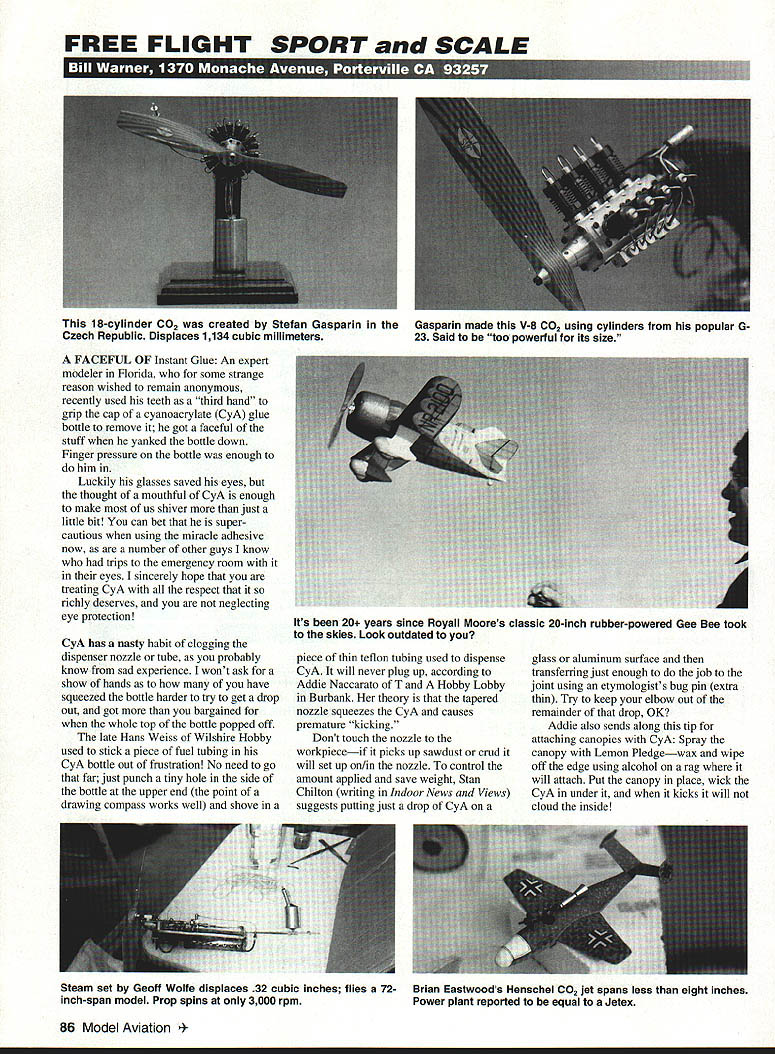
ENGINES, JETS AND STEAM Fritz Mueller sent photos of new Gasparin CO2 engines — an 18-cylinder radial that is incredible. I've watched guys fuss trying to get twin cylinders synchronized for maximum power; I can imagine getting 18 to purr together. The G-63 engine cylinders displace a total of 1,134 cubic millimeters and make a great conversation piece. Anyone who can talk Mr. Gasparin out of four of them, build a Lockheed Super Constellation for them, and get it to fly gets my unqualified vote for the NFFS Achievement Award for 1995.
According to Fritz, the V-8 is just a display model — "too powerful for its size." Odd as it may seem, a scale engine could conceivably look just right in a model and pull the front end off with its torque.
Eric Marsden sent an intriguing snapshot of fellow Brit Brian Eastwood's Pistachio Henschel taken at Crawley — an experimental CO2 jet thrust unit. As of the end of 1994 the unflown jet was reported to be equal to a Jetex of comparable size in power and duration.
Eric also included a photo of Geoff Wolfe's .032 cu. in. steam engine that flies a 72-inch RC model. Eric says it has an oil pump driven off the engine and that the engine turns about 3,000 rpm on the shown prop. Wow — the last time I saw a steam-powered airplane fly...
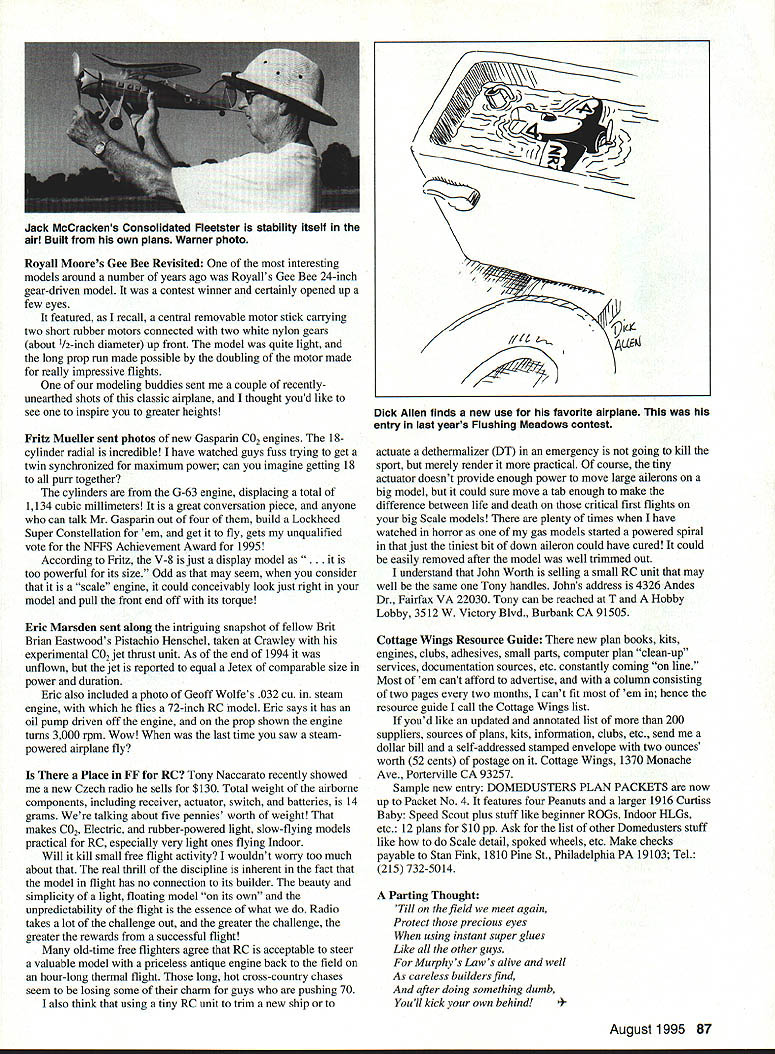
Royall Moore's Gee Bee Revisited
One of the most interesting models around a number of years ago was Royall Moore's Gee Bee 24-inch gear-driven model. It was a contest winner and certainly opened up a few eyes.
It featured, as I recall, a central removable motor stick carrying two short rubber motors connected with two white nylon gears (about 1/2-inch diameter) up front. The model was quite light, and the long prop run made possible by the doubling of the motor made for really impressive flights.
One of our modeling buddies sent me a couple of recently unearthed shots of this classic airplane, and I thought you'd like to see one to inspire you to greater heights!
Is There a Place in FF for RC?
Tony Naccarato recently showed a new Czech radio that sells for $130. Total weight of the airborne components, including receiver, actuator, switch and batteries, is 14 grams — talking about five pennies' worth of weight. That makes CO2, electric, and rubber-powered light, slow-flying models practical for RC, especially very light ones flying indoor.
Will it kill small free flight activity? I wouldn't worry too much about it. The real thrill and discipline is inherent in the fact that the model in flight has no connection to its builder. The beauty and simplicity of a light, floating model "on its own" and the unpredictability of the flight is the essence of what we do. Radio takes a lot of the challenge out, and the greater the challenge, the greater the rewards from a successful flight.
Many old-time free fliers agree that RC is acceptable to steer a valuable model with a priceless antique engine back to the field once an hour-long thermal flight. Those long, hot cross-country chases seem to be losing some of their charm for guys who are pushing 70.
I also think that using a tiny RC unit to trim a new ship or to actuate a dethermalizer (DT) in an emergency is not going to kill the sport, but merely render it more practical. Of course, the tiny actuator doesn't provide enough power to move large ailerons on a big model, but it could be enough to make the difference between life and death on those critical first flights of your big Scale models. There are plenty of times when I have watched in horror as one of my scale models started a powered spiral that just the tiniest bit of down aileron could have cured. It could be easily removed after the model was well trimmed out.
I understand that John Worth is selling small RC units that may be the same one Tony handles. John's address is: 4326 Andes Dr., Fairfax VA 22030. Tony can be reached at T and A Hobby Lobby, 3512 W. Victory Blvd., Burbank CA 91505.
Cottage Wings Resource Guide
There are new plan books, kits, engines, clubs, adhesives, small parts, computer plan "clean-up" services, documentation sources, etc., constantly coming online. Most can't afford to advertise, and with a column consisting of two pages every two months, I can't list them all; hence the resource guide I call the Cottage Wings List.
If you'd like an updated and annotated list of more than 200 suppliers, sources of plans, kits, information, clubs, etc., send me a dollar bill and a self-addressed stamped envelope with two ounces' worth (52 cents) of postage on it to: Cottage Wings, 1370 Monache Ave., Porterville CA 93257.
Sample new item
- DOMEDUSTERS PLAN PACKETS are now up to Packet No. 4. It features four Peanuts and a large 1916 Curtiss Baby; Speed Scout plus beginner ROGs, Indoor HLGs, etc. — 12 plans for $10 postpaid. Ask for the list of other Domedusters stuff while at it: scale detail, spoked wheels, etc. Make checks payable to Stan Fink, 1810 Pine St., Philadelphia PA 19103; Tel: (215) 732-5014.
A Parting Thought
'Till on the field we meet again, Protect those precious eyes When using instant super glues Like all the other guys. For Murphy's Law's alive and well As careless builders find, And after doing something dumb, You'll kick your own behind!
Transcribed from original scans by AI. Minor OCR errors may remain.

