
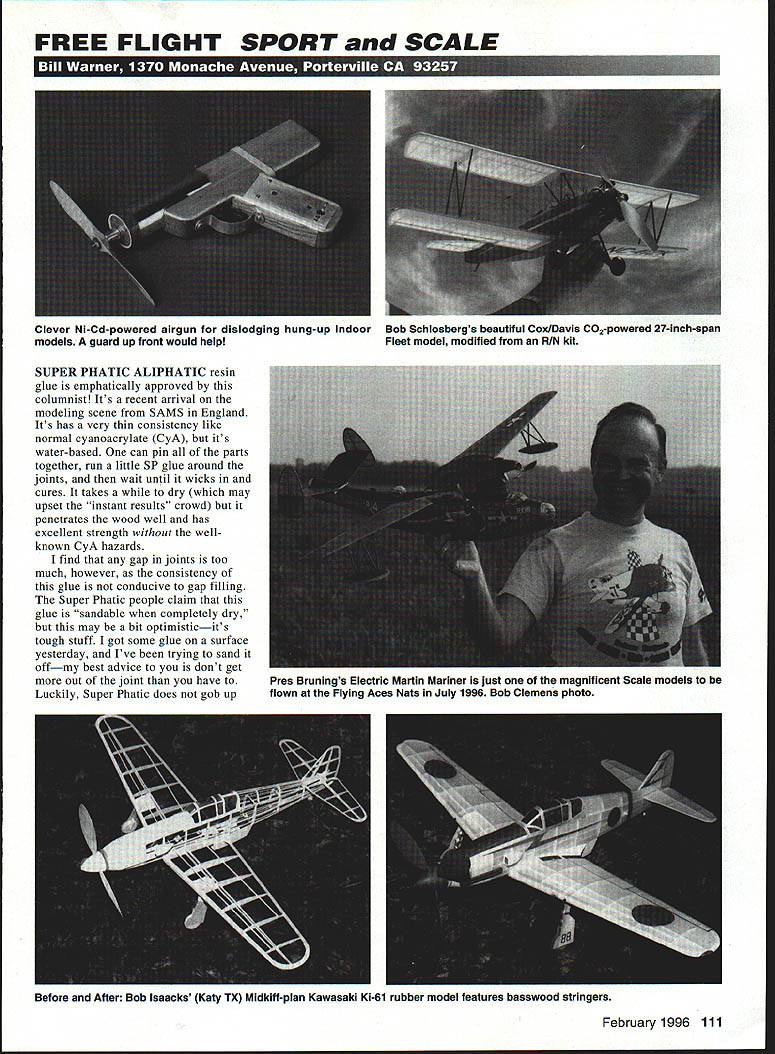
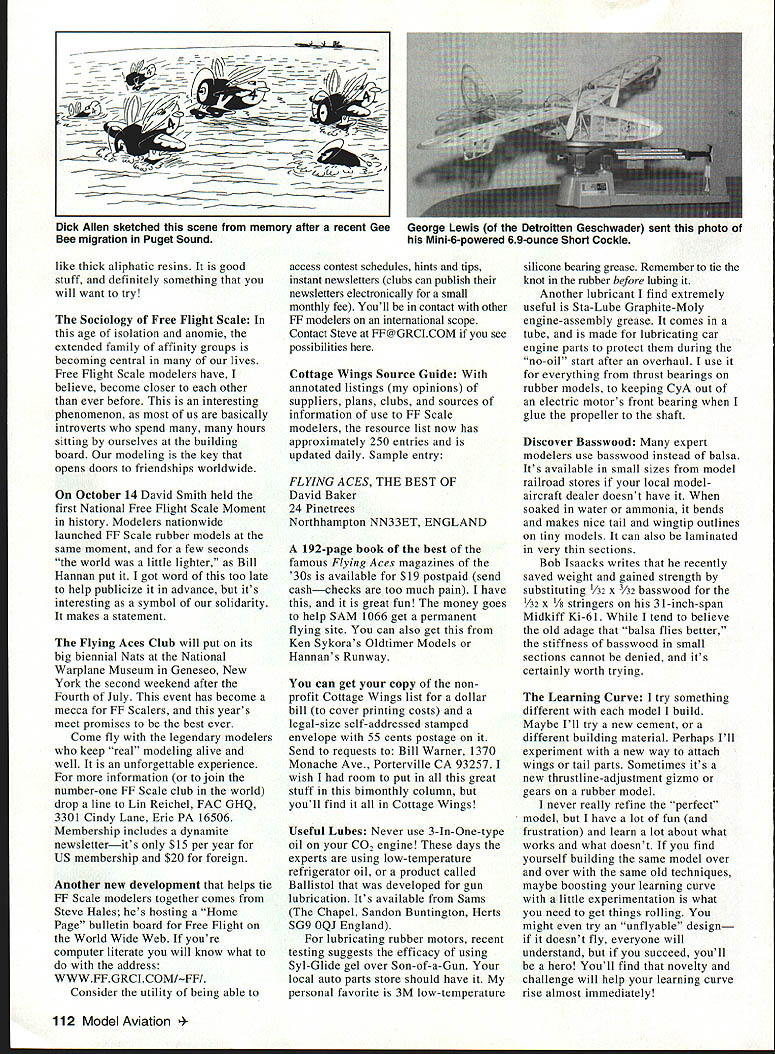
FREE FLIGHT SPORT and SCALE
Bill Warner, 1370 Monache Avenue, Porterville, CA 93257
Super Phatic aliphatic resin glue
Super Phatic aliphatic resin glue is emphatically approved by this columnist. It's a recent arrival on the modeling scene from Sams in England. It has a very thin consistency like normal cyanoacrylate (CyA), but it's water-based. One can pin all of the parts together, run a little Super Phatic around the joints, and then wait until it wicks in and cures. It takes a while to dry (which may upset the "instant results" crowd), but it penetrates the wood well and has excellent strength without the well-known hazards of CyA.
I find that any gap in joints is too much, however, as the consistency of this glue is not conducive to gap filling. The Super Phatic people claim that this glue is "sandable when completely dry," but this may be a bit optimistic—it's tough stuff. I got some glue on a surface yesterday and I've been trying to sand it off—my best advice is don't get more out of the joint than you have to. Luckily, Super Phatic does not gob up joints like thick aliphatic resins. It is good stuff and definitely something you will want to try!
The sociology of Free Flight Scale
Age, isolation, anomie, extended family, affinity groups — these are becoming central to many lives. Free Flight Scale modelers have, I believe, become closer to one another than ever before. This is an interesting phenomenon, since most of us are basically introverts who spend many hours sitting alone at the building board. Our modeling is the key that opens doors to friendships worldwide.
On October 14, David Smith held the first National Free Flight Scale Moment in history. Modelers nationwide launched FF Scale rubber models at the same moment, and for a few seconds "the world was a little lighter," as Bill Hannan put it. I got word of this too late to help publicize it in advance, but it's an interesting symbol of solidarity.
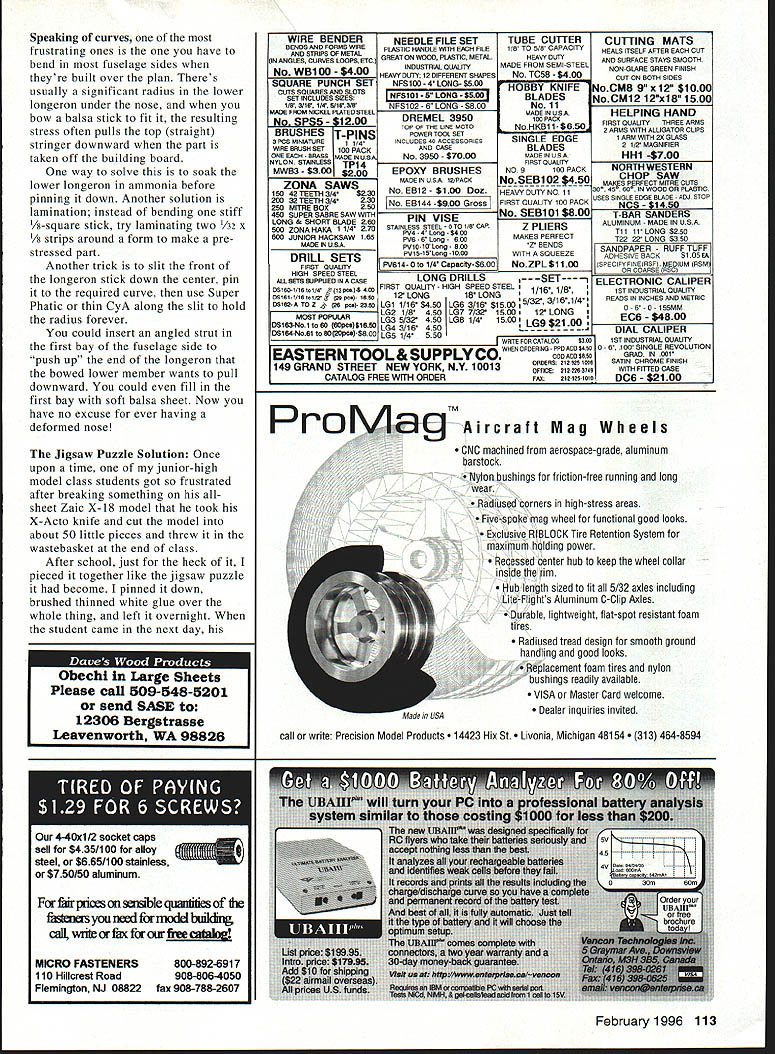
The Flying Aces Club will put on its big biennial Nats at the National Warplane Museum in Geneseo, New York the second weekend after the Fourth of July. This event has become a mecca for FF Scalers, and this year's meet promises to be the best ever. Come fly with the legendary modelers who keep real modeling alive. For information or to join the number-one FF Scale club in the world, drop a line to:
- Lin Reichel, FAC GHQ, 3301 Cindy Lane, Erie, PA 16506.
- Membership includes a dynamite newsletter; it's $15 per year (U.S. membership), $20 foreign.
Another development that helps tie FF Scale modelers together comes from Steve Hales, who is hosting a Home Page bulletin board, Free Flight World Wide Web. If you're computer literate you'll know what to do with the address: WWW.FFGRC.COM/~FFI. Consider the utility of being able to access contest schedules, hints and tips, and instant newsletters (clubs can publish newsletters electronically for a small monthly fee). Contact Steve at FF@GRC.COM to explore the possibilities.
Cottage Wings Source Guide
Cottage Wings Source Guide — annotated listings and opinions of suppliers, plans, clubs, and sources of information useful to FF Scale modelers — now has approximately 250 entries and is updated daily. Sample entry:
FLYING ACES, THE BEST OF David Baker 24 Pinetrees Northampton NN3 3ET England
A 192-page book of the best of the famous Flying Aces magazines of the '30s is available for $19 postpaid (send cash — checks are too much pain). It's great fun; money goes to help SAM 1066 get a permanent flying site. You can also get this from Ken Sykora's Oldtimer Models or Hannan's Runway.
You can get a copy of the non-profit Cottage Wings list for a dollar bill (to cover printing costs) and a legal-size self-addressed stamped envelope with 55 cents postage. Send requests to Bill Warner, 1370 Monache Ave., Porterville, CA 93257.
I wish I had room to include all this great stuff in each bimonthly column — you'll find it all in Cottage Wings.
Useful lubes
Never use 3-In-One-type oil on CO2 engines. These days experts use low-temperature refrigerator oil or Ballistol, a product developed for gun lubrication. Ballistol is available from Sams, Chapel, Sandon, Buntingford, Herts SG9 0QJ, England.
For lubricating rubber motors, recent testing suggests Syl-Glide gel is more effective than Son-of-a-Gun from the local auto parts store. My personal favorite is 3M low-temperature silicone bearing grease. Remember: tie a knot in the rubber before lubing it.
Another lubricant I find extremely useful is Sta-Lube Graphite-Moly engine-assembly grease. It comes in a tube and is made for lubricating car engine parts to protect them during the "no-oil" start after an overhaul. I use it for everything from thrust bearings on rubber models to keeping CyA out of an electric motor's front bearing when I glue the propeller to the shaft.
Discover basswood
Many expert modelers use basswood instead of balsa. It's available in small sizes from model railroad stores if your local model-aircraft dealer doesn't have it. When soaked in water or ammonia it bends and makes nice tail and wingtip outlines on tiny models. It also laminates into very thin sections.
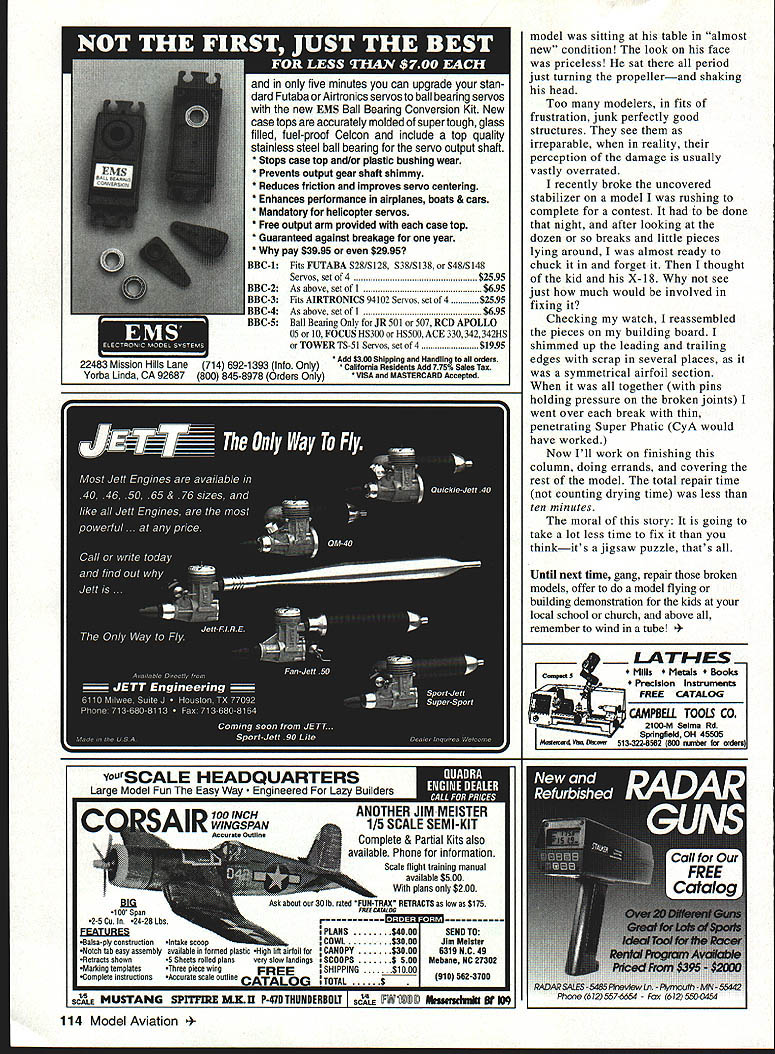
Bob Isaacks recently saved weight and gained strength by substituting 1/32" x 3/32" basswood for the 1/32" x 1/2" stringers on his 31-inch-span Midkiff Ki-61. While I tend to believe the old adage that "balsa flies better," the stiffness of basswood in small sections cannot be denied and it's certainly worth trying.
The learning curve
I try something different with each model I build. Maybe I'll try a new cement, a different building material, a new way to attach wings or tail parts, a new thrustline-adjustment gizmo, or gears on a rubber motor. I never really refine the "perfect" model, but I have a lot of fun (and frustration) and learn what works and what doesn't.
If you find yourself always building the same model with the same techniques, boost your learning curve with a little experimentation. Try that unwieldy "design" — if it doesn't fly, everyone will understand. But if you succeed, you'll be a hero. Novelty and challenge will help your learning curve rise almost immediately.
One of the most frustrating curves to make is the radius in the lower longeron under the nose when building fuselage sides over the plan. Bowing a balsa stick to fit often pulls the straight top stringer downward when the part is removed from the board. Solutions:
- Soak the lower longeron in ammonia before pinning it down.
- Laminate two 3/32" x 3/32" strips around a form to make a pre-stressed strut instead of bending one stiff 1/8" square stick.
- Slit the front of the longeron stick down the center, pin it to the required curve, then use Super Phatic or thin CyA along the slit to hold the radius forever.
- Insert an angled strut in the first bay of the fuselage side to "push up" the end of the longeron the bowed lower member wants to pull downward, or fill in the first bay with soft balsa sheet.
Now you have no excuse for ever having a deformed nose!
The jigsaw puzzle solution
Once upon a time, one of my junior-high model class students got so frustrated after breaking something on his all-sheet Zaic X-18 model that he took his X-Acto knife and cut the model into about 50 little pieces and threw it in the wastebasket at the end of class.
After school, just for the heck of it, I pieced it together like the jigsaw puzzle it had become. I pinned it down, brushed thinned white glue over the whole thing, and left it overnight. When the student came in the next day, his model was sitting at his table in "almost new" condition. The look on his face was priceless; he sat there all period just turning the propeller and shaking his head.
Too many modelers, in fits of frustration, junk perfectly good structures. They see them as irreparable when, in reality, the damage is usually far less than they think.
I recently broke the uncovered stabilizer on a model I was rushing to complete for a contest. It had to be done that night. After looking at the dozen or so breaks and little pieces, I was almost ready to chuck it in. Then I thought of the kid and his X-18. Why not see how much would be involved in fixing it?
Checking my watch, I reassembled the pieces on my building board. I shimmed the leading and trailing edges with scrap in several places, as it was a symmetrical airfoil section. When it was all together (with pins holding pressure on the broken joints) I went over each break with thin, penetrating Super Phatic (CyA would have worked). The total repair time (not counting drying) was less than ten minutes.
The moral of the story: it's going to take a lot less time to fix it than you think—it's a jigsaw puzzle, that's all.
Until next time, gang: repair those broken models, offer to do a model repair demo or building demonstration for the kids at your local school or church, and above all, remember to wind in a tube! +
Transcribed from original scans by AI. Minor OCR errors may remain.

