
Free Flight: Sport and Scale
Bill Warner 1370 Monache Avenue, Porterville CA 93257
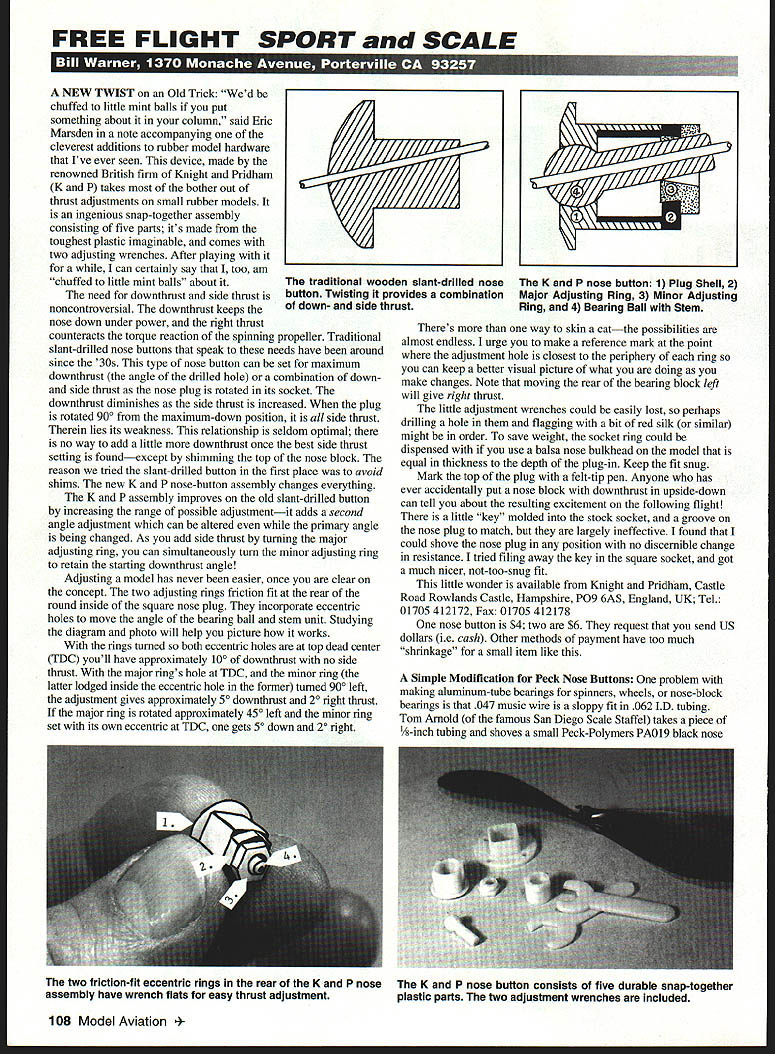
A NEW TWIST on an Old Trick: "We'd be chuffed to little mint balls if you put something about it in your column," said Eric Marsden in a note accompanying one of the cleverest additions to rubber model hardware that I've ever seen. This device, made by the renowned British firm Knight and Pridham (K and P), takes most of the bother out of thrust adjustments on small rubber models. It is an ingenious snap-together assembly consisting of five parts; it's made from very tough plastic, and comes with two adjusting wrenches. After playing with it for a while, I can certainly say that, too, am "chuffed to little mint balls" about it.
The need for downthrust and side thrust is noncontroversial. Downthrust keeps the nose down under power, and right thrust counteracts the torque reaction of the spinning propeller. Traditional slant-drilled nose buttons that address these needs have been around since the '30s. This type of nose button can be set for maximum downthrust (the angle of the drilled hole) or a combination of down- and side thrust as the nose plug is rotated in its socket. The downthrust diminishes as the side thrust is increased. When the plug is rotated 90° from the maximum-down position, it is all side thrust.
Therein lies its weakness. This relationship is seldom optimal; there is no way to add a little more downthrust once the best side-thrust setting is found—except by shimming the top of the nose block. The reason we tried the slant-drilled button in the first place was to avoid shims. The new K and P nose-button assembly changes everything.
The K and P assembly improves on the old slant-drilled button by increasing the range of possible adjustment—it adds a second angle adjustment which can be altered even while the primary angle is being changed. As you add side thrust by turning the major adjusting ring, you can simultaneously turn the minor adjusting ring to retain the starting downthrust angle.
Adjusting a model has never been easier once you are clear on the concept. The two adjusting rings friction-fit at the rear of the round inside of the square nose plug. They incorporate eccentric holes to move the angle of the bearing ball and stem unit. Studying the diagram and photo will help you picture how it works.
With the rings turned so both eccentric holes are at top dead center (TDC), you'll have approximately 10° of downthrust with no side thrust. With the major ring's hole at TDC and the minor ring (the latter lodged inside the eccentric hole in the former) turned 90° left, the adjustment gives approximately 5° downthrust and 2° right thrust. If the major ring is rotated approximately 45° left and the minor ring set with its own eccentric at TDC, one gets about 5° down and 2° right.
There's more than one way to skin a cat—the possibilities are almost endless. I urge you to make a reference mark at the point where the adjustment hole is closest to the periphery of each ring so you can keep a better visual picture of what you are doing as you make changes. Note that moving the rear of the bearing block left will give right thrust.
The little adjustment wrenches could be easily lost, so perhaps drilling a hole in them and flagging with a bit of red silk (or similar) might be in order. To save weight, the socket ring could be dispensed with if you use a balsa nose bulkhead on the model that is equal in thickness to the depth of the plug. Keep the fit snug. Mark the top of the plug with a felt-tip pen. Anyone who has ever accidentally put a nose block downthrust upside-down can tell you about the resulting excitement on the following flight!
There is a little "key" molded into the stock socket and a groove on the nose plug to match, but they are largely ineffective. I found that I could shove the nose plug in any position with no discernible resistance. I tried filing away the key in the square socket and got a much nicer, not-too-snug fit.
This little wonder is available from Knight and Pridham, Castle Road, Rowlands Castle, Hampshire, PO9 6AS, England, UK; Tel.: 01705 412172, Fax: 01705 412178.
One nose button is $4; two are $6. They request that you send US dollars (cash). Other methods of payment have too much "shrinkage" for a small item like this.
A Simple Modification for Peck Nose Buttons
One problem with making aluminum-tube bearings for spinners, wheels, or nose-block bearings is that 0.047-inch music wire is a sloppy fit in 0.062-inch I.D. tubing. Tom Arnold (of the famous San Diego Scale Staffel) takes a piece of 1/8-inch tubing and shoves a small Peck-Polymers PA019 black nose button in each end of the tubing, cutting off the head when applicable. The result is an extended bearing that runs smoothly and fits perfectly!
Turn on the Bubble Machine!
No, that isn't Lawrence Welk talking—that's a free-flight modeler seriously seeking a long flight on his/her model. The search for the elusive thermal takes many forms: getting a fresh haircut, using a tall pole and a Mylar streamer in conjunction with a thermistor, piggybacking on buzzards, and blowing "fluffies" (dried cattail fluff) into the breeze. Those of us with heavy models sometimes toss a handful of gravel in the air—when it stays up, we fly. There are drawbacks to some of the above thermal-detection methods, however.
Attending a big free-flight meet is often like flying in a forest, with all of the poles and Mylar streamers looking for all the world like an antenna farm. Fluffies are popular with people close downwind who have to breathe them. One cheap and clever way to spot lift (and not antagonize your fellow modelers) is to use a bubble gun. I got mine at a drugstore for $6. You pour in some bubble liquid, stand 30 to 50 feet upwind from the person launching the model, and, when the breeze calms (and the thermal is building), turn the crank and let out a stream of bubbles. When they rise happily skyward, it is time to fly!
Cottage Wings Resource Guide
If you are looking for the latest plans, clubs, materials, documentation, books, etc., useful to a FF scale modeler, I guarantee my annotated list will be of use to you. At last count, it contained more than 16,000 words. Send a dollar bill (to cover printing costs) and a 4 x 9-1/2-inch self-addressed stamped envelope (with 55 cents postage on it) to Bill Warner, 1370 Monache Ave., Porterville CA 93257.
New additions just this month include CO2 engines made by Daniel Baird, just-out kits from Dave Diels and Scientech, sources for computer software, the latest plan packs from the Flying Aces and Domedusters, plans with photo-etched parts from Greggovsky, a huge collection of WW I and earlier plans from Smileys, and lots more!
Flying Scale Oak Leaf
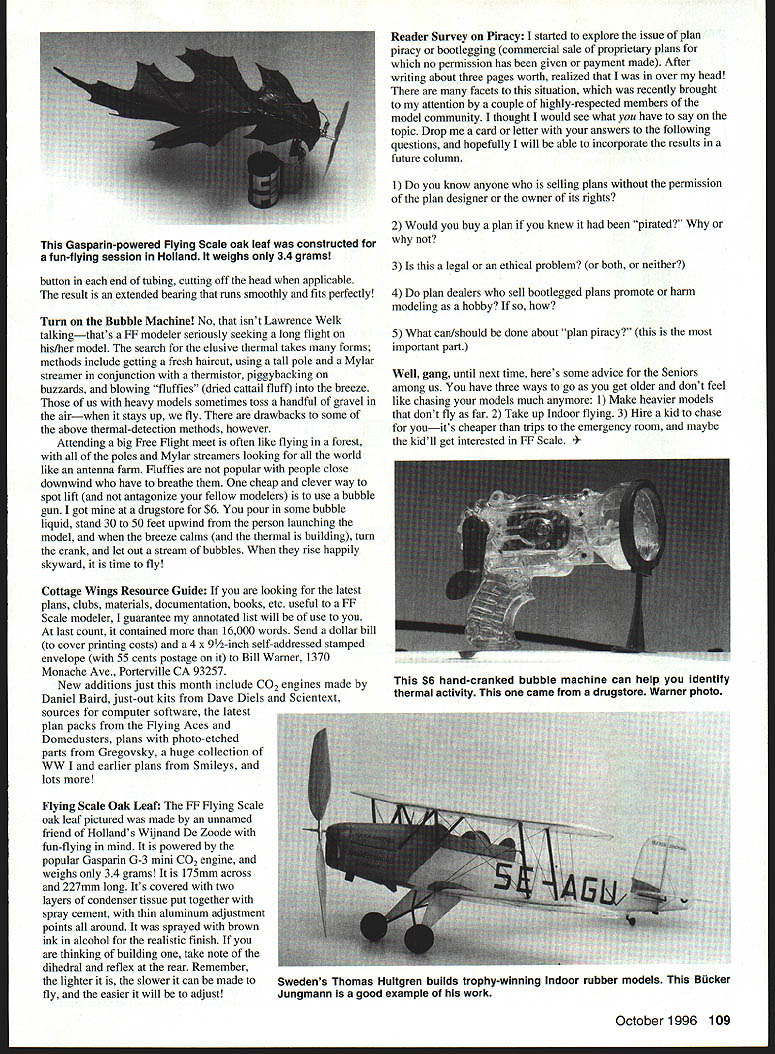
The FF flying-scale oak leaf pictured was made by an unnamed friend of Holland's Wijnand De Zoode with fun-flying in mind. It is powered by the popular Gasparin G-3 mini CO2 engine and weighs only 3.4 grams! It is 175 mm across and 227 mm long. It's covered with two layers of condenser tissue put together with spray cement, with thin aluminum adjustment points all around. It was sprayed with brown ink in alcohol for the realistic finish. If you are thinking of building one, take note of the dihedral and reflex at the rear. Remember, the lighter it is, the slower it can be made to fly, and the easier it will be to adjust!
Reader Survey on Piracy
I started to explore the issue of plan piracy or bootlegging (commercial sale of proprietary plans for which no permission has been given or payment made). After writing about three pages worth, I realized that I was in over my head! There are many facets to this situation, which was recently brought to my attention by a couple of highly respected members of the model community. I thought I would see what you have to say on the topic. Drop me a card or letter with your answers to the following questions, and hopefully I will be able to incorporate the results in a future column.
- Do you know anyone who is selling plans without the permission of the plan designer or the owner of its rights?
- Would you buy a plan if you knew it had been "pirated"? Why or why not?
- Is this a legal or an ethical problem? (or both, or neither?)
- Do plan dealers who sell bootlegged plans promote or harm modeling as a hobby? If so, how?
- What can/should be done about "plan piracy?" (this is the most important part.)
Well, gang, until next time, here's some advice for the seniors among us. You have three ways to go as you get older and don't feel like chasing your models much anymore:
- Make heavier models that don't fly as far.
- Take up indoor flying.
- Hire a kid to chase for you—it's cheaper than trips to the emergency room, and maybe the kid'll get interested in FF scale.
Transcribed from original scans by AI. Minor OCR errors may remain.

