
FREE FLIGHT SPORT and SCALE
Bill Warner, 1370 Monache Avenue, Porterville CA 93257
FF Scale Column to Split
Well gang, I have some good news. You are about to get two FF Scale columnists for the price of one. I'll be alternating this bimonthly column with my old modeling buddy Fernando Ramos, who did a great FF Scale column in Model Builder for many years. I'll be handling civil and general Scale topics and Fernando will be handling the military subjects. I mention this in advance so you'll know where to send which pictures, etc. Fernando's address is 19361 So. Mesa Dr., Villa Park CA 92667.
I will also be turning the Cottage Wings list over to someone else at the end of this year, and maybe that someone could be you if you have a computer and are willing to put in extra work to help other modelers on a volunteer basis.
Flightmasters Celebrates 50 Years
The Flightmasters club hit the big five‑oh this year! They are planning a big party which includes their annual Scale contest and a banquet near Disneyland in Anaheim, California, November 30–December 1. Send a self‑addressed, stamped envelope (SASE) to me or to Fernando Ramos for a flyer on the event. Come and celebrate with us and enjoy the beautiful Southern California flying weather!
Happiness Is a Snug Nose Block
How many times does a loose nose block pop out and ruin a flight? One that is so floppy that it cancels out any thrust adjustments you have built in is the most common. The one that falls out and drops down taking about a foot of slack rubber motor sure can kill a nice glide. The most amusing is the one that jumps out under power and reinstalls itself upside down, giving you instant upthrust and opposite side thrust. Wheeee!
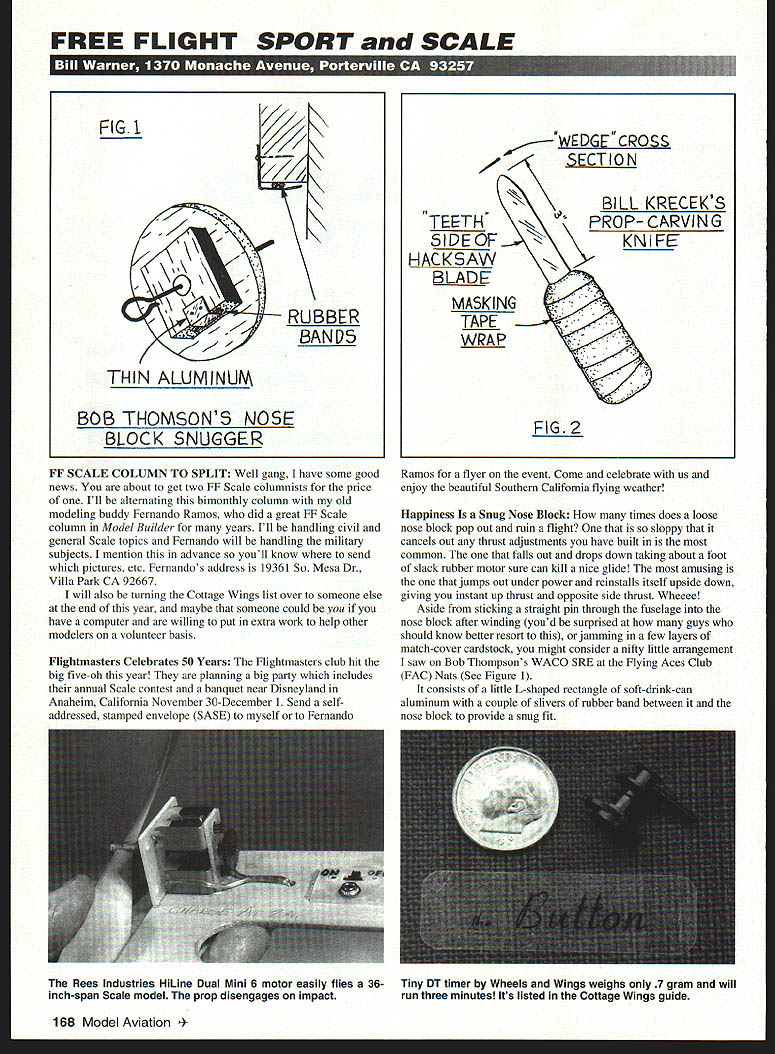
Aside from sticking a straight pin through the fuselage into the nose block after winding (you'd be surprised at how many guys who should know better resort to this), or jamming in a few layers of match‑cover cardstock, you might consider a nifty little arrangement I saw on Bob Thompson's WACO SRE at the Flying Aces Club (FAC) Nats (see Figure 1).
It consists of a little L‑shaped rectangle of soft‑drink‑can aluminum with a couple of slivers of rubber band between it and the nose block to provide a snug fit.
What Is a Good Electric Motor?
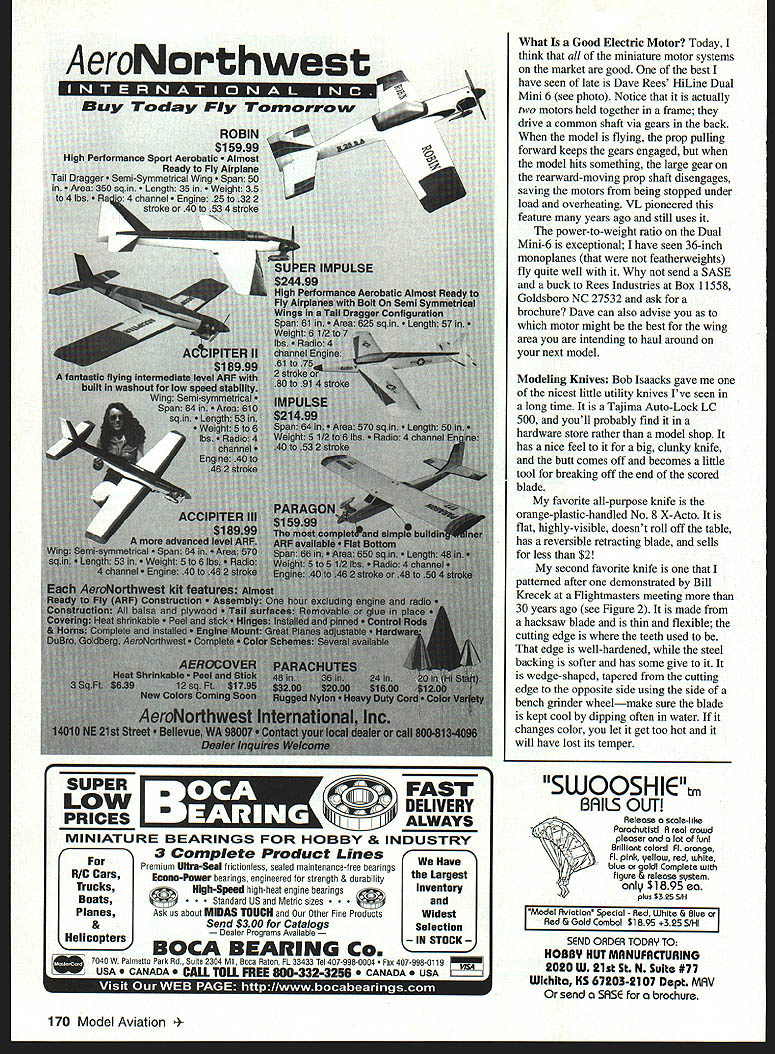
I think that all of the miniature motor systems on the market are good. One of the best I have seen is Dave Rees' HiLine Dual Mini‑6. Notice that it is actually two motors held together in a frame; they drive a common shaft via gears in the back. When the model is flying, the prop pulling forward keeps the gears engaged, but when the model hits something the large gear on the rearward‑moving prop shaft disengages, saving the motors from being stopped under load and overheating. VL pioneered this feature many years ago and still uses it.
I have seen 36‑inch monoplanes (that were not featherweights) fly quite well with it. Why not send a SASE and a buck to Rees Industries at Box 11558, Goldsboro NC 27532 and ask for a brochure? Dave can also advise you as to which motor might be the best for the wing area you are intending to haul around on your next model.
Modeling Knives
Bob Isaacks gave me one of the nicest little utility knives I've seen in a long time. It is a Tajima Auto‑Lock LC‑500, and you'll probably find it in a hardware store rather than a model shop. It has a nice feel to it for a big, clunky knife, and the butt comes off and becomes a little tool for breaking off the end of the scored blade.
My favorite all‑purpose knife is the orange‑plastic‑handled No. 8 X‑Acto. It is flat, highly visible, doesn't roll off the table, has a reversible retracting blade, and sells for less than $2!
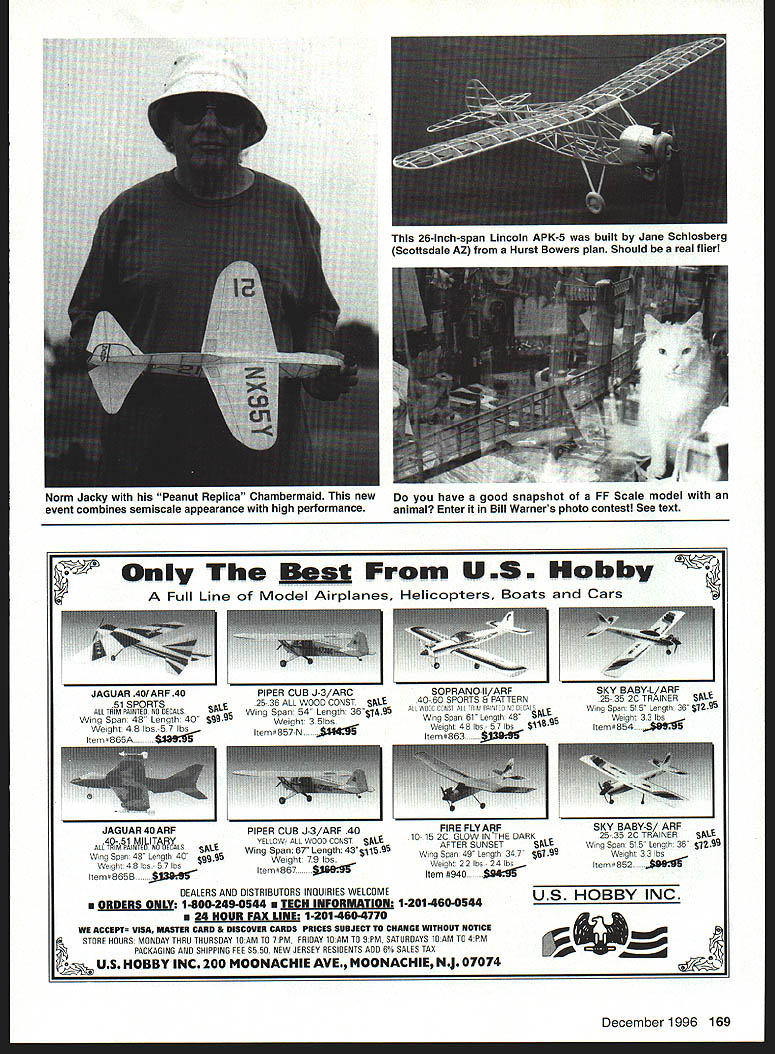
My second favorite knife is one that I patterned after one demonstrated by Bill Krecek at a Flightmasters meeting more than 30 years ago (see Figure 2). It is made from a hacksaw blade and is thin and flexible; the cutting edge is where the teeth used to be. That edge is well‑hardened, while the steel backing is softer and has some give to it. The edge is wedge‑shaped, tapered from the cutting edge to the opposite side using the side of a bench grinder wheel—make sure the blade is kept cool by dipping often in water. If it changes color, you let it get too hot and it will have lost its temper.
Use extreme care when grinding the knife blade so it doesn't get away from you and take off a finger. Grinding only the last three inches of the hacksaw blade will leave you something to hang onto; preferably wear leather gloves. Always wear eye protection.
The final sharpening to the very shallow wedge shape is done on wet‑or‑dry abrasive paper on a flat surface, drawing the knife away from the sharp edge. Cut off the excess blade length and wrap it with masking tape until you have a handle that's about one inch thick. It is an excellent tool for carving props, and I feel it is superior to anything similar available on the market. Mine has reduced many a balsa block to chips with only a minor stropping on a length of leather belt rubbed with jeweler's rouge and oil every year or so.
SAMS
I always thought that SAMS stood for Society of Antique Modelers, and so it does. It also stands for George Wallbridge's St. Albans Model Supply in England, one of the world's foremost mail‑order model shops. (Don't worry if you, too, were confused—people often see the AMA decal on my car and inquire as to whether I am a doctor or a motorcyclist.)
Some Thoughts on Rubber Motors
The Flying Aces recently went to a new formula of 15% rubber‑motor weight (based on the weight of the model) in some mass‑launch events. The airplanes were just flying too long, making retrieval between rounds difficult for some of the older guys.
You and I probably don't have that problem, being either of the younger generation—or not having many models that routinely fly a couple of miles. For us, something in the neighborhood of 30% of the total model weight including motor will be what we are shooting for.
One thing that you will notice when you start really building light models is that you can increase the length of your rubber motor and up the pitch and diameter on those props for some really long runs. I saw one highly successful model recently with a motor that was five times the hook‑to‑rear peg length! When I go more than 1½ to 2 times that distance, I start losing power. Just start simplifying and adding lightness!
FAC Squadron List Corrections
Please add the D.C. Maxecuters, Frank Rowsome, 10904 Bellehaven Rd., Damascus MD 20872 to the list published recently in this column. Also, please update the Marin Aero Club's address: c/o George Benson, 204 Benson Circle, Mill Valley CA 94941.
Dick Baxter's Peanut Replica Event
Dick Baxter of the Flightmasters has an event that combines simplicity with semiscale appearance and high performance. No‑Calorie Profile Scale has held its own for a number of years, despite protests from purists that they look stupid. The devotees of Profile fire back that they are quick and fly like blazes and look better than Easy Bs. Both sides have good points.
Baxter's position is to box up the fuselage of a profile enough to cover up the motor and avoid the unfinished look of a Profile model's off side. A box fuselage can substitute for a round one, which is one big advantage.
Peanut Replica Rules
- 12‑ to 16‑inch wingspan, rubber power only.
- Airframe must be 3‑D. Specifically, the motor must be inside.
- Major markings and control surfaces must be represented at least on the top surfaces of the wing and horizontal tail, and both sides of the fuselage and vertical tail.
- Single‑surface covering is OK and encouraged.
- Flying surfaces can have a flat‑plate airfoil, and the fuselage cross‑section can be slab‑sided (or any shape the modeler wishes). Normal Peanuts and most Dime‑Scale models are eligible. Only profiles are excluded.
- The contestant must identify the full‑scale aircraft that was modeled, and more than one‑third of the other contestants must agree that it is indeed recognizable as that airplane. This rule is applied after judging, so don't lose your airplane. Photos and drawings are advised to validate obscure aircraft. Secret balloting is allowed.
Most "fresh" things in modeling go through a fairly predictable life cycle. Most new events either get unnecessarily complicated or they tend to homogenize into look‑alikes. Towline gliders once looked like real sailplanes rather than a wing and a stab tied together by a pencil. Even semiscale Control Line Stunt models or RC trainers may have had some personality back in the dim history of those categories.
Peanut Scale has barely survived the urge of the masses to build Fikes and Lacey M‑10s just because they win contests. The ultimate death knell for a fresh, fun event is inclusion in the AMA Competition Regulations. Remember when the "book" said you had to have a scale ruler for your Peanut Scale model to get judged? Even the highly successful Flying Aces rules (which encourage diversity by awarding bonus points for weird airplanes) can be discouraging if people begin to think that "Only multiengine canard seaplanes have a chance at winning." I suggest that you and your club jump on Peanut Replica while it still has its innocence.
Cottage Wings Resource Guide
For a dollar bill and a self‑addressed legal‑sized envelope with 55 cents postage on it, I'll send you my latest updated copy of the annotated resource list of suppliers, plans sources, clubs, and information sources of use to FF Scale modelers. This is a non‑profit deal to help you keep up with what is available, where you can get it, and give you a clue as to if it's useful or not. Sample listing:
WHEELS AND WINGS 1908‑C Trice Valley Blvd. #221 Walnut Creek, CA 94595 (510) 937‑8063
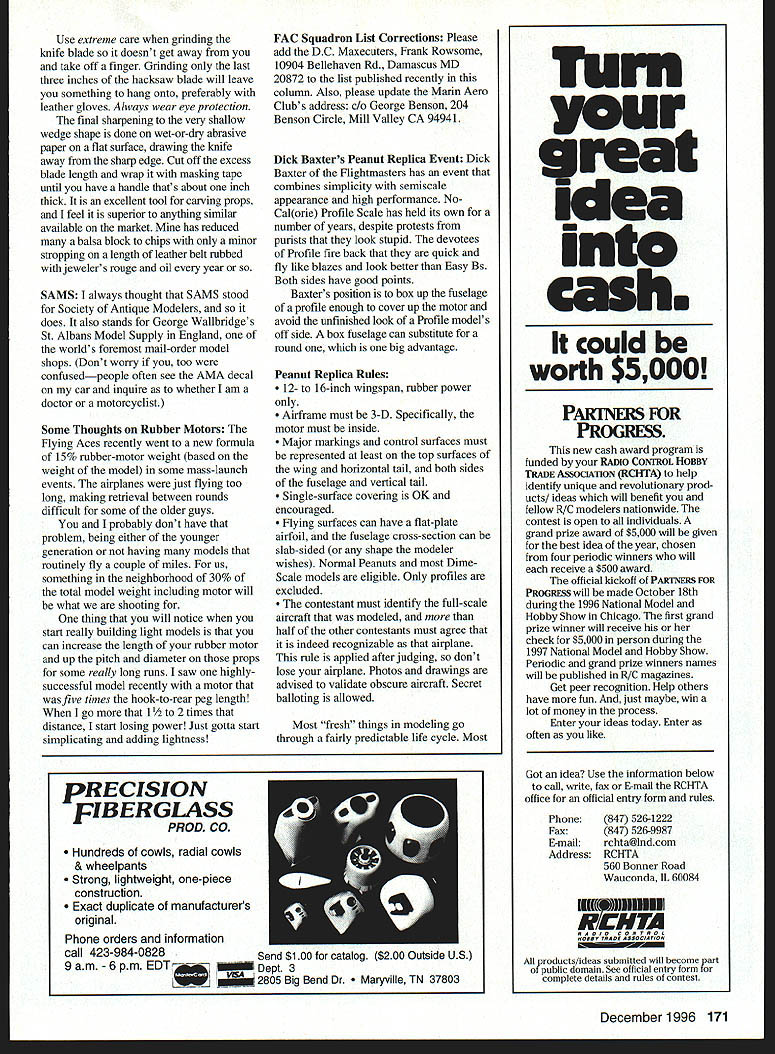
Bob Munson has a couple of little DT timers that weigh only 0.7 gram which would be ideal for small FF Scale models. Professionally made, these devices (named Button) can run up to six minutes. They use an internal viscous substance for resistance. $18 plus $1 postage. I have static‑tested one, and it works great.
Free Flight with Animals Photo Contest
Back in his younger days when he was editing Model Builder, Bill Northrop made fun of a certain RC magazine that always put gorgeous young ladies posing with mediocre airplanes on their cover—he put a dog alongside a model of his on an MB cover! Although I do not have the Model Aviation cover at my disposal, I am running a contest for the best snapshot of a Free Flight Scale model with an animal. Photos will be judged on originality and depth of field.
All photos become the property of myself, and will not be returned unless a SASE is enclosed. Winners will receive prizes selected from the goodies manufacturers send me for review. The best submissions will be published in this column. The decision of the judges (my cat and I) will be final.
Send your snapshot to Bill Warner, 1370 Monache Avenue, Porterville CA 93257 by January 1, 1997. See ya on the field!
Transcribed from original scans by AI. Minor OCR errors may remain.

