
FREE FLIGHT: SPORT and SCALE
Bill Warner 1370 Monache Avenue, Porterville, CA 93257
Flying floats indoors
Flying floats indoors is a challenge, especially in a small site such as that used by the Norwich, Connecticut FAC (Flying Aces Club) Squadron. Al "Grayhawk" Lawton allows that the middle school cafeteria has a volume roughly equivalent to three phone booths.
The club runs a low-key floatplane event once a year, and Al's solution to the inevitable exchange of fisticuffs between model and wall was a detachable float arrangement. Installed on his "ten-cent" Cessna A‑W, the two front attachment tubes first slide over the axles where the wheels used to be, with a 90° bend rearward into which the front wire stubs fixed to the floats fit, allowing them to knock off backwards on impact.
Two Z struts hold the rear of the floats, with the same "knock back" feature at the rear as at the front, completing the installation. A little length of fine rubber can prevent the disconnect from being complete, giving it more of a shock-absorbing than a knock-off function. Those who have tried knock-off wing struts on biplanes know how a strut can disconnect and then come back and punch itself clear through the wing. Better to give it some limited leeway.
Al added about 0.7 square inches of fin area "...to compensate for the aggregate additional lateral area up front and to prevent Dutch roll." The floats and adapters, sprayed with silver Krylon, added only two grams to the weight of the model, which turned 50 seconds under an 18-foot ceiling. Good going, Grayhawk!
Contest winners
On the Fourth of July we pulled 10 cards randomly from the many possible winners. The beautiful little GM-120 Gasparin CO2 engine from SAMS goes to John Stott of Sandy Hook, Connecticut.
The top ten received kits and plans from Dave Diels, Westwings (SAMS), A.A. Lidberg and a few others from my private file. Recipients:
- Henry Frautschy, Kenosha, Wisconsin
- Bob Haight, Las Vegas, Nevada
- Dick Oglesbee, Mountain View, California
- Denis Kearney, Hayward, California
- Paul Grabski, Pensacola, Florida
- Mark Braunlich, Willoughby, Ohio
- Fred Komlosy, North Palm Beach, Florida
- Mike Hostage, Montgomery, Alabama
- L. Scott McGowin, Acworth, Georgia
The correct answers were:
- The Wright Flier: The Wright Bros.
- The Spirit of St. Louis: Ryan
- The Floyd Bennett: Ford
- The Bonzo: Steve Wittman
- The Winnie Mae: Lockheed
- Le Point d'Interrogation: Breguet
- The Southern Cross: Fokker
- The Woolaroc: Travel Air
- Glamorous Glennis: Bell
- The Grosvenor House: de Havilland
Thanks to all who entered. It again verifies my confidence that this column's readers are not only great modelers, but avid aero historians!
Scale ornithopters — are they neglected?
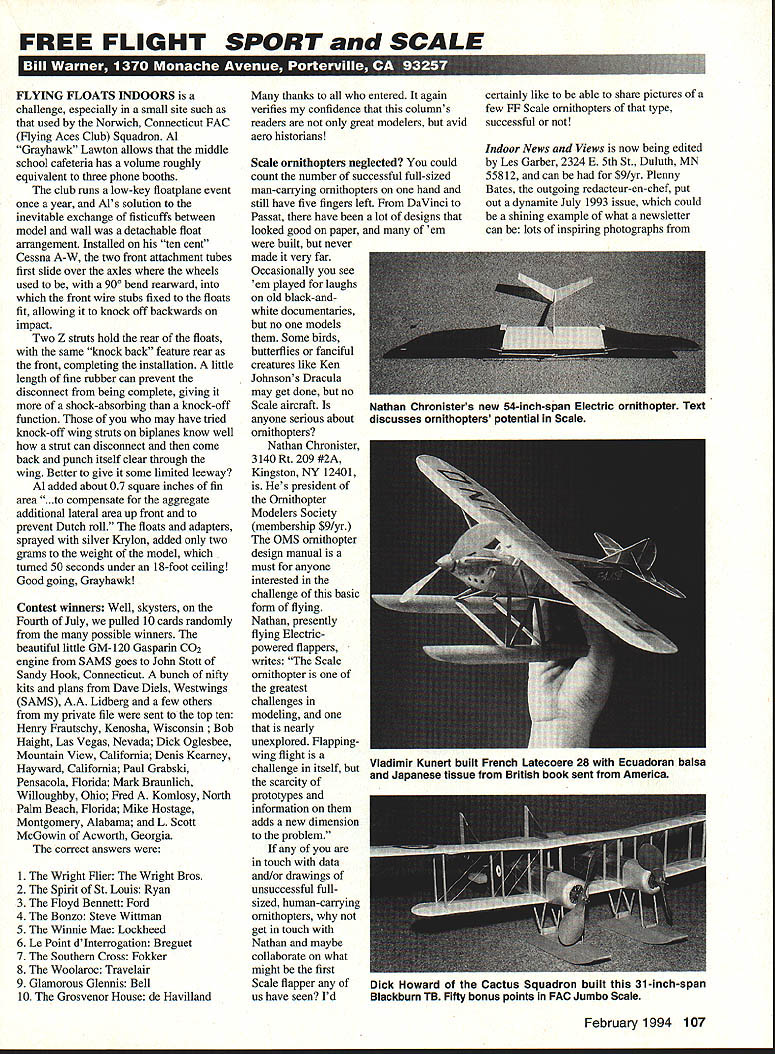
You could count the number of successful full-sized man-carrying ornithopters on one hand and still have fingers left. From Da Vinci to Passat, there have been many designs that looked good on paper; many were built but never made it very far. Occasionally you see them played for laughs on old black-and-white documentaries, but no one models them. Some birds, butterflies or fanciful creatures like Ken Johnson's "Dracula" may get done, but few Scale aircraft. Is anyone serious about ornithopters?
Nathan Chronister 3140 Rt. 209 #2A, Kingston, NY 12401
Nathan is president of the Ornithopter Modelers Society (membership $9/yr). The OMS ornithopter design manual is a must for anyone interested in this basic form of flying. Nathan, presently flying electric-powered flappers, writes: "The Scale ornithopter is one of the greatest challenges in modeling, and one that is nearly unexplored. Flapping-wing flight is a challenge in itself, but the scarcity of prototypes and information on them adds a new dimension to the problem."
If you have data or drawings of unsuccessful full-sized human-carrying ornithopters, contact Nathan — maybe collaborate on what might be the first Scale flapper any of us have seen. I'd certainly like to share pictures of a few FF Scale ornithopters of that type, successful or not!
Indoor News & Views
Indoor News & Views is now being edited by Les Garber, 2324 E. 5th St., Duluth, MN 55812, and can be had for $9/yr. Plenny Bates, the outgoing editor-in-chief, put out a dynamite July 1993 issue, which could be a shining example of what a newsletter can be: lots of inspiring photographs from the Indoor Champs, plus how to take those kinds of shots, plans, hints, sources, etc.
Caveat emptor — check your kits
Bob Lopshire, back in Gainesville, Florida, recently bought a kit from an established company (not the one known for using 40-lb. balsa), and found the printwood was 10% over the plan sizes. As he was already well into the project by the time he discovered this, he was understandably perturbed. There were also many parts missing.
The moral: spend a few minutes checking any kit for matching sizes and completeness before starting. Scratch-building from plans is an alternative, but even then you may find rib patterns that do not match the wing plan (usually too short). If you have wrong-size die-cut parts, you are grounded. If you are cutting your own ribs, you can always make them a little long and trim the trailing edges to fit as they are installed.
Cottage industries list and materials
For those having a tough time finding suppliers of materials, tools, information, plans, clubs, etc. for FF Scale, the daily-updated annotated cottage industries list I put out as a non-profit service now has nearly 200 listings. My opinions of the ones I have dealt with may be of some use. You can get a copy for a large SASE (with 52 cents postage) and a dollar to cover postage. Send to:
Barry J. Berman 1375 N. Broadway, E-6, Escondido, CA 92026
Barry has carbon fiber "tow" (like yarn) — about ten yards with lots of little hairlike fibers that add strength where they are stuck on. For a buck and a few cents, it's a bargain. He also has drawings for the Boeing 80 (highly detailed with views, construction, interior, marking and color schemes — interior and exterior). Plan measures 18 x 84 inches. $10 postpaid.
Cure for depression — new book
Bill Hannan's latest book, Stick and Tissue 3, is probably the most exciting thing to come down the pike this year. If you can get it, buy it. It starts with an article and three-view of the Gee-Bee "Ascender" (ever wonder why so many canards got that same name?), follows with Emmanuel Fillon's plan for a rubber-powered Clément Ader Eole (which beat the Wrights into the air by 13 years), contains magnificent plans for a Peanut Comper Swift by Ken McDonough, a Peanut Moth ultralight from Germany, and a "cheaty-cheat" plastic/fiberglass flying wing. Uruguay's Ulises Alvarez gives advice on how to adjust an Indoor Scale model.
The book includes superb photographs ranging from the framework of Kaz Suzuki's (Japan) SR-71 rubber-powered ducted-fan model to Doug Mechard's compressed-air Waterman Aerobile. There are also one-page three-view drawings of 1924 Dietrich-Gobiet "flying fivers." You'll likely love this slick little book enough to buy two and lend one to make converts. Priced at $9.95.
Getting started in FF Scale
Each month I get letters from folks who are getting interested in what I like to think of as the hard core of our hobby: FF Scale. If I had to recommend just one place to get everything you need, it would be Peck-Polymers. Sandy Peck and her daughter Vera work hard to keep the latest stuff in stock — from beginners' books to building materials, from CO2 motors to FF Scale plans, from Zap to razor planes.
I can't imagine a more modeler-oriented supplier. Their catalog is $4.00.
Peck-Polymers P.O. Box 710399, Santee, CA 92072-0399
On kit pricing
Rubber Scale kits cost too much? A fellow complained about a rubber kit costing ten bucks. After talking to the manufacturer I found that after paying for materials, plan printing, boxing, labor, employee health plan, rent, phone, electricity, advertising, office and computer expenses, machinery to print the wood, etc., the firm was making less than twenty cents on each kit sold.
"The safe distance to stand from a winding motor is equal to the square of the knots in that motor." — Words of wisdom from Ken Sykora's 1930s model shop.
More on ornithopters (reprise)
Scale ornithopters remain neglected. Nathan Chronister (see above) remains active with OMS; membership $9/yr and the OMS ornithopter design manual is strongly recommended. Nathan is flying electric-powered flappers and stresses that Scale ornithopters are a nearly unexplored challenge due to both the difficulty of flapping-wing flight and the scarcity of prototypes and information.
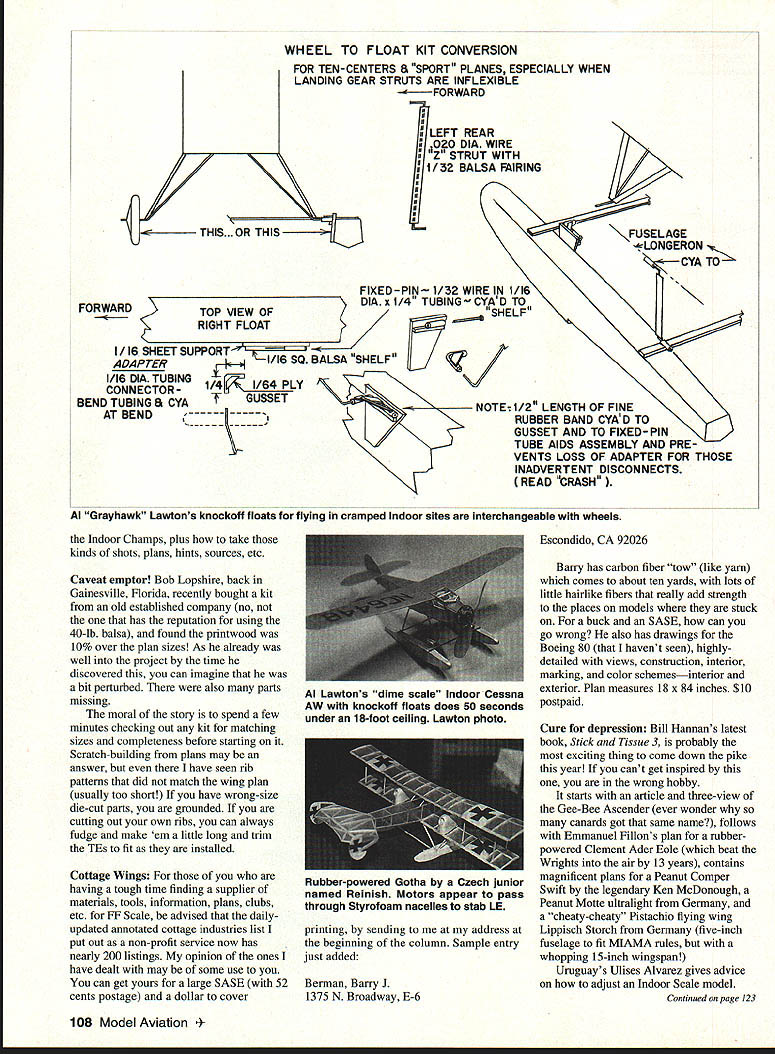
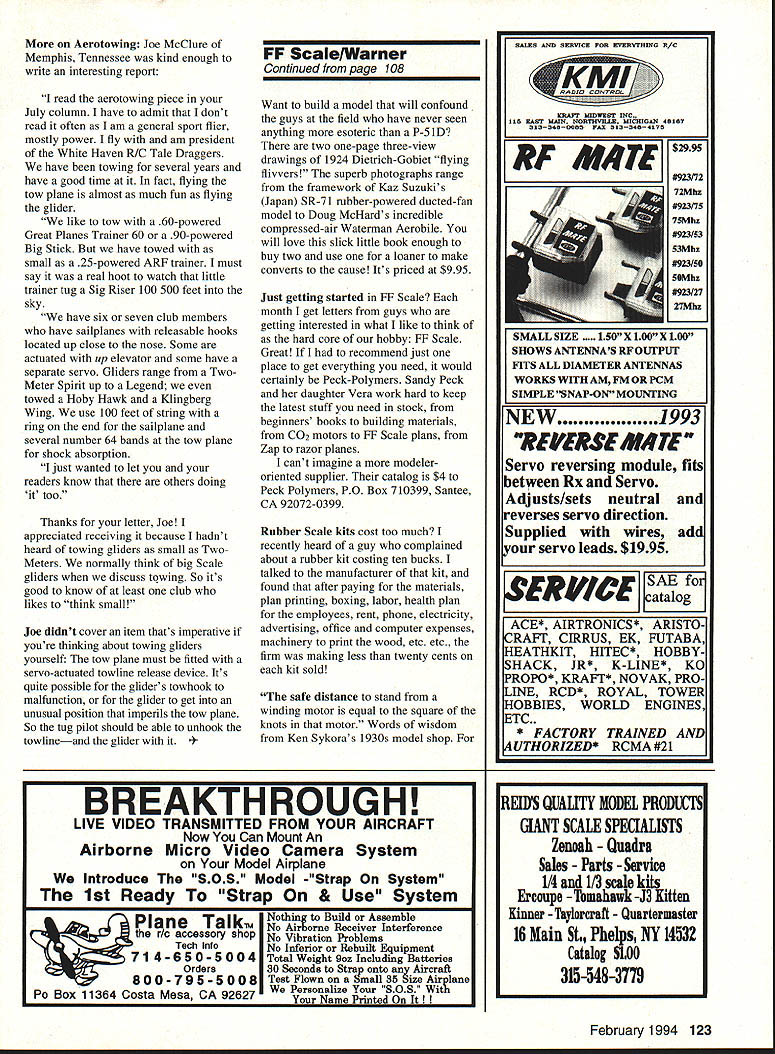
Nathan built a new 54-inch-span electric ornithopter; other builders have produced interesting Scale pieces: Vladimir Kunert built a French Latecoere 28 (Ecuadorian balsa, Japanese tissue); Dick Howard of the Cactus Squadron built a 31-inch-span Blackburn TBD. If you have relevant data, drawings, or photos, contact Nathan — we'd love to see and share examples.
Old-Timer plans and supplies
For a unique 1993 catalog of Old-Timer plans and supplies, send $2 to:
Old Timer Model Supply Box 7334, Van Nuys, CA 91409
It's always popular with club editors for the great Otto Kuhni clip-art type drawings they can use to jazz up newsletters.
Nose-heavy models — a recommendation
George Batiuk recently scaled down Henry Struck's old Nats-winning Caudron but ran into a problem on the leading edge of the wing, due to a plastic prop and plastic Williams Brothers cylinders. Jacking up the trailing edge of the stab didn't fix the problem. George plans to lighten the nose by using a carved balsa prop and balsa cylinders.
How many would simply add weight to the tail to move the CG rearward to about 33% of the chord? I prefer George's approach. Adding weight at the tail or nose can have serious side-effects if the model needs to recover from a stall. Keeping nose and tail light while centralizing weight gives the best flying stability.
Closing notes
Well, gang, until next time, keep the knots on those silicone-rubbed rubber motors safety-tied with thread, keep your rubber off the space heater, and observe National Use-Your-Winding-Tube Week.
Transcribed from original scans by AI. Minor OCR errors may remain.

