
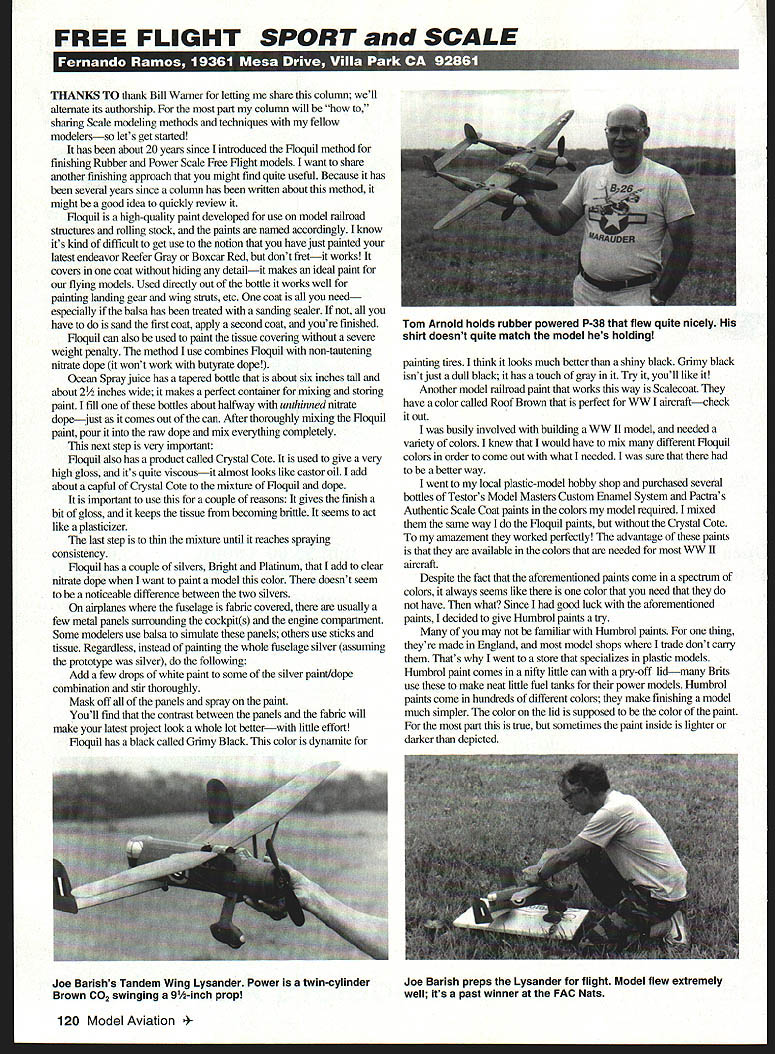
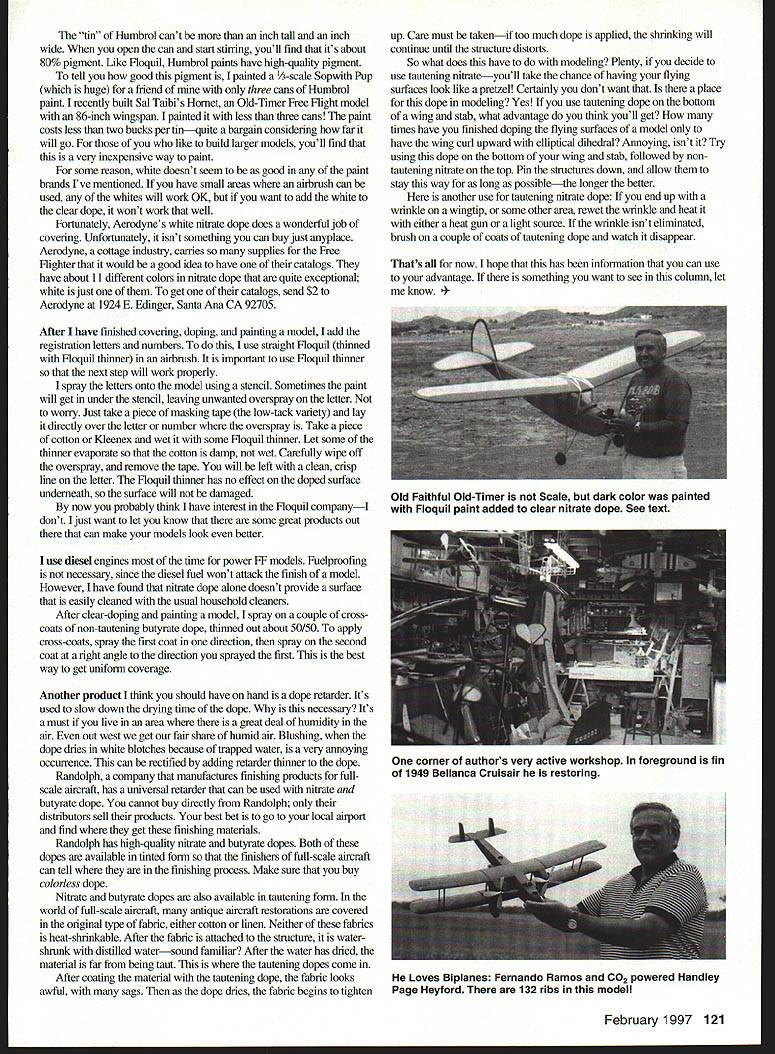
FREE FLIGHT SPORT and SCALE
Fernando Ramos 19361 Mesa Drive, Villa Park, CA 92861
Introduction
Thanks to Bill Warner for letting me share this column; we’ll alternate its authorship. For the most part my column will be “how to,” sharing scale modeling methods and techniques with my fellow modelers—so let’s get started!
It has been about 20 years since I introduced the Floquil method for finishing rubber- and power-scale free flight models. I want to share another finishing approach that you might find useful. Because it has been several years since a column has been written about this method, a quick review is in order.
Floquil method
Floquil is a high-quality paint developed for model railroad structures and rolling stock; the paints are named accordingly. It may feel odd to paint your latest endeavor Reefer Gray or Boxcar Red, but it works. Floquil covers in one coat without hiding detail, making it ideal for our flying models. Used directly from the bottle it works well for landing gear, wing struts, etc. One coat is often enough—especially if the balsa has been treated with a sanding sealer. If not, sand the first coat, apply a second coat, and you’re finished.
Floquil can also be used to paint tissue covering without a severe weight penalty. The method I use combines Floquil with non-tautening nitrate dope (it won’t work with butyrate dope).
Mixing Floquil with nitrate dope
I use a tapered Ocean Spray juice bottle (about six inches tall and 2½ inches wide) for mixing and storage. My mixing steps:
- Fill the bottle about halfway with unthinned nitrate dope (as it comes from the can).
- Thoroughly mix the Floquil paint, then pour it into the raw dope and mix completely.
- Add about a capful of Floquil Crystal Cote to the mixture.
This next step is very important: Crystal Cote gives the finish a bit of gloss and keeps the tissue from becoming brittle—acting somewhat like a plasticizer. The last step is to thin the mixture to spraying consistency.
Floquil has a couple of silvers, Bright and Platinum, that I add to clear nitrate dope when I want a silver finish. There doesn’t seem to be a noticeable difference between the two.
Silver panels on fabric-covered fuselages
On fabric-covered fuselages there are usually a few metal panels around the cockpit(s) and engine compartment. Instead of painting the whole fuselage silver (assuming the prototype was silver), try this:
- Add a few drops of white paint to some of the silver paint/dope combination and stir thoroughly.
- Mask off the panels and spray on the paint.
The contrast between the panels and the fabric makes the model look much better with little effort.
Tires and alternate paint lines
Floquil’s Grimy Black is excellent for tires; it’s not a flat black but has a touch of gray that looks more realistic than a shiny black.
Another model railroad paint line that works similarly is Scalecoat. Their Roof Brown is perfect for WW I aircraft—check it out.
Using Model Masters, Pactra, and Humbrol
While building a WWII model I needed a variety of colors and purchased Testor’s Model Masters Custom Enamel System and Pactra’s Authentic Scale Coat paints in appropriate colors. I mixed them the same way as Floquil paints (but without Crystal Cote) and they worked well. These paints are available in many colors suited to WWII aircraft.
If a needed color isn’t available there, try Humbrol paints. Humbrol, made in England, comes in small tins with many colors—often hundreds. The color printed on the lid is a guide but the paint inside can sometimes be lighter or darker. Humbrol tins are tiny and very pigment-rich—about 80% pigment. The coverage is excellent and the price economical; a little goes a long way, making Humbrol a good choice for larger models.
Whites and Aerodyne
White seems to be weaker in all the brands mentioned when mixed into clear dope. If you have small areas for an airbrush, any white will work, but adding white to clear dope often gives poor coverage.
Aerodyne’s white nitrate dope covers very well. Aerodyne offers about 11 different nitrate dope colors that are exceptional; white is one of them. They are a cottage industry and not widely stocked. To get a catalog, send $2 to Aerodyne, 1924 E. Edinger, Santa Ana, CA 92705.
Registration letters and stencil overspray cleanup
After covering, doping, and painting, I add registration letters and numbers using straight Floquil (thinned with Floquil thinner) in an airbrush. It’s important to use Floquil thinner so the next cleanup trick works properly.
If paint seeps under the stencil and leaves overspray:
- Lay a low-tack masking tape directly over the letter or number.
- Wet a piece of cotton or tissue with Floquil thinner, let some evaporate so it’s damp rather than wet.
- Carefully wipe off the overspray, then remove the tape.
The overspray will come off leaving a clean, crisp edge, and the Floquil thinner will not damage the doped surface underneath.
Final finishing: cross-coats and fuelproofing
I use diesel engines for power free flight models most of the time. Diesel fuel won’t attack the finish, so special fuelproofing isn’t necessary. However, nitrate dope alone doesn’t provide a surface that cleans easily with household cleaners.
After clear-doping and painting, spray on a couple of cross-coats of non-tautening butyrate dope thinned about 50/50. To apply cross-coats, spray the first coat in one direction, then spray the second coat at a right angle to the first. This gives uniform coverage.
Dope retarders and Randolph products
A dope retarder slows the drying time of dope and is essential in humid areas to prevent blushing (white blotches caused by trapped moisture). Randolph makes a universal retarder usable with both nitrate and butyrate dope. Randolph products are sold through distributors—check with local airports for suppliers.
Randolph also makes high-quality nitrate and butyrate dopes. These dopes are available tinted for full-scale finishing; for modeling, make sure you buy colorless dope.
Tautening vs non-tautening dope — modeling uses
In full-scale restorations, tautening dopes are used on cotton or linen that is not heat-shrinkable. After application the fabric tightens as the dope dries. If too much is applied, structure distortion can occur.
For modeling, using tautening nitrate dope on flying surfaces is risky—you can end up with warped control surfaces or elliptical dihedral. However, tautening dope has useful applications:
- Use tautening dope on the bottom of wings and stabs and non-tautening nitrate on the top. Pin the structures down and leave them pinned as long as possible. This helps counteract upward curling and preserves the intended airfoil shape.
- To remove a stubborn wrinkle (for example on a wingtip), wet the wrinkle and apply heat with a heat gun or lamp. If it remains, brush on a couple of coats of tautening dope and the wrinkle will disappear.
Closing
I hope this information is useful. If there’s something you’d like to see in this column, let me know.
Transcribed from original scans by AI. Minor OCR errors may remain.

