
FREE FLIGHT SPORT and SCALE
Bill Warner, 1370 Monache Avenue, Porterville CA 93257
It has been 20 years since I took up this column from my good friend Von Rottensox (Ralph Kuenz). Not only does time fly when one is having fun, but one tends to forget, in the never-ending search for new things to write, that many newcomers to Free Flight (FF) Scale were not reading what we wrote 10 or 15 years ago; a few useful hints might need to be repeated. After a good deal of thought about what I would like to know if I was starting this fascinating hobby again, I came up with these:
- Get your hands on the Cottage Wings resource guide, which lists almost everything you'll need to get into modeling. Get a beginner's book from one of the sources listed; the Bill McCombs and Don Ross books are must-haves.
- Stuff You Will Find Useful:
- Testors green-tube glue.
- An X-Acto #8 retractable-blade knife and single-edge razor blades.
- A sanding block with 100-grit garnet paper glued to it; 220-grit garnet paper for general fine sanding.
- Sewing pins.
- A piece of 1/2-inch Celotex wallboard on which to build.
- Saran Wrap to keep the plan and the model parts you are building separate.
- A Dremel Moto-Tool with thin cutoff wheels and needle-nose pliers.
- A 5-to-1 or 16-to-1 winder for rubber motors — essential for flying.
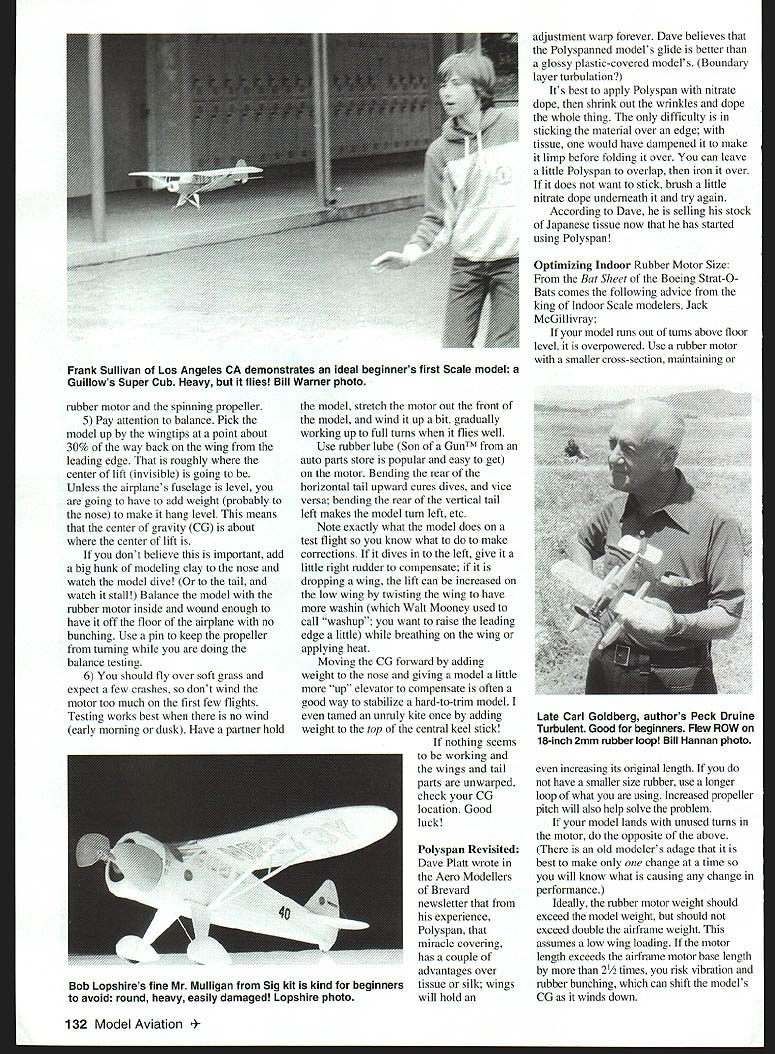
- Choose model subjects with an eye to flying ability. High-wing monoplanes with box fuselages fly well for beginners. A Lacey M-10 Peanut may be ugly, but it is a cinch to build and fly. (I once made one from a Peck kit and flew it indoors during a contest in less than 3½ hours.)
Go for models with a box fuselage; a light structure; a large horizontal tail and long nose with an inline engine design; a rubber motor position that extends about an equal distance in the fuselage from a point 1/3 of the way back from the wing's leading edge; and a large enough hole in the front of the fuselage to get a stretch-wound rubber motor back through. The nose plug assembly should be snug, yet easily removable for stretch-winding.
Get some experience with simple non-scale models before going to a more complicated scale aircraft.
- Build and fly without unwanted warps. On very light structures, preshrink your tissue by gluing it on a “picture frame” and spraying it with a water mist. Tissue already on a model should be shrunk with rubbing alcohol because the low percentage of water in it will shrink the tissue less than straight water. Use clear dope only, diluted 50% with thinner. Apply only one or two coats, using a non-tautening dope to prevent warps. Or add about nine drops per ounce of TCP (tricresyl phosphate) to your raw dope. Castor oil will work in a pinch, but sometimes blushes.
Sight underneath the flying surfaces or test on a flat surface, and remove any warps by steaming and twisting in the opposite direction of the warp.
A little wash-in (just noticeable) in the left wing (pilot's left) is okay; it gives extra lift to help counteract the torque of the wound rubber motor.
- Pay attention to balance. Pick the model up at the wingtips; the point about 30% of the way back from the wing leading edge is roughly the center of lift. If the airplane won't hang level, you'll have to add weight—probably in the nose—to make it hang level. Hanging level means the center of gravity (CG) is about at the center of lift. Don't believe anyone who says balance isn't important—add a big hunk of modeling clay to the nose and watch the model dive; if the tail stalls, adjust. Balance the model with the rubber motor inside and wound enough to have the propeller off the floor without bunching. Use a pin to keep the propeller turning during balance testing.
- You should fly over soft grass and expect a few crashes. Don't wind the motor too much on the first few flights. Testing works best with no wind—early morning or dusk. Have a partner hold the model, stretch the motor out in front of the model, and wind up a bit, gradually working up to full turns. Use rubber lube; "Son of Gun" from the auto parts store is popular and easy to get.
Bending the rear horizontal tail upward cures dives; vice versa, bending the rear vertical tail to the left makes the model turn left, etc. Note exactly what the model does on a test flight so you know what corrections to make. Dives left? Give a little right rudder to compensate. A dropping wing lift can be increased on a low wing by twisting the wing—Walt Mooney used to call it "wash-in"—you want to raise the leading edge a little by applying heat. Moving the CG forward by adding weight to the nose, giving the model a little up elevator, is often a good way to stabilize a hard-to-trim model. I tamed an unruly kite once by adding weight to the top of the central keel stick!
If nothing seems to be working and the wings and tail parts are unwarped, check your CG location. Good luck!
Polyspan Revisited
Dave Platt wrote in the Aero Modellers of Brevard newsletter that, from his experience, Polyspan, that miracle covering, has a couple of advantages over tissue or silk: wings will hold an adjustment warp forever. Dave believes that the Polyspanned model's glide is better than a glossy plastic-covered model's (boundary-layer turbulation?).
It's best to apply Polyspan with nitrate dope, then shrink out the wrinkles and dope the whole thing. The only difficulty is in sticking the material over an edge; with tissue, one would have dampened it to make it limp before folding it over. You can leave a little Polyspan to overlap, then iron it over. If it does not want to stick, brush a little nitrate dope underneath it and try again.
According to Dave, he is selling his stock of Japanese tissue now that he has started using Polyspan!
Optimizing Indoor Rubber Motor Size
From the Bat Sheet of the Boeing Strat-O-Bats comes the following advice from the king of indoor scale modelers, Jack McGillivray:
If your model runs out of turns above floor level, it is overpowered. Use a rubber motor with a smaller cross-section, maintaining or even increasing its original length. If you do not have a smaller size rubber, use a longer loop of what you are using. Increased propeller pitch will also help solve the problem.
If your model lands with unused turns in the motor, do the opposite of the above. (There is an old modeler's adage that it is best to make only one change at a time so you will know what is causing any change in performance.)
Ideally, the rubber motor weight should not exceed the model weight, but should not exceed double the airframe weight. This assumes a low wing loading. If the motor length exceeds the airframe motor base length by more than 2½ times, you risk vibration and rubber bunching, which can shift the model's CG as it winds down.
Trophies With Class
Even a blind sow can pick up a few acorns, and sooner or later most modelers wind up with a shelf of dust collectors known as trophies—often with plastic replicas of nondescript airplanes or golden-winged women on the top. (Medals and plaques are a nice change of pace and need less maintenance.)
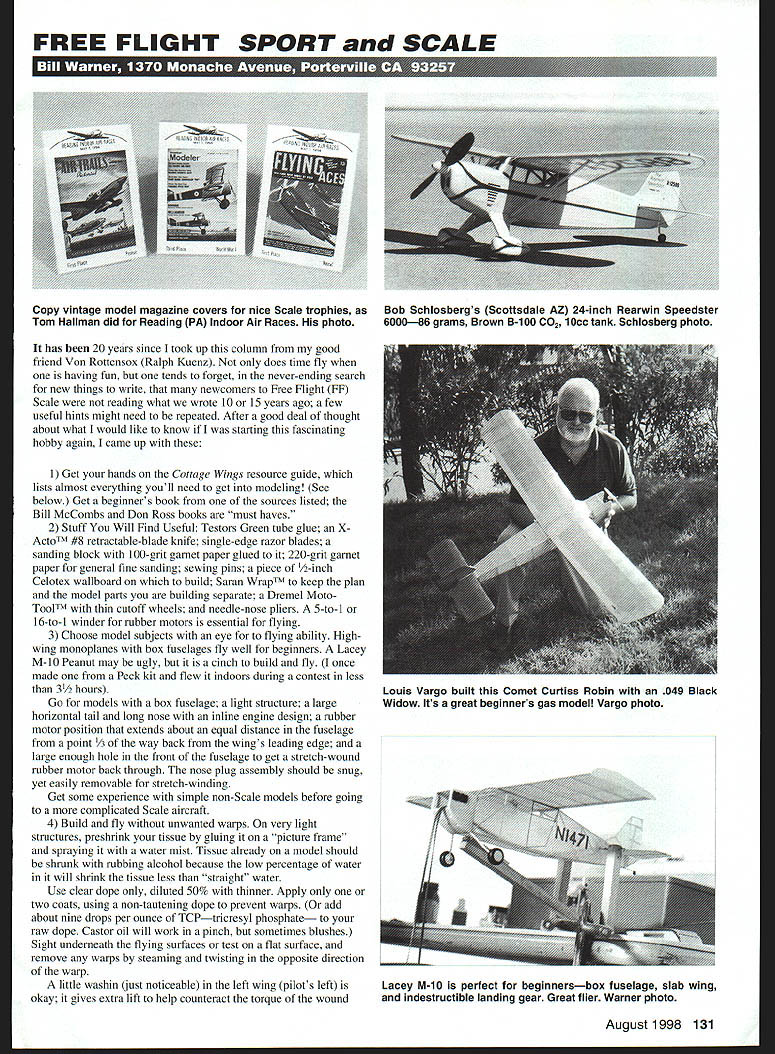
One of the nicest trophy treatments is incorporating a vintage model magazine cover: color copiers have made it possible to inexpensively reduce an image to any size. Coating one with resin on a wooden backing or sandwiching one in a frame makes for a trophy one can be proud to own and display.
Cottage Wings Resource Guide
Probably the most useful thing for any Free Flight scaler these days is knowing where to find the good stuff—materials, plans, good kits, documentation, clubs in your area, etc. You can get all of this information by obtaining a copy of Cottage Wings. Send a large self-addressed stamped envelope with two ounces of postage (55¢ in April) and $1.50 to cover printing costs to Carlo Godel, 2873 Unaweep Ave., Grand Junction, CO 81503. Having done this listing myself for a long time, I suggest sending him two dollar bills, which saves the hassle of checks and wrapping quarters. It's worth it!
Cottage Wings is a non-profit, oft-updated service to modelers, and contains comments on each product or service that may be useful. You'll find everything from a source for Polyspan and the books mentioned earlier, to addresses for the previously mentioned Aero Modellers of Brevard and Boeing Strat-O-Bats.
Well, until next time, remember to keep your rubber out of the sun and sand, don't overdo those long chases if you're older than 70, and help a kid get started in modeling this month!
Transcribed from original scans by AI. Minor OCR errors may remain.

