
FREE FLIGHT: SPORT and SCALE
Fernando Ramos 19361 Mesa Dr., Villa Park, CA 92861
Background on pendulums
A variety of pendulums can be used to give model airplanes more spiral stability. I’ll give a little background on pendulums and share where I got most of my knowledge and experience with them.
Those who have been in modeling as long as I have—50+ years—might remember the well-known British modeler P. E. Norman. He was a true exponent of the pendulum and used it to make his models do aerobatics. Spectators would stand back and marvel at how well his scale subjects flew.
This early pendulum consisted of a hanging weight that swung left or right for rudder control and fore-and-aft for elevator control. Sometimes it provided both, giving rudder and elevator control.
Early experiments and lessons learned
My first attempt was a pendulum that controlled rudder and elevator in a model of the Sopwith Tabloid on floats. The first time I hand-launched the aircraft, it dove into the ground. Fortunately, I was in a field of very tall grass. I fired up the engine again and tried another hand launch with similar results. Finally the light came on: as I ran to give the model a good heave, the mass had swung back, giving me down elevator. To overcome it I had to toss the model at about a 45° angle. That helped, but the overall flight still wasn't satisfactory. A ROW (rise-off-water) launch would have been helpful, but no water was available.
At about the same time, Jack McCracken had built a beautiful 1-inch = 1-foot Staggerwing Beechcraft with zero dihedral in the wings. He had a vertical pendulum installed for rudder control. We test-flew his aircraft in a field with very tall grass. At first the model went into a pretty tight left turn; then, as it built up speed, the turn became steeper and steeper until it spiraled into the grass. There was no damage to the model.
We concluded that as the speed increased and the Staggerwing tightened the turn, centrifugal force caused the mass to swing to the outside of the turn, producing more of the unwanted turn.
One Saturday morning Jack and I went for a nice ride in my then-new Marquart Charger biplane. We landed in Hemet, CA, where there is quite a bit of sailplane activity. Jack handed me a small plywood board with three different pendulum arrangements and asked me to hold it while he got out. While flying, he held the board up against the instrument panel and watched each configuration, particularly in a turn.
The vertical pendulum did nothing in a coordinated turn; it just hung there. The other two arrangements were Jack’s innovation: they angled back and down and swung in an arc left to right. The only difference between those two was that one’s axis was vertical to the bulkhead it was mounted on and the other’s axis was angled back about 10°. The latter was more sensitive, and Jack decided on it for his Staggerwing.
After a couple of weeks with the new pendulum added to the Staggerwing, we returned to the field with tall grass. It worked extremely well. There was still a rather steep bank in the turn, but the pendulum kept it safe. The model was most impressive during the glide: it would go into a bank and the pendulum would pull it out. Remember—no dihedral. The position of the mass made the difference: since the pendulum was angled downward, in a bank centrifugal force had no effect because it would have to overcome gravity. Jack was a sharp and excellent model builder.
Putting pendulums into practice
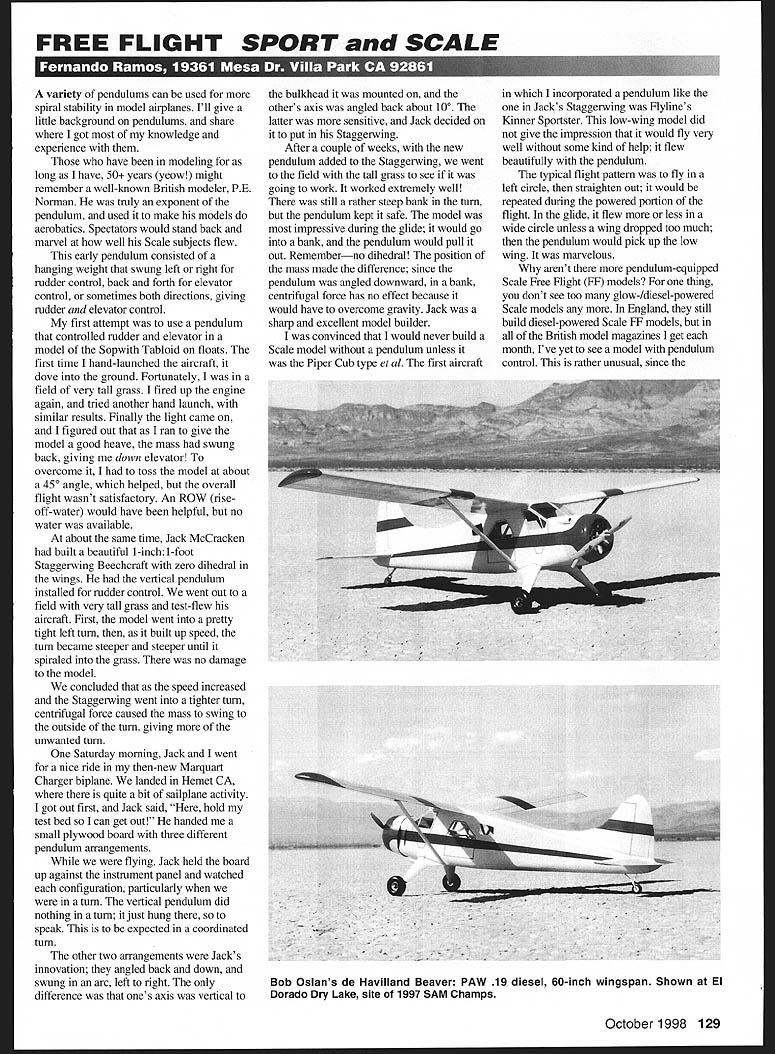
I was convinced I would never build another scale model without a pendulum unless it was a Piper Cub or another high-wing design with ample dihedral. The first aircraft in which I incorporated a pendulum like Jack’s was Flyline’s Kinner Sportster. This low-wing model did not look like it would fly well without some help; with the pendulum it flew beautifully.
Typical flight pattern: fly in a left circle, then straighten out; repeat during the powered portion of the flight. In the glide it tended to fly in a wide circle unless a wing dropped too much, in which case the pendulum picked up the low wing. It was marvelous.
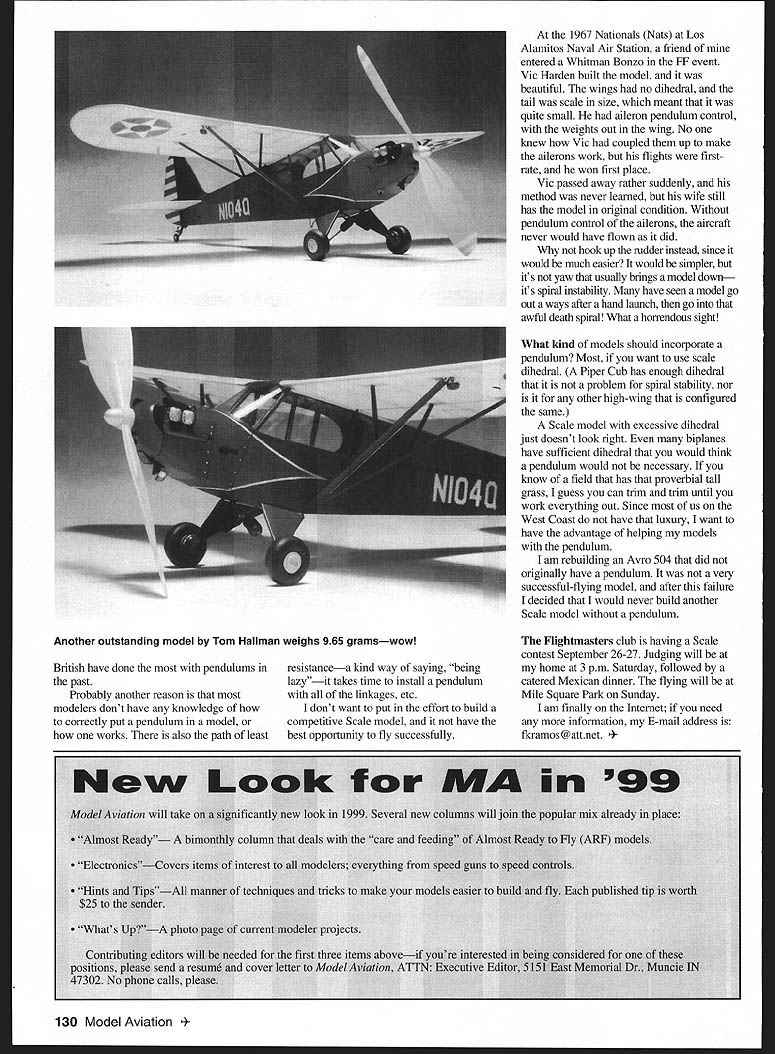
At the 1967 Nationals (Nats) at Los Alamitos Naval Air Station, a friend entered a Whitman Bonzo in the free-flight event. Vic Harden built the model and it was beautiful. The wings had no dihedral and the tail was scale in size (quite small). He had aileron pendulum control, with the weights out in the wing. No one knew how Vic had coupled them up to make the ailerons work, but his flights were first-rate and he won first place. Vic passed away rather suddenly and his method was never learned, but his wife still has the model in original condition. Without pendulum control of the ailerons, the aircraft never would have flown as it did.
Why aren’t there more pendulum-equipped scale free-flight models?
- There are far fewer glow- and diesel-powered scale models today. In England they still build diesel-powered scale free-flight models, but in the British model magazines I receive I’ve yet to see a model with pendulum control, which is unusual because the British did the most with pendulums in the past.
- Many modelers lack knowledge of how to correctly install or tune a pendulum or how one works.
- Installation takes effort—linkages, mounting, and adjustments—which many modelers avoid (the path of least resistance).
I don’t want to put in the effort to build a competitive scale model and not give it the best opportunity to fly successfully.
Why not hook the rudder up instead? It would be simpler, but it’s not yaw that usually brings a model down—it’s spiral instability. Many have seen a model go out a ways after a hand launch and then go into that awful death spiral.
Which models should incorporate a pendulum?
Most models that aim to use scale dihedral. A Piper Cub has enough dihedral for spiral stability, and other similar high-wing designs are fine without a pendulum. A scale model with excessive dihedral just doesn’t look right, and many biplanes have little dihedral yet still need help. If you have a field with that proverbial tall grass you might be able to trim and trim until you work everything out, but since most of us on the West Coast don’t have that luxury, I prefer to give my models the advantage of a pendulum.
I am rebuilding an Avro 504 that did not originally have a pendulum. It was not a very successful-flying model, and after that failure I decided I would never build another scale model without a pendulum.
Events and contact
The Flightmasters club is having a scale contest September 26–27. Judging will be at my home at 3 p.m. Saturday, followed by a catered Mexican dinner. Flying will be at Mile Square Park on Sunday.
If you need any more information, I am finally on the Internet: fkramo@att.net.
Transcribed from original scans by AI. Minor OCR errors may remain.

