
Free Flight: Sport and Scale
Bill Warner, 1370 Monache Ave., Porterville CA 93257
Advice for Newcomers
Follow Aristotle's advice. Okay, you've decided to build a Free Flight (FF) Scale model, but you can't decide what size is best to start with, or how heavy to make it. Follow Aristotle's advice and seek the Golden Mean.
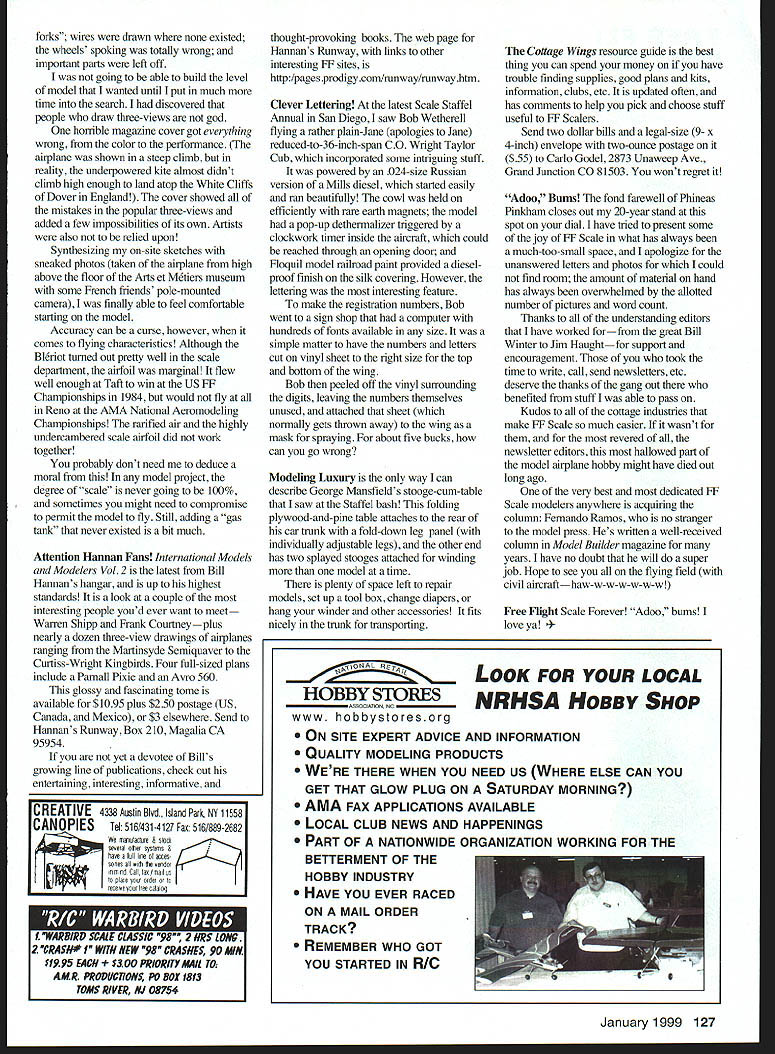
A model of about 36 inches is ideal for FF Scale. It's a nice compromise between huge crowd-drawing models, such as Don Munn's giant rubber-powered racers (which require special logistics to build, transport, and store), and the wee eight-inch-span Pistachios, which tax building fingers and sometimes get sat upon.
The best advice for someone starting out in FF Scale is to blow up that Peanut plan or reduce that Jumbo plan to the magic 36-inch span (give or take a few inches). If you can build it to weigh:
- less than four ounces (rubber-powered), or
- less than 16 ounces (gas or electric),
you are almost guaranteed success in the air!
The Search for Truth
Searching for true scale can be frustrating, and sometimes finding it can be dangerous. From the time I saw my first Blériot XI, I knew that I would have to build one! It had an ancient feel, and the complicated shock-absorbing crosswind landing gear fascinated me.
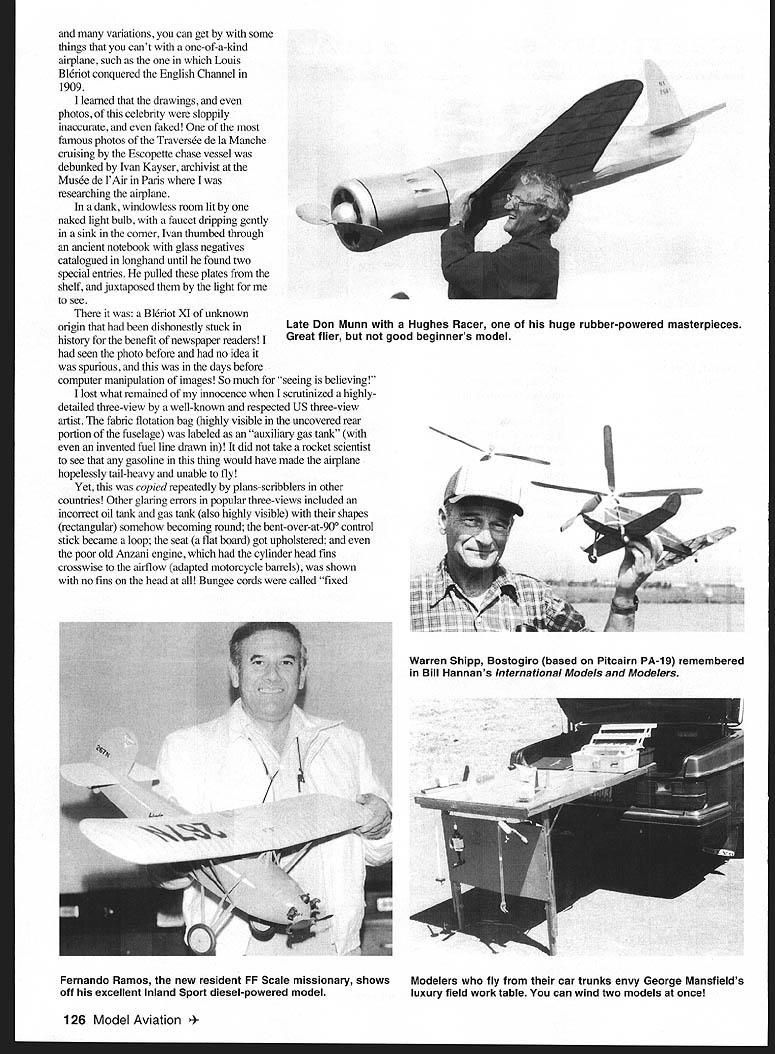
I made an indoor model of the Blériot XI, which did quite well, so I decided to go for broke and do an outdoor gas model. It took 20 years to get the available information straightened out, and the quest for this elusive grail of "true scale" led me to some interesting discoveries.
When you build a generic model, where there was a production run and many variations, you can get by with some liberties that you can't with a one-of-a-kind airplane, such as the one in which Louis Blériot conquered the English Channel in 1909.
I learned that the drawings, and even photos, of this celebrity were sloppily inaccurate, and sometimes faked. One of the most famous photos of the Traversée de la Manche cruising by the Escopette chase vessel was debunked by Ivan Kayser, archivist at the Musée de l'Air in Paris, where I was researching the airplane.
In a dank, windowless room lit by one naked light bulb, with a faucet dripping gently into a sink in the corner, Ivan thumbed through an ancient notebook of glass negatives catalogued in longhand until he found two special entries. He pulled these plates from the shelf and juxtaposed them by the light for me to see.
There it was: a Blériot XI of unknown origin that had been dishonestly stuck in history for the benefit of newspaper readers! I had seen the photo before and had no idea it was spurious, and this was in the days before computer manipulation of images. So much for "seeing is believing!"
I lost what remained of my innocence when I scrutinized a highly detailed three-view by a well-known and respected U.S. three-view artist. The fabric flotation bag (highly visible in the uncovered rear portion of the fuselage) was labeled as an "auxiliary gas tank" (with even an invented fuel line drawn in)! It did not take a rocket scientist to see that any gasoline in this thing would have made the airplane hopelessly tail-heavy and unable to fly.
Yet this was copied repeatedly by plans-scribblers in other countries. Other glaring errors in popular three-views included an incorrect oil tank and gas tank (also highly visible) whose shapes (rectangular) somehow became round; the bent-over-at-90° control stick became a loop; the seat (a flat board) got upholstered; and even the poor old Anzani engine, which had the cylinder-head fins crosswise to the airflow (adapted motorcycle barrels), was shown with no fins on the head at all! Bungee cords were called "fixed."
I was not going to be able to build the level of model that I wanted until I put in much more time into the search. I had discovered that people who draw three-views are not god.
One horrible magazine cover got everything wrong, from the color to the performance. The airplane was shown in a stupor climb, but in reality the unpowered kite almost didn't climb high enough to land atop the White Cliffs of Dover. The cover showed all of the mistakes in the popular three-views and added a few impossibilities of its own. Artists were also not to be relied upon.
Synthesizing my on-site sketches with sneaked photos (taken of the airplane from high above the floor of the Arts et Métiers museum with a French friend's pole-mounted camera), I was finally able to feel comfortable starting on the model.
Accuracy can be a curse, however, when it comes to flying characteristics. Although the Blériot turned out pretty well in the scale department, the airfoil was marginal. It flew well enough at Taft to win the USFF Championships in 1984, but would not fly at all in Reno at the AMA National Aeromodelling Championships. The rarified air and the highly undercambered scale airfoil did not work together.
You probably don't need me to deduce a moral from this. In any model project, the degree of "scale" is never going to be 100%, and sometimes you must compromise to permit the model to fly. Still, adding a "gas tank" that never existed is a bit much.
Attention Hannan Fans!
International Models and Modelers Vol. 2 is the latest from Bill Hannan's hangar, and is up to his highest standards! It is a look at a couple of the most interesting people you'd ever want to meet—Warren Shipp and Frank Courtney—plus nearly a dozen three-view drawings of airplanes ranging from the Martinsyde Semiquaver to the Curtiss-Wright Kingbirds. Four full-sized plans include a Parnall Pixie and an Avro 560.
This glossy and fascinating tome is available for $10.95 plus $2.50 postage (U.S., Canada, and Mexico), or $3.00 elsewhere. Send payment to Hannan's Runway, Box 210, Magalia CA 95954.
If you are not yet a devotee of Bill's growing line of publications, check out his entertaining, interesting, informative, and thought-provoking books. The web page for Hannan's Runway, with links to other interesting FF sites, is http://pages.prodigy.com/runway/runway.htm.
Clever Lettering!
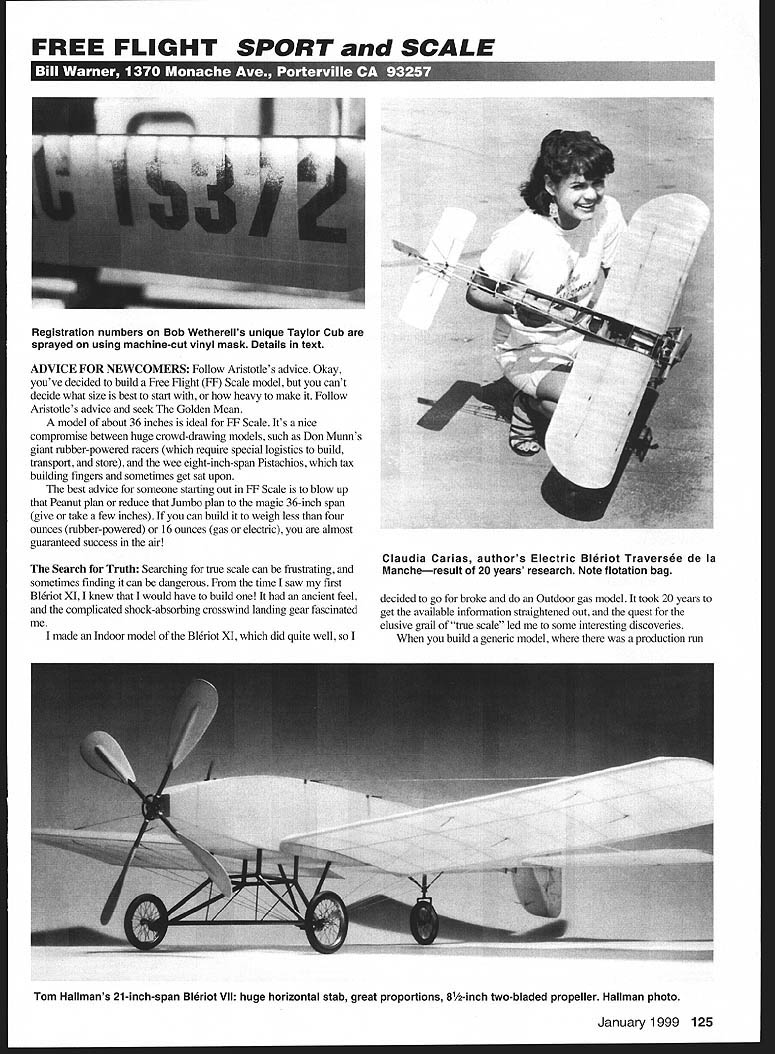
At the latest Scale Staffel Annual in San Diego, I saw Bob Wetherell flying a rather plain-Jane (apologies to Jane) reduced-to-36-inch-span C.O. Wright Taylor Cub, which incorporated some intriguing features. It was powered by an .024-size Russian version of a Mills diesel, which started easily and ran beautifully. The cowl was held on efficiently with rare-earth magnets; the model had a pop-up dethermalizer triggered by a clockwork timer inside the aircraft, which could be reached through an opening door; and Floquil model-railroad paint provided a diesel-proof finish on the silk covering. However, the lettering was the most interesting feature.
Bob's process:
- He went to a sign shop that had a computer with hundreds of fonts available in any size.
- He had the numbers and letters cut on vinyl sheet to the right size for the top and bottom of the wing.
- Bob peeled off the vinyl surrounding the digits, leaving the numbers themselves in place, and attached that sheet (which normally gets thrown away) to the wing as a mask for spraying.
For about five bucks, how can you go wrong?
Modeling Luxury
Modeling luxury is the only way I can describe George Mansfield's stool-cum-table that I saw at the Staffel bash. This folding plywood-and-pine table attaches to the rear of his car trunk with a fold-down leg panel (with individually adjustable legs), and the other end has two splayed stools attached for winding more than one model at a time.
There is plenty of space left to repair models, set up a toolbox, change diapers, or hang your winder and other accessories. It fits nicely in the trunk for transporting.
The Cottage Wings Resource Guide
The Cottage Wings resource guide is the best thing you can spend your money on if you have trouble finding suppliers, good plans and kits, information, clubs, etc. It is updated often and has comments to help you pick and choose items useful to F/F scalers.
Send two dollar bills and a legal-size (9 x 4-inch) envelope (with two-ounce postage on it) to G. C. Gould, 2873 Unawap Ave., Grand Junction CO 81503. You won't regret it!
"Adoo," Bums!
"Adoo," bums! The fond farewell of Phineas Pinkham closes out my 20-year stand at this spot on your dial. I have tried to present some of the joy of FF Scale in what has always been a much-too-small space, and I apologize for the unanswered letters and photos for which I could not find room; the amount of material on hand has always been overwhelmed by the allotted number of pictures and word count.
Thanks to all of the understanding editors that I have worked for—from the great Bill Winter to Jim Haught—for support and encouragement. Those of you who took the time to write, call, and send letters deserve the thanks of the gang out there who benefit from the stuff I was able to pass on.
Kudos to all of the cottage industries that make FF Scale so much easier. If it wasn't for them, and for the most revered of all, the newsletter editors, this most hallowed part of the model airplane hobby might have died out long ago.
One of the very best and most dedicated FF Scale modelers anywhere is Fernando Ramos, who is no stranger to the model press. He's written a well-received column in Model Builder magazine for many years. I have no doubt that he will do a super job. Hope to see you all on the flying field (with civil aircraft—haw-w-w-w-w-w!).
Free Flight Scale forever! "Adoo," bums! I love ya!
Transcribed from original scans by AI. Minor OCR errors may remain.

