

FREE FLIGHT SPORT and SCALE
Fernando Ramos
19361 Mesa Dr., Villa Park, CA 92861
Happy New Year / Intro
Happy New Year! I hope you had a wonderful holiday season. It is hard to believe that 1999 is here, and 2000 is just around the corner.
This is my first column since Bill Warner's retirement. I had promised a follow-up to the pendulum, but because of time constraints and the holidays I was unable to complete the work needed to make pendulum construction an easier task. I am building a Sopwith Camel. The fuselage is framed, and it will have a pendulum. As I assemble different parts to the system, I plan to photograph them so you can see how the pendulum is made and installed. I will definitely have this done for the next column.
Last summer I went to England for the first time. I want to share some wonderful experiences I had and give you a perspective on British free-flight (FF) scale.
Travel and arrival
A former student of mine married an Englishman and is living in Great Britain. She invited me to stay with them anytime the opportunity arose, and in August I got the chance to go; flying models at Old Warden (home of the phenomenal Shuttleworth collection of flying machines) and Middle Wallop was the underlying reason.
I traveled with Jim Adams. Our flight left LAX (Los Angeles International Airport) at about 1:15 a.m., connected in Dallas and Chicago, and finally on to London. When we arrived (about 11 p.m. local time), we learned our luggage and models had not arrived with us. We didn't get them until 7 p.m. the next day.
I went shopping with my hostess and found a bank to exchange dollars for pounds. I handed the man $500 and received about 350 pounds; the exchange rate was roughly $1.74 to one pound and I was charged five pounds for the service. I eventually learned it is best to use a credit card, because the typical exchange rate is about $1.50 to one pound. I left my traveler's checks in my pocket. I also discovered that the cost of living in the U.K. is very high; a trip to the grocery store was quite an eye-opener.
Old Warden
I spent my first weekend at Old Warden, where I met my good friend and modeler Charlie Newman. I couldn't believe what I saw: a beautiful grass strip (T-shaped) and old-time hangars where Shuttleworth stores its aircraft museum. The museum closes the field for two days to let modelers sport-fly to their hearts' content.
There are some differences between what I saw there and what I see at my local flying site:
- Most modelers brought their families; many youngsters flew and chased models for their dads.
- People brought picnic lunches and ate between flights.
- The majority of power models were diesel-powered and many were scale-type rather than the competition models you often see.
- Glow engines were uncommon; Jetex-powered scale types were well represented and flew very well.
- A large group of rubber-powered models ranged from scale to Old-Timer.
- Radio-control pilots largely kept to one end of the field.
Vendors sold items I had never seen in the U.S.; mouth-watering displays. Sam's, a British modeling supplier, had a large tent packed with goodies.
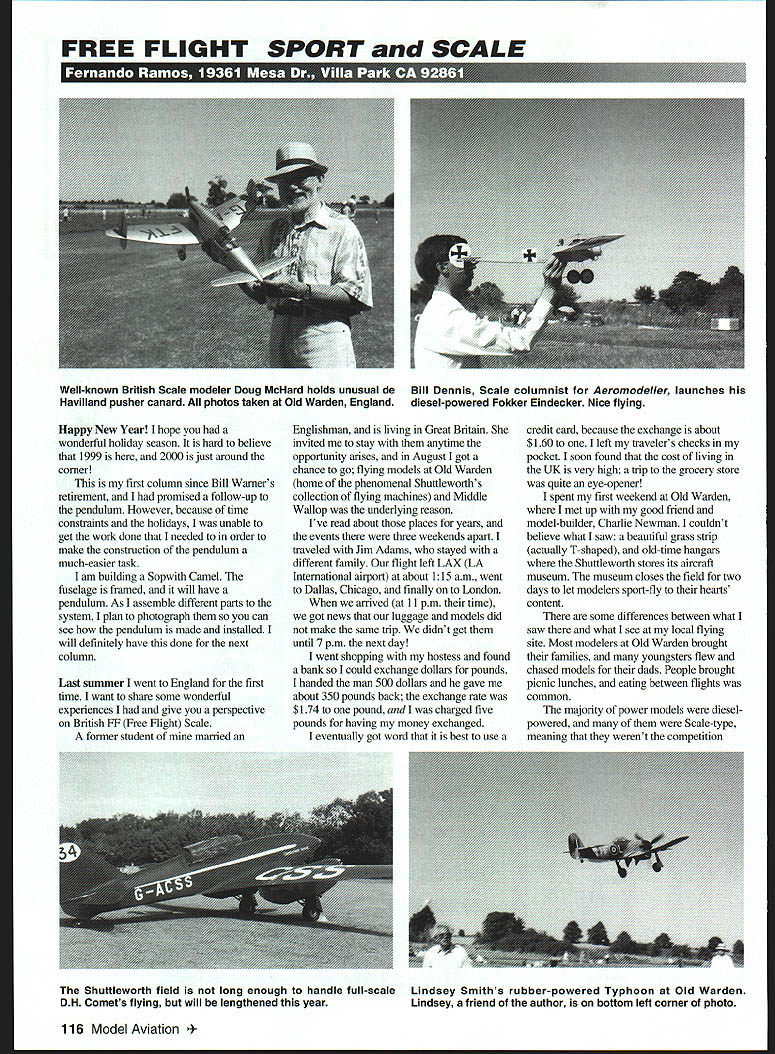
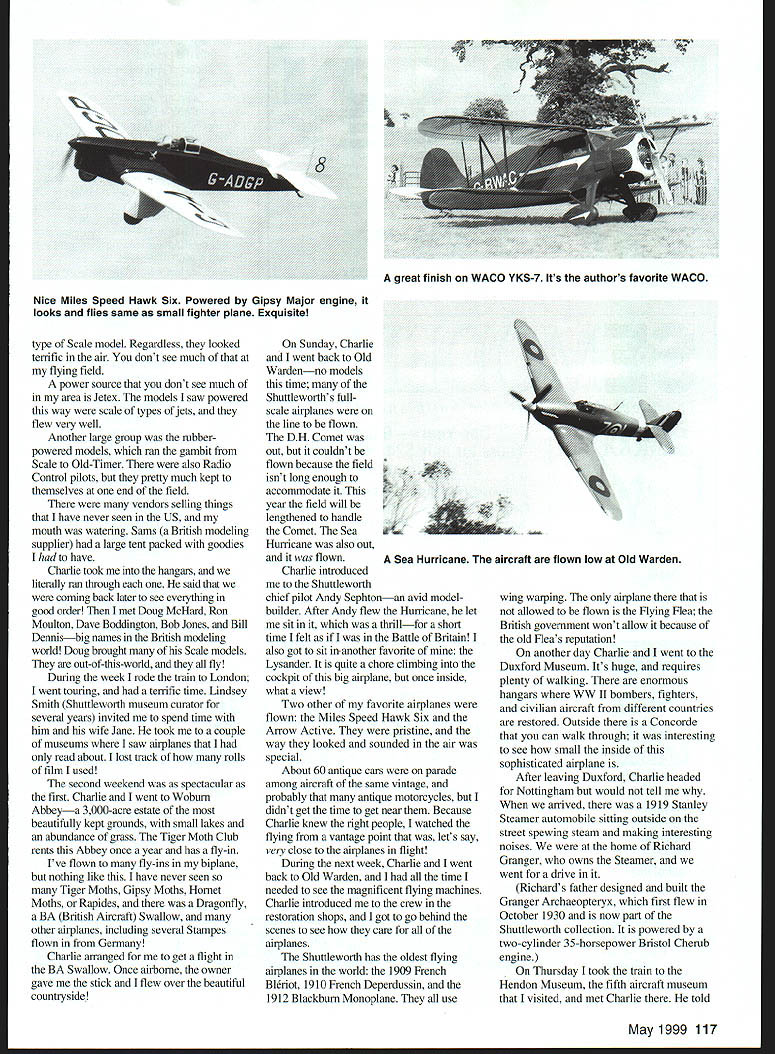
Charlie took me through the hangars. I literally ran through, saying I was "coming back later to see everything." I met Doug McHard, Ron Moulton, Dave Boddington, Bob Jones, Bill Dennis—big names in the British modeling world. Doug brought scale models that were out of this world in appearance and flight.
London and museums
During the week I rode the train to London and spent time touring. Lindsey Smith, Shuttleworth museum curator for several years, invited me to spend time with him and his wife Jane. They took me to a couple of museums where I saw airplanes I had read about and lost track of my rolls of film.
I visited several museums while in England:
- Shuttleworth restoration shops (behind the scenes) — I saw how they care for the airplanes and learned they have some of the oldest flying aircraft in the world, including a 1909 French Blériot, a 1910 French Deperdussin, and the 1912 Blackburn Monoplane. They all use wing warping. The only airplane not allowed to fly is the Flying Flea; the British government will not allow it because of its reputation.
- Duxford Museum — huge, with enormous hangars where WWII bombers, fighters, and civilian aircraft are restored; outside there is a Concorde you can walk through.
- Hendon Museum — another magnificent collection; seeing an Avro Lancaster in beautiful shape was a highlight, as was the Bristol Beaufighter.
Woburn Abbey and Shuttleworth flying
The second weekend was spectacular. First, Charlie and I visited Woburn Abbey, a 3,000-acre estate with beautifully kept grounds, small lakes, and abundant grass. The Tiger Moth Club rents the Abbey once a year for a fly-in. I've been to fly-ins in biplanes; nothing like this. I had never seen so many of these types of aircraft:
- Tiger Moths and Gipsy Moths
- Hornet Moths
- Rapides
- Dragonfly
- BAe Swallows
- Stampes (several flown in from Germany)
Charlie arranged a flight for me in a BAe Swallow. Once airborne the owner gave me the stick and I flew over the countryside.
On Sunday we returned to Old Warden (no models that day). Shuttleworth's full-scale airplanes were lined up. The de Havilland Comet couldn't be flown because the field wasn't long enough; the field will be lengthened this year to accommodate the Comet. The Sea Hurricane was also out.
Charlie introduced me to Shuttleworth chief pilot Andy Sephton—an avid model-builder. After Andy flew the Hurricane, he let me sit in it, which was a thrill; for a short time I felt as if I was in the Battle of Britain. I also got to sit in a Lysander. It's quite a chore to climb into the cockpit of this airplane, but once inside the view is fantastic.
Two other favorites on display were the Miles Speed Hawk Six and the Arrow Active. They were pristine, and the way they looked and sounded in the air was special.
About 60 antique cars paraded among aircraft of the same vintage, along with more than 100 vintage motorcycles. Because Charlie knew the right people, I watched flying from a vantage point very close to the airplanes in flight.
Duxford, Nottingham and the Stanley Steamer
On another day Charlie and I went to the Duxford Museum. It's huge and requires plenty of walking. There are enormous hangars where WWII bombers, fighters, and civilian aircraft from different countries are restored. Outside the hangars is a Concorde you can walk through; it was interesting to see how small the inside of this sophisticated airplane is.
After leaving Duxford, Charlie headed for Nottingham. When we arrived, a 1919 Stanley Steamer was sitting outside on the street; it was steaming and making interesting noises. We were at the home of Richard Granger, who owns the Steamer and had it out for a show and a drive.
Note: Richard's father designed and built the Granger Arachnopteryx, which first flew in October 1930 and is now part of the Shuttleworth collection. It is powered by a two-cylinder 35-horsepower Bristol Cherub engine.
Hendon, Middle Wallop and FF Scale
On Thursday I took the train to the Hendon Museum and met Charlie there. He joked that he was going to "museum me out"—and he nearly did!
The aircraft at Hendon are magnificent. Seeing an Avro Lancaster in such beautiful shape almost stopped my heart; it's my favorite WWII bomber. The Bristol Beaufighter was another heartstopper.
Friday was the first day of flying at Middle Wallop; however, my hostess had arranged to go to an opera at Glyndebourne in East Sussex, and I went with her (I love opera).
Saturday was my first day at Middle Wallop. Envision a roughly half-mile-square manicured lawn; it was like being on a gigantic golf course. One fly in the ointment was that the wind was blowing pretty hard and the drift was off the field.
Many vendors sold neat stuff from the trunks of their cars. I was almost out of pounds, otherwise I would have needed another suitcase to bring goodies home. There were many people to meet and interesting old-time models; I was awestruck.
Sunday was scheduled for FF Scale and I had hoped to fly my Avro 504, but it rained. That was the first time during my trip that the weather was lousy, and on that day I was scheduled to fly my model. Fortunately, Lindsey had a tent where we spent many hours visiting with modelers from across the UK and Europe.
I headed home on Monday.
Final thoughts
I am grateful to the many friends who made this trip exceptional, and to the weather, which was wonderful about 97% of the time. (Charlie was quick to point out that I did not experience typical British weather.) If you can ever make this trip, do it!
This wasn't a typical column of mine. I want this to become a how-to column that will be beneficial when you build your scale models. Any questions or input you have can be sent by E-mail: fkramors@att.net. Photographs of your scale models are most welcome.
Transcribed from original scans by AI. Minor OCR errors may remain.

