
FREE FLIGHT SPORT and SCALE
Fernando Ramos 19361 Mesa Dr., Villa Park, CA 92861 E-mail: fkramos@att.net
I am going to expound on the virtues of diesel engines for model airplanes.
I am a real fanatic about diesel engines. I have somewhere in the neighborhood of 150 of them in all sizes, ranging from the smallest, of .008 cubic inch (cu. in.), to a .60 size that I use for Radio Control (RC), which I fly occasionally.
The range of diesel engines available, particularly to Free Flight (FF), is extensive. A slew of them are in the .035- to .09-cu. in. range, and can be purchased easily. This assortment is ideal for FF Scale, or for sport models.
In the Old-Timer movement, many diesels are used for Class A competition, since small ignition engines are hard to find. There is also quite a range of diesel engines that are equipped with a throttle for RC operation.
Why use a diesel rather than the old-reliable glow engine?
The biggest advantage is that you can decrease the diesel's compression (in essence, like throttling back) for the hair-raising first few test flights. The glow engine has to be screaming, even with the propeller on backward, giving you cardiac palpitations during those initial flights.
You can increase the diesel's compression a little at a time, while making any necessary adjustments to the model until you have reached maximum rpm.
You can also use much longer-diameter propellers with diesels, providing a great deal of torque. And you do not have to fuelproof the model with diesels. Just finish with nitrate and butyrate, and you will be just fine. Diesels are more fuel-efficient than glow engines; it is amazing how long a diesel engine can run on a small tank.
And you don't need a starting battery and accessories—just put fuel in the tank, and crank.
"Diesels can't be all good," you say. "What are some of the negatives?" There are a couple of drawbacks, which I believe are minor.
- Diesels spew gunk from the exhaust. Those of you who are into electric probably aren't about to get your hands dirty. I love it! That's why there are products such as Formula 409 to clean your models. Glow isn't much better in this regard.
- Diesels can sometimes be cantankerous to get started. However, once you learn the idiosyncrasies of these engines, you will probably love them.
The advantage of having diesels in FF Scale models is the range of power available. You can have virtually any size model that suits you, from a 20-inch span to a 48-inch span, and anything in between. With glow engines, there is .020 cu. in., then there is a jump to .049 cu. in.
I am building a 26½-inch-span Bristol M1D, in which I am installing an .015 cu. in. diesel. I envision the model flying in fairly large circles, no higher than 50 feet. I know that it will do this, because I can control the speed of the engine by regulating the compression. This is the way to see a Scale model fly!
Some of you might be saying, "I can do this flying electric or CO2!" Have at it; that's why there are so many different-colored ties. There is more than one way to power a Scale model. If you have never tried diesel power, give it a try.
If you are wondering where to get a diesel engine and fuel, old English-designed Mills diesels are probably the best for the first-time diesel user.
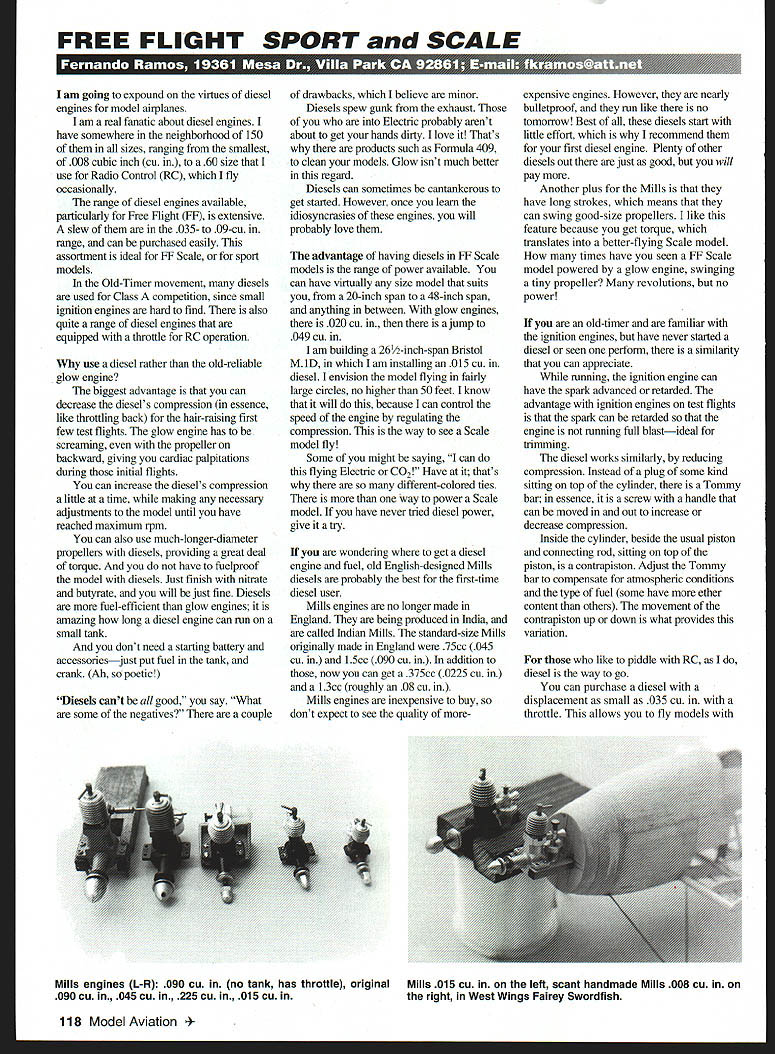
Mills engines are no longer made in England. They are being produced in India, and are called Indian Mills. The standard-size Mills originally made in England were .75 cc (.045 cu. in.) and 1.5 cc (.090 cu. in.). In addition to those, now you can get a .375 cc (.0225 cu. in.) and a 1.3 cc (roughly .08 cu. in.).
Mills engines are inexpensive to buy, so don't expect to see the finish quality of more-expensive engines. However, they are nearly bulletproof, and they run like there is no tomorrow! Best of all, these diesels start with little effort, which is why I recommend them for your first diesel engine. Plenty of other diesels out there are just as good, but you will pay more.
Another plus for the Mills is that they have long strokes, which means that they can swing good-size propellers. I like this feature because you get torque, which translates into a better-flying Scale model. How many times have you seen a FF Scale model powered by a glow engine, swinging a tiny propeller? Many revolutions, but no power!
Diesel operation basics
If you are an old-timer and are familiar with the ignition engines, but have never started a diesel or seen one perform, there is a similarity that you can appreciate.
While running, the ignition engine can have the spark advanced or retarded. The advantage with ignition engines on test flights is that the spark can be retarded so that the engine is not running full blast—ideal for trimming.
The diesel works similarly, by reducing compression. Instead of a plug of some kind sitting on top of the cylinder, there is a Tommy bar; in essence, it is a screw with a handle that can be moved in and out to increase or decrease compression.
Inside the cylinder, beside the usual piston and connecting rod, sitting on top of the piston, is a contrapiston. Adjust the Tommy bar to compensate for atmospheric conditions and the type of fuel you use (some fuels have more ether content than others). The movement of the contrapiston up or down is what provides this variation.
For those who like to piddle with RC, as I do, diesel is the way to go.
You can purchase a diesel with a displacement as small as .035 cu. in., with a throttle. This allows you to fly models with restricted-area operations. You can get up to .60 cu. in. to fly models with seven-foot spans. I have a PAW 60 (Progress Aero Works, England) on an 80-inch sport model, swinging a 16 x 6 propeller. According to the instructions, I could have used an 18 x 6 prop at low speed.
I have several Sport Scale RC models, and they are all powered by diesel engines.
Where to buy diesel engines and fuel
There are more sources than I'm going to give, but I have had dealings with the first two:
- Carlson Engine Imports
814 E. Marconi Ave., Phoenix, AZ 85022 Tel. and Fax: (602) 863-1684 Carries a variety of diesels, including all of the Indian Mills, and a couple of different diesel fuels. If you mail Carlson a dollar, you will receive a catalog jam-packed with diesel engines.
- Eric Clutton ("Dr. Diesel")
Mostly handles PAW diesels; they are great engines, and they have the .035 cu. in. diesel with a throttle. Eric has written a terrific book: Dr. Diesel's Diary ... All You Wanted To Know About Model Diesel. This compendium has everything needed to start, run, and maintain diesel engines. Eric's address: 913 Cedar Ln., Tullahoma, TN 37388.
- David Banks
Has 1/2- and 1/3-size .045 Mills made in Russia; they are beautifully finished and great runners, but more costly. David also has many reproductions of the great old engines, such as the Elfins that have been reduced in size. Address: 46 Queensbury Rd., Kingsbury, London, UK NW9 8LT.
- Aerodyne
A growing cottage industry supplying many FF needs. Aerodyne makes a variety of fuels for every kind of model engine. I have the company make diesel fuel for me that has a higher ether content, for the very small diesels. Aerodyne moved from Santa Ana, CA to Hesperia, CA. Their old telephone number was (714) 258-0805; call it and you will be provided with the new one.
Thanks for all of the E-mail. It is an easy way for me to correspond with you. I still need photos of your latest endeavors. My E-mail address and my home address are at the top of the column.
Transcribed from original scans by AI. Minor OCR errors may remain.

