
Free Flight: Sport and Scale
Bill Warner, 1370 Monache Avenue, Porterville, CA 93257
"Try it, you'll like it!"
"TRY IT, YOU'LL LIKE IT!" says the one and only Dave Stott, referring to putting panel lines, control surface outlines, etc. on models.
You may remember Tom Arnold's theory, summarized in my March visit with you, where he stated that you couldn't see panel lines on a lot of aircraft, and that modelers overdid the lines on their models.
Dave went about studying the 18 retired scale models in his hangar and came to the conclusion that five variables affect what you see on a model:
- Distance
- Viewing angle
- Amount of light
- Glare
- Contrast
Dave's models used .040 to .050 black tissue strips, ink lines, and separate pieces to show separations. Sometimes these were mixed on the same model, as in the case of half an elevator being separate and movable, with a tissue strip portraying a "separation" on the opposite side.
Says Dave, "In viewing the models and viewing photographs, I can see the same variable (contrast being replaced by surface reflectivity in the case of the planes in the photos) conditions affecting the result. The resulting impression seems to me to be identical!" Well, gang, there's always another side to the story—the never-ending search for realism continues!
Tom Arnold on judges' bias
Tom Arnold, Scale Staffel newsletter editor and FF Scale gadfly, recently took on the issue of colored tissue vs. airbrushed paint. He allows that there are a number of good reasons for choosing either method of finishing, but adds one interesting twist: judges' bias.
If you had IPMS (International Plastic Modelers Society) judging, the painted, detailed model would win out over a similar colored-tissue-covered model, as it would look more like the real airplane.
In reality, says Tom, the judges are usually fellow fliers, and "what translucent Fairchild 24 with the striping and balsa structure showing through just yearns to rise higher and higher out of the judge's very hands. They can see the sunlight shining through the tissue, making it fairly glow a bright yellow against a blue sky. It looks light, it feels light, it is light, and it is the symbol of a young man's summer day in a green field."
Guess how that model will fare against an airbrushed, heavier-looking one as a result of the judge/flier's subconscious prejudices? Something to think about, especially in light of the fact that Tom has never made a model that wasn't beautifully airbrushed and detailed! Some guys will just make models the way they want to regardless.
Heat-applied windows
Master modeler Jim Alaback has found another way to stick those pesky windshields. He runs a bead of RC-56 around the frame and lets it dry; then he puts the cut-to-size acetate sheet on and applies a little heat with a MonoKote iron (not too much) around the edges, and it's stuck without a hint of a smear. Clever idea. Now I have to find someone who owns a MonoKote gun so I can try it.
Flat-finish color copier decals
From the amount of mail I have received on the "how-to" decal stuff we put in last time, I think we should make surface-decoration techniques a regular part of the column!
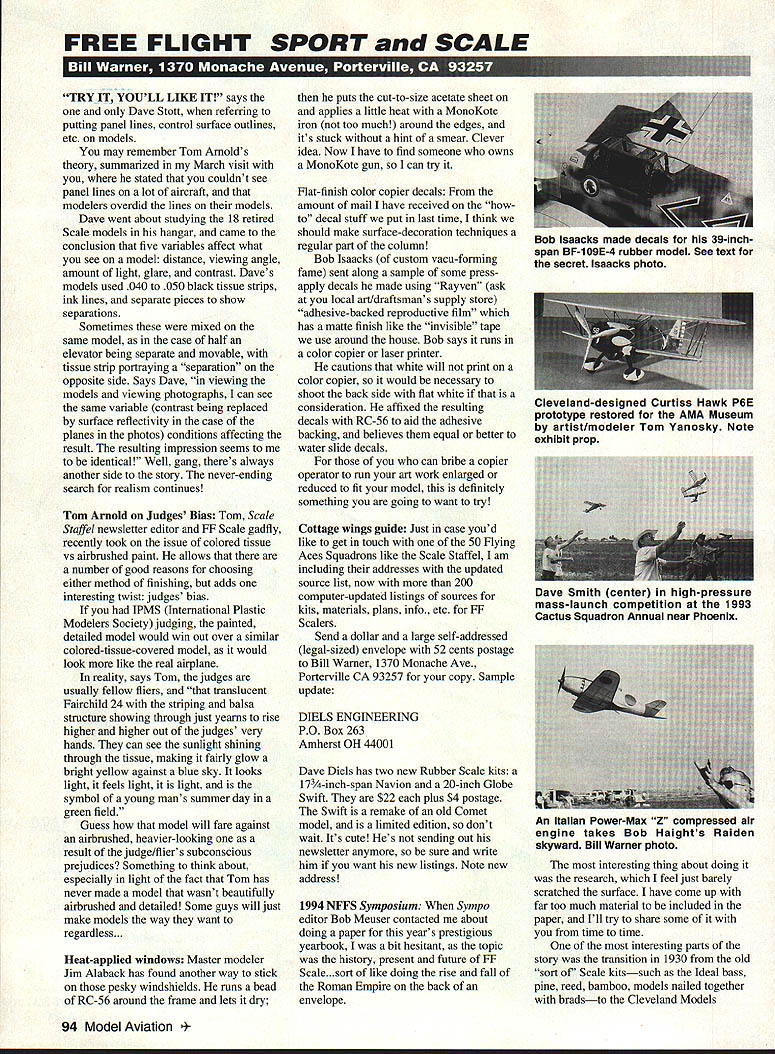
Bob Isaacks (of custom vacu-forming fame) sent along a sample of some press-apply decals he made using "Rayven" (ask at your local art/draftsman's supply store) adhesive-backed reproductive film, which has a matte finish like the "invisible" tape we use around the house. Bob says it runs in a color copier or laser printer.
He cautions that white will not print on a color copier, so it would be necessary to shoot the back side with flat white if that is a consideration. He affixed the resulting decals with RC-56 to aid the adhesive backing, and believes them equal or better to water-slide decals.
For those of you who can bribe a copier operator to run your artwork enlarged or reduced to fit your model, this is definitely something you are going to want to try!
Cottage wings guide
Just in case you'd like to get in touch with one of the 50 Flying Aces Squadrons like the Scale Staffel, I am including their addresses with the updated source list, now with more than 200 computer-updated listings of sources for kits, materials, plans, info, etc. for FF Scalers.
Send a dollar and a large self-addressed (legal-sized) envelope with 52 cents postage to: Bill Warner 1370 Monache Ave. Porterville, CA 93257 for your copy.
Sample update:
DIELS ENGINEERING P.O. Box 263 Amherst, OH 44001
Dave Diels has two new rubber-scale kits: a 17 3/4-inch-span Navion and a 20-inch Globe Swift. They are $22 each plus $4 postage. The Swift is a remake of an old Comet model and is a limited edition, so don't wait. He's not sending out his newsletter anymore, so be sure and write him if you want his new listings. Note new address!
1994 NFFS Symposium
When Sympo editor Bob Meuser contacted me about doing a paper for this year's prestigious yearbook, I was a bit hesitant, as the topic was the history, present and future of FF Scale—sort of like doing the rise and fall of the Roman Empire on the back of an envelope. The interesting thing about doing it was the research, which I feel I just barely scratched the surface of. I have come up with far too much material to include in the paper, and I'll try to share some of it with you from time to time.
One of the most interesting parts of the story was the transition in 1930 from the old "sort of" scale kits—such as the Ideal bass-pine, reed, bamboo models nailed together with brads—to the Cleveland Models' landmark Great Lakes all-balsa model that even had decals photo-reduced from the originals! Here we are more than sixty years later, and the models are still good enough to get your heart beating faster by just looking at the plans.
Recordkeeping for improved performance
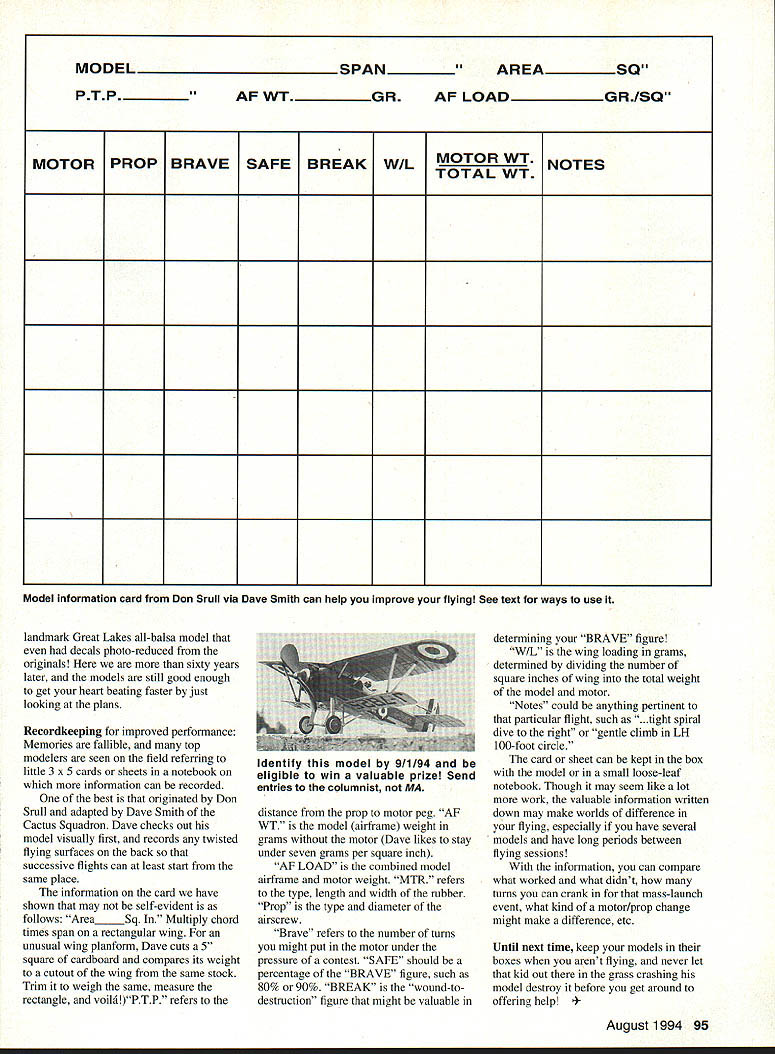
Memories are fallible, and many top modelers are seen on the field referring to little 3 x 5 cards or sheets in a notebook on which more information can be recorded.
One of the best systems was originated by Don Srull and adapted by Jim Smith of the Cactus Squadron. Dave checks out his model visually first and records any twisted flying surfaces on the back so that successive flights can at least start from the same place.
The information on the card that may not be self-evident follows:
- "Area ___ Sq. In." — Multiply chord times span on a rectangular wing. For an unusual wing planform, Dave cuts a 5" square of cardboard and compares its weight to a cutout of the wing from the same stock. Trim the rectangle to weigh the same, measure it, and voilà!
- "P.T.P." — Prop-to-pegging distance (distance from the prop to motor peg).
- "AF WT." — Airframe weight in grams without the motor (Dave likes to stay under seven grams per square inch).
- "AF LOAD" — Combined model airframe and motor weight.
- "MTR." — Motor type, length and width of the rubber.
- "Prop" — Type and diameter of the airscrew.
- "BRAVE" — Number of turns you might put in the motor under contest pressure.
- "SAFE" — A percentage of the "BRAVE" figure, such as 80% or 90%.
- "BREAK" — The "wound-to-destruction" figure that might be valuable in determining your "BRAVE" figure.
- "W/L" — Wing loading in grams, determined by dividing the total weight of the model and motor by the number of square inches of wing.
- "Notes" — Anything pertinent to that particular flight, such as "...tight spiral dive to the right" or "gentle climb in LH 100-foot circle."
The card or sheet can be kept in the box with the model or in a small loose-leaf notebook. Though it may seem like a lot more work, the valuable information written down may make worlds of difference in your flying, especially if you have several models and have long periods between flying sessions.
With the information, you can compare what worked and what didn't, how many turns you can crank in for that mass-launch event, what kind of motor/prop change might make a difference, etc.
Until next time, keep your models in their boxes when you aren't flying, and never let that kid out there in the grass crashing his model destroy it before you get around to offering help!
Transcribed from original scans by AI. Minor OCR errors may remain.

