
FREE FLIGHT SPORT and SCALE
Bill Warner, 1370 Monache Avenue, Porterville, CA 93257
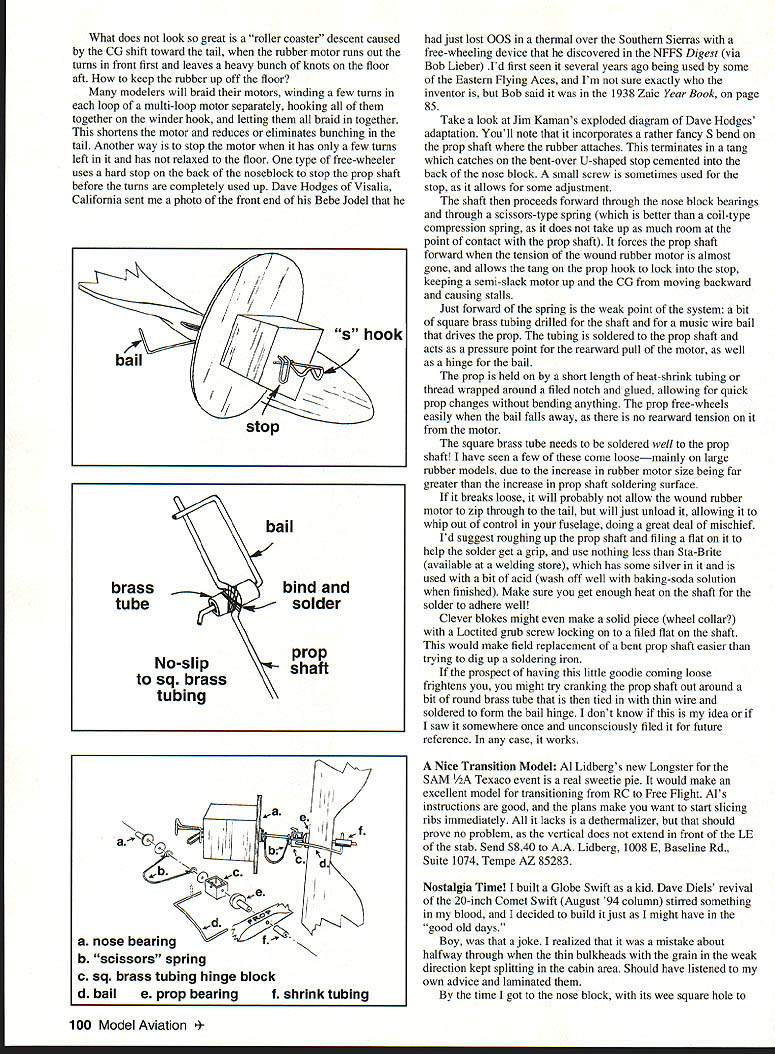
UFO SEEN Over the Kitty Litter Factory! The Burbank-based Blacksheep have an annual over the Memorial Day weekend at Taft, California, that must be seen to be believed. They run more than 70 free-flight events — Scale, non-Scale, Indoor, Outdoor — including one for the "most unusual." All sorts of flying machines from Ken Johnson's flying saucer to Skip Ruff's spaceships were seen in the air over the three days and nights. (Night fliers used Lunker Lights — a type of cyalume fishing lure.)
Among the more memorable sights at the 1994 bash (besides Sal Taibi's great 1/2A Texaco flight on his Corben Ace into the only tree within 20 miles of the flying site, and Mik Mikkelson's new giant 3× enlarged-from-a-Stahl-plan Fairey Barracuda) was my candidate for the "most unusual" category: a 15-pound, twelve-inch-to-the-foot rigid-frame scale sunshade. It caught a superb thermal and put up the most impressive flight of the day, much to the delight of its surprised owners. The picture of the sunshade flying at about 30 feet with the famous Taft landmark kitty-litter factory in the background was taken by yours truly — I guarantee it isn't faked!
If you have any FF Scale models that have been hampered by the lack of good air in your part of the country, plan your vacation next summer in Taft! (I hear Kansas has good air, too. Right, Toto?)
Cactus Video
For those who have dreamed of attending the Cactus Squadron Annual near Phoenix, or for those who collect FF Scale material, the $25 (postage paid) video of their 1993 Annual is well worth it. It's a cut above the usual club video, complete with music and fancy editing by Red Boyles. I watched it while writing this and Bob Schlosberg put up a fantastic flight on his rubber-powered Waco SRE — a true flying museum piece. This tape is an inspiration!
Get yours from:
- Glenna Tarango, 10 S. Cooper Rd., Chandler, AZ 85225.
Glenna can also fill you in on their 1994 Annual, coming up October 15–16.
Free-Wheeling and CG Shift
Having done this column for nearly 15 years, I tend to think first of presenting new stuff for old-time modelers. The danger is that many newcomers need occasional clarification on things we take for granted.
One key to success with a rubber-powered model is keeping the rubber off the floor of the model. A free-wheeling prop that spins when the turns in a rubber motor are used up is pretty much standard for Free-Flight Scale models. Even if it didn't improve flight characteristics over a stopped prop (which it often does), it just makes the model look more realistic on the way down.
What looks disastrous is the "roller-coaster" descent caused by a CG shift toward the tail when the motor runs out. The model will pitch nose-down, then flip front-first, leaving a heavy bunch of knots on the floor at the aft end. Keep the rubber up off the floor. Common remedies:
- Braid motors: wind a few turns in each loop of a multi-loop motor separately, hook them together on the winder, and let them braid in together. This shortens the motor and reduces or eliminates bunching in the tail.
- Use a hard stop: a relaxed-floor type free-wheeler with a hard stop on the back noseblock stops the prop shaft before all turns are used up, keeping some tension and preventing the CG from moving aft.
Dave Hodges of Visalia, California, sent a photo of a Bebe Jodel front end showing a brass-tube "no-slip" to square brass tubing bail, bound and soldered to the prop shaft. This free-wheeling device was found in the NFFS Digest via Bob Lieber and appears in the 1938 Zaic Year Book (page 85). Jim Kaman has an exploded diagram; Dave's adaptation incorporates a rather fancy S-bend prop shaft. Key features:
- The rubber attaches to a tang that catches a bent-over U-shaped stop cemented in the back noseblock. A small screw can be used as the stop for adjustment.
- The shaft proceeds forward through noseblock bearings and passes through a spring assembly. A scissors-type spring is compact; a coil-type compression spring takes more room but works.
- Point contact on the prop shaft forces the shaft forward as the wound rubber tension collapses; the tang/prop hook then locks on the stop, keeping a semi-slack motor up and preventing the CG from shifting aft and causing stalls.
- Just forward of the spring is the weak point: a bit of square brass tubing drilled for the shaft and for a music-wire bail that drives the prop. The tubing is soldered to the prop shaft and acts as a pressure point for the motor's rearward pull and as a hinge for the bail.
- The prop is held on by a short length of heat-shrink tubing or thread wrapped around a filed notch and glued, allowing quick prop changes without bending anything. When the bail falls away the prop free-wheels easily because there's no rearward tension.
Practical cautions and tips:
- The square brass tube must be soldered well to the prop shaft. On large rubber models I've seen this joint come loose, mainly because rubber motor size increases much faster than soldering surface area.
- If it breaks loose, the wound motor may whip inside the fuselage and do a lot of mischief. Rough up the prop shaft, file a flat for better solder grip, and use a quality silver-bearing solder such as Sta-Brite with acid flux. Wash off flux residue with a baking-soda solution after soldering. Make sure you get enough heat for a good bond.
- Clever alternatives: make a solid collar (wheel-collar) with a Loctited grub screw locking on to a filed flat on the shaft for easier field replacement; or crank the prop shaft around a piece of round brass tube tied in with thin wire and soldered as a bail hinge.
- Consider using a stronger attachment method on models with very large motors.
A Nice Transition Model
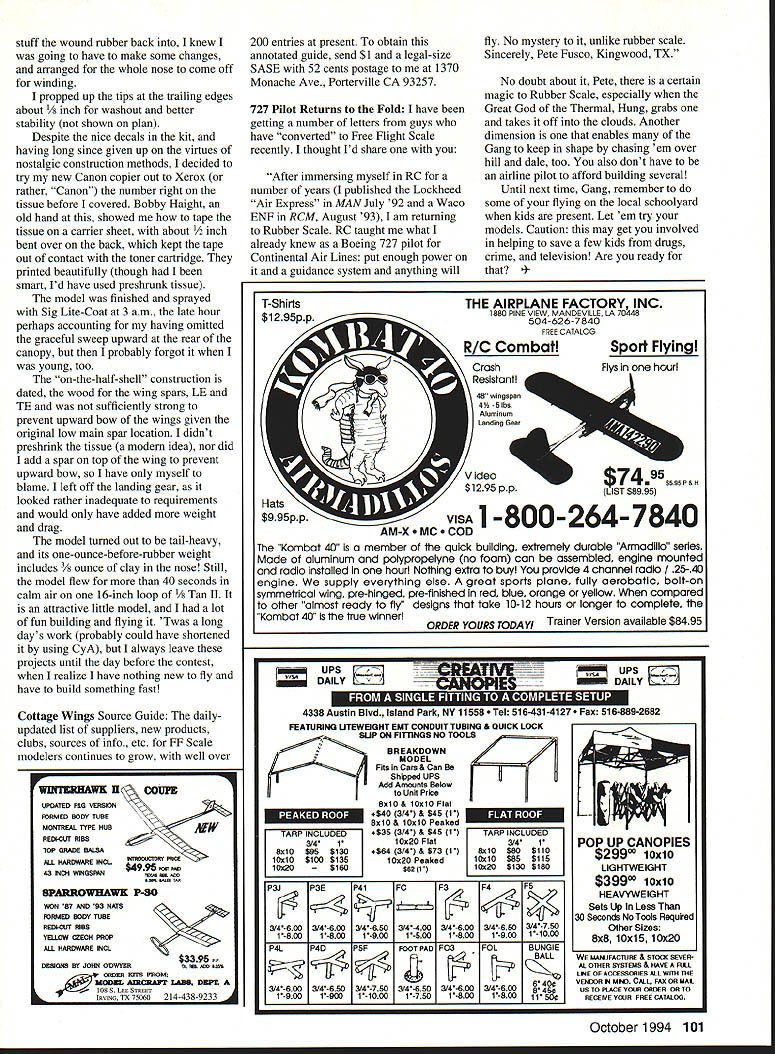
Al Lidberg's new Longster for the SAM 1/2A Texaco event is a real sweetie and would make an excellent model for transitioning from RC to Free Flight. Al's instructions are clear, and the plans entice you to start cutting ribs immediately. It lacks a dethermalizer, but that should be no problem because the vertical does not extend in front of the LE of the stab. Send $8.40 to:
- A.A. Lidberg, 1008 E. Baseline Rd., Suite 1074, Tempe, AZ 85283.
Nostalgia Time!
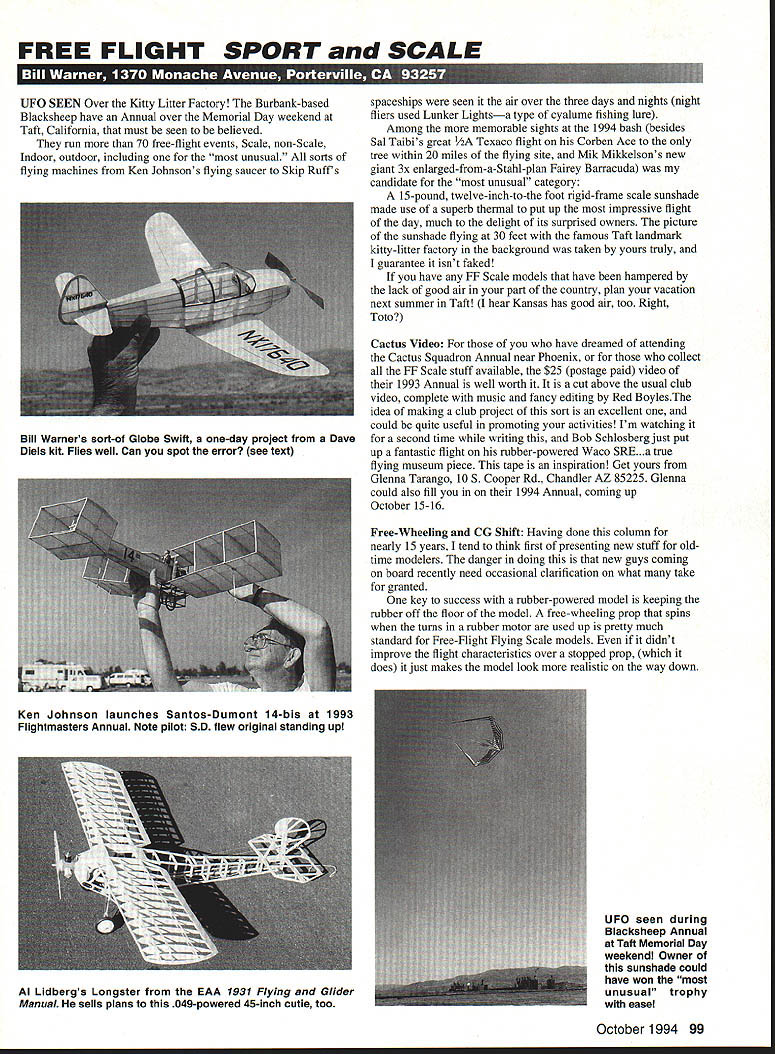
I built a Globe Swift as a kid. Dave Diels' revival of the 20-inch Comet Swift (August '94 column) stirred something in me, so I decided to build it as I might have in the "good old days." Boy, was that a joke.
Mistakes and fixes:
- Thin bulkheads with the grain in the weak direction kept splitting in the cabin area — I should have laminated them.
- The little square nose block hole forced me to redesign the nose so it comes off for winding.
- I propped up the tips at the trailing edges about 1/8 inch for washout and better stability (not on the plan).
- To transfer the number to tissue I taped the tissue on a carrier sheet with about 1/4 inch bent over on the back to keep the tape off the toner cartridge. It printed beautifully (I should have used preshrunk tissue, though).
- Finished and sprayed with Sig Lite-Coat at 3 a.m. (late hour may explain omitting the graceful sweep upward at the rear of the canopy).
- The "on-the-half-shell" construction is dated. Wing spar placement and weak wood allowed upward bow because I didn't add a top spar or preshrink the tissue.
- I left off the landing gear to save weight and drag.
Result: The model was tail-heavy; the one-ounce-before-rubber weight includes 3/8 ounce of clay in the nose. Still, it flew for more than 40 seconds in calm air on one 16-inch loop of 1/8 Tan II. It was an attractive little model and a lot of fun to build and fly. I tend to leave these projects until right before the contest — then build something fast!
Cottage Wings Source Guide
The daily-updated list of suppliers, new products, clubs, sources of info, etc., for FF Scale modelers continues to grow and now has well over 200 entries. To obtain this annotated guide send $1 and a legal-size SASE with 52 cents postage to:
- Bill Warner, 1370 Monache Ave., Porterville, CA 93257.
727 Pilot Returns to the Fold
I've received a number of letters from guys who have "converted" to Free Flight Scale recently. One I liked:
"After immersing myself in RC for a number of years (I published the Lockheed Air Express in MAN July '92 and a Waco ENF in RCJM, August '93), I am returning to Rubber Scale. RC taught me what I already knew as a Boeing 727 pilot for Continental Air Lines: put enough power on it and a guidance system and anything will fly. No mystery to it, unlike rubber scale. Sincerely, Pete Fusco, Kingwood, TX."
No doubt about it, Pete — there is a certain magic to Rubber Scale, especially when the Great God of the Thermal grabs one and takes it off into the clouds. Another dimension is the chase: many of the Gang keep in shape by running after them over hill and dale. And you don't have to be an airline pilot to afford building several!
Until next time, Gang, remember to do some of your flying on the local schoolyard when kids are present. Let them try your models. Caution: this may get you involved in helping save a few kids from drugs, crime, and television! Are you ready for that? +
Transcribed from original scans by AI. Minor OCR errors may remain.

