
Free Flight: Sport & Scale
Bill Warner
A FREE-FLIGHT pilot ejected when the controls of his F-102A froze, and the plane continued on its merry way in free‑flight mode. An article in the Winter 1986 Journal of the American Aviation Historical Society, sent to me by Bob Scholberg in Arizona, tells the story of this 1960 incident near Kansas City, MO.
After the Mayday call, about 15 minutes elapsed before another F-102 could get into formation with the abandoned ship, nicknamed the "Loose Goose," which had decided to keep flying a roughly triangular course. By bringing a wing from his plane close under the low wing of the errant ship, the second pilot could level the other craft’s wing using the airflow from his own wing. In this way the maverick plane could be induced either to fly straight or to roll. After about an hour and 20 minutes of "free flight," the abandoned F-102 finally ran out of fuel over an unpopulated area and crashed.
What is "true free flight"?
Indoor fliers have been known to guide their microfilm-covered ships with a helium-filled balloon on a string, and magnet steering is old hat in Europe. These tricks raise the question: what is true free flight?
Aside from attempts to control a model by shouting at it, would it be "legal" to use an RC model to herd your errant free‑flight (FF) back onto the field if you never bumped it? How about the Frenchman who used a pneumatic timer to pull a double-sided blade-type cam through sets of followers to actuate his model's rudder and elevator? With a "program" built into each side of the cam (rudder on one side, elevator on the other) he could produce figure eights, loops, and the like.
Is use of a proportional or two-speed engine control actuated by a timer to be considered cheating? It won't be long before someone works up an entire flight program using miniaturized electronics and memory to do anything an RC model will do.
This is a far cry from the rubber‑band‑powered models with little bomb-drop or flap‑lowering controls actuated by the slackening rubber as it winds down. Still, things like fuse- or Silly‑Putty‑operated DTs give some degree of control to a model.
Perhaps the fact that most of these devices and tricks don't work too well (like the cam-controlled rudder on the old Mattel electric-powered Super Star toy) will make the point moot. I must admit feeling a bit uneasy upon seeing some of the Old-Timers standing beside their lovely "Free Flight" models with radio transmitters in their hands.
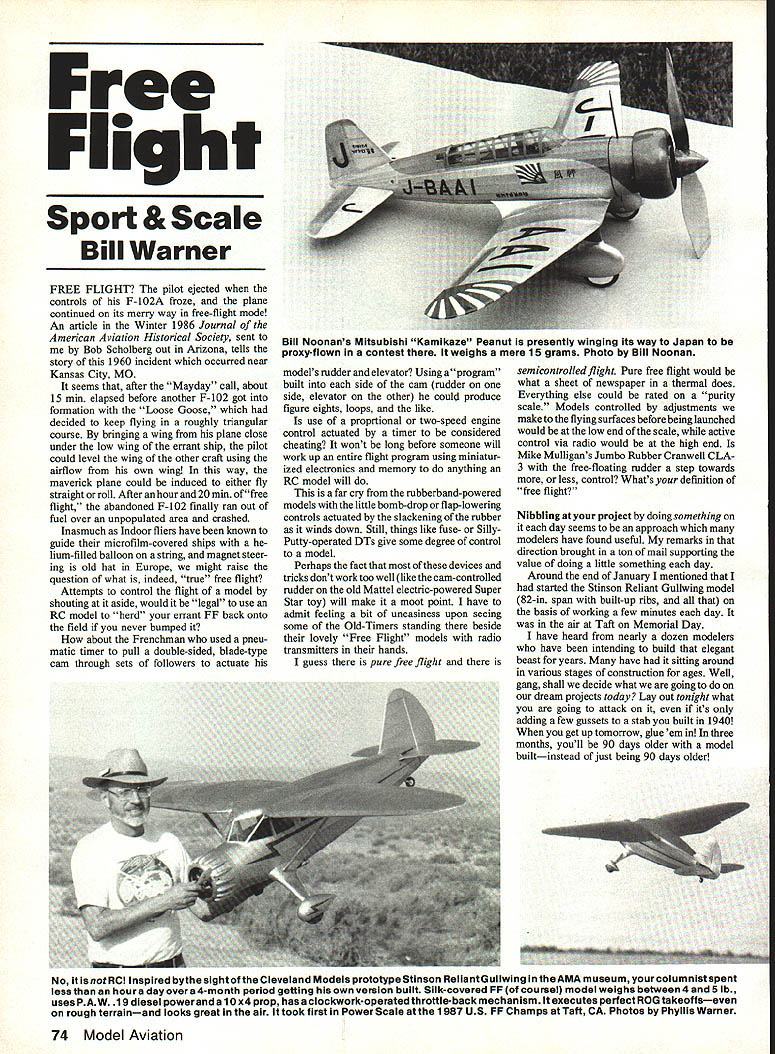
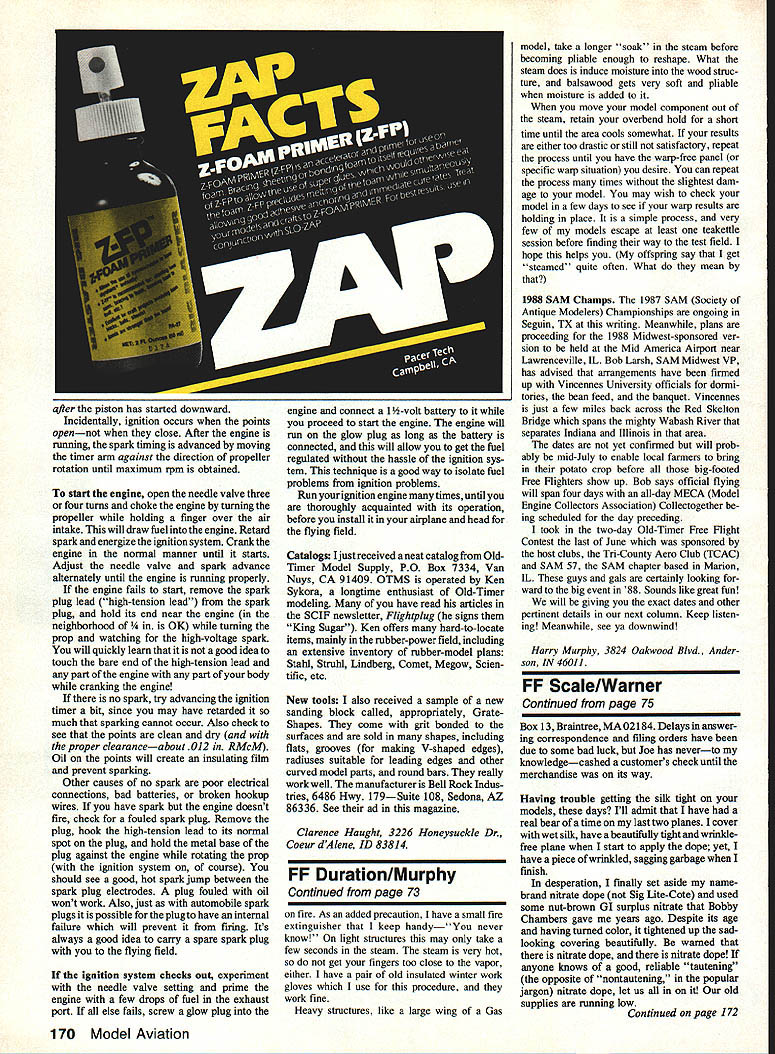
I suppose there is pure free flight and there is semi‑controlled flight. Pure free flight would be what a sheet of newspaper does in a thermal. Everything else could be rated on a "purity" scale: models controlled by adjustments made to the flying surfaces before launch would be at the low end, while active control via radio would be at the high end. Is Mike Mulligan's Jumbo Rubber Cranwell CLA-3 with the free‑floating rudder a step toward less control, or more control? What's your definition of "free flight"?
Build a little every day
Nibbling at a project by doing something on it each day is an approach many modelers have found useful. My remarks to that effect brought in a ton of mail supporting the value of doing a little each day.
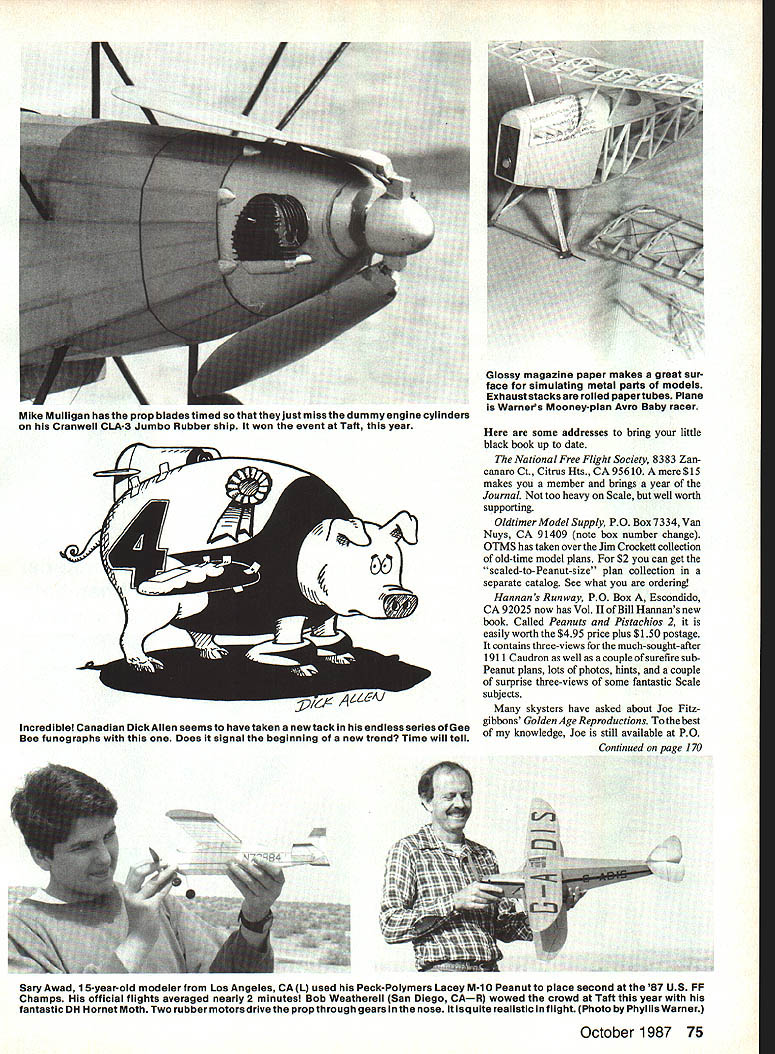
Around the end of January I mentioned I had started a Stinson Reliant Gullwing model (82 in. span with built-up ribs and all that) on the basis of working a few minutes each day. It was flying at Taft on Memorial Day. I have heard from nearly a dozen modelers who have been intending to build that elegant beast for years; many have had it sitting around in various stages of construction for ages.
Well, gang, shall we decide what we are going to do on our dream projects today? Lay out tonight what you are going to attack on it, even if it's only adding a few gussets to a stab you built in 1940. When you get up tomorrow, glue 'em in! In three months you'll be 90 days older with a model built—instead of just being 90 days older!
I spent less than an hour a day over a four-month period getting my own version built. Silk-covered free‑flight, the model weighs between 4 and 5 lb, uses a PAW 19 diesel and a 10x4 prop, and has a clockwork‑operated throttle‑back mechanism. It executes perfect ROG takeoffs even from rough terrain and looks great in the air. It took first in Power Scale at the 1987 U.S. Free Flight Championships at Taft, CA.
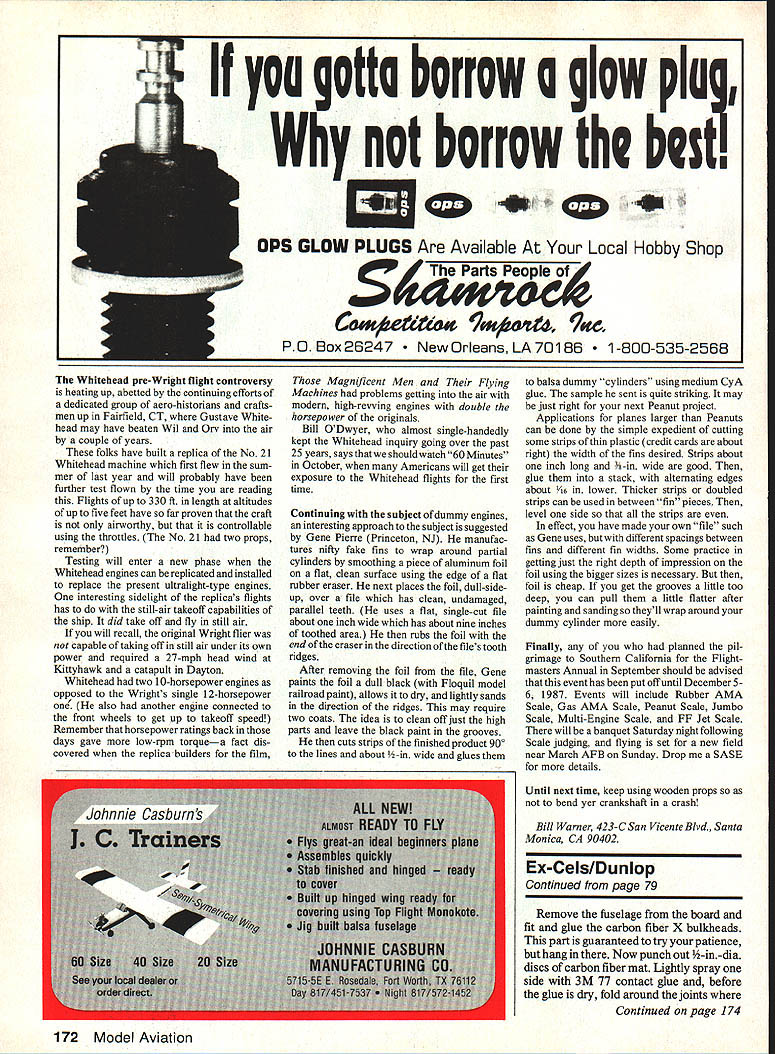
Incredible Canadian Dick Allen seems to have taken a new tack with an endless series of Gee Bee funographs. Does this signal the beginning of a new trend? Time will tell. Glossy magazine paper makes a great surface simulating metal parts on models; exhaust stacks can be rolled from paper tubes. Some of the Mooney-plan Avro Baby racer details are worth noting.
Meanwhile, keep building, keep flying, and keep the spirit of free flight alive.
Those Magnificent Men... and Whitehead
"Those Magnificent Men and Their Flying Machines" had problems getting into the air with modern, high‑revving engines with double the horsepower of the originals.
Bill O'Dwyer, who almost single‑handedly kept the Whitehead inquiry going over the past 25 years, says we should watch "60 Minutes" in October, when many Americans will get their exposure to the Whitehead flights for the first time.
Dummy engine fins — a tip from Gene Pierre
Gene Pierre (Princeton, NJ) suggests a nifty approach to mock engine fins. He makes textured foil fins to wrap around partial dummy cylinders:
- Smooth a piece of aluminum foil on a flat surface using the edge of a flat rubber eraser.
- Place the foil, dull side up, over a file that has a clean, parallel tooth (Gene uses a flat, single-cut file about 1 inch wide).
- Rub the foil with the end of the eraser in the direction of the file's tooth ridges.
- Remove the foil, paint it dull black (Floquil model railroad paint works well), allow to dry, then lightly sand in the direction of the ridges to clean off just the high parts and leave black paint in the grooves. Two coats may be necessary.
- Cut strips 90° to the lines and about 1/2 in. wide, and glue them to balsa dummy "cylinders" using medium CYA glue.
The sample Gene sent is quite striking and may be just right for your next Peanut project.
For larger models, cut strips of thin plastic (old credit cards are about the right thickness) to the width of the fins desired. Strips about 1 in. long and 3/4 in. wide are good. Glue them into a stack with alternating edges about 1/16 in. lower, then level one side so all strips are even. You have effectively made your own "file" to impress the foil with different fin spacing and widths. Practice getting the depth right; foil is cheap, and if grooves are too deep you can flatten them a bit after painting and sanding so they wrap easier.
Until next time, keep using wooden props so as not to bend your crankshaft in a crash!
Addresses and resources
- National Free Flight Society, 8383 Zancanaro Ct., Citrus Heights, CA 95610. A $15 membership brings a year of the Journal. Not heavy on Scale, but well worth supporting.
- Oldtimer Model Supply, P.O. Box 7334, Van Nuys, CA 91409. (Note box number change.) OTMS has taken over the Jim Crockett collection of old‑time model plans. For $2 you can get the "scaled‑to‑peanut‑size" plan collection in a separate catalog — see what you are ordering!
- Hannan's Runway, P.O. Box A, Escondido, CA 92025. Now has Vol. II of Bill Hannan's new book, Peanuts and Pistachios 2. It is worth the $4.95 price plus $1.50 postage and contains three‑views for the much‑sought 1911 Caudron, a couple of surefire super‑peanut plans, lots of photos, hints, and surprise three‑views of some fantastic Scale subjects.
Many have asked about Joe Fitzgibbon's Golden Age Reproductions; to the best of my knowledge, Joe is still available.
Bill Warner 423‑C San Vicente Blvd. Santa Monica, CA 90402
Transcribed from original scans by AI. Minor OCR errors may remain.

