

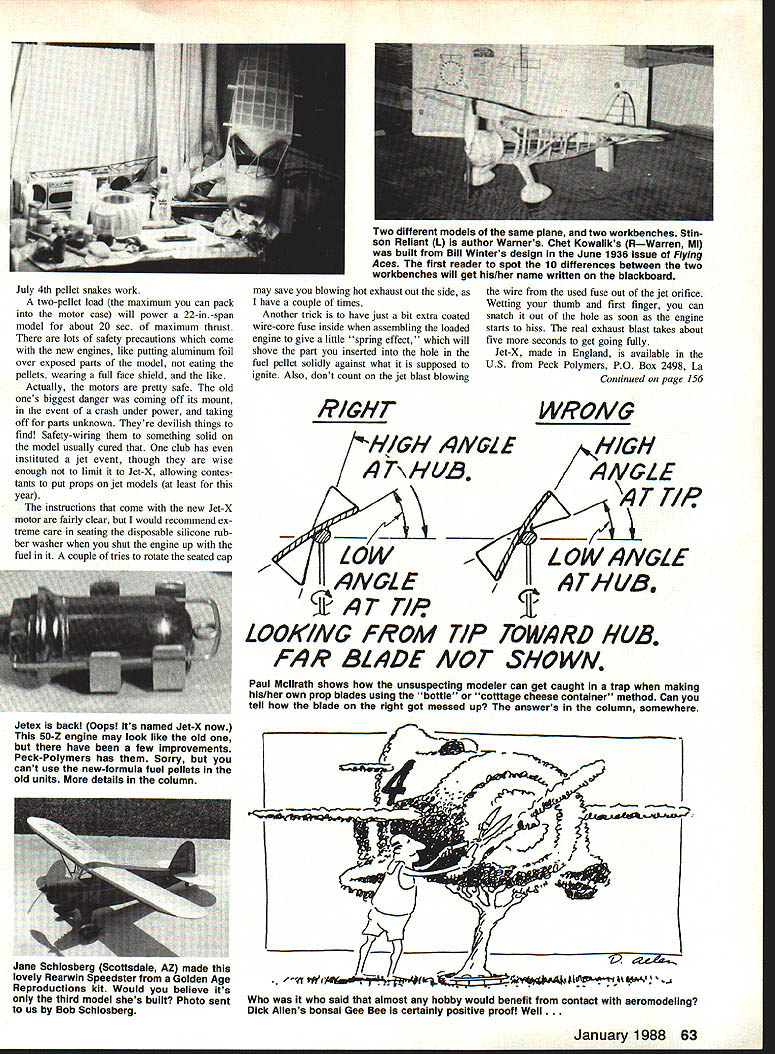
Free Flight: Sport & Scale
Bill Warner
ALL KIDS love to light fuses. The Fourth of July used to be my favorite holiday. When Jetex motors came along in 1947, many of us fuse-lighters attached these new toys to our models with varying degrees of success. The Jetex event at the Nats was always spectacular, with about one-sixth of the models refusing to light, about one-third crashing at high jet-powered speed, and about one-fifth flying out of sight.
The first really good jet flight I ever saw was Hal Swanson's Opel Hatry model launched from a rail at a Flightmasters Annual back in the early Sixties. It had one of the bigger engines (Scorpion?) and flew exactly as one would imagine the real one would. It is about the only good Scale subject I can think of for this form of power; most of the others require a thin metal tube down the center of the fuselage to keep the model from burning up, with the engine up near the CG.
Still, some crafty modelers may think up ways of utilizing the new Jet-X 50-Z (the smallest-size motor from the old line) in other Scale applications. Maybe aluminum drink-can augmenter tubes can be concocted to permit enclosing the motors. They get hot, that's for sure!
Whereas the old fuel, having a guanidine nitrate base, gave a steady burn but was hard to light and required a disposable screen between the fuel and the jet orifice, the new fuel burns in short fits of a half to a full second—sort of a pulse. The screen is gone, and I have had no problems with it lighting every time. It contains potassium dichromate, the stuff which makes July 4th pellet snakes work.
A two-pellet load (the maximum you can pack into the motor case) will power a 22-inch-span model for about 20 seconds of maximum thrust. There are lots of safety precautions which come with the new engines, such as:
- Putting aluminum foil over exposed parts of the model.
- Not eating the pellets.
- Wearing a full face shield.
Actually, the motors are pretty safe. The old one's biggest danger was coming off its mount in the event of a crash under power and taking off for parts unknown. They're devilish things to find. Safety-wiring them to something solid on the model usually cured that. One club has even instituted a jet event, though they are wise enough not to limit it to Jet-X, allowing contestants to put props on jet models (at least for this year).
The instructions that come with the new Jet-X motor are fairly clear, but I recommend extreme care in seating the disposable silicone rubber washer when you shut the engine up with the fuel in it. A couple of tries to rotate the seated cap may save you blowing hot exhaust out the side, as I have a couple of times.
Another trick is to have just a bit of extra coated wire-core fuse inside when assembling the loaded engine to give a little "spring effect," which will shove the part you inserted into the hole in the fuel pellet solidly against what it is supposed to ignite. Also, don't count on the jet blast blowing the wire from the used fuse out of the jet orifice. Wetting your thumb and first finger, you can snatch it out of the hole as soon as the engine starts its flame. The real exhaust blast takes about five more seconds to get going fully.
Jet-X, made in England, is available in the U.S. from Peck Polymers, P.O. Box 2498, La Mesa, CA 92044. The engine is $10.95 by itself, and $22.49 with pellets, wick, gaskets, etc. Add $2 for postage. Bad news for those holding old Jetex engines who can't get fuel for them: the new fuel will not work (so they say) in your old engine.
One final caution to those with Jetex experience: be careful drying pellets! The old pellets were hygroscopic (they soaked up moisture). If you left them around very long they would not light for anything. Guys used to put them on a cookie sheet in the oven and leave them for a long time at low heat. The flash point of the new ones, which are gas-generating at 200°F, would seem to make this an unwise solution. Maybe you could use an "oven" made from a cardboard box with a low-wattage light bulb inside. It would be better out in the yard—just in case they did go off!
Nitrate Dope Sources
Two good nitrate-dope sources have come to my attention in my search to find someone who shrinks up the dope solid. I hesitate to use the word "tautening," as it offends my aeromodeling sensibilities.
- Randolph clear nitrate is the most user-friendly I've tried. It's available from Wag-Aero, 1216 N. Road, Lyons, WI 53148; tel. (414) 763-9586. A quart goes for a bit over five bucks, plus postage (based on zip code and weight). Ric used their nitrate dope on his second-place-at-the-Nats T-Craft's silk, only to have it sag into a bag sitting in the hot sun. (It has since re-tightened.)
- Aero-Dyne was suggested by Art Watkins of Mt. View, CA. It's available from Allen Heinrich, 3154 Falcon, Pomona, CA 91767; tel. (714) 593-5789. It goes for about $1.50 a gallon. Allen also sells a good diesel fuel at $1.10 a gallon.
Thanks, guys!
Mini-Electrics
Mini-electrics are beginning to boom. By now you probably have a box full of toy electric motors and gears and have been scouring seller's rooms for small batteries to run them. Tom Schmitt (Rockville, MD) sent along a catalog from R & D Electronics, 12909 Pine Island Rd., Cape Coral, FL 33909; tel. (813) 772-1144. They have:
- Super Sub "C" 1.2-volt, 2-Ah cells at 99 cents.
- A 1/4-A three-pack delivering 3.6 volts at 100 mA for only $2.50 per stick.
- The little Kodak disc-camera minimotors with carbon brushes at $3.50.
When rewound, or when the end with the good brushes is put on a toy car motor, you have a very nice, cheap miniature power plant. Gear it 3:1 to 7:1, and your winner is built! R & D has a minimum order of $10, so send them a check and see if there isn't anything else you can use.
Useful Shop Tips
Anyone in your family smelling bad lately? If there is, you might suggest they try some Dry Idea antiperspirant. Why? Because the cap of the product is perfect for a cowling for a radial or rotary engine. Maybe we could write and suggest they put out their antiperspirant stuff in different sizes.
The latest rage in fillers is here. Actually, it's been around for some time, and lots of you just haven't discovered it yet. Red Devil, DAP, and just about everyone else have what is touted as "lightweight" or "one-step" spackling paste. You can tell by the fact that it is in a plastic rather than a metal container, it is white, and it smells funny. It is light, sands like balsa, and cleans up with water. It's great for fillets, blends, and sloppy builders like me. You can find it in hardware and paint stores, and even in model shops from time to time. Thanks to Walt Mooney and Paul McIlrath for this one.
Paul suggests mixing in a drop of colored ink to match the material to the color of the surrounding area. Maybe Dr. Marin's dyes or food coloring would work. Adding a little white glue to the filler, says Paul, makes it stickier but harder to sand. Its main ingredient, I believe, is glass microballoons, so I would suggest you not inhale too much of the sanding dust.
Involving Family
I have been hearing good things this month about people getting their wives more involved in modeling. Not only is Shelly Dittman into her new hobby, but Jane Schlosberg has done her third model in recent months. I like to hear of people sharing a good thing. Unfortunately, some of the women get so good at it that it makes us guys look bad! (Like Addie Nazareth's huge float biplane she just finished for the Lockheed Museum!)
Recommended Reading: Ultralights
Hey, Lympne fans, Richard Riding, editor of Aeroplane Monthly, has a new book out called Ultralights: The Early British Classics. It incorporates a lot of material which has already appeared in the magazine series, but it also has a great deal of interesting new stuff.
The photo section on the early engines is super (26 selected engines from the ABC 398cc to the Walter Micron)! Ninety planes like the Watkinson Dingbat, Bearnan Parasol, Carden-Baynes Scud III, Angus Aquila, Comper autogiro, Short Cockle, etc., grace its pages. There are over 400 photographs, scale drawings, and data tables covering this Golden Age of British lightplane history during the years between the two world wars. The book is compelling for modelers, and is available for 19.95 British pounds in hardback (ask your bank or an international money order for that amount; they'll charge you in dollars). It is available from Patrick Stephens, Ltd., Dennington Estate, Wellingborough, Northants, NN8 2QD, England. Highly recommended.
Understanding Propellers
Understanding propellers can be difficult. My kids in classes at school often do things like curve two opposite-direction blades on the same blank, put the camber on the face of one blade and the rear of the other, and things like that. Pennypalme props go on upside-down, blades get pitch set in a way that gives full drag on a "feathered" blade trying to turn, with the other set at zero pitch.
Adults sometimes do not quite understand how a prop works, either. The current fad of molding blades on the side of a bottle or cutting them from a cottage cheese container points out a certain misunderstanding.
A spinning propeller's tips move through the air faster than its hub. That's the way distance around a circle works. Props get their thrust from the way the blades are angled forward and from their pitch, "like the pitch of a thread" (Brits call them "airscrews"). The tip, moving faster, needs a lower angle of pitch, as it gets its thrust augmented by the extra speed at which it is turning.
The root end of the blade near the hub is just puttering around, so it needs all the help it can get to come even close to what the tips are developing, and therefore needs a much higher angle. In fact, most ready-made plastic props are carefully pitched, and you will see this in their design.
Now, when you cut a blade from a cylinder like a cottage cheese container, you normally let the blade be 15° left of the vertical on the cylinder or 15° left if molding balsa laminates on a bottle. This gives you a blade which, when folded in a normal fashion, will have more pitch at the hub and less at the tip.
If (as a number of modelers who should know better have found out) you make your blades slanted to the right, guess what happens when you make a perfectly (almost) normal-looking prop? You guessed it: the pitch is high where you need low, and vice versa. It will fly a model, alright, but performance will suffer. Thanks to Paul McIlrath for this one!
Keep your blades aligned right and your Peanuts out of the snowdrifts!
Bill Warner 423-C San Vicente Blvd. Santa Monica, CA 90402
Transcribed from original scans by AI. Minor OCR errors may remain.

