
Free Flight: Sport & Scale
Bill Warner 423-C San Vicente Blvd. Santa Monica, CA 90402
FAC Nats (Geneseo, NY — July 8–10, 1988)
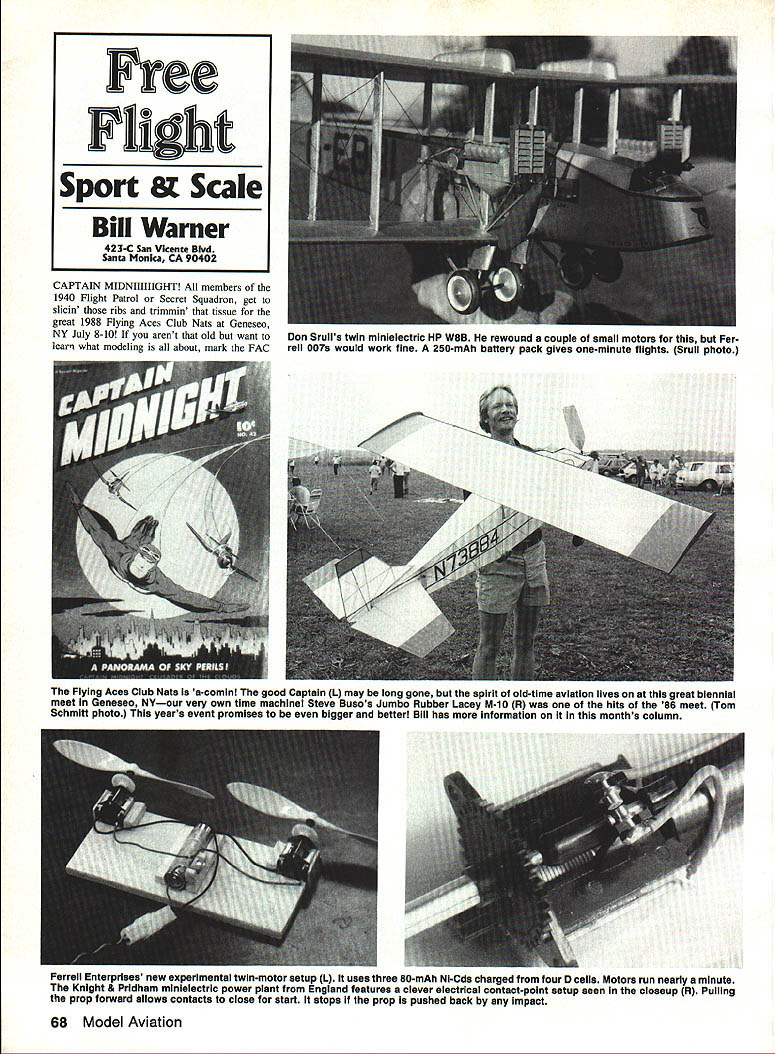
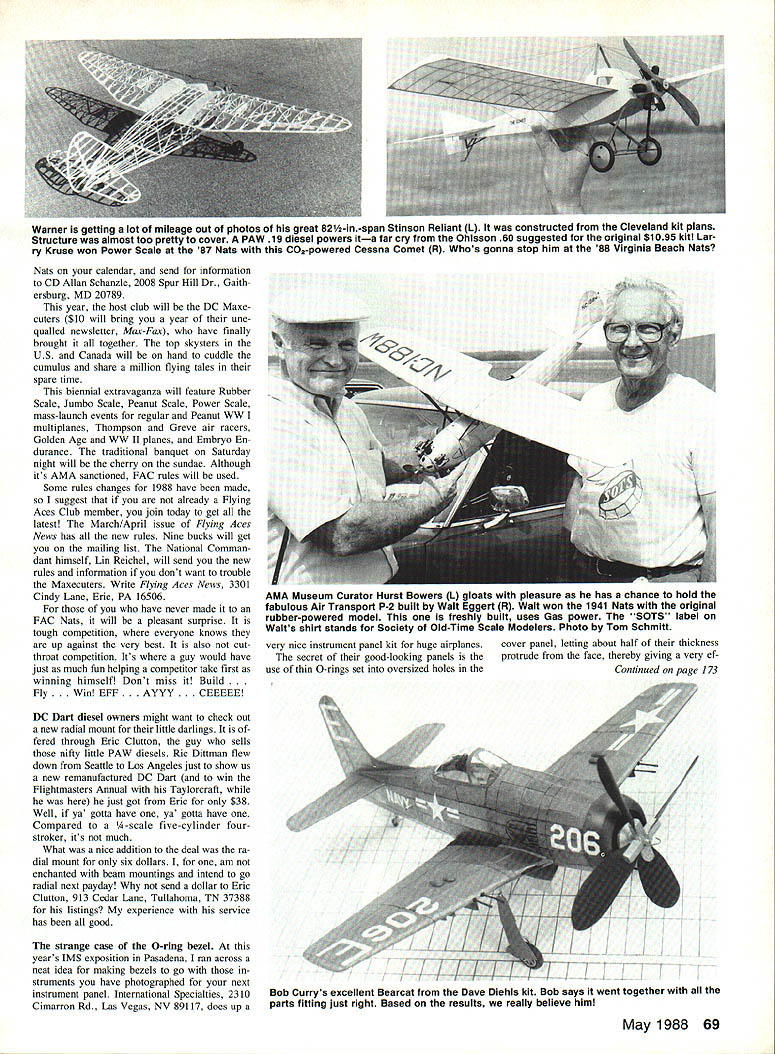
CAPTAIN MIDNIGHT! All members of the 1940 Flight Patrol or Secret Squadron, get to slicin' those ribs and trimmin' that tissue for the great 1988 Flying Aces Club Nats at Geneseo, NY, July 8–10! If you aren't that old but want to learn what modeling is all about, mark the FAC Nats on your calendar.
This year's event promises to be even bigger and better! Bill has more information on it in this month's column. Nats on your calendar, and send for information to Contest Director Allan Schanzle, 2008 Spur Hill Dr., Gaithersburg, MD 20789.
This year the host club will be the DC Maxecuters ($10 will bring you a year of their unequaled newsletter, Max-Fax), who have finally brought it all together. The top skysters in the U.S. and Canada will be on hand to cuddle the cumulus and share a million flying tales in their spare time.
This biennial extravaganza will feature:
- Rubber Scale
- Jumbo Scale
- Peanut Scale
- Power Scale
- Mass-launch events for regular and Peanut WW I multiplanes
- Thompson and Greve air racers
- Golden Age and WW II planes
- Embryo Endurance
The traditional banquet on Saturday night will be the cherry on the sundae. Although it's AMA sanctioned, FAC rules will be used.
Some rules changes for 1988 have been made, so I suggest that if you're not already a Flying Aces Club member, you join today to get all the latest! The March/April issue of Flying Aces News has all the new rules. Nine bucks will get you on the mailing list. The National Commandant himself, Lin Reichel, will send you the new rules and information if you don't want to trouble the Maxecuters. Write: Flying Aces News, 3301 Cindy Lane, Erie, PA 16506.
For those of you who have never made it to an FAC Nats, it will be a pleasant surprise. It is tough competition, where everyone knows they are up against the very best. It is also not cut‑throat competition; it's where a guy would have just as much fun helping a competitor take first as winning himself! Don't miss it. Build • Fly • Win! F... A... C...!
DC Dart radial mount
DC Dart diesel owners might want to check out a new radial mount for their little darlings. It is offered through Eric Clutton, the guy who sells those nifty little PAW diesels. Ric Dittman flew down from Seattle to Los Angeles just to show us a new remanufactured DC Dart he just got from Eric for only $38. Well, if ya' gotta have one, ya' gotta have one. Compared to a 1/4-scale five‑cylinder four‑stroker, it's not much.
What was a nice addition to the deal was the radial mount for only six dollars. I, for one, am not enchanted with beam mountings and intend to go radial next payday! Why not send a dollar to Eric Clutton, 913 Cedar Lane, Tullahoma, TN 37388 for his listings? My experience with his service has been all good.
O-ring bezels and instrument panels
The strange case of the O-ring bezel. At this year's IMS exposition in Pasadena, I ran across a neat idea for making bezels to go with those instruments you have photographed for your next panel. International Specialties, 2310 Cimarron Rd., Las Vegas, NV 89117, does up a very nice instrument panel kit. Huge airplane‑secret good‑looking panels use thin O‑rings set in oversized holes in the instrument panel, letting about half the thickness protrude from the face, thereby giving a very effective three‑dimensional aura to the whole affair.
Their price of $8.95 plus 50¢ postage is for the instrument photo sheet of 20 instruments, thin plywood, clear plastic sheet, eight O‑rings, and 32 little machine screws to hold the sandwich together. It's for quarter‑scalers, but with a reduction Xerox machine and a surplus store that carries O‑rings, you could supply your whole club with the wherewithal to make panels for pea‑sized models.
Old-Timers — airfoils and model choices
There is a statement floating around to the effect that "Any airfoil can be used on an Old‑Timer model," which I have to disagree with — at least in the way I read the rules. Use the original airfoil, please.
I have three Gollywocks ready to fly, all built from the Pond version of the AT plan, so I am not anti‑Gollywock. I just want to see some variety!
I flew the Gollywock as a mere lad. It was the first model I managed to make a folding propeller for. The first model I made that would climb was a Jabberwock. I couldn't make the folder work, and Dad saved the day by carving a prop for me to replace the one I screwed up trying to make into a folder. It was, as I said, the first model that ever climbed. Really, I had never even seen a rubber model fly, except my own, and all they ever did (the few that flew a little) was go the length of the yard about head high. So, on its first flight I wound the thing up and let it go in the back yard. To my astonishment, it went up and cut itself in two on the power line that went diagonally across the yard.
Enough of that! Back to now. If I were not so sentimental about Gollywocks, what would I build? Well, I think the best way to select an Old‑Timer project is to find something that appeals to your sense of reason — something you can relate to. Roy Beaumont's C‑stick model is very pretty, very streamlined and slick; or there is the Stratometer, which will appeal to many because of the sheet‑box fuselage. Then there are Noonan's Homesick Angel, Korda's C‑stick, Joe Ot's Sun Spot, and lots more.
But, if you want to win and want to have an edge, my opinion of the best ship for the event is Al Cassano's Championship Stick from the May 1940 Air Trails. Joe Macay won the SAM Champs with this ship back in 1983, and he was flying against the big Rubber Stick models! (Well, Macay tied for first, to be honest about it. Sandy Chapman was also flying the same design as first place!) He wrote this up in the February 1985 issue of the NFFS Digest, a good article worth looking up.
If you want to build a Small Stick model, my suggestion is the Stratometer. Now, what of small Cabin models? Which should be the best to build if you do not want to do what most folks will do — that is, build Jabberwocks and the Dyna‑Moes? Keep those cards and letters coming in, but I vote for the C version of Otto Kurth's Cabin model, which he calls Super Stuff. John Pond has the plans, and Otto tells me he is drawing up a C version.
The plan that John Pond sells has a five‑panel wing, which could be built without the center panel (i.e., a four‑panel version) for an area under 150 sq. in. — and this is the version that Otto Kurth used to fly the Cabin event in 1940.
Come to think of it, you could fly one model in two events by building both versions of the wing. But if you try that and lose one, you'll be out of both events! Anyway, the C version of the Super Stuff will be tough, because of the light fuselage, large lifting stab, and good prop. Old Otto knew what he was doing in 1940!
Which reminds me of a story (that may be true) wherein someone recently told Chet Larson that he had no idea what he was doing at the time. Chet looked at him and said, in a very matter‑of‑fact way, "I knew."
And, is it true that at the 1939 Wakefield Champs someone said to Dick Korda, "You go first. I want to wait for better air."
Kits, photos, and documentation
Lee Campbell, of Campbell's Custom Kits, told me that he may kit Leo Vartanian's hand‑launched glider from the September 1941 Model Airplane News. He says that this is the first Old‑Timer HLG he has seen that is not prone to turn in on thermals. He does have some notes of several modern designs, as well as nostalgia and late‑mail hobby‑shop items. The catalog is from Campbell's Custom Kits, P.O. Box 5996, Lake Worth, FL 33461‑0181.
I welcome photos, and the magazine will pay the standard rates for pictures that are used — but keep in mind that most will be printed small and in black‑and‑white, so a color slide or a dark‑red fuselage in dark‑green grass will look like — if it's printed in the magazine — there is nothing connecting the wing and stab!
I very much want a photo of a Theo‑Radical designed by Maurice Schoenbaum. If you are looking for a superior design for 'C' Gas, this may be the one: ply fuselage, crutch fuselage, long tail moment, large lifting stab. It should handle power well. The fin is small. Yes, it is possible to have too much tail!
Publications: Skyways and World War I Aeroplanes
Thermals.
Skyways, the journal of the aeroplane from 1920–1940, has been out for a year now. This quarterly publication is the sister to Leo Ondyke's great WW I Aero journal. Ken Rust has done a super job on it and is to be highly commended! It is wall‑to‑wall aviation history for restorers, replica builders, and Scale modelers.
Let's just take the latest issue that I have (October 1987) and see what you might find interesting. How about Focke‑Wulf Stosser factory brochure photos (including panel); uncovered Aeronca Model L structure; Curtiss‑Kirkham triplane drawings (both on and off floats); closeups of the Ford XB‑906; shots of the rare Chicago‑Midwest X tandem‑engined monoplane; a Nardi FN 305 restoration; a DC‑2 restoration; a chronology of 1926 and 1927; a reprinted 1921 booklet for airline pilots describing the VFR routes (landmarks, emergency landing fields); plus lots of interesting photos of seldom‑seen craft.
If you have not yet been exposed to Skyways or WW I Aero, I can guarantee a pleasant surprise when you become acquainted. A sample copy of either is $4, and a year's membership to either journal/organization is $20. WW I Aero puts out five issues yearly, and Skyways has four.
I have also recently been made aware of their Master Materials List, which contains plans and documents in their files that can be purchased in the form of Xerox copies. These are not model plans, but the real thing! No serious super‑scale builder should be without this list of original documentation. Most of the stuff is pre‑WW I and WW I — things like the plans to build a complete factory Spad, or a Curtiss OX‑5 handbook and repair manual. At $10, it's not cheap, but it lists 30 pages of pretty rare and wonderful stuff. Payment for any of this should be sent to World War I Aeroplanes, Inc., 15 Crescent Rd., Poughkeepsie, NY 12601.
Tamiya acrylic paints
In a recent issue of The Scale Staff newsletter, Tom Arnold extolled the virtues of acrylic paint for Scale models of the flying variety. He hopes to use one coat of dope thinned 50/50, then sprays as "dry" as he can! If you soak the surface, you are going to get wrinkles, as the acrylic has some water in it. These wrinkles then act as little collection basins, and — voila! — you have just painted in 3‑D ridges!
The paint comes in gloss and matte colors, and the bottles have full‑width screw‑off tops which are a pleasure to take off, especially if you remember to wipe the threads off each time you re‑screw them. The acrylics thin with rubbing alcohol or Tamiya thinner and clean up with water (if you are fast).
I used Tamiya acrylics on my electric Bleriot XI a few years ago with good results. To get an "aged" look on the covering and to avoid the "new" look, I mixed a little brown with a lot of clear and then did a bit of "brush‑streaking" with a tiny bit more pigment before the wing dried. It looked almost as bad as the wings on the real plane when I was finished! Acrylic enamel is a bit softer than some other finishes, and the result on a clear is usually a good one. It generally covers pretty well for only a little added weight, though I have not done any comparison tests with a color‑doped finish.
Wire bracing and drag
The January/February issue of the Maxecuters newsletter, Max‑Fax, contained an interesting article by Bud Carson on the effect of streamlining. He notes that the tiny wires used to brace the wings on old‑fashioned aeroplanes actually produced more drag than the wings they were holding up! Hard to believe, but true.
When the airflow goes around a round section, it breaks away as the wire "plows a furrow" through the air, coming back together in a confused, energy‑consuming way. A nice airfoil section leads the separated airflow gently back together behind the wing, greatly reducing drag. A wing or streamlined strut produces the same drag as an unstreamlined wire only on the order of tenths of an inch difference in thickness!
The implications for model builders would seem to be obvious. If you want more flight time — streamline! You may still build those draggy biplanes with so many bracing wires that a trapped mosquito would die of starvation before he got out, but realize that you are paying a price! About all they give you is added strength, a flight which is a bit slower and more stable, and extra Scale points.
Sticky poster putty and other shop tips
While building a dollhouse (my apologies) for a very special young lady, I was introduced to a fantastic sticky‑but‑not‑too‑sticky substance used for temporary attachment of miniature pictures, mirrors, etc., on the walls. It's a light blue in color and is found in most stationery and drugstores in little bubble packs, advertised to stick posters (and the like) on the wall.
The stuff I have is made by Home Improvement Products, Dayton, OH, and I think it is something no modeler should be without. Besides its obvious use for attaching nose ballast which can be removed without harming the model's finish, tiny bits can be used to hold toy boxes to shelves, thereby preventing unwanted roll‑off‑of‑floor.
It can hold inspection panels on (bits the size of a pinhead will do) to let the people peek in at your Dummy Merlin during Scale judging. How about for sticking things in cockpits which have to be taken out before flying (because the rubber motor goes through there), like a seat and control stick — or even a low instrument panel?
It can hold Scale documentation on the wall while you're building; hold tubes of glue to the wall; hold spare parts or tools inside the lid of your field box; or it can hold hollow spinners on removable rubber‑power props. I'll wager that you can find dozens of uses that I haven't even dreamed of!
Until next time, keep your batteries charged and the termites out of your chroma lagopus.* * (also known as balsa)
FF Duration / Hartill
(Reference: the January issue of Model Aviation. See page 114 of that issue. —Ed.)
I find no fault with the petition regarding Free Flight activity, except to note that the nature of it typically requires that it be held far away from where any potential newcomers are likely to see it. Likewise, I don't think that competition Free Flight rules should be changed, except to permit use of RC — after the officially timed portion of the flight is over — for return of the model to the launch point.
My basic premise is that RC can enable Free Flight to be flown from smaller fields, thus alleviating the problem of finding fields big enough to accommodate competition in Free Flight as it is now flown.
Regardless, I love Free Flight as much as a...
Transcribed from original scans by AI. Minor OCR errors may remain.

