
Free Flight: Sport & Scale
Bill Warner 423-C San Vicente Blvd. Santa Monica, CA 90402
The Chambermaid — David Smith (Columbia, SC)
Let's get off the ground this month with a salute to David Smith and his famous disappearing Chambermaid (sometimes referred to unceremoniously as the "Chamberpot" by certain old-timers evidently in the know).
David's model was the Bill Henn design. Two 38‑in. long loops of 4‑in. FAI rubber absorbed 1,500 turns and put the little beauty into the realm of Hung, Great God of the Thermals. The climb was steep and to the right. The 9½‑in. Peck prop was just right. The glide was also to the right. After a long career and literally dozens of two- to three-minute flights, Hung finally took the model (built in 1980) home to his bosom.
Although the model went OOS (out of sight—Ed.) in 10 min. 25 sec., chances are good that it is still up there. I'll let David tell it in his own words:
Launched, Chambermaid went up like a bullet—shot up 300 ft within the first 40 sec. The Peanut landed after a good 70 sec. Dave Rees' Mr. Mulligan after 90 sec.; Chambermaid still going up. I watched it continue to climb, making beautiful circles to the right, getting higher and higher. I trotted the length of the field edge—trees could not keep sight much longer and I realized I couldn’t possibly keep up, running under and behind some dense woods up ahead. I leaned back against a big oak tree in the shade and stood and watched it go out. I would estimate it was about six minutes and had gotten up about 800 ft. About that time a small Cessna flew under. Chambermaid continued to fly on, higher and higher, perfectly trimmed. Finally it got up to the level of the clouds; at times I could see it circling out against the fluffy white clouds. What a beautiful sight! It would poke its nose into a cloud, disappear, reappear on the other side and go back again.
Well, gang, as you can imagine David was having mixed emotions on that one — losing a good friend and trusty model versus the elation of the fulfillment of a modeler's dream. One flight like that is worth a dozen trophies. I'm sending along this month's Thermal‑Worthy Aircraft (TWA) award to him — well deserved!
Thanks, David, for sharing the adventure. We know that, somewhere, the Chambermaid is in good hands.
Letters: Why Kids Aren't Coming Into the Hobby
I've been receiving many letters commenting on why kids are not coming into our hobby in droves. A few viewpoints:
- Reynard McClusky (Delmar, NY), member of the Mid‑Hudson Model Masters, suggests one reason is accessibility: RC car kids can get to places to run them, but flying fields require auto transportation and adults aren't always available. He also thinks schools emphasize clubs, team sports, and social events that don't involve working with one's hands — something too often looked down upon in our upwardly mobile society. He suspects model building still flourishes in many countries where working with hands is highly regarded; he cites kids flying stick‑and‑tissue models off a hill in Innsbruck, Austria.
- John Walker (Charlottesville, VA) notes the lack of a comprehensive model magazine in recent years. In the Thirties any kid had access to model magazines with simple models you could build immediately and that didn't use much balsa — and they flew well. Models were widely available from five‑and‑dime stores to sporting goods stores; one big department store even ran continuous model‑building demonstrations.
- Harry Olehasnick (Grand Rapids, MI) feels beginners often pick scale models without understanding which are hardest to trim and fly. Kids don't see neat, simple models flying overhead. He would like to see kids introduced to simple endurance models spanning 20 to 30 in., which are easier to build and trim than some of the smaller ones.
- Doug Dahlke (Oshkosh, WI) calls many explanations ridiculous. In response to "kids are only interested in cutting‑edge technology," he asks why model rocketry doesn't brim with kids and whether skateboards count as "cutting edge." He notes that if one in ten Juniors stays with the hobby, that's a good retention rate, and he questions adult priorities when money is spent on "frequency control" rather than Junior programs.
Perhaps the "Junior problem" is a bit like the weather — everybody talks about it, but nobody does much. Thermals. Viva Dos Equis!
Corrections and Notices
- The Micro Model Engineering catalog is $5 now.
- The 52‑in. span, SAM‑legal‑for‑FF version of the Strato Streak is $5.85 postpaid from Bob Larsh, 45 S. Whitcomb Ave., Indianapolis, IN 46241.
Model Plans — A. A. Lidberg
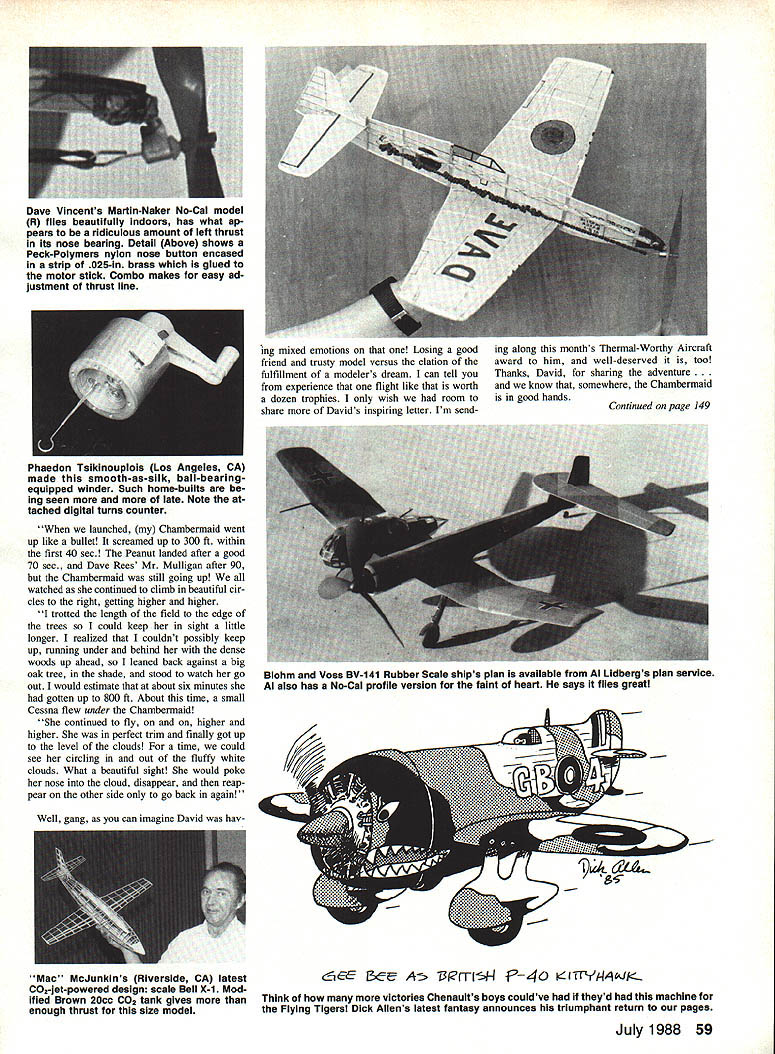
A. A. Lidberg Model Plan Service, 614 E. Fordham Dr., Tempe, AZ 85283, has a number of interesting No‑Cal (profile) Scale plans, including the Zein Z‑50L, Napier‑Heston Racer, Blohm & Voss BV‑141 (the asymmetrical WWII curiosity), Mitsubishi Claude, and the Mosca. All plans include CO2 and electric as well as Rubber Scale. A buck will bring you his catalog of goodies. Many plans are normal Scale ships; the profile series may be of special interest to modelers who like maximum fun for minimal investment.
No‑Cal Profile Scale — Jim Petro's Problem
Jim Petro (4148 E. 13th Ave., Gary, IN 46403) asks for advice on trimming his No‑Cal profile Scales. His low‑wingers are trimmed and balanced for low‑power glide with zero rudder input. He then trims rudder, wing, and thrust angle for a left‑turn with low power.
At this point the models start yawing to the right but are forced left by too large a left rudder deflection. About a quarter of the way into the circle, the model rolls left to inverted, hesitates, and then stall‑dives or starts a flat spin. If he uses high rubber power, the plane zooms in a perfect left‑turn climb until three‑quarters of the power is used up, then it flies straight into the wall in a classic right sideslip.
If you have suggestions, write directly to Jim so he can try them and report back.
CO2 Experiments — Mac McJunkin and Pete Weisman
Mac McJunkin’s CO2 experiments, as reported in the Flightmasters' newsletter, are among the most thorough and interesting I've seen. Jet‑X works, but Mac's simpler CO2 techniques have been remarkably successful. Some homebuilt CO2 motors have been too heavy, unpredictable, or dangerous. I remember the old days of puncturing Sparkletts CO2 cartridges with a phonograph needle — not very practical.
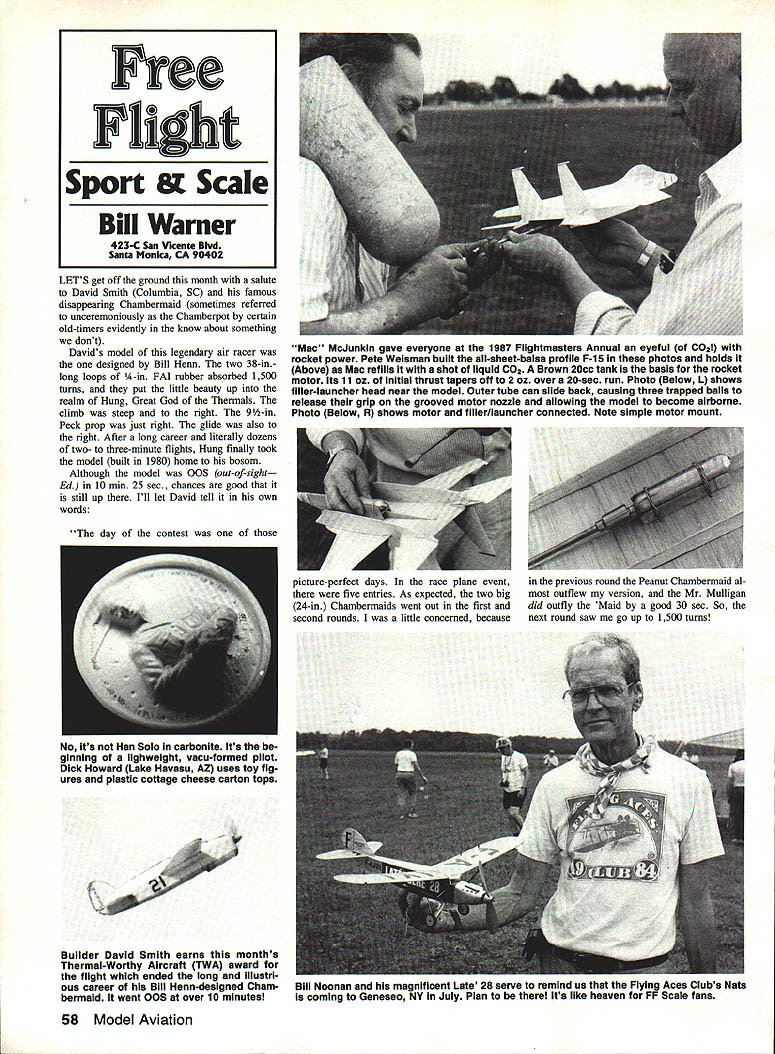
At last year’s Flightmasters Annual in Los Angeles, Mac and Pete Weisman demonstrated that CO2 jets could be practical and reliable. Pete’s all‑sheet‑balsa F‑15 made many spectacular flights of around 20 sec., climbing to 40–50 ft using the Brown 20cc CO2 tank from Peck‑Polymers equipped with a special nozzle with an .010‑in. orifice.
Mac’s special filler/launcher nozzle design features a collet with three radially spaced balls, similar to the common air‑hose connector chuck used in drilling stations. The external tube on the filler is pulled back against spring pressure, allowing the balls to move outward so the jet motor nozzle (which has an annular groove) can be inserted. Releasing the tube locks the balls into the groove. An O‑ring in the filler seals against the nozzle’s chamfered edge. The motor is filled with liquid CO2 from Mac’s fire extinguisher, shut off by its valve, and the model is launched by pulling the external keeper sleeve back to release the nozzle.
Mac has a motor with an .005‑in. orifice which runs longer, but drilling holes that size is beyond the capability of many modelers without specialized equipment.
Digital turns counters are also being used more and more on models. Mac McJunkin’s Riverside, CA CO2 work and similar home‑built experimental motors continue to be a fascinating development.
Miscellany — Dick Howard and Vac‑Formed Pilots
Dick Howard, the Lake Havasu flash, strikes again with cottage‑cheese‑lid pilots. Known for his cottage‑cheese‑container popper blades which power his twin‑engined rubber jobs, his latest achievement is using toy‑store figures and plastic cottage‑cheese carton tops as vac‑formed pilots.
Mac McJunkin’s CO2 demonstrations and David Smith’s Thermal‑Worthy Aircraft award are recent highlights. Thanks again to David for sharing the adventure and knowing the Chambermaid is in good hands. Happy landings!
Transcribed from original scans by AI. Minor OCR errors may remain.

