
Free Flight: Sport & Scale
Bill Warner 423-C San Vicente Blvd. Santa Monica, CA 90402
Naming and Markings
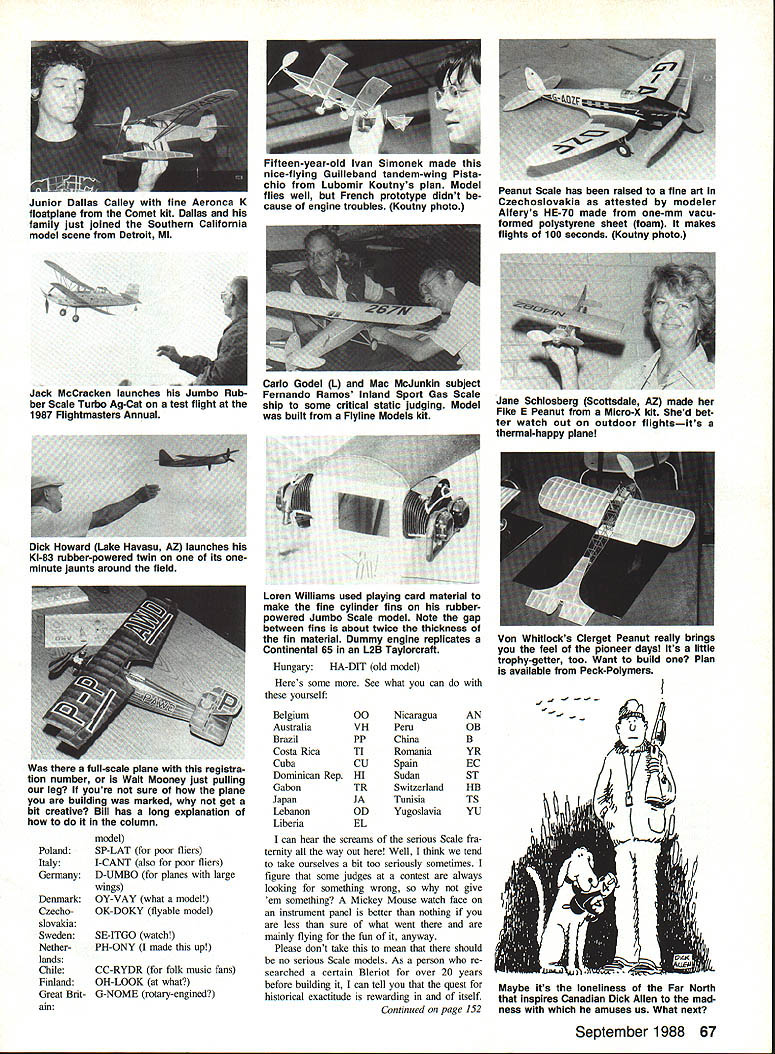
Now that the baby's born, what shall we name it? The letters on the sides and wings of a scale model can make or break it. Purists would not dream of putting on a fictitious registration, but many modelers don't enter contests and want to have fun with their models in more ways than one.
American registrations are pretty dull, as they consist of letters and numbers. Foreign registrations, however, offer a wide latitude for making statements, as they are all letters. In some states people pay to have personalized license plates on their cars. You can have a personalized model in the same way—and for no cost at all!
Actually, many of the three-view drawings and plans available do not give you a clue as to what markings might go on the plane, so you have a free hand (well, sort of). You will probably want to limit yourself to the markings of a particular country. A French plane will probably feel comfortable in French markings if they are in the places where the French put markings. You can get an idea of letter sizes, styles, and positions by looking at photos of other planes from that country and in the proper historical period.
The international code often consists of a prefix that denotes the country followed by a dash and a registration of a preset style. Some of these prefixes and examples of how you might make up a registration are as follows:
- Poland: SP-LAT (for poor fliers)
- Italy: I-CANT (also for poor fliers)
- Germany: D-UMBO (for planes with large wings)
- Denmark: OY-VAY (what a model!)
- Czechoslovakia: OK-DOKY (flyable model)
- Sweden: SE-ITGO (watch!)
- Netherlands: PH-ONY (I made this up!)
- Chile: CC-RYDR (for folk music fans)
- Finland: OH-LOOK (at what?)
- Great Britain: G-NOME (rotary-engined?)
Here are some more country prefixes — see what you can do with these yourself:
- Belgium: OO
- Australia: VH
- Brazil: PP
- Costa Rica: TI
- Cuba: CU
- Dominican Republic: HI
- Gabon: TR
- Japan: JA
- Lebanon: OD
- Liberia: EL
- Nicaragua: AN
- Peru: OB
- China: B
- Romania: YR
- Spain: EC
- Sudan: ST
- Switzerland: HB
- Tunisia: TS
- Yugoslavia: YU
I can hear the screams of the serious scale fraternity all the way out here! Well, I think we tend to take ourselves a bit too seriously sometimes. I figure some judges at a contest are always looking for something wrong, so why not give ’em something? A Mickey Mouse watch face on an instrument panel is better than nothing if you are less than sure of what went there and are mainly flying for the fun of it, anyway.
Please don't take this to mean that there should be no serious scale models. As a person who researched a certain Blériot for over 20 years before building it, I can tell you that the quest for historical exactitude is rewarding in and of itself.
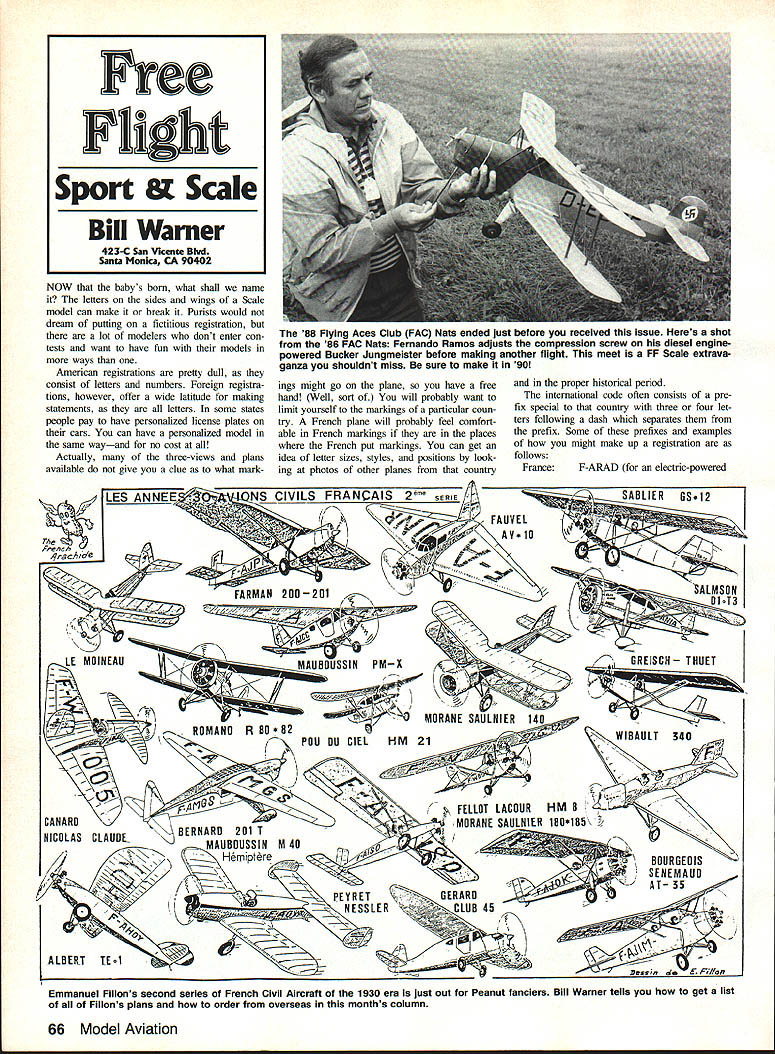
Emmanuel Fillon and French Plans
Emmanuel Fillon is one of the most remarkable modelers I have ever met. Although "retired" to the south of France, he has undertaken tasks which would have frightened off most modelers long ago. He has modeled rubber-powered fan jets, geared helicopters, and styrofoam scale models, built solar-powered models — you name it, he’s built one. Once, jokingly, I asked him if he had ever tried RC. "Well, yes," he admitted, "but I made my own radio!"
In competition he won the 1937 Wakefield Championship and is still bringing home trophies with his scale models. Let us just say that he is one fantastic modeler, and his series of French civil monoplane plans of the Thirties is likely to be the definitive set for that era. The series consists of two plan sets of 20 peanut-scale plans each and is nothing short of fantastic! The second series, just out, contains names never heard before by many modelers this side of the pond.
Have you ever heard of a Peyret-Nessler? Nicolas-Claude? Gérard Claud? Bourgeois? Griesch-Thuret? There are old favorites like the Mauboussin Hémiptère, the Fauvel flying wing, the Bernard 201-T, and the HM-21 Pou de Ciel.
If you'd like a specimen of his work and a list of all his plans including the two Thirties series, send three international reply coupons (available at your U.S. Post Office) to: E. Fillon, 60 Rue du Bocage, 83700 Saint-Raphaël, France.
When ordering plans, please use an International Money Order (from your bank) for the amount in francs. In the past he's had orders for one or two dollars — and winds up in the hole, as the French banks charge about $4 to change these dollars into francs! The price for one of the Thirties series is 150 francs (for 20 plans). A franc is usually worth in the neighborhood of 20 cents, so you have a rough idea. Postage is extra — your post office should be able to tell you what it will take to get 7½ oz. of plans across from France and you can add that to your IMO, which will be about $4. All up, the adventure will cost about $45 — or around $2.25 per plan. This is not as outrageous as it sounds considering the rare, high-quality material involved.
Building Tips and Hints
Happy hints department: writing in the Max-Fax newsletter of the DYC Meccateurs, Pat Daly reports that Mac Papers has been using Teflon tubing in knockoff applications on small models. Tubing of .023 or .024 gauge, roughened on the outside and cyanoacrylated into a hole in the structure, forms the female portion of the structural joint. Then a part of a sewing pin, embedded in the strut-to-wing attachment (or whatever), fits snugly into it. You can use thin cyanoacrylate to make the fit more snug. Don't worry, the Teflon will not stay in the glue; it lets the part rotate freely.
This type of attachment has the double advantage of absorbing crash momentum without breaking parts. It also allows for easy separation for transportation or storage in smaller boxes. The plastic insulation of small wire might work well also. The late Chuck Connors used to use tiny neoprene tubing glued on his profile models for nose bearings, so you can get glue to stick to almost anything if you roughen the surface first.
Want to make a great filler for the cracks and uneven surfaces on balsa parts? I use the fine sanding dust from my hand-held sander mixed with yellow aliphatic glue to a thick-paste consistency. Apply to gaps, let dry, then sand smooth. For a harder fill add a little cyanoacrylate. I also dilute white glue with a bit of water for fills where a less brittle finish is desired.
Peanut Scale and Events
Peanut scale has raised fine art. Czechoslovakia attests: modeler Koutný's HE-70, made of 1-mm vacuformed polystyrene sheet over foam, makes flights of 100 seconds (Koutný photo). Von Whitlock's Clerget Peanut really brings the feel of the pioneer days. It's a little trophy-getter too. Want to build? Plan available from Peck-Polymers.
The Flying Aces Club (FAC) Nats ended just before we received the issue. The free-flight scale extravaganza shouldn't be missed — be sure to make it.
Transcribed from original scans by AI. Minor OCR errors may remain.

