
Free Flight: Sport & Scale
Bill Warner
Earl Stahl's "lost" Thunderbolt plan
What could be more exciting than finding another plan by the great Earl Stahl, completely unknown and unpublished? Anyone who has been around Free Flight Scale very long has built a Stahl Rearwin Speedster or Waco E. Stahl's classic models graced magazine pages long before many of today's modelers were born. They demanded to be built, were turned out by the thousands, and they were designed to fly.
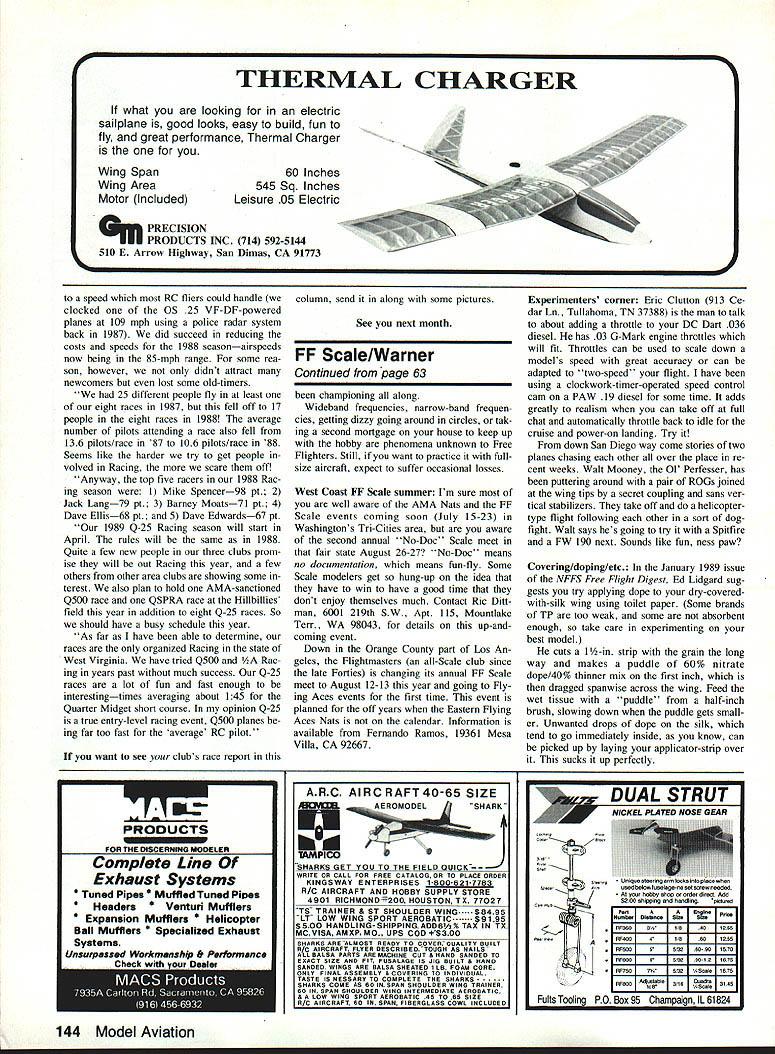
I experienced a thrill when I saw a Stahl drawing I did not even know existed. The February issue of the Scale Staffel newsletter (San Diego) ran an 80% reduction of what was obviously a Stahl P-47 Thunderbolt of the early razorback vintage. Staffel's editor Tom Arnold gleaned this gem from the Okie Free Flight Flyer edited by Bill Baker.
Problem was, the appearance in the Flyer the previous April was actually part of an April Fools' hoax perpetrated by Mik Mikkelson (and others). Many were taken in — SAM 35 in England had flyers of a Stahl "Jug" and a number of American readers were fooled too. Tom was red-faced, repentant, and the Staffel newsletter had a good laugh about it. Stahl fans still like the plan — it flies — and a reprint of the April Fools' Stahl P-47 is available from Mik's Models.
To order:
- Mik's Models, PO Box 1373, Hollywood, CA 90078 — $3 for the 24-in winner.
For real Stahl plans, try John Pond's Old Time Plan Service:
- John Pond, Old Time Plan Service, PO Box 90310, San Jose, CA 95109-3310 — catalogs (two parts) for $3. He has literally thousands of rubber and gas scale plans, including 12 different Rubber Scale Thunderbolts cataloged in two parts.
Models that become exhibits
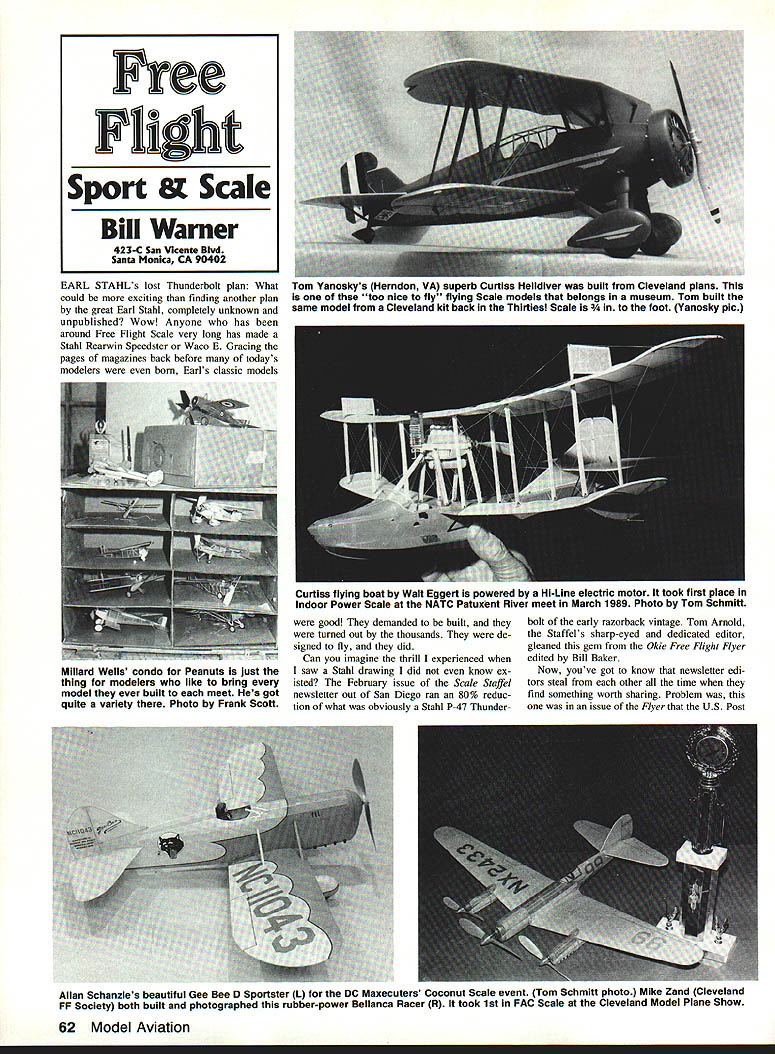
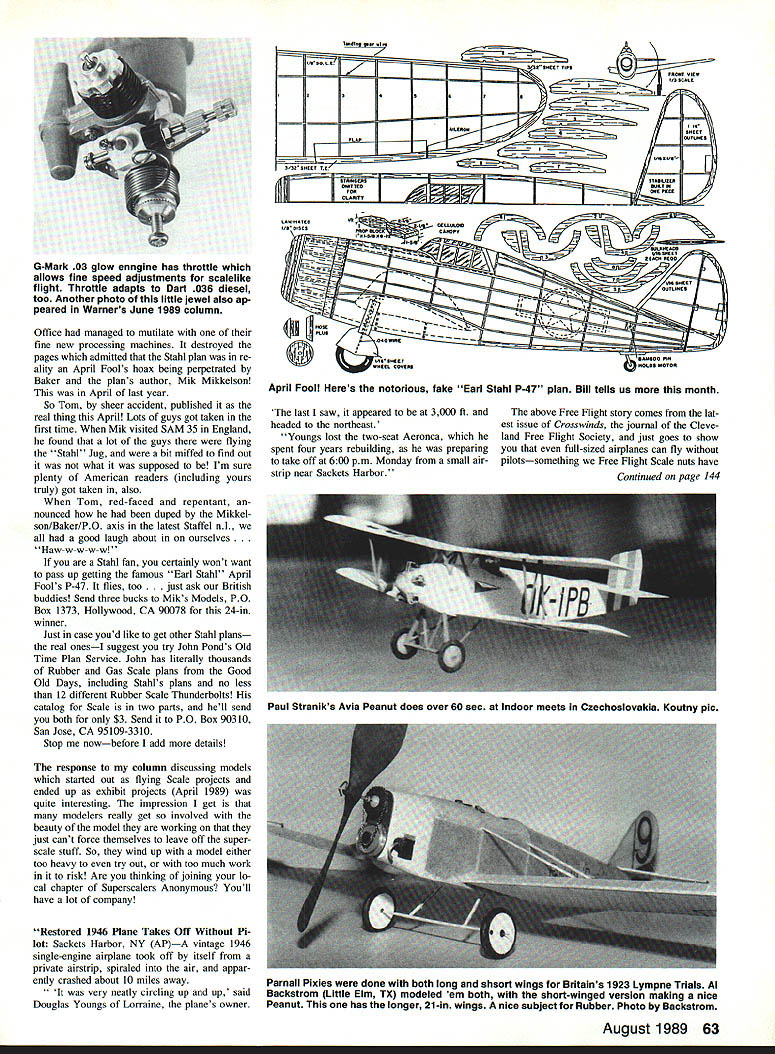
The response to my column about projects that start as flying Scale models and end up as exhibit models (April 1989) was interesting. Many modelers become so involved with the beauty of a model that they can't force themselves to leave off the super-scale detailing. The result can be a model too heavy to trim out or too valuable to risk flying. If you find yourself in this camp, you won't be alone — plenty of company in what I jokingly call "Superscalers Anonymous."
West Coast FF Scale summer events
- AMA Nats and FF Scale events: July 15–23 in Washington's Tri-Cities area.
- Second annual "No-Doc" Scale meet (fun-fly, no documentation): August 26–27 in Washington. Contact Ric Dittman, 6001 29th St. W., Apt. 115, Mountlake Terrace, WA 98043 for details.
- Fightmasters (Orange County) FF Scale meet: August 12–13 this year, moving to Fly-In Acres events. Planned for off years when the Eastern Flying Aces Nats is not on the calendar. Information: Fernando Ramos, 19361 Mesa Villa, CA 92667.
Experimenters' corner
- Throttles for small diesels: Eric Clutton (913 Cedar Ln., Tullahoma, TN 37388) has G-Mark engine throttles that fit a DC Dart .036 diesel. Throttles let you scale down a model's speed or implement a simple two-speed flight.
- Clockwork-timer throttle: I have used a clockwork-timer-operated speed control on a PAW .19 diesel. It allows full-power takeoff and an automatic throttle-back to idle for cruise and power-on landing, adding realism.
- Walt Mooney (C/L professor) has been experimenting with a pair of ROGs joined together by a secret coupling to form vertical stabilizers. They take off and perform helicopter-type flights, following each other in a sort of dogfight. Walt plans to try it with a Spitfire and an Fw-190 next.
Covering, doping and dyeing tissue
Ed Lidgard (NFFS Free Flight Digest, Jan 1989) suggests applying nitrate dope to dry-covered flying wings using toilet paper. Key points:
- Cut a 1/2-in. strip with the grain the long way.
- Fasten a puddle of 60% nitrate dope / 40% thinner mix on the first inch of the strip and drag it sparwise across the wing.
- Feed the wet tissue with a "puddle" from a half-inch brush, slowing when the puddle gets smaller.
- Unwanted drops on the silk can be picked up by laying the applicator-strip over them; the tissue will absorb the excess.
- This method fills about 80% of the pores on the first go-round; finish with another 1/2-in. strip or a soft brush.
- Use a good thinner and do not exceed about 40% dope in the mix.
To remove wrinkles: soften the dope with acetone or thinner, lift the softened doped silk at the edges, and stretch it (tweezers or fingers).
Dyeing tissue:
- Dye adds virtually no weight but overlapping layers can show darker where two layers meet.
- Condenser tissue can be colored with a yellow Marks-A-Lot wide-tip permanent marker — overlaps blend well. Red and blue may not do as well.
- Some modelers open permanent markers, soak the wick in lacquer or dope thinner, and spray the mixture on tissue while on a shrinking frame or on the model. Dick Howard used this to restore a fading blue-tissued model successfully.
- Spray dyes are available at art stores but can be expensive and unreliable (some cans lose pressure quickly). Avoid runs on vertical surfaces by applying thin coats.
- Dr. Martin's dyes with alcohol work well for me.
If you have a great dyeing technique, please share it.
Hatch latch and access hatches
Old plans sometimes suggested holding hatches or cowlings with dress snaps — a frustrating method because aligning the male and female halves blind was difficult, and snaps often overstressed glue joints. I recall a friend's gas-model cowling popping loose from vibration; the prop shredded it before he could shut down the engine.
A more reliable modern option (Gene Stiff, Bat Sheet newsletter) uses nylon wire ties (cable ties):
- Cement the ratcheted head to the inside of the fuselage at one edge of the hatch opening.
- Bend a right-angle into the serrated tail and cement that to the inside of the hatch with serrations facing away from the hatch and aligned to mesh with the ratchet head.
- The result is neat, inexpensive, and secure.
Personally I use a simple three-hook-and-loop rubberband method to retain battery-box hatches on Old-Timers, but the cable-tie latch is an excellent blind-hatch solution.
Miscellaneous notes and contacts
- If you want more information about Russ' E-30 thoughts (motors and tuning for free flight), contact: Russ — 215 E. Montclair Ave., Milwaukee, WI 53217.
- For the Mik's Models reprint of the April Fools' Stahl P-47: Mik's Models, PO Box 1373, Hollywood, CA 90078 — $3.
- For authentic Stahl plans and catalogs: John Pond's Old Time Plan Service, PO Box 90310, San Jose, CA 95109-3310 — catalogs (two parts) $3.
Have a great summer flying. And remember: if God had intended us to use fancy little wrenches to remove glow heads, he would not have given us pliers.
Transcribed from original scans by AI. Minor OCR errors may remain.

