
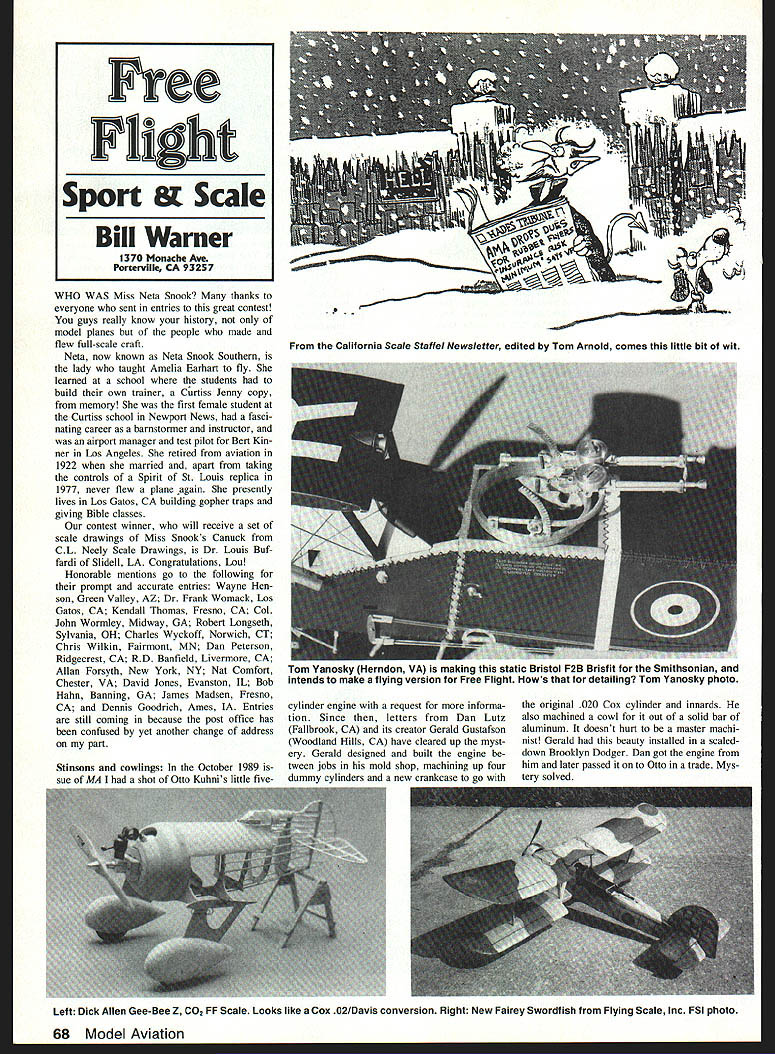
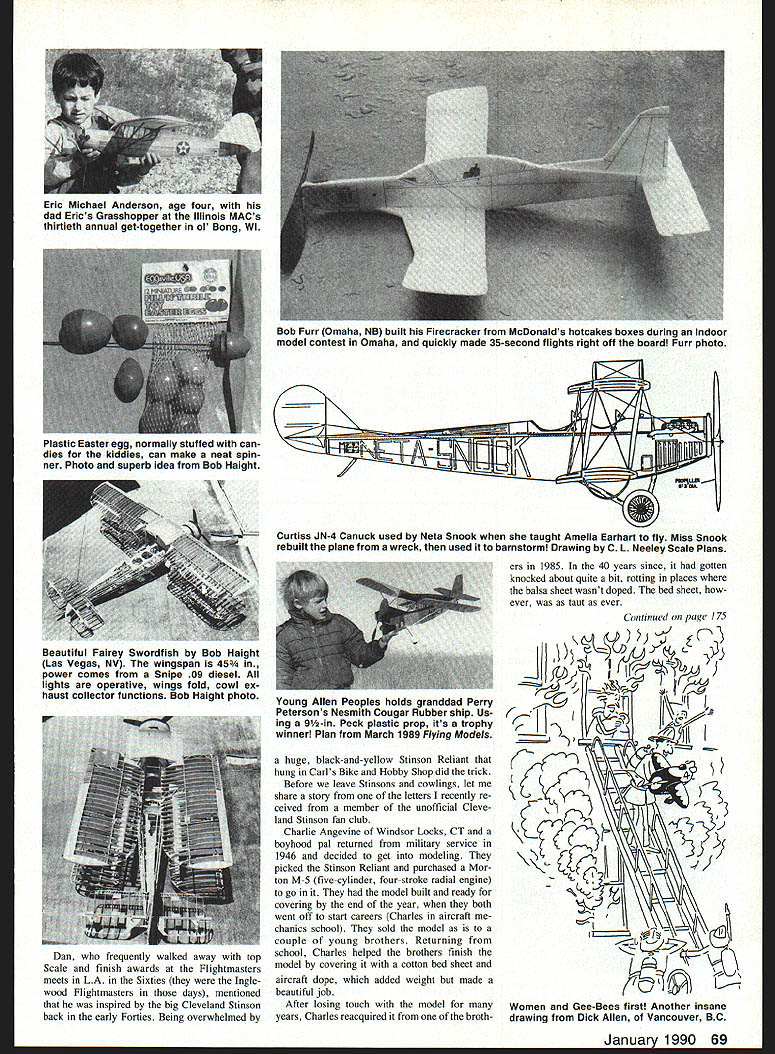
Free Flight: Sport & Scale
Bill Warner 1370 Monache Ave. Porterville, CA 93257
Who was Neta Snook?
Many thanks to everyone who sent in entries to this great contest! You guys really know your history, not only of model planes but of the people who made and flew full-scale craft.
Neta, now known as Neta Snook Southern, is the lady who taught Amelia Earhart to fly. She learned at a school where the students had to build their own trainer, a Curtiss Jenny copy, from memory. She was the first female student at the Curtiss school in Newport News, had a fascinating career as a barnstormer and instructor, and was an airport manager and test pilot for Bert Kinner in Los Angeles. She retired from aviation in 1922 when she married and, apart from taking the controls of a Spirit of St. Louis replica in 1977, never flew a plane again. She presently lives in Los Gatos, CA, building gopher traps and giving Bible classes.
Our contest winner, who will receive a set of scale drawings of Miss Snook's Canuck from C.L. Neely Scale Drawings, is Dr. Louis Buffardi of Slidell, LA. Congratulations, Lou!
Honorable mentions go to the following for their prompt and accurate entries:
- Wayne Henson, Green Valley, AZ
- Dr. Frank Womack, Los Gatos, CA
- Kendall Thomas, Fresno, CA
- Col. John Wormley, Midway, GA
- Robert Longseth, Sylvania, OH
- Charles Wyckoff, Norwich, CT
- Chris Wilkin, Fairmont, MN
- Dan Peterson, Ridgecrest, CA
- R.D. Banfield, Livermore, CA
- Allan Forsyth, New York, NY
- Nat Comfort, Chester, VA
- David Jones, Evanston, IL
- Bob Hahn, Banning, CA
- James Madsen, Fresno, CA
- Dennis Goodrich, Ames, IA
Entries are still coming in because the post office has been confused by yet another change of address on my part.
Stinsons and cowlings
In the October 1989 issue of SAM I had a shot of Otto Kuhnis's little five-cylinder engine with a request for more information. Since then, letters from Dan Lutz (Fallbrook, CA) and its creator Gerald Gustafson (Woodland Hills, CA) have cleared up the mystery. Gerald designed and built the engine between jobs in his mold shop, machining up four dummy cylinders and a new crankcase to go with the original .020 Cox cylinder and innards. He also machined a cowl for it out of a solid bar of aluminum. It doesn't hurt to be a master machinist! Gerald had his beauty installed in a scaled-down Brooklyn Dodger. Dan got the engine from him and later passed it on to Otto in a trade. Mystery solved.
Dan, who frequently walked away with top scale and finish awards at the Flightmasters meets in L.A. in the Sixties (they were the Inglewood Flightmasters in those days), mentioned that he was inspired by the big Cleveland Stinson back in the early Forties. Being overwhelmed by a huge, black-and-yellow Stinson Reliant that hung in Carl's Bike and Hobby Shop did the trick.
Before we leave Stinsons and cowlings, let me share a story from one of the letters I recently received from a member of the unofficial Cleveland Stinson fan club.
Charlie Angevine of Windsor Locks, CT, and a boyhood pal returned from military service in 1946 and decided to get into modeling. They picked the Stinson Reliant and purchased a Morton M-5 (five-cylinder, four-stroke radial engine) to go in it. They had the model built and ready for covering by the end of the year, when they both went off to start careers (Charles in aircraft mechanics school). They sold the model as is to a couple of young brothers. Returning from school, Charles helped the brothers finish the model by covering it with a cotton bed sheet and aircraft dope, which added weight but made a beautiful job.
After losing touch with the model for many years, Charles reacquired it from one of the brothers in 1985. In the 40 years since, it had gotten knocked about quite a bit, rotting in places where the balsa sheet wasn't doped. The bed sheet, however, was as taut as ever.
A lot of reconstruction and manufacturing were necessary, using Wylam scale drawings rather than the original plans. After an unsuccessful attempt to spin a cowl from an old aluminum pot, he made a fiberglass cowl instead. Next came the rocker arm blisters for the cowl.
Charles first made a hardwood form for the streamlined bump, then molded the female form over it in plaster of Paris with an aluminum tube bonded into the bottom. Using a heat gun meant for stripping paint, he used lamp power to pull the heated sheet plastic down into the cavity. It took about three dozen tries to get the 18 blisters that were needed.
Silkspan was used to cover the new vertical fin and the fuselage, which had originally been sheeted; but the bed sheet was just painted over. Two problems still remain—finding an affordable engine of the proper size, and deciding whether or not to fly it.
Charles has had plenty of advice against flying it, but is leaning toward biting the bullet anyway. Says Charles: "If it does crash, it will be a fitting and final end to the saga of a 42-year-old maiden. If it flies well and safely, I'll be a hero." I can certainly empathize with that philosophy! If any of you sentimental old-timers out there would like to help Charles out with an extra engine and/or encouragement, you can write him at 41 Circle Dr., Windsor Locks, CT 06096.
Plastics department
The ol' Vegas Vulture, Bobby Haight, advises you to stock up at Easter-time on those little plastic eggs that you're supposed to stuff with candies for the kids. They make great spinners, as evidenced by his Fiat G-55 Centauro. They're not as heavy as you might expect. In any case, you could always vacuum-form over them.
Robert Furr of Omaha, NE reports that his Firecracker, built out at an indoor contest site from meat-tray foam and McDonald's hotcakes boxes, flew over 30 seconds right off the board. Originally using a 3/16-oz. Sig prop, Bob has improved his times since switching to a 6-in. Peck unit. He uses an 11 x 1/2 x 1/4-in. balsa motor stick.
Paul McIlrath of Cedar Rapids, IA writes that his J-3 Piper peanut cranked from foam is the lightest he's ever built. In addition to the foam, he uses only a few reinforcing strips of balsa and a plastic prop. His Pou Du Ciel uses the blue insulating foam for the fuselage and empennage, with yellow (meat-tray foam) for the main wing, which he neatly bends up into its characteristic parabolic dihedral in a matter of seconds. Paul feels that the versatility and durability of foam recommend it for many uses. Its low cost and uniform consistency as a lightweight material make it a good medium for a quick project.
Balsa department
Prior to the advent of plastics, balsa was the material of choice for the discriminating modeler. For legions of balsa lovers, this wood can never be supplanted by any man-made material. Fred Wilson, writing in the June/July issue of the Digest of the National Free Flight Society ($15 per year from NFFS, 6146 E. Cactus Wren Rd., Scottsdale, AZ 85253), suggests picking up the 1989 Sig Catalog #51 as a good way of learning more about balsa. The catalog contains tables of wood sizes for balsa, spruce, dowels, and plywood.
I wonder how many people know the facts behind this wonder wood, and why it's so difficult to find the prized 3–4 lb/ft³ C-grain sheet? I'd like to share a few bits of info gleaned from Fred's article, and from a presentation Sal and Mike Taibi gave to a Flightmasters meeting a couple of years ago (they've been in the model business for many years, since Sal worked in the saw room at Berkeley Models in 1938).
The balsa tree, technically a hardwood, grows like a weed and lives like a pest in Ecuador and Peru, sometimes reaching 30 ft in the first year. It grows wild and can't be cultivated, getting its start in the shade of other trees.
The wood, 90% air, has an excellent strength-to-weight ratio but practically no resistance to fungus and decay. Only about half the wood that emerges from the drying kilns is usable. About 10% of this is used in the modeling industry. Sal says that of the 10,000 board-feet minimum that he's required to buy, only about 50–100 ft is usable!
They try to save as much as they can when they band-saw, using extra-thin blades moving at extremely high speed. Finally, 90% of the balsa is sanded on both sides. Still, a lot of excellent wood goes to the dump in the form of sawdust. Now you know why balsa is so precious!
Looking at the end of the sheet, you'll see the growth-ring pattern. Sheets with the grain running perpendicular to the flat surface of the sheet are called A-grain; they're what you get when you saw a sheet straight from the edge of the log to the heart. A-grain is very supple and goes around curves well.
C-grain has the growth rings more or less parallel to the flat surface and won't bend much before it cracks with the grain. Frank Zaccai used to call it "cracker-grain." Highly desirable because of its stiffness, naturally it's the scarcest cut.
All other sheets are called B-grain. Falling somewhere between the A- and C-grains, this is the most common type of balsa around. The growth rings cut across the end of the sheet at approximately 45°, leaving lots of leeway on the actual random angle. It's a good multipurpose cut.
Perhaps the single factor that most influences a modeler's choice of balsa is density. Since it's not a man-made product, you'll find lots of sheets that are soft on one side and hard on the other. Fred takes his Triner brand scale (purchased from an office supply house for about $10) to the hobby shop. Using a piece of masking tape hanging from the scale as a note to mark the wood, he weighs his sheets before purchase. He then takes the cream of the crop home and candles them.
Candling is accomplished by taping a black construction paper mask with a 3-in. slot over a lamp. In a dark room you can easily spot and mark the lighter areas and the darker dense areas. It will help you spot those so-called wind checks, or side-to-side weakness cracks, that are caused by the tree falling. You don't want one of those in the middle of a spar!
The Sig Catalog can be obtained by sending $3 to Sig Mfg. Co., 401 So. Front St., Montezuma, IA 50171. Another source of helpful information as well as a source for balsa and kits is Micro-X Products, P.O. Box 1063, Lorain, OH 44055. Their catalog (St. 50) has a sheet on the subject of analyzing grain.
Good medicine for tissue in Japan
By way of Bill McCombs down in Dallas (whose flying and adjusting book has just been translated and published in Japanese) comes some interesting news. Tsuyoshi Katsuyama of Tokyo mentions a medicinal drink called Fibe-Mini, a vegetable fiber drink intended to add regularity. Diluted 5:1 and applied to tissue, it makes the tissue unshrinkable! Applied in higher concentrations, it will make the tissue stretch. Well, gang, this seems too good to be true. But we won't know till we try, and so your homework assignment for next month is to find the American equivalent of Fibe-Mini. I expect all of you out there have before you some sort of nasty concoction to try it on tissue and report back to us. I tried Budweiser, but it shrinks it just the same as water.
In the same letter Tsuyoshi notes the disappearance of Gampi tissue from stores. Made from the fibers of the wild Kozo tree, it was used in Japan instead of Esaki (0.024 oz. per 100 sq. in.), and names have gone the way of '72.
Should you be interested in obtaining a copy of Bill McCombs' book in English or Japanese, I suggest you write him at 416 Sista Dr., Dallas, TX 75224. It's a treasure trove of information for the scale modeler who wants his or her model to fly.
Free Flight: Sport & Scale
Neat new drawings
- 34-in. Fairey Swordfish, rubber. Send $6 to FSI, 1905 Colony Rd., Metairie, LA 70003.
- 40-in. Cessna Airmaster, rubber. Send $6 to A.A. Liberg, 614 E. Fordham Dr., Tempe, AZ 85283.
- 34-in. Rearwin Cloudster (three-view super-scale). Send $19.80 to Vern Clements, 308 Palo Alto Dr., Caldwell, ID 83605.
- 32-in. JN-4 Curtiss Canuck as flown by Miss Neta Snook when she taught Amelia Earhart (three-view scale drawings). Send $11 to C.L. Neely, P.O. Box 3963, Visalia, CA 93278.
Errata
The photo caption on page 73 of the October 1989 issue of MA identifies one of Ralph Kuzner's models as a Martin-Baker. It's actually, as several readers have informed me, a P-51. The Martin-Baker 5 has slightly rounded stab tips. The Gamma in the same photo should have been identified as a Northrop Gamma (Jack Northrop having left Lockheed by then, I suppose).
Well, gang, until next time, keep the silverfish out of your tissue and your Trexler's Armor-All!
Note new address: Bill Warner, 1370 Monache Ave., Porterville, CA 93257.
FF Duration/Linstrum
(Continued from page 71)
This stooge took me to a club meeting in Los Angeles. I fell in love with it and know that Wakefield fliers and those who wind the big Mulvihills will want it as an essential piece of field equipment.
Some of the stooge's important features follow:
- It's made of hardwood and extra-strong aluminum tubing and sheet. It has two sizes of pins and holes for large or small models.
- You can assemble the head block four ways, so you can get two widths and two heights. This can be changed easily in the field to accommodate different models.
- The fuselage support arm is infinitely adjustable, elevating the nose to just where you want it when the motor is stretched out. Two pegs and 300-lb. test nylon cord will hold up under the biggest motor you can wind.
- You can put all your stuff on the stooge with a small ply table and holes for a winder (see drawing), stuffing stick, winding tube, and fishout wire.
This stooge belongs in every serious rubber flier's kit. To get your simply terrific Simplex stooge by return mail postpaid, send a check or money order for $52 (in U.S.A.; California residents add sales tax) to Simplex Stooge, 143 Richmond St., El Segundo, CA 90245.
NFFS Champs / Murphy
(Continued from page 77)
The first of a host of flying scale events, AMA Peanut Scale, was flown on Tuesday. Flying one of those odd and complex-looking Santos Dumonts, Jim Miller (Dayton, OH) edged out two comparatively orthodox ships—Claude Curry's Lacy and Carl Loehle's Fike—to take first place. Don DeLoach mustered enough points with his Waterman Gosling to win the Junior/Senior category.
The final three Nostalgia events were well represented as Monday's had been. Bob Watson of Morton Grove, IL, captured 1/2A Gas. Dennie Phillips (Chappaqua, NY) won Class B handily with a gorgeous City Boy 61. Dennis' model looked too pretty to fly with its red silk and light blue doped trim. Elmer Jordan picked up his second win of the day in the Nostalgia Gas Ignition event with his Arden, 19-powered Ehling Phoenix.
As I was getting ready to leave the field early to prepare for the SAM dinner at the local Lawrenceville Elks Club, Jim had asked me to help him launch his A2 Nordic Glider on the effort. He thought it would be a 20-second test hop. Forty-five minutes later his high-thermaling model finally DTEd over a gravelly pit only about a mile to the west. That gave us an idea of the scarcity of wind drift on this second day of competition. On the same line as this note, the 1/2A and Nostalgia events went on without a hitch.
Although the A2 incident erased any opportunity to win, place, or show, we're happy to mention that the Elks Club crew — Norm Reames, Bob Placer, and I — did an admirable job in the field events. After a most delicious dinner, SAM 57 passed out about a thousand dollars worth of door prizes to lucky winners, including a $100 lifetime membership in SAM. It was a terrific evening.
Contest Director Dick Smith and his crew were all smiles as events began Wednesday morning. Floyd Miller's early weather forecast continued to predict fine weather.
Transcribed from original scans by AI. Minor OCR errors may remain.

