
Free Flight: Sport & Scale
Bill Warner
1370 Monache Ave., Porterville, CA 93257
Springs
Modelers always seem to need springs, yet the sizes required are not always readily available. Springs have many uses:
- Hold down hatch covers
- Cushion landings
- Imitate valve springs on dummy engines
- Center-caster tail wheels
- Other custom installations
There are two common types of springs:
- Tension (extension) springs: resist being pulled apart and act to pull things together (useful to keep a cowling pulled down tight).
- Compression springs: resist being compressed and push things apart (used in landing-gear struts, often with two nesting sizes of tubing for a sliding leg).
Both types are easy to make with a little practice.
Winding springs by hand
In a machine shop springs are wound on a lathe by feeding wire onto a round mandrel held in the chuck. A guide with a hole controls the feed angle and tension; the carriage movement controls coil spacing. A slow carriage movement winds coils tightly together (as for an extension spring); a faster movement spaces the coils farther apart (as for a compression-type coil spacing).
You can hand-wind springs easily:
- Use thin music wire or guitar string (.015 works well around nails of various diameters).
- Clamp the end of the wire in vise-grip pliers and wrap the wire tightly around the round mandrel (nail or rod), keeping the wire-feed angle slightly behind the actual wind to maintain tight coils.
- For a tension spring, bend the hook end with needle-nose pliers.
- For a compression-type spring, grasp the coils and stretch or compress until the spring takes the desired set; closer coils give a stiffer action.
Small-diameter springs with wide coil spacing can be stiff when used as sliding landing gear or oleo struts. To create progressively stiffer action, start the spring with close coil spacing at one end and increase the spacing toward the other end. The wheel will see a softer action on initial contact and get stiffer as the leg shortens on harder landings.
Using a simple winder
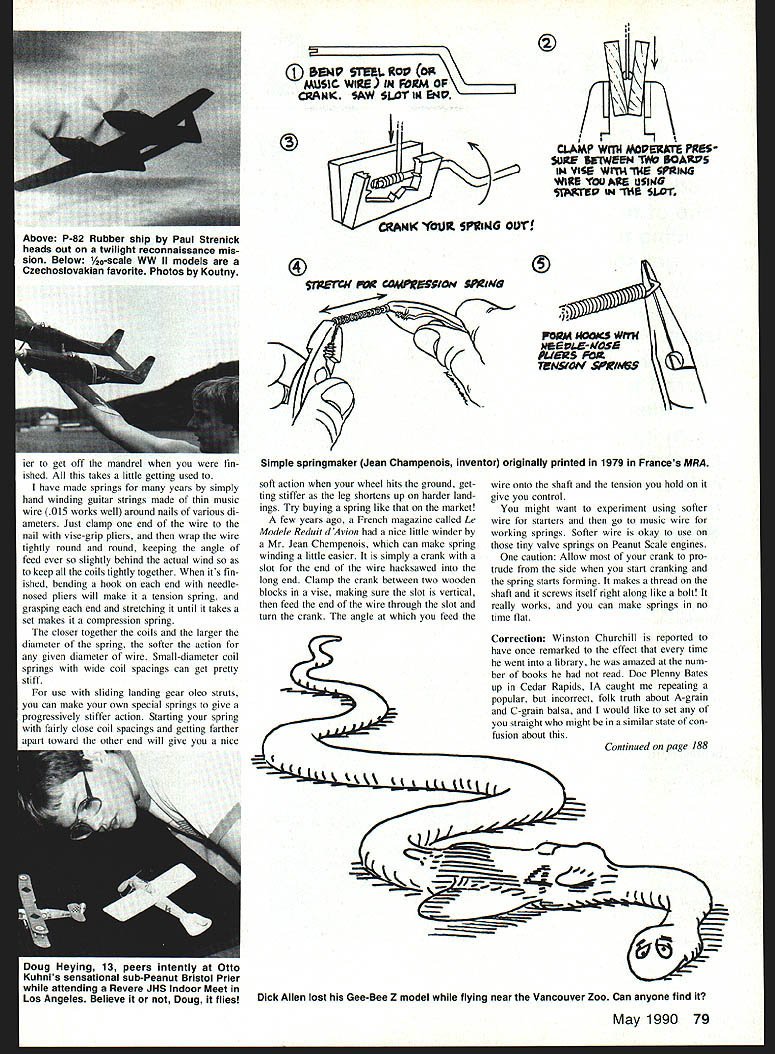
A small winder published in Le Modèle Réduit d'Avion by Jean Champenois makes spring winding easier. Use a hacksawed long end as a crank, clamp it between two wooden blocks in a vise with the slot vertical, feed the wire through the slot, and turn the crank while angle-feeding the wire onto the shaft. Tension control gives consistent coils.
Tips and cautions:
- Experiment with softer wire when starting; then move to music wire for working springs. Softer wire is fine for tiny valve springs and Peanut Scale engines.
- Allow the crank to protrude to the side when you start cranking; as the spring forms the wire will thread along the shaft like a bolt and will screw itself on.
Correction: A- and C-grain balsa
I once repeated a popular but incorrect folk truth about A-grain and C-grain balsa. The little lines seen on the end of balsa sheets are not growth rings (as they would be in pine). Those lines are medullary rays, which radiate from the center of the tree outward.
- C-grain (cracker) balsa: the medullary rays are parallel to the sheet's top and bottom surfaces.
- A-grain (bendable) balsa: the rays connect the two surfaces.
- B-grain: rays are at an intermediate angle across the sheet end.
If someone confuses growth rings with medullary rays, you can now set them straight.
Nylon screws
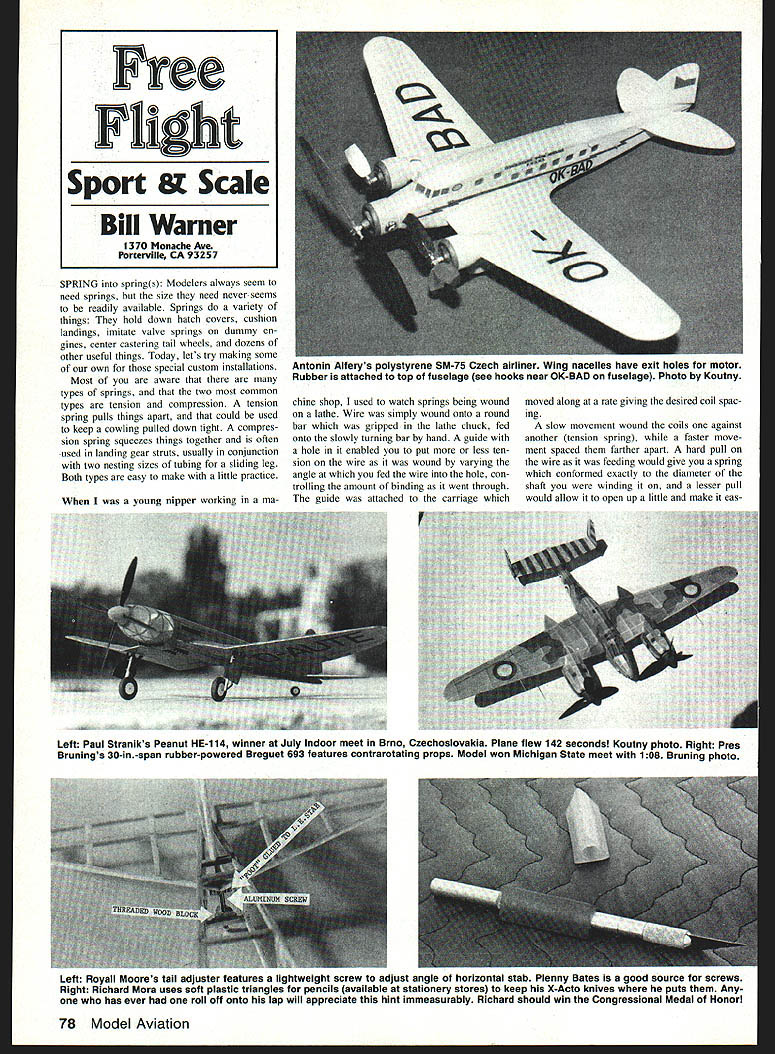
Many modelers use small nylon screws as an adjusting mechanism for trim. Royall Moore once sold an adjusting screw consisting of an aluminum screw threaded into a glued block in the fuselage with a freely rotating tooth glued to the trailing edge of the horizontal stabilizer. Joe Bailey used a small-diameter nylon screw for the same purpose.
If you want nylon screws, send $1 and a SASE with 45¢ postage to: Plenny Bates 2505 White Eagle Tr. S.E. Cedar Rapids, IA 52403
He supplies 25 screws (2-56 slotted head) for that amount.
U.S. Free Flight Champs to move
In 1990 the annual Memorial Day Bash at Taft moved to a new location known as Lost Hills, farther north in California's Central Valley. Sal Taibi reports the new site is even better than the old one: very flat, unobstructed by trees or bushes, and excellent for thermals. You can do long flights and still land on the field.
Balsa density
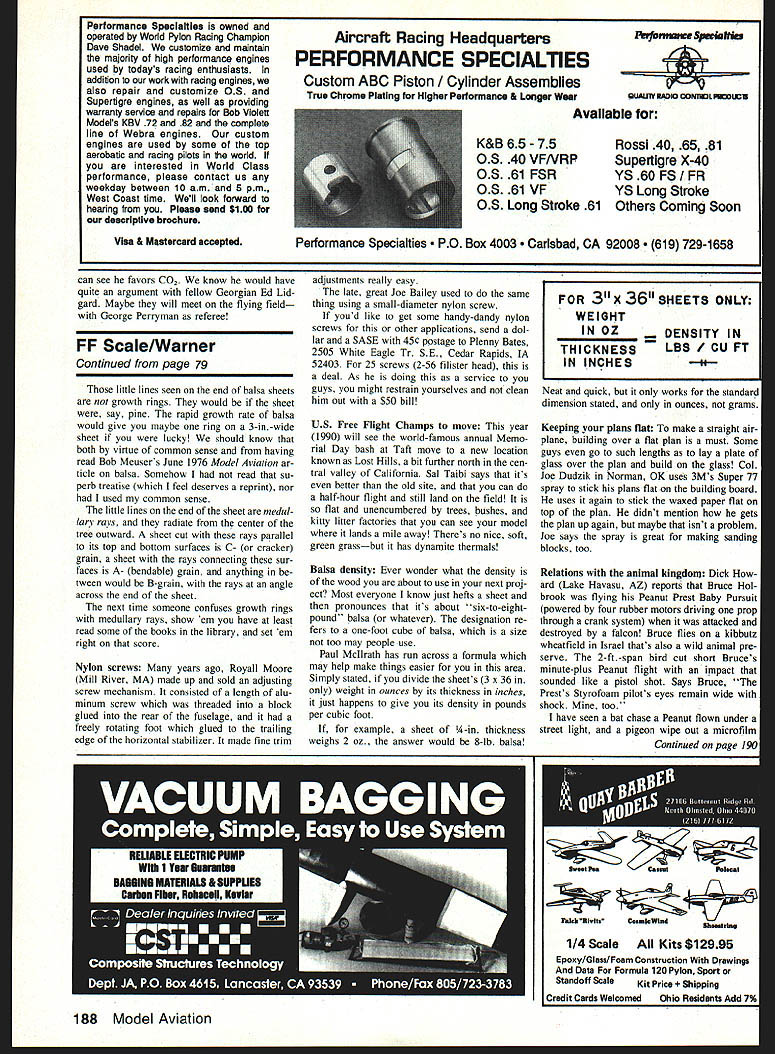
To estimate the density (pounds per cubic foot) of a 3" x 36" balsa sheet, divide the sheet's weight in ounces by its thickness in inches. Example: a 1/4" sheet that weighs 2 oz. is 8-lb. balsa (2 ÷ 0.25 = 8).
Relations with the animal kingdom
Dick Howard reports that Bruce Holbrook was flying his Peanut Predator (powered by four rubber motors driving one prop through a crank system) over a kibbutz wheatfield that is also a wild-animal preserve when it was attacked and destroyed by a falcon. The 2-ft.-span bird ended Bruce's minute-plus Peanut flight with an impact that sounded like a pistol shot. Bruce says, "The Presto's Styrofoam pilot's eyes remain white on the shock."
I have also seen a bat chase a Peanut flown under a street light.
Transcribed from original scans by AI. Minor OCR errors may remain.

