
Free Flight: Sport & Scale
Bill Warner 1370 Monache Ave. Porterville, CA 93257
WHAT GOES UP must come down. That's a truism — everything except taxes. Certainly returning to terra firma accounts for most modelers' grief. Assuming your model is Free Flight and has no pilot to flare at the last moment, it generally flies right smack into the deck with only minimal help from ground effect. Quite often the main purpose of the landing gear (I prefer the word undercarriage, since the gear serves for more than just landings in the classical sense) is to make the plane look scale, help ROG (rise‑off‑ground), and cushion the crash.
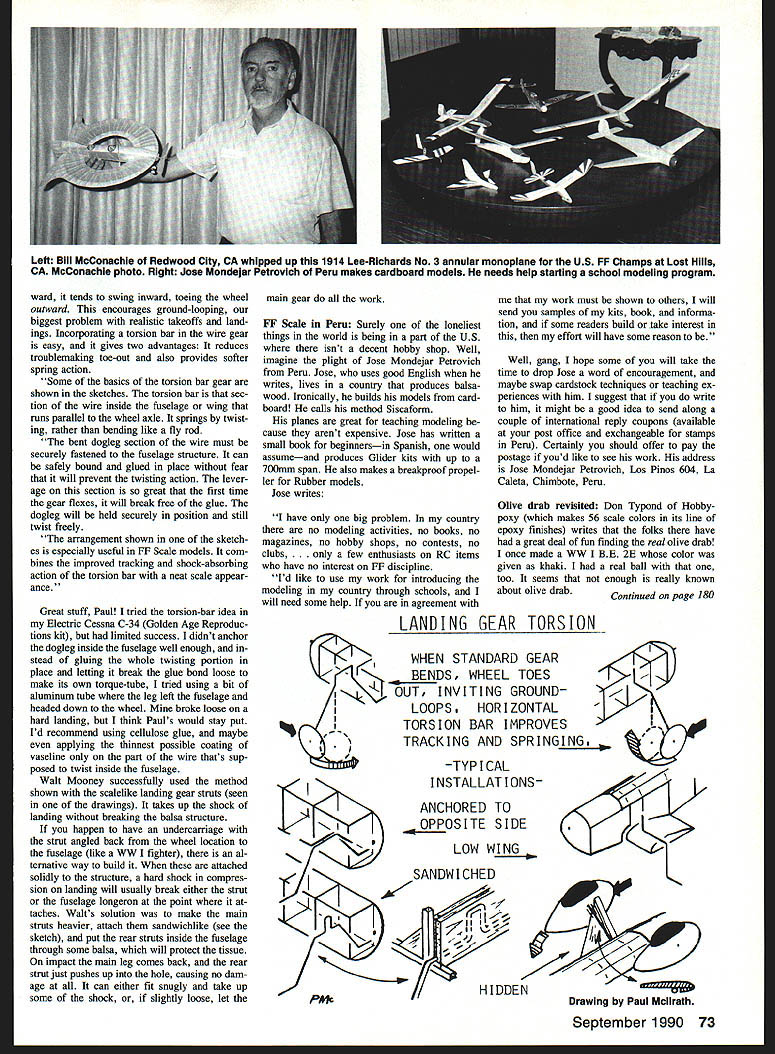
Torsion‑bar undercarriage (Paul McIlrath)
Paul McIlrath, Cedar Rapids, IA, offers some neat thoughts on undercarriage construction. He points out that much of the force on the wheel and gear is backward as well as upward — true for both takeoffs and landings. The industry‑standard single‑strut wire gear is neat and effective, but a simple variation can noticeably improve performance.
Incorporating a torsion‑bar wire gear is easy and gives two main advantages:
- Reduces trouble‑making toe‑out (which encourages ground‑looping).
- Provides a softer, more forgiving spring action.
Basics of the torsion‑bar arrangement:
- The torsion‑bar section of wire inside the fuselage or wing runs parallel to the wheel axle; the springs twist rather than bend like a fly rod.
- A dogleg section of wire must be securely fastened to the fuselage structure where it leaves the fuselage and heads down to the wheel.
- You can glue the dogleg in place; although it may seem the glue would prevent twisting, the first flex will usually break the glue locally and the dogleg will remain held yet still twist freely.
Paul tried the idea on an electric Cessna C‑34 (Golden Age Reproductions kit) with limited success because he didn't anchor the dogleg inside the fuselage well enough. He experimented with a short length of aluminum tube at the fuselage exit for the leg; the tube assembly eventually broke loose on a hard landing. Recommended practice:
- Anchor the dogleg securely inside the fuselage (epoxy, glued balsa bearing, or a snug tube/ferrule).
- Consider using cellulose glue and apply a very thin coating of Vaseline to the part of the wire intended to twist, so the glue holds the dogleg position but does not lock the torsion action.
Walt Mooney's sandwich strut
Walt Mooney successfully used a related method for scale‑like landing gear struts that take up shock before it breaks balsa structure. The problem arises especially when the undercarriage strut is angled back and the wheel is located near the fuselage (as on many WW‑I fighters): a hard shock or compression landing tends to break either the strut or the fuselage longeron where it attaches.
Walt's solution:
- Make the main struts heavier and attach them sandwich‑style to the structure.
- Put the rear struts inside the fuselage through a block of balsa so they protect the tissue covering on impact.
- When the main leg comes back, the rear strut simply pushes up through a hole, causing little or no damage.
- The rear strut can be fitted snugly to absorb some shock, or slightly loose to allow free movement.
This arrangement combines improved tracking, shock absorption, and a neat scale appearance.
FF Scale in Peru (Jose Mondejar Petrovich)
One of the loneliest plights in modeling is being in a country without hobby shops or clubs. Jose Mondejar Petrovich of Chimbote, Peru, writes in good English that although Peru produces balsa wood, he builds his models from cardboard using a method he calls Siscaform.
Key points about Jose's work:
- His card‑stock models are inexpensive and well suited to teaching modeling.
- He has written a small beginner's book (presumably in Spanish).
- He produces glider kits up to 700 mm span and makes a breakproof propeller for rubber models.
- He reports there are virtually no modeling activities, books, magazines, hobby shops, contests, or clubs in his area and would like help introducing modeling in schools.
Jose asked for encouragement and for anyone interested to exchange techniques or teaching experiences. If you write to him, consider including international reply coupons (available at post offices) or offering to pay postage. His address:
Jose Mondejar Petrovich Los Pinos 604 La Caleta Chimbote, Peru
Olive drab revisited
Don Tyner of Hobby‑Poxy (which produces 56 scale colors in tins of epoxy finishes) reports they've had a great deal of fun tracking down the "real" olive drab. I once painted a WW‑I B.E.2E whose color was listed as khaki; that project was enjoyable, too. It seems there is still more to learn about authentic olive drab shades for scale work.
Transcribed from original scans by AI. Minor OCR errors may remain.

