
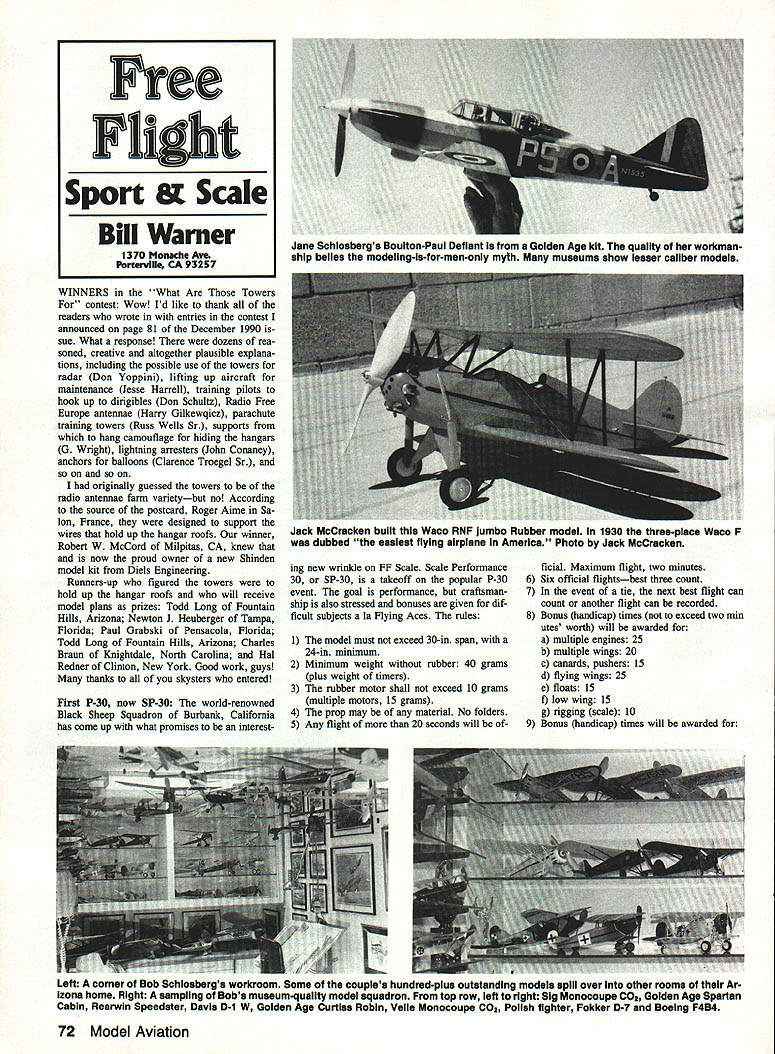
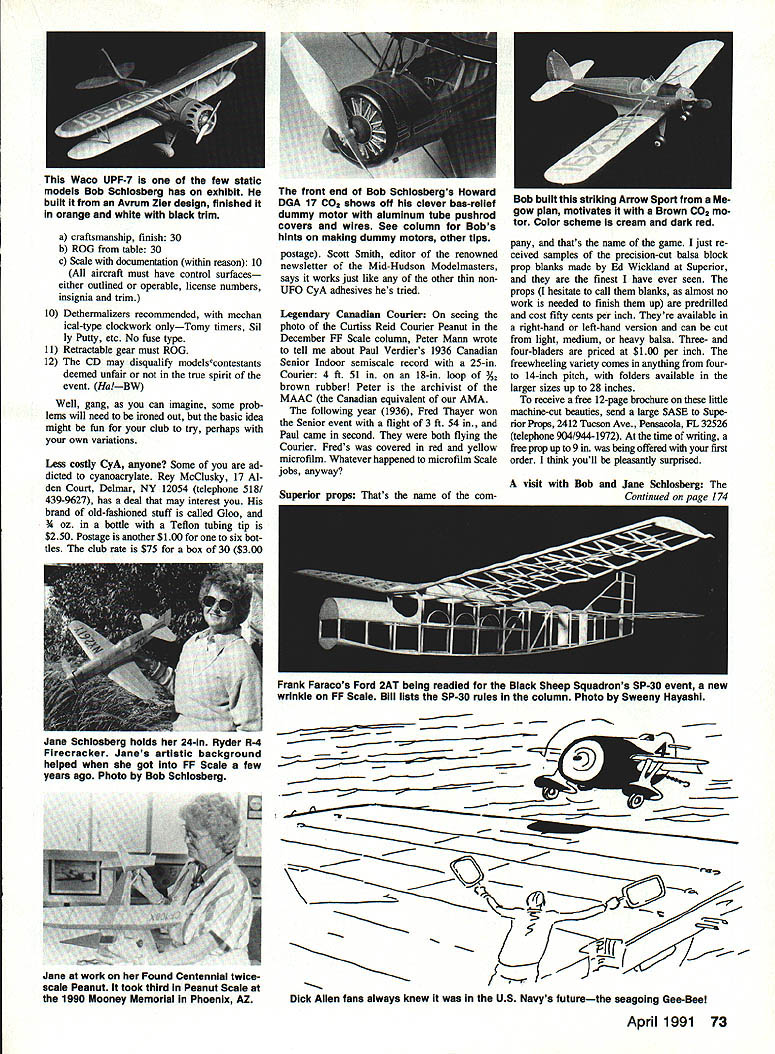
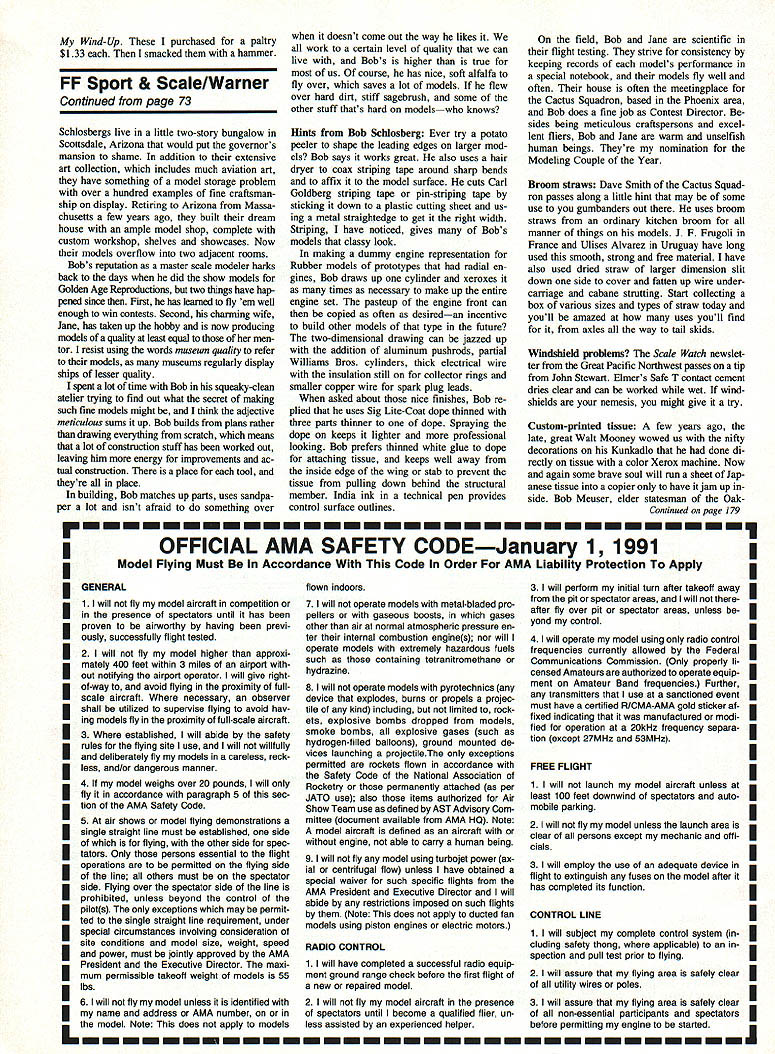
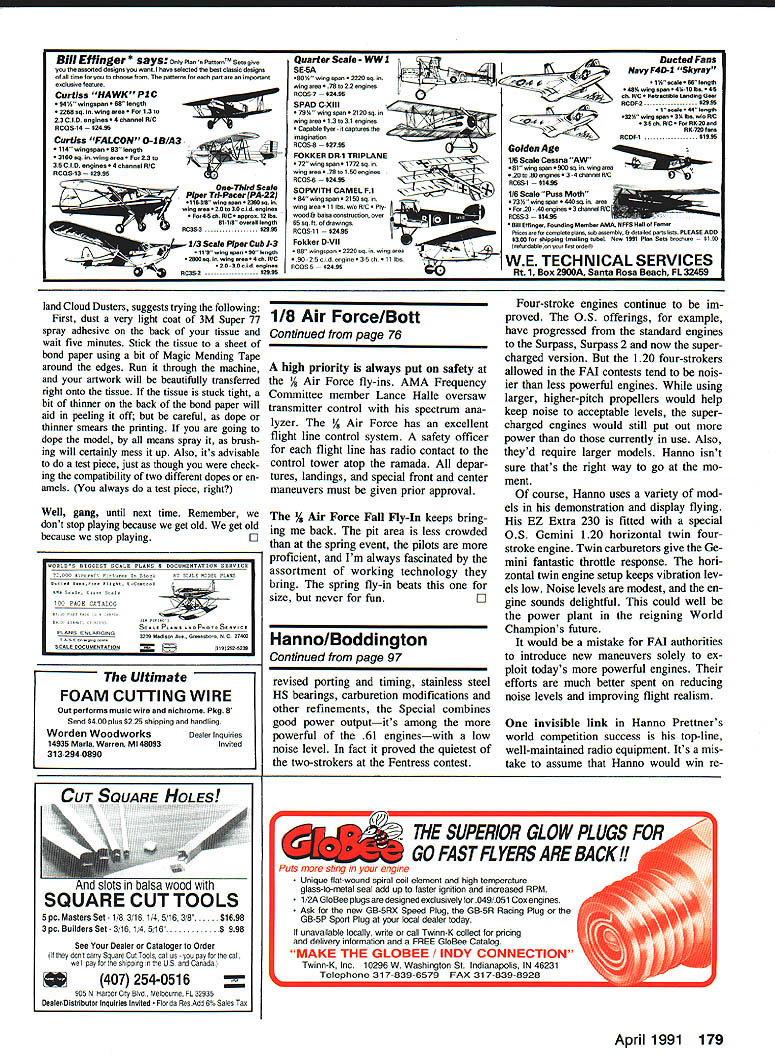
Free Flight: Sport & Scale
Bill Warner 1370 Monache Ave Porterville, CA 93257
WINNERS in the "What Are Those Towers For" contest
Wow! I'd like to thank all of the readers who wrote in with entries in the contest I announced on page 81 of the December 1990 issue. What a response! There were dozens of reasoned, creative and altogether plausible explanations, including use of the towers for radar (Don Yoppini), lifting up aircraft for maintenance (Jesse Harrell), training pilots to hook up dirigibles (Don Schultz), Radio Free Europe antennae (Harry Gilkewicz), parachute training towers (Russ Wells Sr.), supports from which to hang camouflage for hiding the hangars (G. Wright), lightning arresters (John Conaney), anchors for balloons (Clarence Troegel Sr.), and more.
I had originally guessed the towers to be of the radio antenna farm variety—but not! According to the source of the postcard, Roger Aime in Salon, France, they were designed to support the wires that hold up the hangar roofs. Our winner, Robert W. McCord of Milpitas, CA, knew that and is now the proud owner of a new Shinden model kit from Diels Engineering.
Runners-up who figured the towers hold up the hangar roofs will receive model plans as prizes:
- Todd Long, Fountain Hills, Arizona
- Newton J. Heuberger, Tampa, Florida
- Paul Grabski, Pensacola, Florida
- Charles Braun, Knightdale, North Carolina
- Hal Redner, Clinton, New York
Good work, guys — many thanks to all of you who entered!
First P-30, now SP-30
The world-renowned Black Sheep Squadron of Burbank, California has come up with what promises to be an interesting new wrinkle on FF Scale. Scale Performance 30, or SP-30, is a takeoff on the popular P-30 event. The goal is performance, but craftsmanship is also stressed and bonuses are given for difficult subjects. The Flying Aces rules:
- The model must not exceed 30 in. span, with a 24 in. minimum.
- Minimum weight without rubber: 40 grams (plus weight of timers).
- The rubber motor shall not exceed 10 grams (multiple motors, 15 grams).
- The prop may be of any material. No folders.
- Any flight of more than 20 seconds will be official. Maximum flight, two minutes.
- Six official flights—best three count.
- In the event of a tie, the next best flight can count; another flight can be recorded.
- Bonus (handicap) times (not to exceed two minutes) will be awarded for:
- multiple engines: 25
- multiple wings: 20
- canards; pushers: 15
- flying wings: 25
- floats: 15
- low wing: 15
- rigging (scale): 10
Well, gang, I can imagine some problems will need ironing out, but the basic idea might be fun for a club to try, perhaps with its own variations.
Less costly CyA, anyone?
Some addicted to cyanoacrylate (CyA) might be interested in a deal from Rey McClusky, 17 Alden Court, Delmar, NY 12054, telephone 518/439-9627. He offers a brand of old-fashioned CyA called Gloo: 1-oz bottle with Teflon tubing tip, $2.50; postage another $1.00. Six bottles, club rate $7.50; box of 30, $30.00.
Scott Smith, editor of the newsletter of the Mid-Hudson Modelmasters, says it works just like any of the other thin cyanoacrylate adhesives he's tried.
Legendary Canadian Courier
On seeing the photo of the Curtiss Reid Courier Peanut in the December FF Scale column, Peter Mann wrote to tell me about Paul Verdier's 1936 Canadian Senior Indoor sesquimodel record with a 25-in. Courier: 4 ft. 5 in. on an 18-in. loop of 3/32 brown rubber! Peter is the archivist of the MAAC (the Canadian equivalent of our AMA). The following year (1936), Fred Thayer won the Senior event with a flight of 3 ft. 5 in., and Paul came in second. They were both flying the Courier. Fred's was covered in red and yellow microfilm. Whatever happened to microfilm scale jobs, anyway?
Superior Props
That's the name of the company, and that's the name of the game. I just received samples of the precision-cut balsawood prop blanks made by Ed Wicklard at Superior, and they are the finest I have ever seen. The props (I hesitate to call them blanks, as almost no work is needed to finish them up) are predrilled and cost fifty cents per inch. They're available in a right-hand or left-hand version and can be cut from light, moderate, or heavy balsa. Three- and four-bladers are priced at $1.00 per inch. The freewheeling variety comes in anything from four- to 14-inch pitch, with folders available in the larger sizes up to 28 inches.
To receive a free 12-page brochure on these little machine-cut beauties, send a large SASE to Superior Props, 2412 Tucson Ave., Pensacola, FL 32526 (telephone 904/944-1972). At the time of writing, a free prop up to 9 in. was being offered with your first order. I think you'll be pleasantly surprised.
A visit with Bob and Jane Schlosberg
The Schlosbergs live in a little two-story bungalow in Scottsdale, Arizona that would put the governor's mansion to shame. In addition to their extensive art collection, which includes much aviation art, they have something of a model storage problem with over a hundred examples of fine craftsmanship on display. Retiring to Arizona from Massachusetts a few years ago, they built their dream house with an ample model shop, complete with custom workshop, shelves and showcases. Now their models overflow into two adjacent rooms.
Bob's reputation as a master scale modeler harks back to the days when he did the show models for Golden Age Reproductions, but two things have happened since then. First, he has learned to fly 'em well enough to win contests. Second, his charming wife, Jane, has taken up the hobby and is now producing models of a quality at least equal to those of her mentor. I resist using the words "museum quality" to refer to their models, as many museums regularly display ships of lesser quality.
I spent a lot of time with Bob in his squeaky-clean atelier trying to find out what the secret of making such fine models might be, and I think the adjective meticulous sums it up. Bob builds from plans rather than drawing everything from scratch, which means a lot of construction details have been worked out, leaving him more energy for improvements and actual construction. There is a place for cachet, and it's all in place.
In building, Bob matches up parts, uses sandpaper a lot and isn't afraid to do something over when it doesn't come out the way he likes it. We all work to a certain level of quality that we can live with, and Bob's is higher than is true for most of us. Of course, he has nice, soft alfalfa to fly over, which saves a lot of models. If he flew over hard dirt, stiff sagebrush, and other rough surfaces, who knows?
Hints from Bob Schlosberg
- Use a potato peeler to shape the leading edges on larger models — it works great.
- Use a hair dryer to coax striping tape around sharp bends and to affix it to the model surface.
- Cut Carl Goldberg striping tape or pin-striping tape by skiving it down on a plastic cutting sheet and using a metal straightedge to get the right width. Striping gives many of Bob's models that classy look.
- For dummy radial engines, draw one cylinder and xerox it as many times as necessary to make up the entire engine front. The pasteup of the engine front can then be copied as often as desired. Jazz it up with aluminum pushrods, partial Williams Bros. cylinders, thick insulated wire for collector rings and smaller copper wire for spark plug leads.
- Finishes: Bob uses Sig Lite-Coat dope thinned with three parts thinner to one part dope. Spraying the dope on keeps it lighter and more professional looking. He prefers thinned white glue to dope for attaching tissue, and keeps well away from the inside edge of the wing or stab to prevent tissue from pulling down behind the structural member. India ink in a technical pen provides control surface outlines.
- On the field, Bob and Jane are scientific in their flight testing. They strive for consistency by keeping records of each model's performance in a special notebook. Their models fly well and often. Their house is often the meeting place for the Cactus Squadron, based in the Phoenix area, and Bob does a fine job as Contest Director. Besides being meticulous craftspersons and excellent fliers, Bob and Jane are warm and unselfish human beings — my nomination for Modeling Couple of the Year.
Broom straws
Dave Smith of the Cactus Squadron passes along a little hint that may be of use to modelers elsewhere. He uses broom straws from an ordinary kitchen broom for general maintenance on his models. J. F. Frugoli in France and Ulises Alvarez in Uruguay have long used this smooth, strong and free material. I have also used dried straw of larger dimension and found one side useful to cover and fasten up wire undercarriage and cabane strutting. Start collecting a box of various sizes and types of straw today and you'll be amazed at how many uses you'll find for it, from axles all the way to tail skids.
Windshield problems?
The Scale Watch newsletter from the Great Pacific Northwest passes on a tip from John Stewart. Elmer's Safe-T contact cement dries clear and can be worked with white. If windshields are your nemesis, you might give it a try.
Custom-printed tissue
A few years ago, the late Walt Mooney wowed us with the nifty decorations on his Kunkel that he had done directly on tissue with a color Xerox machine. Now again some brave soul will run a sheet of Japanese tissue into a copier only to have it jam up inside. Bob Meuser, elder statesman of the Oakland Cloud Dusters, suggests trying the following:
First, use a very light coat of 3M Super 77 spray adhesive on the back of your tissue and wait five minutes. Stick the tissue to a sheet of bond paper using a bit of Magic Mending Tape around the edges. Run it through the machine, and your artwork will be beautifully transferred right onto the tissue. If the tissue is stuck tight, a bit of thinner on the back of the bond paper will aid in peeling it off; but be careful, as dope or thinner smears the printing. If you are going to dope the model, by all means spray it, as brushing will certainly mess it up. Also, it's advisable to do a test piece, just as though you were checking the compatibility of two different dopes or enamels.
Well, gang, until next time. Remember, we don't stop playing because we get old. We get old because we stop playing.
Transcribed from original scans by AI. Minor OCR errors may remain.

