
Free Flight: Sport & Scale
Bill Warner
Sikorsky S‑39 and the Johnsons
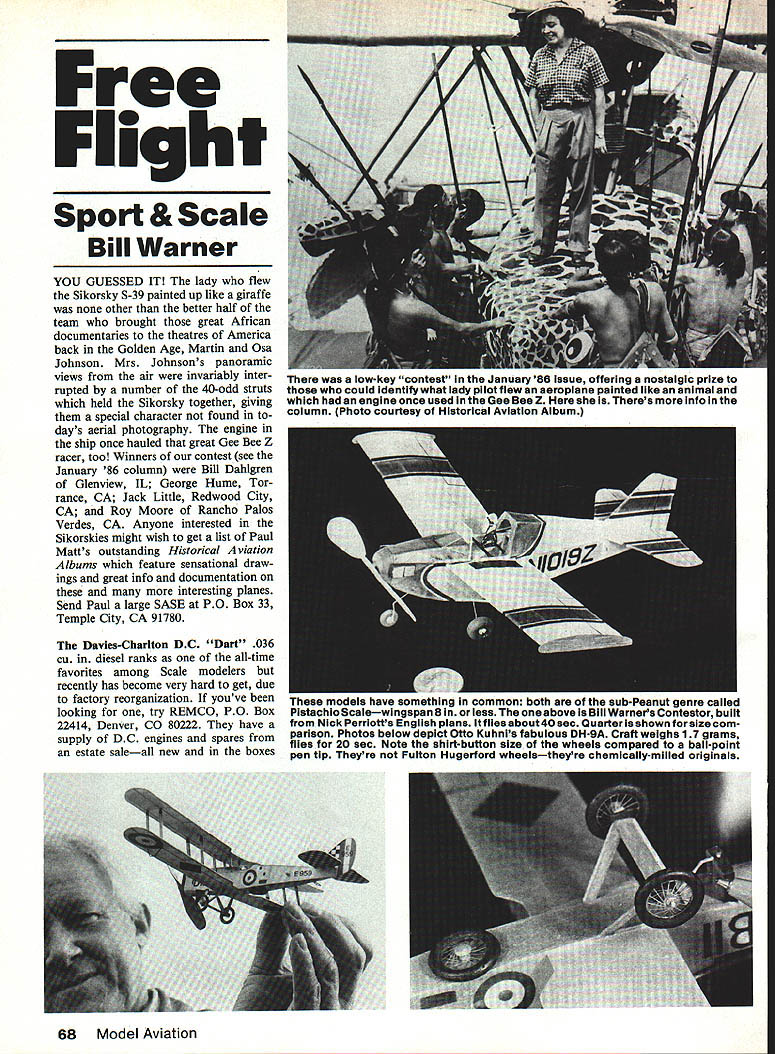
You guessed it — the lady who flew the Sikorsky S‑39 painted like a giraffe was none other than Osa Johnson, the better half of the team (Martin and Osa Johnson) who brought those great African documentaries to American theatres in the Golden Age. Mrs. Johnson's panoramic aerial views were invariably interrupted by the 40‑odd struts that held the Sikorsky together, giving those photos a special character not found in today's aerial photography. The engine in that ship once hauled the great Gee Bee Z racer, too.
Contest Winners
Winners of our contest (see the January ’86 column):
- Bill Dahlgren, Glenview, IL
- George Hume, Torrance, CA
- Jack Little, Redwood City, CA
- Roy Moore, Rancho Palos Verdes, CA
Resources: Paul Matt’s Historical Aviation Albums
Anyone interested in Sikorskys or other classic types might request Paul Matt’s outstanding Historical Aviation Albums, which feature sensational drawings and thorough documentation. They’re a bargain at $14.50 a copy. Send a large SASE to:
- Paul Matt, P.O. Box 33, Temple City, CA 91780
Davies‑Chariton D.C. “Dart” Engine Availability
The Davies‑Chariton D.C. “Dart” .036 cu. in. diesel ranks as an all‑time favorite among scale modelers but has become hard to find due to factory reorganization. If you’ve been looking for one, try:
- REMCO, P.O. Box 22414, Denver, CO 80222
They have a supply of D.C. engines and spares from an estate sale — all new and in the boxes.
Pistachio (Sub‑Peanut) Size
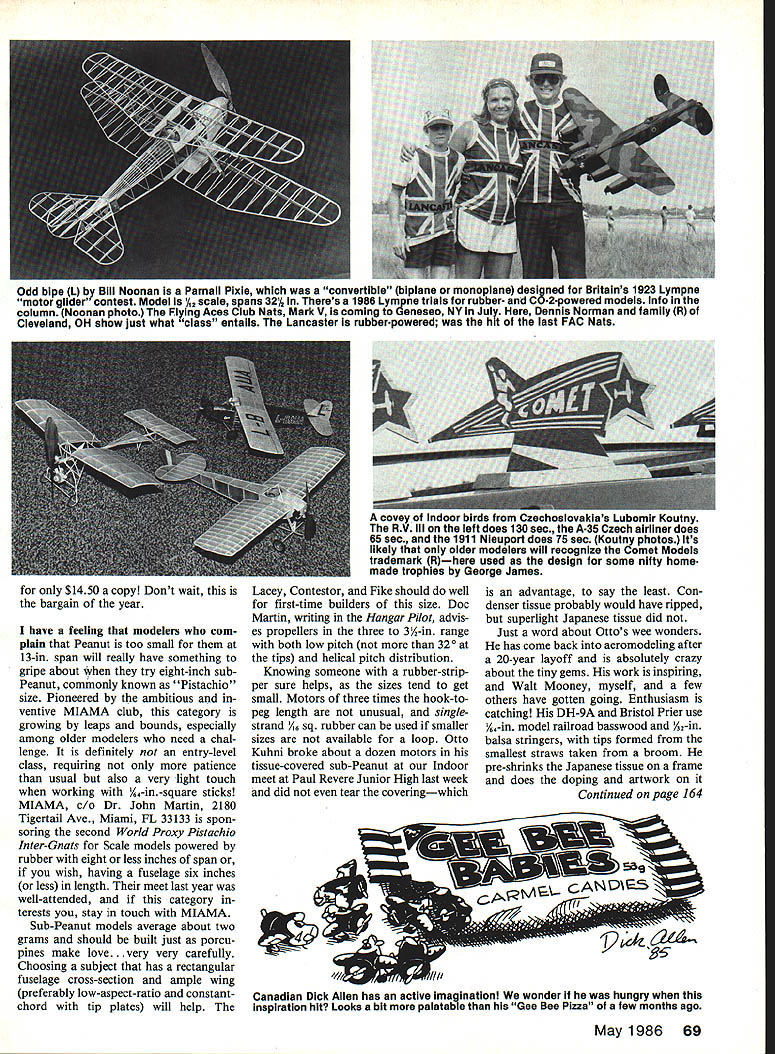
If you thought Peanut (13‑in. span) was small, brace yourself for the eight‑inch sub‑Peanut, commonly called “Pistachio.” Pioneered by the inventive MIAMA club, this category is growing rapidly, especially among older modelers seeking a challenge. It is definitely not an entry‑level class: it requires great patience and an extremely light touch when working with 1/4‑in. square sticks.
MIAMA is sponsoring the second World Proxy Pistachio Inter‑Gnats for scale models powered by rubber that have an eight‑inch span or less — or, if you prefer, a fuselage six inches or less in length. Their meet last year was well attended. For information:
- MIAMA, c/o Dr. John Martin, 2180 Tigertail Ave., Miami, FL 33133
Sub‑Peanut models average about two grams and should be built just — porcupines make love — very, very carefully.
Tips for Building Sub‑Peanuts
- Choose a subject with a rectangular fuselage cross‑section and ample wing area — preferably low aspect‑ratio, constant‑chord wings with tip plates.
- Good first subjects: the Lacey Contestor and the Fike.
- Propellers: 3 to 3‑1/2 in. diameter with low pitch (not more than 32° at the tips) and a helical pitch distribution (advice from Doc Martin, Hangar Pilot).
- Motors: motors three times the hook‑to‑peg length are common; single‑strand 1/16‑sq. rubber can be used when loops in smaller sizes are unavailable.
- A rubber‑strip presser is handy because the motors tend to get very small.
At our indoor meet at Paul Revere Junior High, Otto Kuhni broke about a dozen motors in his tissue‑covered sub‑Peanut without tearing the covering. Condenser tissue probably would have ripped; superlight Japanese tissue did not.
Otto Kuhni’s Techniques
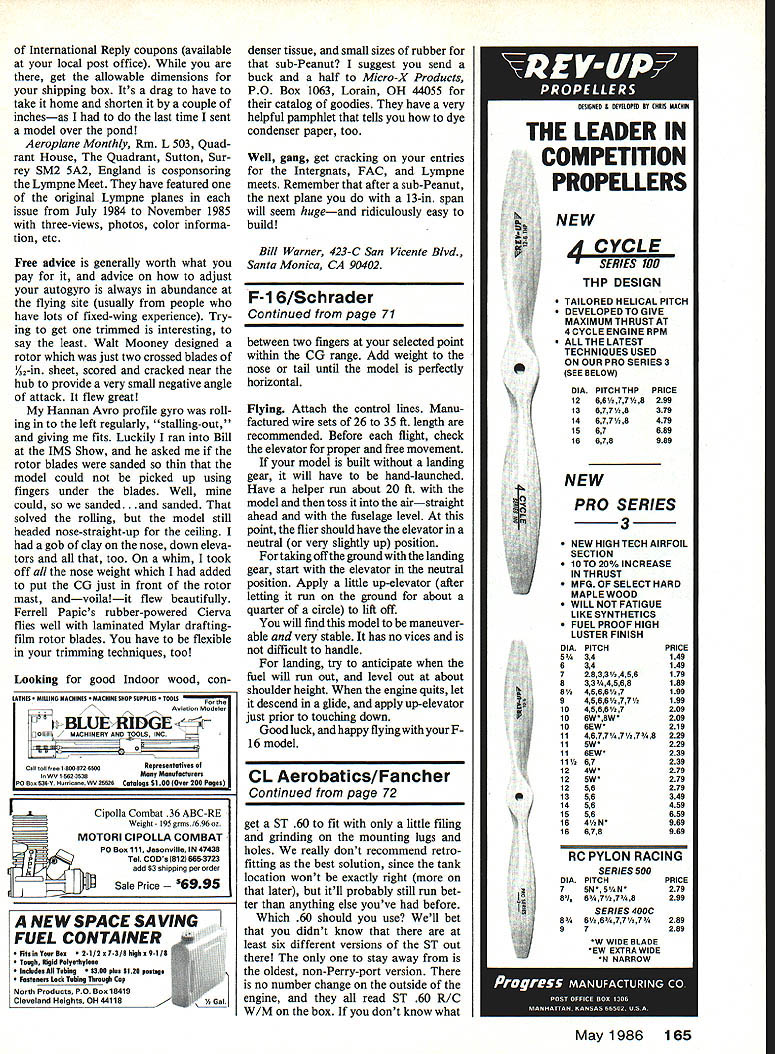
Otto, back into aeromodeling after a 20‑year layoff, is enthusiastic about tiny models. His work is inspiring: his DH‑9A and Bristol Fighter use 1/8‑in. model‑railroad basswood with 1/32‑in. balsa stringers; tips formed from the smallest broom straws; Japanese tissue pre‑shrunk on a frame, then painted and detailed. He sticks covering on with thinned white glue and lightly airbrushes Floquil model railroad enamel to get opacity while keeping weight under two grams.
His approach to wheels is unique. Otto draws the hub, rim, and spoke pattern, has the artwork photographically reduced (several sizes on a sheet), and uses chemical milling (photo‑etching) on very thin (.001‑in.) brass. The artwork is projected onto a photo‑sensitized coating; ultraviolet light hardens the exposed areas, and an acid bath removes the rest, leaving tiny, accurately spoked wheel sides to which balsa tires are added.
Plans and Small‑Scale Subjects
I received a one‑inch‑to‑the‑foot plan for a rubber‑power ABC Robin and a list of other plans from Speed Wilson of Toko. The list includes some 30 plans at 1/2‑scale that sell for $4 each postpaid, and a few larger‑scale plans for about $10, mostly from the late‑Twenties to mid‑Thirties era. On the sample plan the lettering wasn’t fancy and some outlines were freehand, but everything needed to build the model was there: gussets, braces, and sensible design. Speed Wilson (a commercial pilot) says most plans were drawn for his own use; some are better than others. For a price list:
- Toko, P.O. Box 283, Welches, OR 97067
Flying Aces Nats (Mark V)
The Flying Aces Nats, Mark V, is coming on July 18–20 at Geneseo, NY (about 30 miles south of Rochester). Co‑directors Bob Clemens and Vet Thomas are staging the meet at the Geneseo Airport, which also houses the National Warplane Museum.
Event highlights:
- Friday night: indoor flying with a wine‑and‑cheese reception to kick off the festivities.
- Saturday & Sunday: Flying Aces events including regular and mass‑launch Free Flight Scale contests.
- Saturday night: banquet.
- Lodging: dormitory lodging and meals about a mile away; motels nearby.
For details and schedules, send a large SASE to:
- Bob Clemens, 95 Shoreview Dr., Rochester, NY 14612
If you need a copy of the Flying Aces rules, ask Bob — and plan to attend; the next Nats won’t be for two years.
1986 Lympne Trials (Recreation)
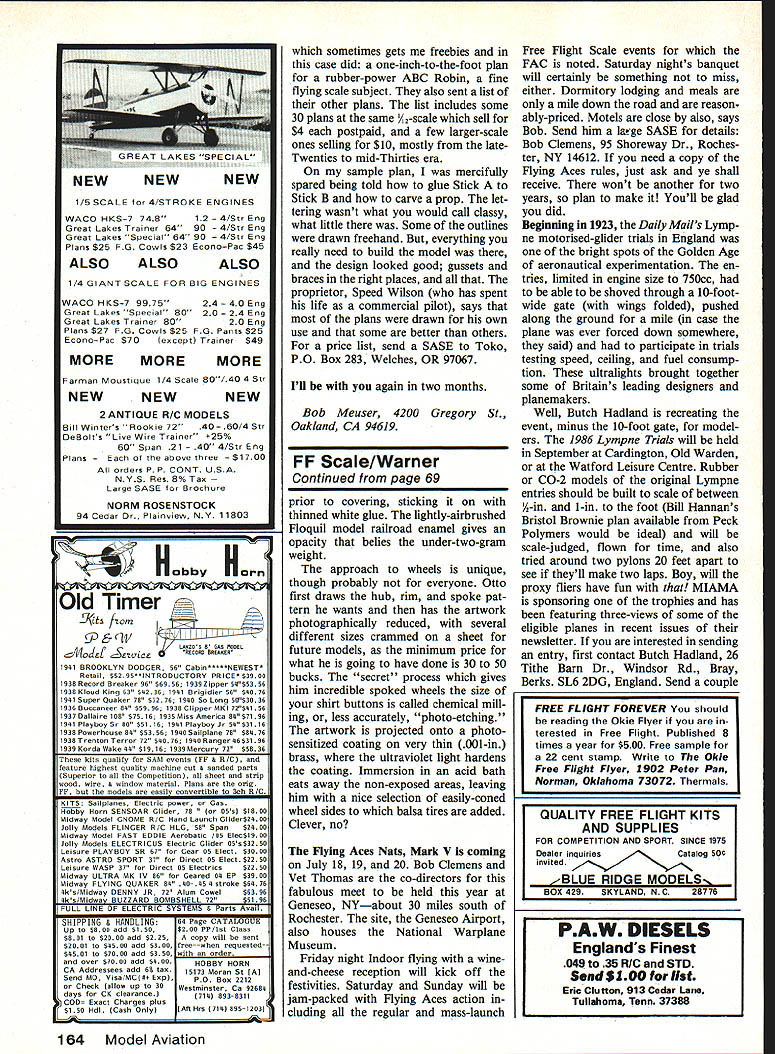
Beginning in 1923, the Daily Mail Lympne motor‑glider trials were a highlight of the Golden Age of aeronautical experimentation. Entries were limited to 750 cc engines, had to fold to pass through a ten‑foot‑wide gate, be pushable for a mile, and were tested for speed, ceiling, and fuel consumption. These ultralights drew Britain’s leading designers and planemakers.
Bill Hannan is recreating the event (minus the ten‑foot gate) for modelers. The 1986 Lympne Trials will be held in September at Cardington, Old Warden, or the Watford Leisure Centre. Rules:
- Build rubber or CO2 models of original Lympne types to a scale of 1/4‑in. to 1‑in. to the foot.
- Models will be scale‑judged, flown for time, and tried around two pylons 20 feet apart to see if they’ll make two laps.
Bill Hannan’s Bristol Brownie plan (available from Peck Polymers) is ideal. MIAMA is sponsoring one of the trophies and has featured three‑views of eligible planes in its newsletter. For entry information:
- Dutch Haddland, 26 Tithe Barn Rd., Windsor R.D., Bray, Berks. SL6 2DG, England
Closing
Well, gang, get cracking on your entries for the Internats, FAC, and Lympne meets. After a sub‑Peanut, a 13‑in. span plane will seem huge — and ridiculously easy to build!
Bill Warner 423‑C San Vicente Blvd. Santa Monica, CA 90402
Transcribed from original scans by AI. Minor OCR errors may remain.

