
Free Flight: Sport & Scale
Bill Warner 1370 Monache Ave., Porterville, CA 93257
WELL, GANG, let's make some noise!
Rigby noisemaker for Rubber Scale
One of the problems with rubber scale models is that they're too quiet — unless, of course, you happen to break a motor. Remember the ol' Megow "Motor Hum" devices? Just a little ratchet plate behind the prop or a bit of reed or bamboo could spice up your life a bit.
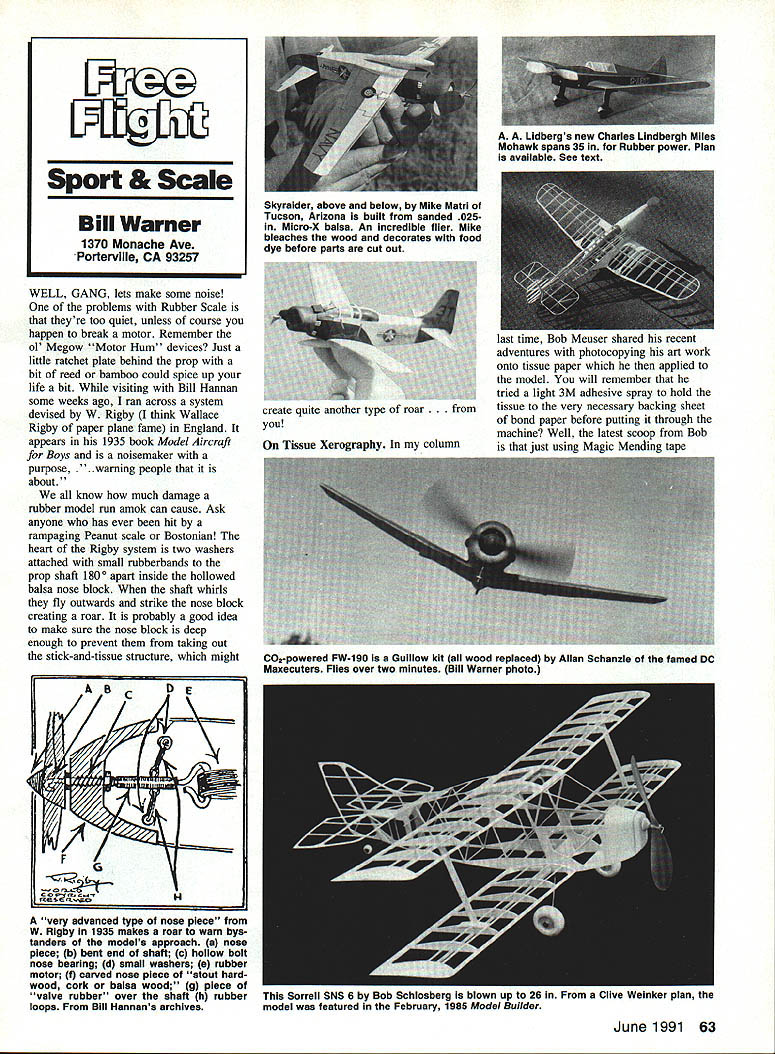
While visiting Bill Hannan some weeks ago I ran across a system devised by W. Rigby (I think Wallace Rigby of paper-plane fame in England) that appears in his 1935 book Model Aircraft for Boys. It's a noisemaker with a purpose — warning people that a runaway model is about.
We all know how much damage a rubber model run amok can cause. Ask anyone who has ever been hit by a rampaging Peanut scale or Bostonian! Rigby's system uses two washers attached with small rubber bands to the prop shaft, 180° apart, inside a hollowed balsa nose block. When the shaft whirls, they fly outwards and strike the nose block, creating a roar. It's a good idea to make the nose block deep enough to prevent the washers from taking out the stick-and-tissue structure — otherwise you might create quite another type of roar... from you.
Tissue xerography and decals
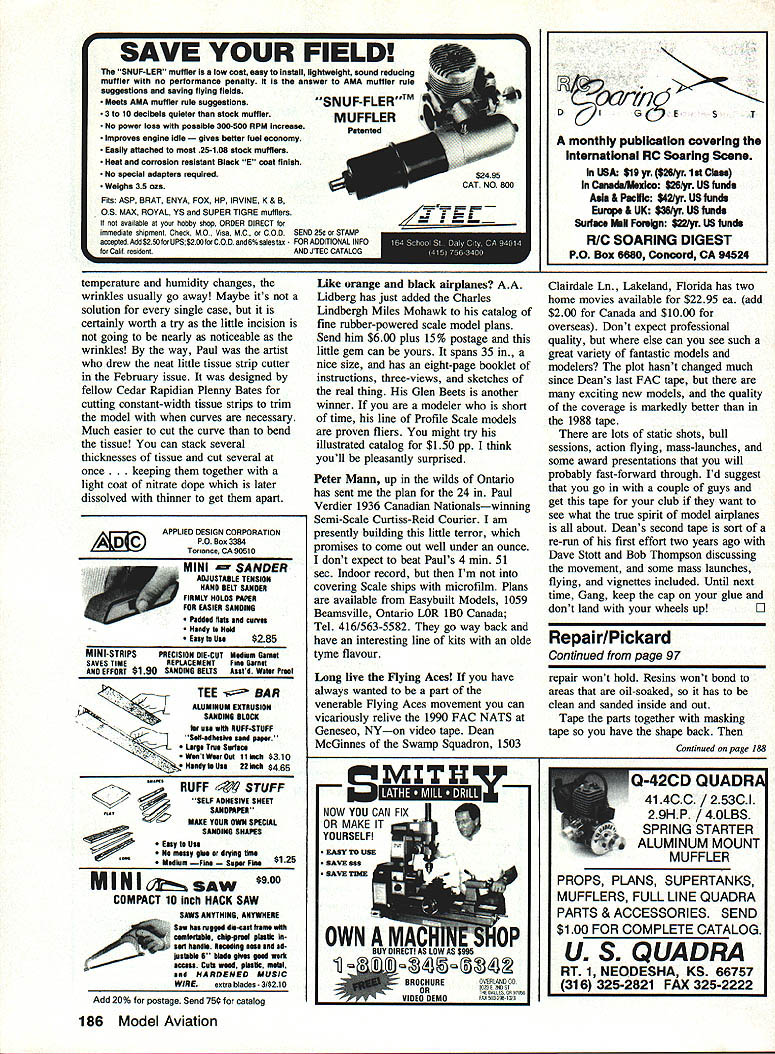
In my column last time, Bob Meuser shared his recent adventures photocopying his artwork onto tissue paper, which he then applied to models. You may remember he tried a light 3M adhesive spray to hold the tissue to the necessary backing sheet of bond paper before putting it through the machine. The latest scoop from Bob is that he is just using Magic Mending Tape.
Quick, dirty decals can be made using Magic Mending Tape:
- Stick a piece of tape to glass and place the artwork beneath the glass.
- Trace over the copy using India ink (available in different colors).
- To get the ink to stick, roughen the tape surface with No. 600 wet-or-dry abrasive paper and use a little vinegar.
- Cut out with a razor blade or hobby knife until you get it right.
- When applying, be careful — rub down and push out any air.
A coat of dope or Dull Cote lacquer sprayed over will keep the ink permanent.
White trim over color is always hard, as white tissue letters, etc., will let dark colors underneath bleed through. Pres Bruning used to spray his tissue trim lightly with colored dope and then apply it using a light mist of 3M adhesive on the back. I have used typing paper before and find it effective if a bit heavy.
To reduce wrinkles in tissue at difficult corners
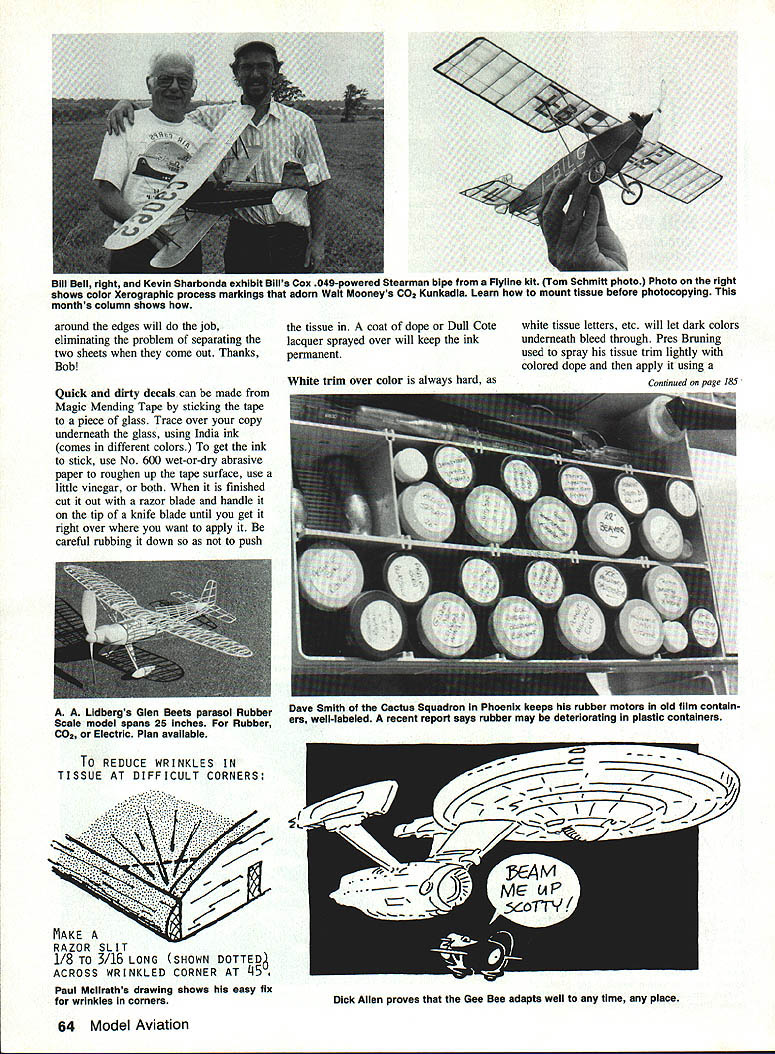
Paul McIlrath's drawing shows his easy fix for wrinkles in corners. The technique:
- Make a razor slit about 1/8 to 3/16 inch long, cut at about 45° across the wrinkled corner to provide stress relief.
- Over time, with temperature and humidity changes, the wrinkles usually go away.
This little incision is often less noticeable than the wrinkle. Paul was also the artist who drew the neat little tissue strip cutter in the February issue, designed by Cedar Rapidian Plenny Bates to cut constant-width tissue strips for curved trim. You can stack several thicknesses of tissue and cut several at once, keeping them together with a light coat of nitrate dope which is later dissolved with thinner to separate them.
Fibe-Mini and tissue shrinking experiments
More on Fibe-Mini comes from Leonard Dzinka in Kalamazoo, Michigan. He points out that Frank Zaic (Model Glider Design, p.171) notes tissue shrinks when wetted because fibers get fatter and shorter. Leonard theorizes water may be trapped in the fibers and that Fibe-Mini — a product from Japan — works by putting water with a high concentration of solute around the fibers, drawing water out by osmotic pressure (similar to salt drawing water out of cells).
Leonard suggested trying Metamucil (a drugstore fiber laxative) or the water used to cook oatmeal as substitute fiber sources; MSG (monosodium glutamate) was also suggested.
I had our 51% fast lab try experiments:
- Two teaspoons of Metamucil in a cup of water on a 4x4 inch tissue-covered frame warped about the same as plain tap water.
- A stronger Metamucil solution (blended) produced the same warpage.
- A 50/50 Fibe-Mini/water solution soaked into the paper without warping the fragile frame.
- Full-strength Fibe-Mini applied to a badly warped frame relaxed the paper so much it went from a Pringle shape to floppy when dry.
The problem remains of finding a substitute for Fibe-Mini other than a Japanese grocery store. Keep experimenting, guys!
International WACO Association
Attention WACO owners! If you think Weaver Aircraft Company produced the finest aeroplanes, be aware of the International WACO Association. The premiere issue of their magazine is 24 pages, glossy, with mouth-watering photos — a Red Cross YKS-7 on floats in Norway, the new YMF-5 WACOs, a shot of DH Gipsy six installation in a YOC-6 fuselage in Australia, UPF-7 and WACO 4 histories, a Jacobs R-755 engine installation, factory prints and close-up photos, plus valuable sources of info from owners willing to share expertise.
If future quarterly issues are as good as the first, their $25 membership ($35 Canadian for foreign) may be worth it. The IWA and Aviation Heritage people share an address: P.O. Box 2065, Terre Haute, IN 47802. Paul Matt's famous WACO 3-view drawings are available from the Aviation Heritage end and can be ordered by calling 800/999-0141 (UMF/YMF-5, UPF-7, YKS-6). If you have any WACO model airplane plans, Larry Ladd, the IWA model columnist, would love to feature them. Contact Larry at 6547 St. Mary's Rd., Floyd's Knobs, IN 47119.
Flying Aces videotape
Long live the Flying Aces! If you've always wanted to be part of the venerable Flying Aces movement, you can vicariously relive the 1990 FAC NATS at Geneseo, NY — on videotape. Dean McGinnes of the Swamp Squadron, 1503 Clairdale Ln., Lakeland, FL has two home movies available for $22.95 each (add $2.00 for Canada and $10.00 for overseas). Don't expect professional quality, but where else can you see such a great variety of fantastic models and modelers? The tapes include static shots, build sessions, action flying, mass launches, and some award presentations.
I'd suggest going in with a couple of guys and getting this tape for your club if you want to see the true spirit of model airplanes. Dean's second tape is a re-run of his effort two years ago with Dave Stoff and Bob Thompson discussing the movement, with mass launches, flying, and vignettes included.
Until next time, Gang — keep the cap on your glue and don't land with your wheels up!
Transcribed from original scans by AI. Minor OCR errors may remain.

