
Free Flight: Sport & Scale
Bill Warner 1370 Monache Ave., Porterville, CA 93257
Tall but true stories
Whenever modelers get together, stories of the strange and wonderful emerge.
- Fred Griffith's legendary seven-hour flight: launched on an official flight at the Nationals, it came down in a backyard barbecue at 7 p.m. with ice crystals in the wings.
- Walt Mooney's start: a Sleek Streek flew across his nose while he was flying a sailplane at 7,000 feet.
- Don Munn's Bostonian rubber ship: at a Scale Staffel meet in San Diego, the ship meandered across the street, glided onto a baseball diamond, flew over the pitcher’s head and across the plate at belt height. The batter swatted it—into a thousand pieces.
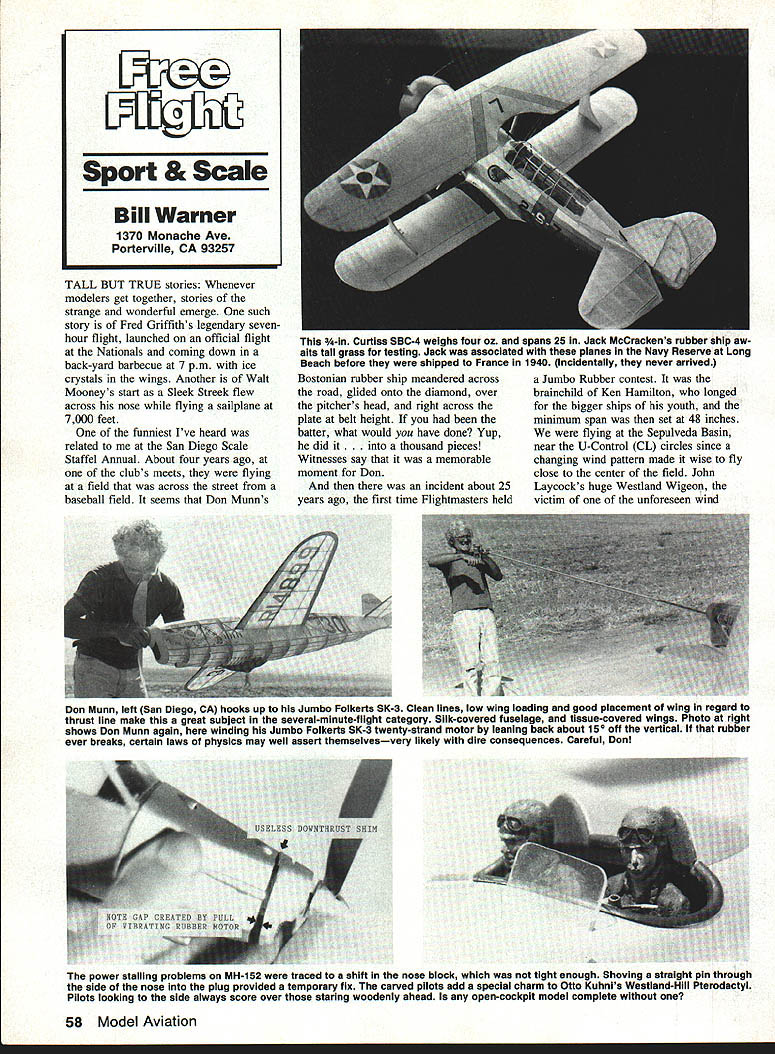
- Jumbo Rubber, Sepulveda Basin: at the first Flightmasters Jumbo Rubber contest (minimum span 48 inches), John Laycock’s huge Westland Wigeon suffered an unforeseen wind-induced power-stall problem. The shift in the nose block was traced to the nose block not being tight enough; a straight pin through the side into the plug provided a temporary fix.
Another favorite: in the early sixties, a fellow from West Virginia flying a Class B Kiwi had a nasty stall on the glide. With nothing to ballast the nose except his car keys, he shoved them into the nose—problem solved. Tough walk home and even tougher explaining to his dad where the car was and why.
Nose-block stalling — diagnosis and cure
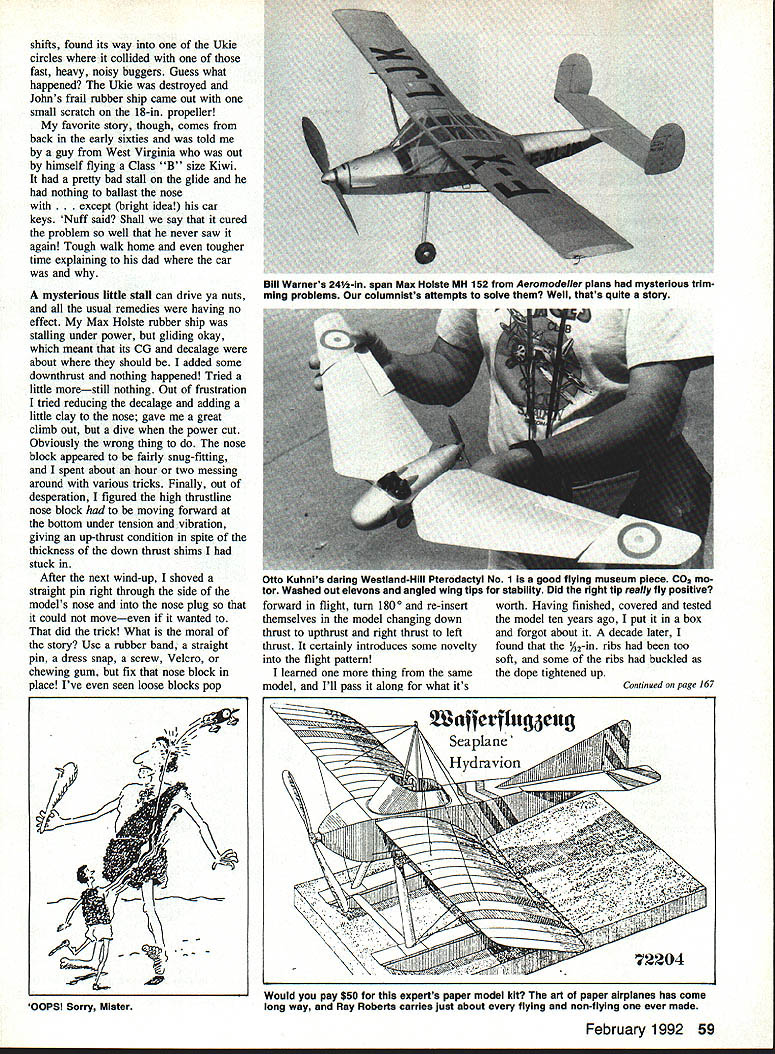
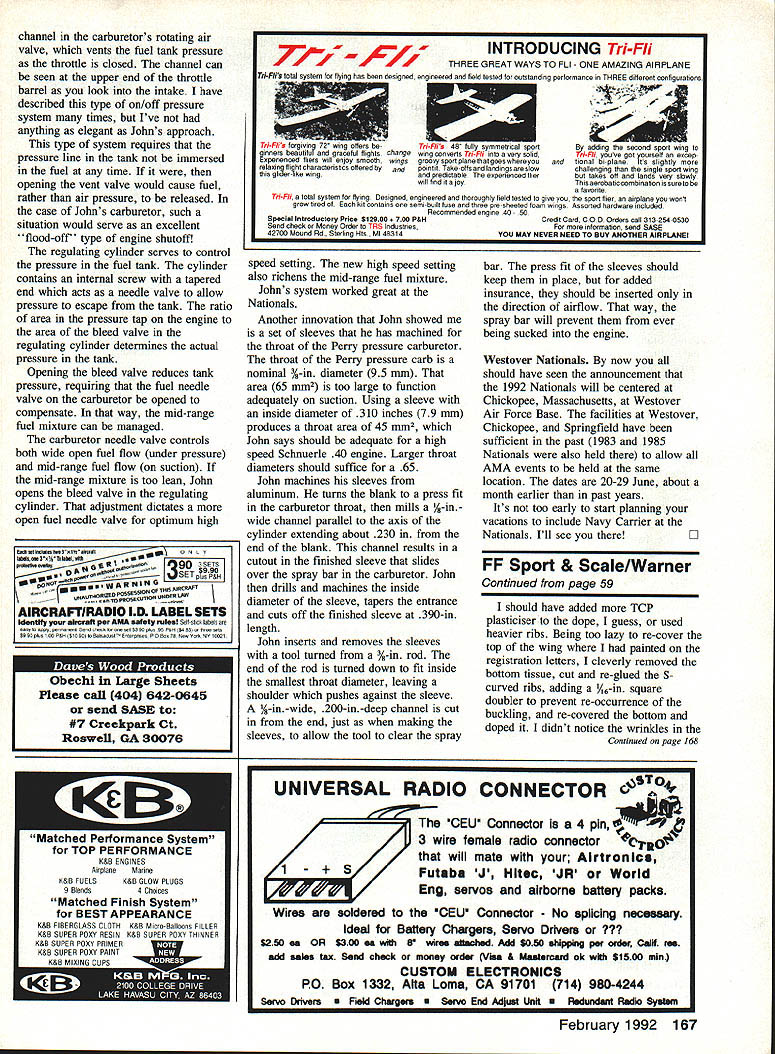
A mysterious little stall can drive you nuts. My Max Holste rubber ship was stalling under power but gliding OK, which meant CG and decalage were about right. I tried adding downthrust, then more downthrust—no effect. Reducing decalage and adding nose clay gave a great climb out but a dive when power cut (obviously wrong). The nose block appeared snug, but I finally realized the high-thrust-line nose block was moving forward at the bottom under vibration and tension, creating an effective up-thrust despite down-thrust shims.
The fix: shove a straight pin through the side of the nose into the nose plug so it cannot move. That did the trick.
Moral: fix that nose block in place. Possible methods:
- rubber band
- straight pin
- dress snap
- screw
- Velcro
- chewing gum
I’ve even seen loose blocks pop; don’t risk it.
Rib buckling after long storage — repair approach
After finishing, covering and testing a model, I put it in a box and forgot it for ten years. The 1/2‑in. ribs had been too soft; some ribs buckled as the dope tightened up.
What I did: rather than re-cover the decorated top, I removed the bottom tissue, cut and re-glued the S‑curved ribs, added a 1/8‑in. square doubler to prevent re‑occurrence, re-covered the bottom and doped it. I didn’t notice the top tissue wrinkles until contest time.
Next time I’d show a few tightly fitting temporary braces between the leading and trailing edges to hold the original top tissue taut while repairing the ribs. Once ribs are repaired the braces can be removed and the bottom covered.
Perry pressure-carburetor sleeves (John’s method)
John also showed a throat-sleeve modification for the Perry pressure carburetor. The throat of a Perry pressure carb is nominally 3/16 in. diameter (9.5 mm), an area of about 65 mm²—too large to function adequately on suction. Using a sleeve with an inside diameter of .310 in. (7.9 mm) yields a throat area of about 45 mm², suitable for a high-speed Schnuerle .40 engine; larger throat diameters should suffice for a .65.
How John makes the sleeves:
- Machine sleeves from aluminum, turned to a press fit for the carb throat.
- Mill a 1/8‑in.-wide channel parallel to the axis, extending about .230 in. from the end; this cutout slides over the spray bar.
- Drill and machine the inside diameter, taper the entrance and cut off the finished sleeve at .390 in. length.
Insertion/removal tool:
- Turn a tool from 3/16‑in. rod; turn the end down to fit inside the smallest throat diameter, leaving a shoulder to push against the sleeve.
- Cut a 1/8‑in. wide, .200‑in. deep channel from the end so the tool clears the spray bar.
The press fit should keep sleeves in place, but insert them only in the direction of airflow so the spray bar prevents the sleeve from being sucked into the engine.
Note: John’s new high‑speed setting also richens the mid‑range fuel mixture; his system worked great at the Nationals.
Westover Nationals
The 1992 Nationals will be centered at Chicopee, Massachusetts, at Westover Air Force Base. Facilities at Westover, Chicopee and Springfield have been sufficient in the past (1983 and 1985 Nationals were held there) to allow all AMA events at the same location. Dates: 20–29 June, about a month earlier than in past years.
Plan ahead if you want to include Navy Carrier at the Nationals. See you there!
Tuning and maintenance tips
- Electric motor tune-up: Tom Schmitt (Hi-Line, Ltd.) suggests a shot of television tuner cleaner on the armature while the motor is running—rev increase can be seen right away.
- Quickie stuffer stick (idea from Gene Pierre): tape a 1‑in. length of plastic straw at one end of a hard stick (shish‑kebab skewer). Push the end of the motor loop through from the stick end with just enough loop protruding to insert the rear motor peg or pin. Once connected, the stick pulls right out over the rubber.
- Thinning dope (Doug Dahlke’s tip): warm the dope container with a light bulb or hot water (no open flames) to thin it before applying. He says it soaks in less and is lighter, with fewer fumes.
- Marking and lining: Sanford’s "Ultra Fine Point" permanent marker is excellent for fine lines and decorations.
Supplies, plans and paper models
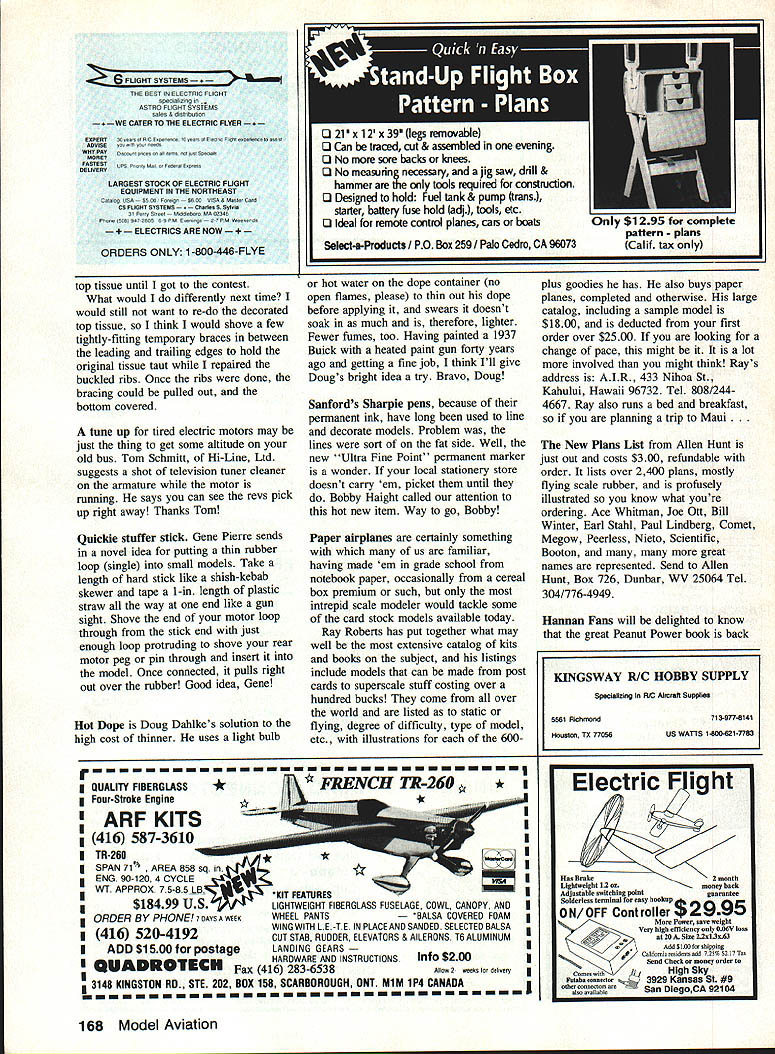
- Paper airplanes: Ray Roberts compiles an extensive catalog of paper airplane models and books—600+ items, static and flying, with difficulty and type listed. His catalog (including a sample model) is $1.00, deducted from your first order over $25.00. Contact: A.I.R., 433 Nihoa St., Kahului, Hawaii 96732. Tel. 808/244-4667. (Ray also runs a bed and breakfast on Maui.)
- New Plans List (Allen Hunt): $3.00 (refundable with order). Lists over 2,400 plans, mostly flying scale rubber, profusely illustrated. Send to Allen Hunt, Box 726, Dunbar, WV 25064. Tel. 304/774-9949.
- Hannan fans: the great Peanut Power book is back.
FF Duration / Murphy
The wing merely defines the airfoil shape and is built as lightly as possible. The leading edge is soft balsa with a .003 carbon reinforcement sandwiched in for nick resistance. The trailing edge is a 1.0‑in. wide hollow structure built up from 1/16 balsa. All ribs and turbulator spars are cut from light balsa.
- Initial wing: weighed 139 grams and was covered with Micafilm. It proved too flexible—tips washed out and the ship zeroed out three seconds into the engine run. That caused spectacular bunt-like pullouts on short runs and was impracticable for longer runs.
- Rebuilt wing: full-depth vertical webs added to the front and back of the main spar; recovered with MonoKote. New wing weighs 188 grams and is stiff—even on 12‑second engine runs.
- Tail: stabilizer built from light balsa and covered with 1 mil Mylar.
- Performance: overall weight just under 25 ounces. Flown right/right pattern with variable-incidence rudder and stab, the ship is very fast and performs well even in strong winds. After resolving wing consistency problems, the model began accumulating contest hardware. One Category III record attempt fell short with a string of 14 maxes totaling 31 minutes 35 seconds. The model’s mission is to capture that record in coming seasons.
Thank you to Norm for supplying the three-view and story line. For more information, send a SASE to Norm at 5695 Marshall Road, Dayton, OH 45429.
CO2 and electric
Carl Stokes recently took me to task over my off‑hand comments suggesting that a rule change or two might be in order to thwart the resultant marathon flyoff situations we were experiencing.
Transcribed from original scans by AI. Minor OCR errors may remain.

