
Free Flight: Sport & Scale
By Bill Warner
1370 Monache Ave. Porterville, CA 93257
Jets are not too popular with the Free Flight Scale crowd. Most of us grew up with the idea that real airplanes have round engines, two wings, and drag their tails when on the ground. Somehow, the hiss of a jet never stirred our blood like the snarl of a Wright Cyclone. And the chances of getting a ride in one at the local airport were about on a par with getting a date with Betty Grable.
Jets look funny with propellers on ’em. Still, ducted-fan free-flights have been flown before. Some of the more successful ones were the Berkeley Skyray and a number of other ducted-prop (rather than multi-bladed fan) models by a fellow named Richter who used to frequent the Sepulveda Basin in Los Angeles in the sixties. Walt Mooney even had a good-flying Tee Dee .010-powered Vigilante that sucked air through the top of the fuselage and ducted it out the rear. Jon Hoshizaki, now a robot designer, made a successful ducted-prop rubber-powered MiG-15 peanut some 25 years ago.
In those same years, Jetex was popular. Harold Osborne's huge Jetex Scorpion 600-powered Opel Hatry taking off from a rail at a Flightmasters meet was a picture! Jetex engines could be buried inside fuselages with the efflux carried out via a thin aluminum augmenter tube. Still, some guys could never get Jetex engines to light off, and others lit models by accident. Most of the ducted-prop models' access problems came with the powerplant.
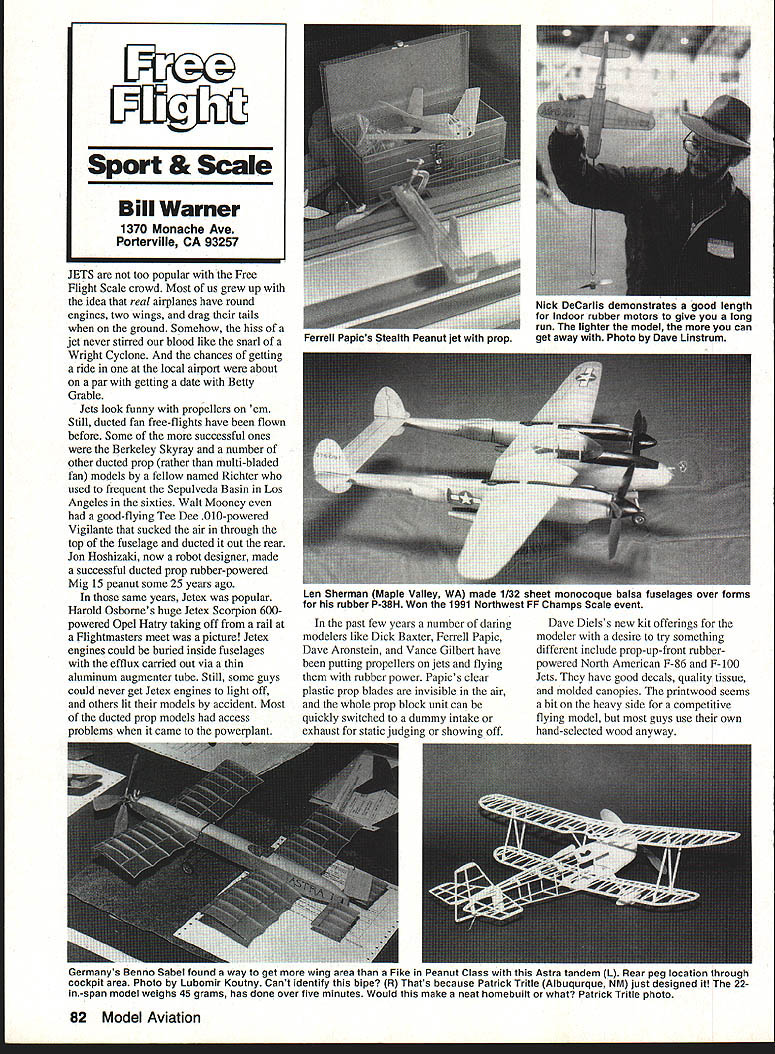
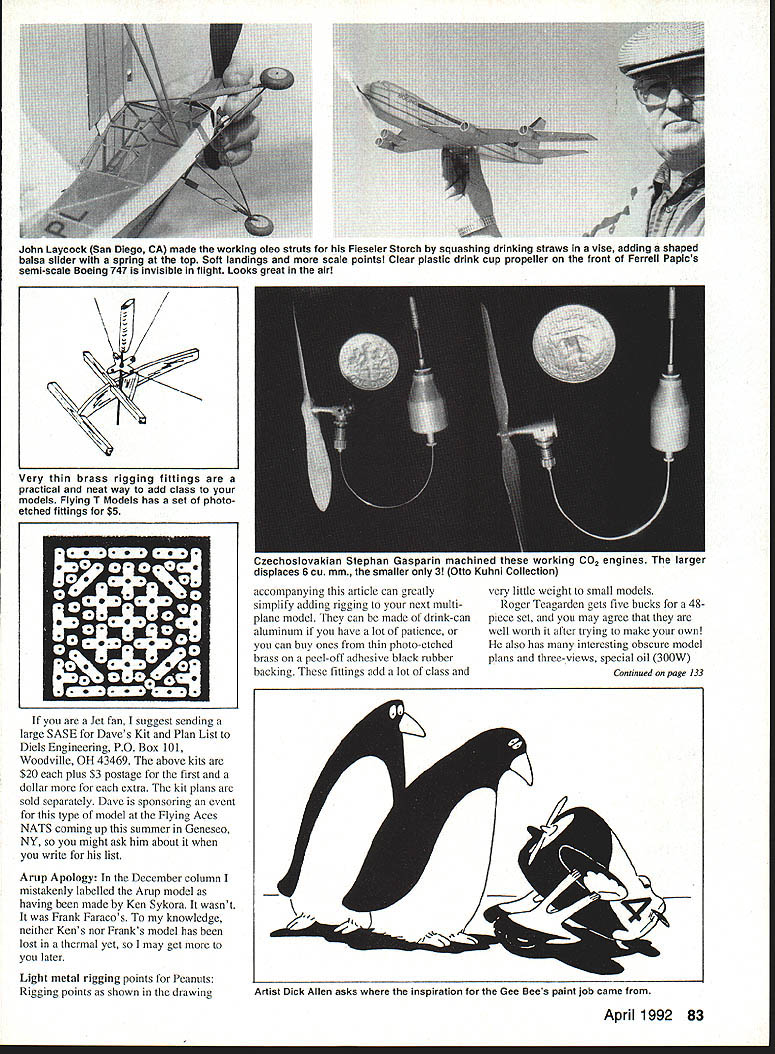
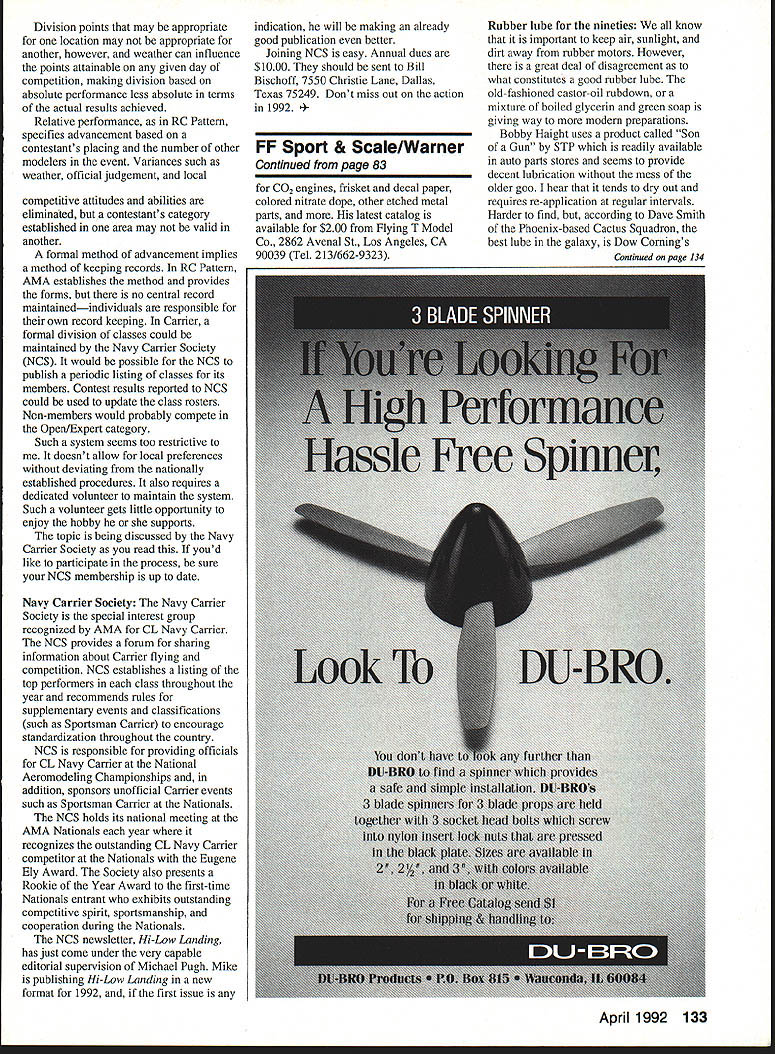
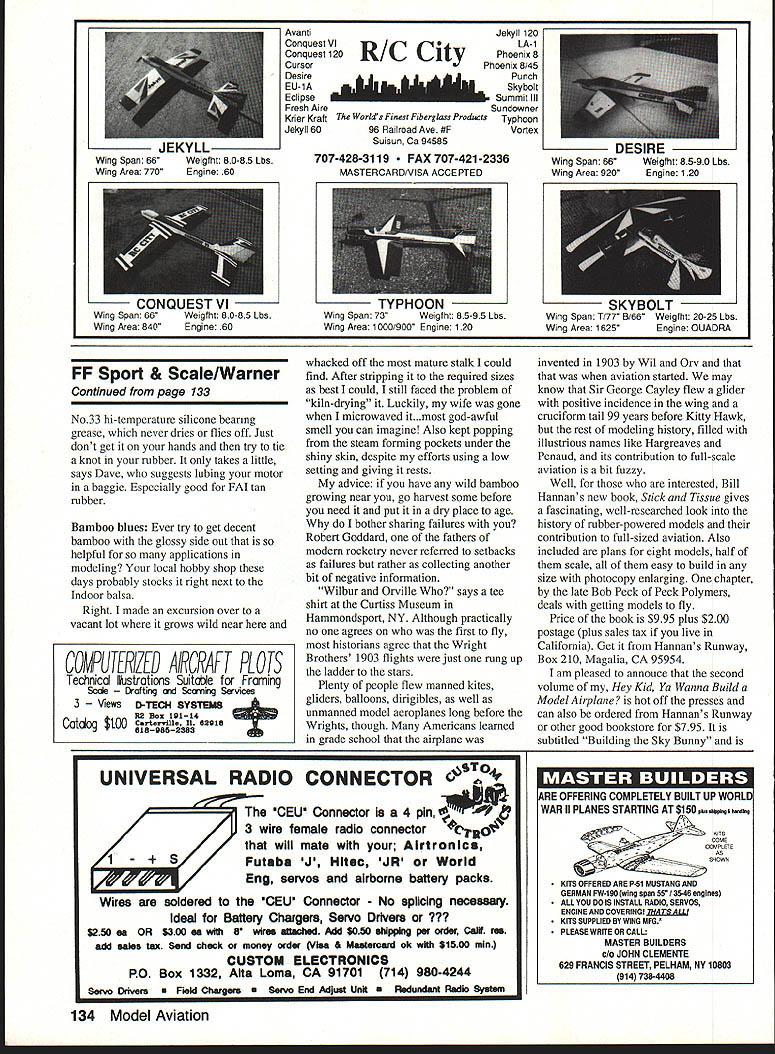
In the past few years a number of daring modelers have been putting propellers on jets and flying them with rubber power. Notable names include:
- Dick Baxter
- Ferrell Papic
- Dave Aronstein
- Vance Gilbert
Papic's clear plastic prop blades are invisible in the air, and the whole prop block unit can be quickly switched to a dummy intake or exhaust for static judging or showing off.
Recent kit offerings
Dave Diel's new kits for the modeler who wants to try something different include prop-up-front rubber-powered North American F-86 and F-100 jets. They have good decals, quality tissue, and molded canopies. The plywood seems a bit on the heavy side for a competitive flying model, but most guys use their own hand-selected wood anyway.
Very thin brass rigging fittings are a practical and neat way to add class to your models. Flying T Models has a set of photo-etched fittings for $5.
If you are a jet fan, I suggest sending a large SASE for Dave's Kit and Plan List to Diels Engineering, P.O. Box 101, Woodville, OH 43469. The above kits are $20 each plus $3 postage for the first and a dollar more for each extra. The kit plans are sold separately. Dave is sponsoring an event for this type of model at the Flying Aces NATS coming up this summer in Geneseo, NY, so you might ask him about it when you write for his list.
Arup apology
In the December column I mistakenly labeled the Arup model as having been made by Ken Sykora. It wasn't. It was Frank Faraco's. To my knowledge, neither Ken's nor Frank's model has lost a thermal yet, so I may get more to you later.
Light metal rigging points for peanuts
Rigging points as shown in the drawing accompanying this article can greatly simplify adding rigging to your next multiplane model. They can be made from drink-can aluminum if you have a lot of patience, or you can buy ones made from thin photo-etched brass on a peel-off adhesive black rubber backing. These fittings add a lot of class and very little weight to small models.
Roger Teagarden gets five bucks for a 48-piece set, and you may agree that they are well worth it after trying to make your own! He also has many interesting obscure model plans and three-views, and sells:
- special oil (300W) for CO2 engines
- frisket and decal paper
- colored nitrate dope
- other etched metal parts
His latest catalog is available for $2.00 from Flying T Model Co., 2862 Avenal St., Los Angeles, CA 90039 (Tel. 213/662-9323).
Rubber lube for the nineties
We all know that it is important to keep air, sunlight, and dirt away from rubber motors. However, there is a great deal of disagreement as to what constitutes a good rubber lube. The old-fashioned castor-oil rubdown, or the mixture of boiled glycerin and green soap, is giving way to more modern preparations.
Bobby Haight uses a product called "Son of a Gun" by STP which is readily available in auto parts stores and seems to provide decent lubrication without the mess of the older goo. I hear that it tends to dry out and requires re-application at regular intervals.
Harder to find, but according to Dave Smith of the Phoenix-based Cactus Squadron, the best lube in the galaxy is Dow Corning No. 33 hi-temperature silicone bearing grease, which never dries or flies off. Just don't get it on your hands and then try to tie a knot in your rubber motor. It only takes a little, says Dave, who suggests lubing your motor in a baggie. Especially good for FAI tan rubber.
Bamboo blues
Ever try to get decent bamboo with the glossy side out that is so helpful for so many modeling applications? Your local hobby shop these days probably stocks it right next to the indoor balsa.
Right. I made an excursion over to a vacant lot where it grows wild near here and whacked off the most mature stalk I could find. After stripping it to the required sizes as best I could, I still faced the problem of "kill-drying" it. Luckily, my wife was gone when I microwaved it... most god-awful smell you can imagine! Also kept popping from the steam forming pockets under the shiny skin, despite my efforts using a low setting and giving it rests.
My advice: if you have any wild bamboo growing near you, go harvest some before you need it and put it in a dry place to age. Why do I bother sharing failures with you? Robert Goddard, one of the fathers of modern rocketry, never referred to setbacks as failures but rather as collecting another bit of negative information.
"Wilbur and Orville Who?"
A test exhibit at the Curtiss Museum in Hammondsport, N.Y., promotes the question: who was first? Although practically no one agrees on who was the first to fly, most historians agree that the Wright Brothers' 1903 flights were just one rung up the ladder to the stars.
Plenty of people flew manned kites, gliders, balloons, dirigibles, as well as unmanned model aeroplanes long before the Wrights. Many Americans learned in grade school that the airplane was invented in 1903 by Wil and Orv and that was when aviation started. We may know that Sir George Cayley flew a glider with positive incidence in the wing and a cruciform tail 99 years before Kitty Hawk, but the rest of modelers' history, filled with illustrious names like Hargreaves and Pénaud, and its contribution to full-scale aviation is a bit fuzzy.
For those who are interested, Bill Hannan's new book, Stick and Tissue, gives a fascinating, well-researched look into the history of rubber-powered models and their contribution to full-sized aviation. Also included are plans for eight models, half of them scale, all of them easy to build in any size with photocopy enlarging. One chapter, by the late Bob Peck of Peck Polymers, deals with getting models to fly. Price of the book is $9.95 plus $2.00 postage (plus sales tax if you live in California). Get it from Hannan's Runway, Box 210, Magalia, CA 95954.
Books and publications
I am pleased to announce that the second volume of my Hey Kid, Ya Wanna Build a Model Airplane? is hot off the presses and can also be ordered from Hannan's Runway or other good bookstores for $7.95. It is subtitled "Building the Sky Bunny" and is an intermediate guide. The third volume, "The Flying Aces Moth and Lucky M-10," should appear in March or sooner. Published by TAB/McGraw-Hill.
While on the topic of beginners' books, Don Ross, author of the popular Rubber-Powered Model Airplanes, informs me that the book is now in its second printing, and he has a closet full just waiting for you to order at $12.95 each. You can get it from Hannan's Runway, Peck Polymers, or order direct from Don at 38 Churchill Rd., Creskill, NJ 07626.
Sleek Streekers beware
Those of you familiar with my approach to beginning modeling know that the North Pacific Sleek Streek is the model I usually start kids on. Well, watch out, for quality control on this model has really hit a new low. The wood may be heavy and warped, the white plastic front end will most likely break on the first impact, and to top it all off, last weekend Tony Naccarato called my attention to one that had the free-wheeling ramp on the front of the prop actually molded backwards!
Yes, you can re-cut it in the right direction, replace the lousy wood, and make a new front end using a piece of aluminum tube, glued and thread-bound onto a spacer block, but why should you have to for $1.59? If you get a crummy one, I suggest you write ’em and raise the devil. (North Pacific Products, Inc., Chicago, IL 60609.)
If they want to save a buck by having ’em made in Korea, that's their affair, but the lack of quality control resulting in selling unworkable beginner's models is unforgivable. If we don't all work to make life easier for beginners, pretty soon kids will get the idea that you have to have a hundred bucks worth of RC gear to get started in modeling!
Vac-u-forming with the Mattel unit
Many modelers still possess the handy-dandy Mattel toy vacu-form unit from several years back, but either can't get plastic sheets or can't get it to "suck down" like it used to. I use a heat-forming clear plastic sheet (I think it's butyrate plastic) from Sig, cut to the old sheet size, then just squeeze the two halves of the frame together until the teeth punch through. I think Bill Watson introduced me to this. Works great.
Regarding the vacuum, Bobby Haight has removed the old pump and tapped a vacuum-cleaner hose on where it once was, which gives not only more power, but a constant pull-down rather than the old up-and-down. Keep your eyes out for the Mattel units at garage sales; they're still worth their weight!
Cottage Wings source guide
Our Cottage Wings source guide now lists over a hundred places someone getting started in Free Flight Scale can find materials, information, plans, newsletters, etc. I'll send you the updated list for a No. 10 SASE and a buck to cover printing (address at beginning of column). Feel free to reproduce it and pass it along!
Well, gang, until next time, keep the guinea pig out of your balsa supply, help a junior modeler, and find some time to start work on that dream model. Remember, the journey of a thousand miles starts with a 2-hour delay at the airport!
Transcribed from original scans by AI. Minor OCR errors may remain.

