
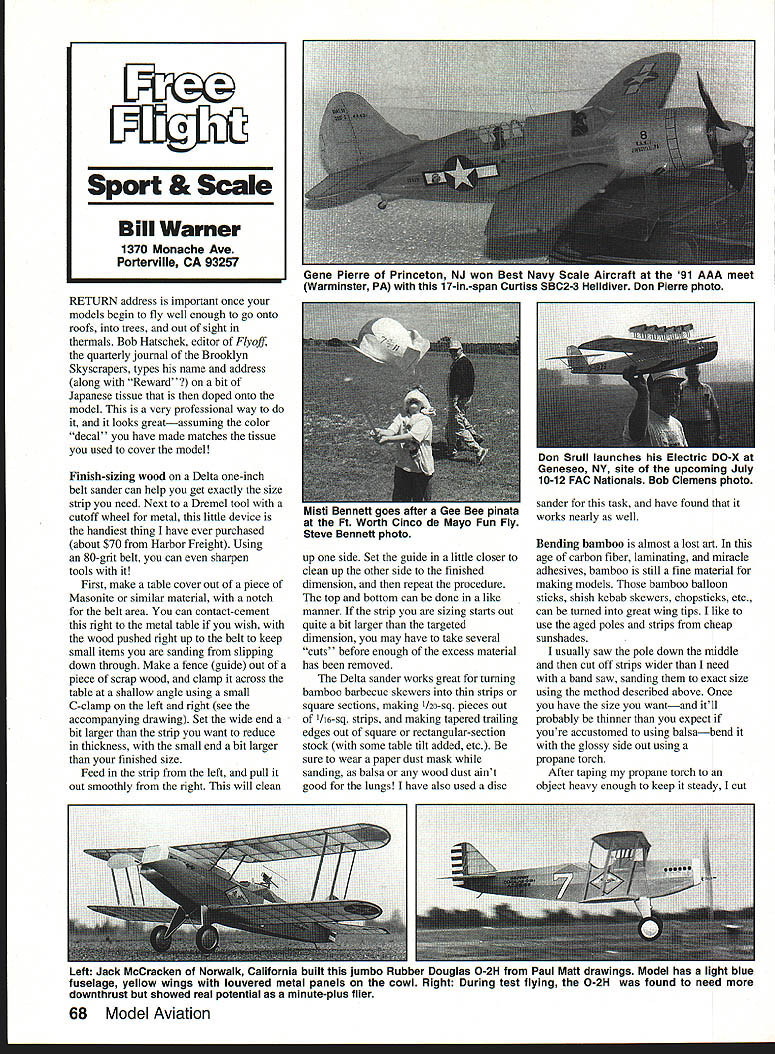
Free Flight: Sport & Scale
Bill Warner 1370 Monache Ave. Porterville, CA 93257
Return address
A return address becomes important once your models begin to land on roofs, in trees, or disappear in thermals. Bob Hatschek, editor of Flyoff (the quarterly journal of the Brooklyn Skyscrapers), types his name and address (sometimes with “Reward?”) onto a bit of Japanese tissue and dopes it onto the model. This is a very professional method and looks great—assuming the color “decal” you made matches the tissue used to cover the model.
Finishing wood on a one-inch belt sander
A Delta one-inch belt sander is extremely useful for finish-sizing wood and getting exactly the strip size you need. Next to a Dremel with a cutoff wheel, this little device is the handiest tool I own (about $70 from Harbor Freight). Using an 80-grit belt it can even sharpen tools.
To set it up:
- Make a table cover from a piece of Masonite or similar material with a notch for the belt area. You can contact-cement this to the metal table if you wish, pushing the wood up to the belt to keep small items from slipping down.
- Make a fence (guide) from scrap wood and clamp it across the table at a shallow angle with small C-clamps on the left and right.
- Set the wide end of the guide a bit larger than the strip you want to reduce in thickness, and the small end a bit larger than your finished size.
- Feed the strip in from the left and pull it smoothly out to the right to clean up one side. Move the guide a little closer to clean up the other side to finished dimension. Repeat for top and bottom as needed.
If the strip starts much larger than the target dimension, take several light “cuts” until enough excess is removed.
The Delta sander is great for turning bamboo barbecue skewers into thin strips or square sections, making 1/12-inch square pieces out of 1/16-inch square stock, and forming tapered trailing edges (with some table tilt). I’ve also used a disc sander for this task with nearly as good results. Always wear a paper dust mask while sanding—balsa and wood dust are bad for the lungs.
Bending bamboo
Bending bamboo is almost a lost art, but bamboo remains a fine material for models. Balloon sticks, shish-kebab skewers, chopsticks, and aged poles from sunshades make excellent wingtips.
My method:
- Saw the pole down the middle, then cut off strips wider than needed on a band saw.
- Sand them to exact size using the belt-sander method above (you’ll likely end up thinner than expected if you’re used to balsa).
- Bend with the glossy side out using a propane torch.
With the torch on a very low setting, heat the tubular tip until moisture is evident inside. Slowly move the strip across the hot tip while applying pressure to bend the ends. The heat turns natural oils to steam, making bending easy. Remoisten the strip occasionally to prevent browning. (If you prefer, you can wet bamboo by other methods; I’ve never had trouble with the torch technique.)
Microwaved wing tips
For those who prefer high-tech gadgetry, Rich Hensel (Max-Fax, newsletter of the D.C. Maxecuters) described a quick laminating method:
- Make an undersized form for the bending laminations and wax the form edges.
- Soak the laminating strips, glue them with water-soluble (white) glue, and fasten the laminations to the form with masking tape.
- Wipe away excess glue, place the whole assembly on waxed paper, cover with waxed paper, and microwave on high for three minutes.
A quick way to do wingtips!
TCP finishes revisited
Tricresyl phosphate (TCP) has long been used as a plasticizer for dope to keep nitrate dope from shrinking too tight. Dave Rees (a prolific winner) mixes 10 drops of TCP with thinner in a four-ounce airbrush jar before adding the dope. He prefers to spray rather than brush for a light result and paints over wrinkle-free white tissue for a brighter finish. TCP also adds a bit of gloss, desirable on many light-tissue-covered models. (Tip courtesy of Max-Fax.)
T'ain't funny, McGee!
Some time back I published an anecdote about a control-line (CL) model destroyed when a rubber-powered free-flight (FF) scale ship struck the CL lines. The owner later wrote to say he didn’t find the incident amusing—the crash was caused by the uncontrolled rubber FF scale ship hitting the CL model’s lines, which explains why the more fragile craft was the one destroyed. Many FF scalers found the reversal of expectations humorous.
After that letter, I won’t dare tell of the time a supposedly radio-controlled model was dangerously overflying our FF launch area at Mile Square and then crashed into our midst (no, this was not the one that put Phaedon into intensive care). The late Walt Moody nonchalantly walked across the wreckage on his way to pick up his Peanut. My belated apologies to the owner of the totaled CL model on behalf of all of us who thought the incident hilarious.
Paul Matt's Scale Airplane Drawings
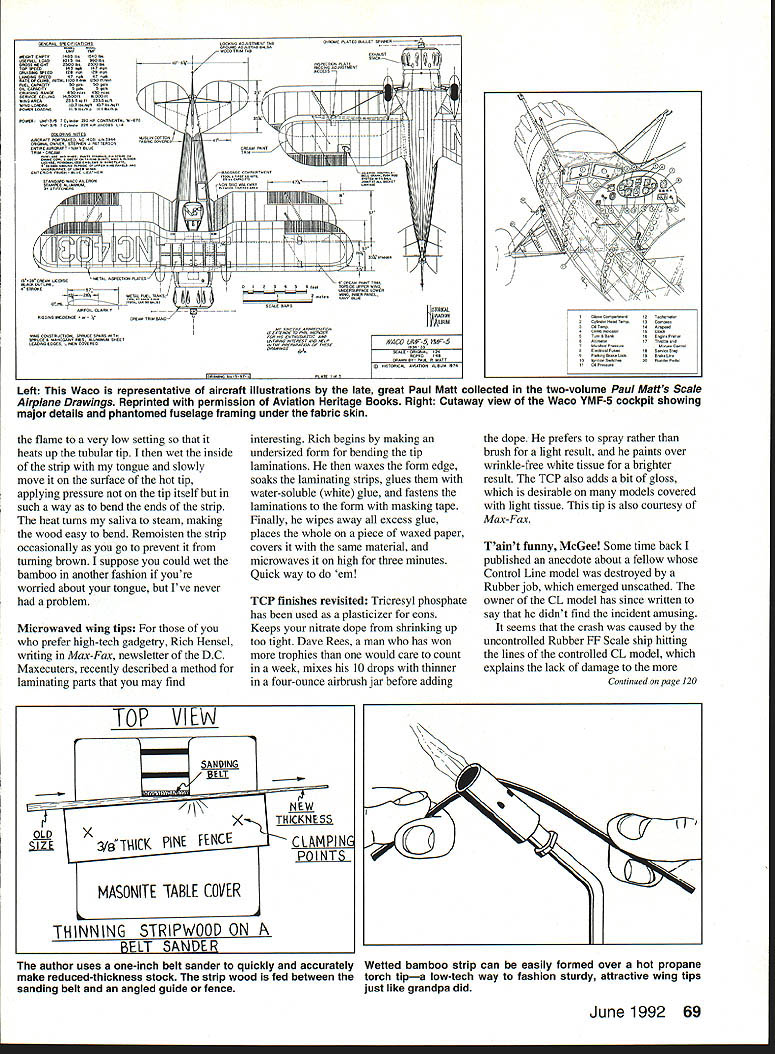
Paul R. Matt left behind some of the finest, clearest, and best-researched aviation drawings ever made—essential for serious scale modelers and historians. These are not just three-views but include multiple views, close-ups, sections, color and markings, cockpit detail, and dimensions.
- Volumes: Volume I (A–G), Volume II (H–W)
- Size: 8-1/2 x 11 in., softbound
- Price: $24.95 each; $3.50 total shipping and handling
- Content: 124 aircraft types from World War I to modern
- Set price: $53.40 (about 43¢ per plane)
- Large-format options: individual types can be ordered in larger sizes (standard two sheets at 1/72 scale) for $8 each.
Order or request the Aviation Heritage catalog (includes new Waco book and Early Flying and Glider manuals): Aviation Heritage Books, P.O. Box 2065, Terre Haute, IN 47802. Toll-free: 1-800-999-0141.
Indoor clubs and newsletters
- "Indoor isn't for Everyone" is the motto of one famous indoor club, but MIAMA’s Hangar Pilot newsletter (issue 145) is full of fun and plans. A year’s supply of back issues is $12.50 to Doc John Martin, 2810 Tigertail Ave., Miami, FL 33133.
- Indoor News and Views (voice of the National Indoor Model Airplane Society) has a new editor, Penny Bates. The folded 11 x 17 in. format accommodates ducted-fan projects and full-size rudder and elevator plans. Subscription: sent by first-class airmail (S&H $5 U.S.) for a year's subscription to Great Britain. Write NAMS, 2505 White Eagle Trail SE, Cedar Rapids, IA 52403; telephone: (319) 362-2969.
Cottage Wings list
For a listing of clubs of interest to FF scale modelers and over 100 sources, send $1 to cover printing plus a 4 x 9 x 1/2-in. SASE and I’ll mail our updated Cottage Wings list. Comments are my own and do not necessarily reflect the views of the AMA.
Flying Aces Club news
Skyteers across the U.S. and Canada are trimming ships for the FAC Nationals, Mk. VIII, July 10–12 at Geneseo, New York. New events include the Flying Hordes mass launch (my favorite), when over a hundred models fill the sky at once—a great photo opportunity. Cole Palen of Old Rhinebeck Aerodrome will be the banquet guest speaker.
For more information or to join the FAC mailing list: Flying Aces GHQ 3301 Cindy Lane Erie, PA 16506
Newsletter subscription: $9/year in the U.S./Canada or $12 overseas for six issues (includes plans and vintage articles).
There will be no Lawrenceville meet this year. Reserve September 5–6 for FAC events at the NFFS Outdoor Championships, to be held at the new AMA National Flying Site in Muncie, Indiana. The FAC also sponsors postal events for those who can’t attend the big meets but want to compete.
Obituaries
I counted more than 40 great modelers who have passed away recently—enough to make one melancholy—but we’re all the better for having flown with them. FAC adjutant Emerson Elwell and Californian Tom Laurie are two who will not soon be forgotten.
Closing
Well, gang, until next time: keep your rubber cool, your model box off your models, and your chase bike idling for those long retrievals.
Transcribed from original scans by AI. Minor OCR errors may remain.

