
Free Flight: Sport & Scale
Bill Warner 1370 Monache Ave. Porterville, CA 93257
"ISN'T IT a little foolish to have rules that promote lost models?" Don James asked readers in the January 1949 Model Airplane News. His thesis was that modelers could have a lot more fun if models were built to be thermal resistant. Don had just attended what was billed as "The First Western Sport Contest," put on by Joe Meckoll and the Los Angeles Thermal Thumbers. The basic rules of this contest were a three-flight total of 4-1/2 minutes, engine run between 20 and 30 seconds, all flights hand launched, and the flier with the total closest to 4-1/2 minutes was the winner.
Aside from a few superb Scale jobs by Granger Williams and Hans Wall, most of the planes were of the type "...usually referred to by contest fliers as 'clunks'." There were no protests, only one crack-up, and the timers "...could have been half-blind." Gee, gang, has it been 40 years?
Anytime you feel that you are getting rootbound, why not plan a simple noncontest that will give even those of us who fly clunks an occasional chance? Thanks to Bill Hannan for sending this item along.
Flying Aces rules
Speaking of rules, the new edition of the Flying Aces rules is ready and can be obtained for $2 from FAC GHQ, 3301 Cindy Lane, Erie, PA 16506.
The Czech connection
George Wallbridge of SAMS, the British mail-order center for Indoor and small Scale stuff, has just returned from three weeks in Czechoslovakia with a few very tasty items hitherto not readily available to modelers outside of that country.
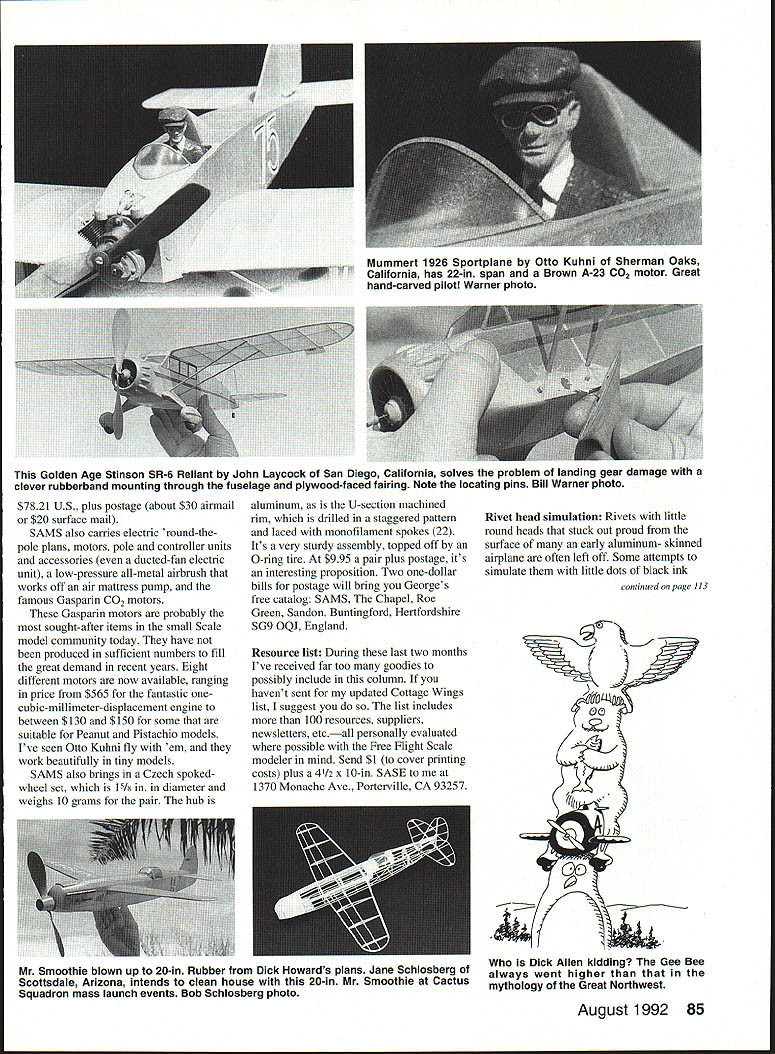
I'd bet the 26-in. Messerschmitt Bf 109E beaded Styrofoam kit is something that many modelers are going to go for in a big way here. Designed for the German market, it did not sell there, as many Germans do not wish to be connected to that aspect of their past. A P-51 is now being planned for this summer in the hope that it will lure a few deutsche marks.
Inside the huge kit one finds the Styrofoam airframe, a three-bladed prop/spinner assembly, bottles of special glue, paints, sandpaper, decals, a canopy, a Modela CO2 .27cc motor with extra-large tank, a shaft extension, an all-metal filler gadget (which uses Sparkletts-type cartridges), a wrench, mounting hardware, spare parts, and some very quaint instructions.
There is even a three-view drawing with a 13-in. wingspan for you Peanut devotees. It's an exciting package, and it should fly nicely as well as have that solid Scale look. The price for this large kit is £44.95, or $78.21 U.S., plus postage (about $30 airmail or $20 surface mail).
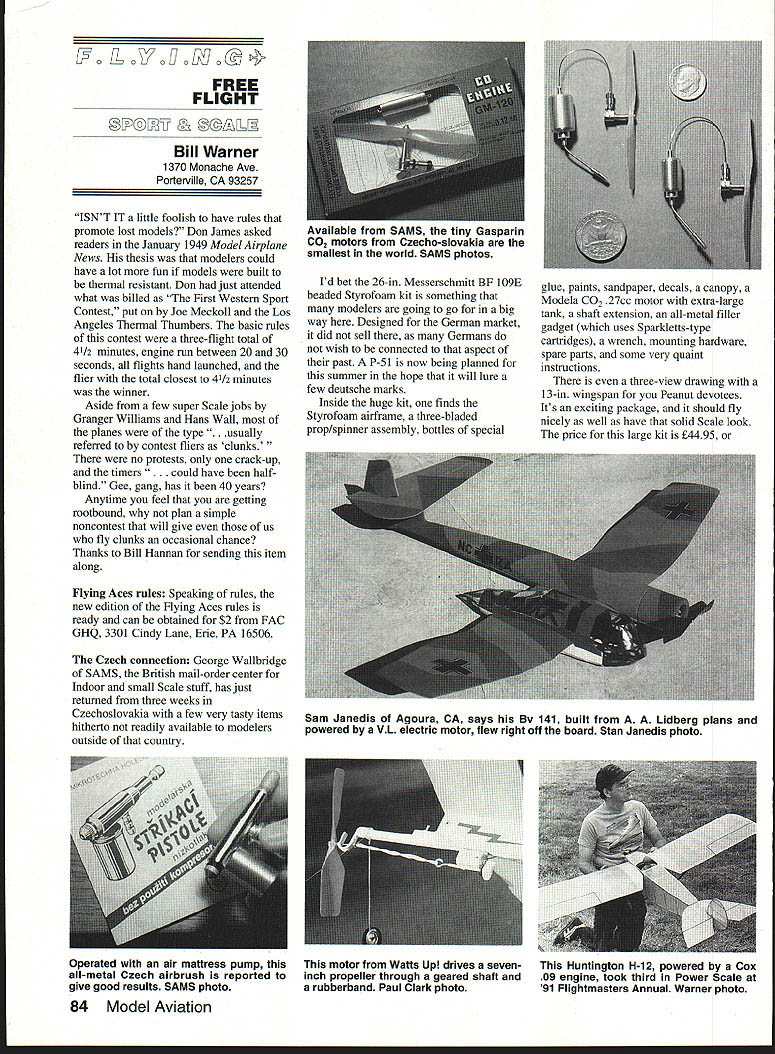
SAMS also carries electric "round-the-pole" planes, motors, pole and controller units and accessories (even a ducted-fan electric unit), a low-pressure all-metal airbrush that works off an air mattress pump, and the famous Gasparin CO2 motors.
The Gasparin motors are probably the most sought-after items in the small Scale model community today. They have not been produced in sufficient numbers to fill the great demand in recent years. Eight different motors are now available, ranging in price from $5.65 for the fantastic one-cubic-millimeter-displacement engine to between $130 and $150 for some that are suitable for Peanut and Pistachio models. I've seen Otto Kuhni fly with 'em, and they work beautifully in tiny models.
SAMS also brings in a Czech spoked-wheel set, which is 1 1/8 in. in diameter and weighs 10 grams for the pair. The hub is aluminum, as is the U-section machined rim, which is drilled in a staggered pattern and laced with monofilament spokes (22). It's a very sturdy assembly, topped off by an O-ring tire. At $9.95 a pair plus postage, it's an interesting proposition. Two one-dollar bills for postage will bring you George's free catalog: SAMS, The Chapel, Roe Green, Sandon, Buntingford, Hertfordshire SG9 0QJ, England.
Rivet-head simulation
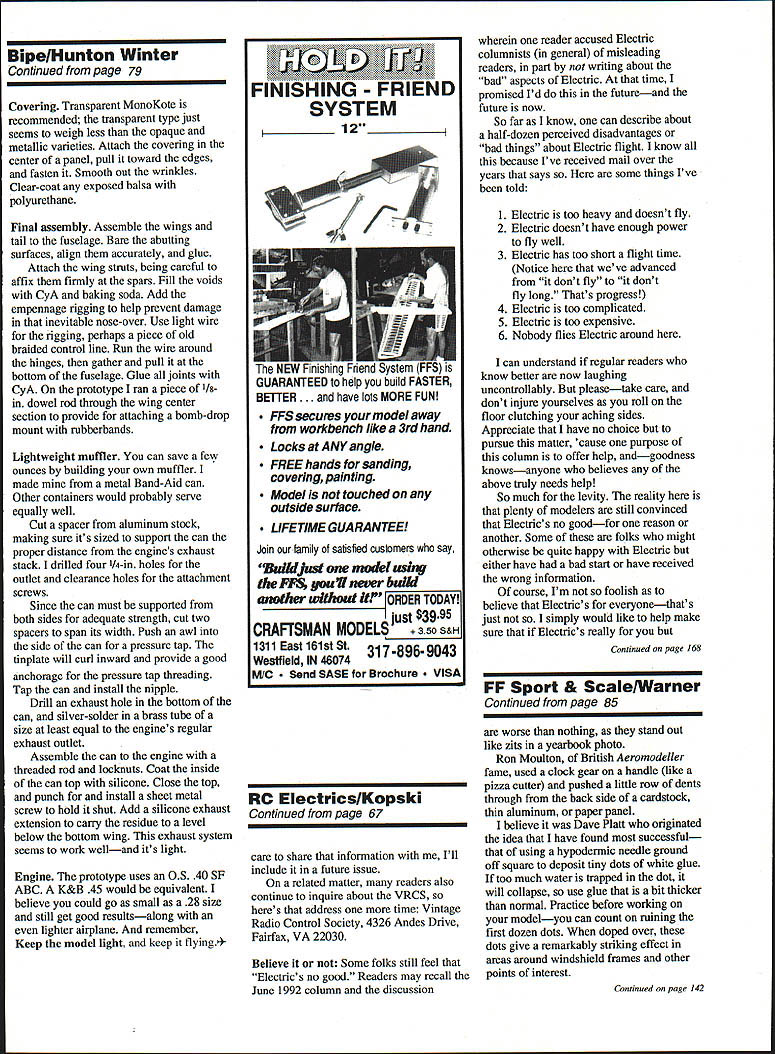
Rivets — the little round heads that stuck out proud of the surface of early aluminum-skinned airplanes — are often left off. Some attempts simulate the little dots with black ink.
Resource list
During these last two months I've received far too many goodies to possibly include in this column. If you haven't sent for my updated Cottage Wings list, I suggest you do so. The list includes more than 100 resources, suppliers, newsletters, etc.—all personally evaluated where possible with the Free Flight Scale modeler in mind. Send $1 (to cover printing costs) plus a 4½ x 10-in. SASE to me at 1370 Monache Ave., Porterville, CA 93257.
Electric: perceived disadvantages
A while back one reader accused Electric columnists (in general) of misleading readers, in part by not writing about the "bad" aspects of Electric. At that time, I promised I'd do this in the future—and the future is now.
So far as I know, one can describe about a half-dozen perceived disadvantages or "bad things" about Electric flight. I know all this because I've received mail over the years that says so. Here are some things I've been told:
- Electric is too heavy and doesn't fly.
- Electric doesn't have enough power to fly well.
- Electric has too short a flight time. (Notice here that we've advanced from "it don't fly" to "it don't fly long." That's progress!)
- Electric is too complicated.
- Electric is too expensive.
- Nobody flies Electric around here.
I can understand if regular readers who know better are now laughing uncontrollably. But please—take care, and don't injure yourselves as you roll on the floor clutching your aching sides.
Appreciate that I have no choice but to pursue this matter, because one purpose of this column is to offer help, and—goodness knows—anyone who believes any of the above truly needs help!
So much for the levity. The reality here is that plenty of modelers are still convinced that Electric's no good—for one reason or another. Some of these are folks who might otherwise be quite happy with Electric but either have had a bad start or have received the wrong information.
Of course, I'm not so foolish as to believe that Electric's for everyone—that's just not so. I simply would like to help make sure that if Electric's really for you...
Molding latex
Being a tin-toy collector, I often get cars and such with missing parts, many of which (such as tires, hubs, face gears, etc.) can be replicated by making a latex mold and casting a new part with epoxy resin or latex. Mold-It, a pure liquid rubber latex, is handy stuff. Available at most hobby stores, the product is made by Joli Plastics and Chemical Co., 14922 Garfield Ave., Paramount, CA 90723.
Mold-It is available in pint cans. Because Mold-It is applied in several thin coats, I keep it in little 35mm film canisters so that I don't have to keep prying the lid off the can.
Use a brush to apply Mold-It over a pilot figure. When you peel it off after a couple of coats, you have a light, hollow, and indestructible pilot.
Lampblack (or even black ink) can be mixed in to make tires. Molds can be backed up with plaster of Paris for pouring epoxy to make gears, etc. Painting a thin coat on balsa tires or spinners can save them from wear and dings. Prop hooks dipped in it save rubber motors from being cut.
I can even envision making latex drive belts by painting a layer on a round form, letting it dry, and then putting a few wraps of thread around and painting over them. Even "vee" or toothed belts could be custom made in this fashion for driving twins, fours, or high-thrust-line applications. If you try it, be sure to let me know how it turns out.
Tools and markers
Bob Lopshire, who recently moved back to Florida, writes that the Pilot Photographic Marker fine-line permanent pen is his choice for panel and control surface lines. It's available at stationers and camera stores. It marks even on resin-coated paper and metal. I agree with Bob that it's very versatile. I've had a problem with 'em getting plugged up fairly often, though. Ricardo Mora in Los Angeles, California, recommends the Pigma fine-line marker, which I have yet to try on a model.
Watts Up!
This is the name of a supplier of the last inexpensive tiny electric motors I've come across. Many of you may have tried little surplus or Radio Shack electric motors and found that they just didn't have the required oomph. What is usually required is a larger size winding on the armature and brushes that will handle the extra juice required for the higher rpm. Watts Up! has rewound, geared systems, batteries, props, and all you'll need to get into Electric at bargain-basement prices. Send an SASE to Paul Clark, P.O. Box 5702, Hamden, CT 06518, for his list.
Hot new plans
The Vulcan American Moth for CO2 by A. A. Lidberg is a real cutie. It includes a three-view, a photocopied picture of the full-scale plane, and great building instructions for $7 postpaid (or $8 if you want his new catalog too). The address is 614 E. Fordham, Tempe, AZ 85283.
Eric Marsden's new Short Cockle (as distinguished from the Short Mussel) shoulder-wing flying boat plan for twin Electric or CO2 has me reaching for the old Uber Skiver and balsa. This very buildable 32-in. gem will stop traffic at the flying site, believe me. Send $9 to B2 Streamlines, P.O. Box 976, Olalla, WA 98359-0976; $2 will get you the catalog of Scale and sport plans.
Flying Aces Plan Packet No. 1
Because the Flying Aces have received many requests for plans that have appeared in their newsletter, they have issued Plan Packet No. 1, with 10 planes on sixteen 11 x 17-in. sheets in a nice folder.
These Rubber Scale models range from a J-3 Cub Peanut to a 28-in. Fokker XX. If these superb models by Dave Stott, Frank Scott, Pres Brüning, Tom Nallen Jr., and Chet Bukowski don't get you building, nothing will. Send $8 plus $2 postage to 3301 Cindy Lane, Erie, PA 16506, in order to bring this collector's item to your doorstep. Don't wait; these will go fast.
The Domedusters Plan Pack
This packet of a dozen plans, about half of them Scale, represents seven different classes of Indoor modeling: Peanut, Pistachio, Bostonian, Mini-Stick, FROG, EZB, and No-Cal Scale. The stars of the Scale jobs are a 1920 Cato Butterfly, a 1925 Messerschmitt M 17, and Percival Mew Gull. Some of the designers are Doc Martin, Dave Linstrum, Stan Fink, and Walt Eggert. Send $8 to Domedusters (c/o Stan Fink, 1810 Pine St., Philadelphia, PA 19103) to get yourself all set up to try your hand at Indoor. You can also subscribe to the Domedusters newsletter for $12 (six issues).
New kits
The Hawker Sea Fury F.B. II, a 21.6-in.-span Rubber ship by Peter Shepherd available from Westwings, can be obtained by sending $19.95 plus $7 postage (bills or VISA/MC) to SAMS (mentioned earlier). Very nice kit, fine balsa.
Dave Diels has a couple of dandy new kits: the 18-in.-span A6M2 Zero for Rubber Scale and a Focke-Wulf TA-152H at 23-1/16-in. span. Price is $20 each plus $3 shipping. You can get Dave's newsletter for a large SASE with two stamps, and for a dollar you can get his complete catalog. Dave promised a couple of civilian planes later in the year.
Well, gang, until we meet again, keep the true spirit of modeling alive, help a junior modeler, and be kind to little old ladies who own sod farms.
LIGHTWEIGHT WHEELS
"What this country needs is a good, lightweight wheel for vintage Free Flight utility." It seems I have mentioned this before, but the need still seems to be with us. Suppliers of R/C accessories currently produce wheels of myriad designs, most of which are too heavy or incorporate those inappropriate wide treads and/or spoked hubs that somehow just don't seem to add any romance to the appearance of an otherwise-gorgeous vintage Free Flight model.
Suppliers like K&B once produced the epitome of class in their streamlined, smoothly contoured, aluminum-hubbed, nylon-tyred wheels. More recently, Miller Manufacturing made a very nice 1-1/4-inch wheel with aluminum hub and plastic rim. K&B's wheels went out of production. Miller's product is no longer made, either. Vendors who have suitable small wheels seem to sell them as parts for R/C or larger models and the price is often ridiculous.
It would be nice if someone would begin producing a simple, reasonably priced 1-1/4-inch or 1-3/8-inch wheel with a narrow profile, soft tire, and a 1/16-inch axle hole. If anyone knows of such a wheel, please write in.
Transcribed from original scans by AI. Minor OCR errors may remain.

