
Free Flight: Sport & Scale
Bill Warner 1370 Monache Ave. Porterville, CA 93257
What is hot vinegar good for? According to Tom Comparet, who telephoned the company that makes the wonderful new Titebond II, it is the only thing that will debond that product. Isn't that good to know? The only problem is that people using this method develop a craving for fish and chips, much in the way that using cellulose glue denatured with mustard used to produce a craving for hot dogs.
Len Sherman's P-38 is one of the finest scale rubber jobs around. Maybe it's because he worked on 'em in WWII. The fine scale appearance of the monocoque booms helped Len win the 1991 NW FF Champs.
Balsa shells are not new; in the past they were often made from solid blocks of balsa that were first shaped on the outside, cut down the middle lengthwise, and then painfully hollowed out and reglued together. You can still do this if you want to.
Bob Boucher used to hollow out parts using a rotary file on a drill press, keeping the wall thickness uniform by the simple expedient of maintaining the wall thickness as clearance between the cutter and the table. If you handle the part carefully and don't shove it too far to either side, you can maintain a perfect dimension.
I used to use a rotary burr in a Dremel tool freehand, holding the part up to the light until I could see light shining through the balsa; I would concentrate on the darker spots. Unlike the fixed-thickness drill press method, this makes allowances for density differences. To use this method, you must brace your hands well so the Dremel does not get away from you and cut material you didn't intend to cut. A variation is to use a gouge such as the X-Acto full-circle cutter.
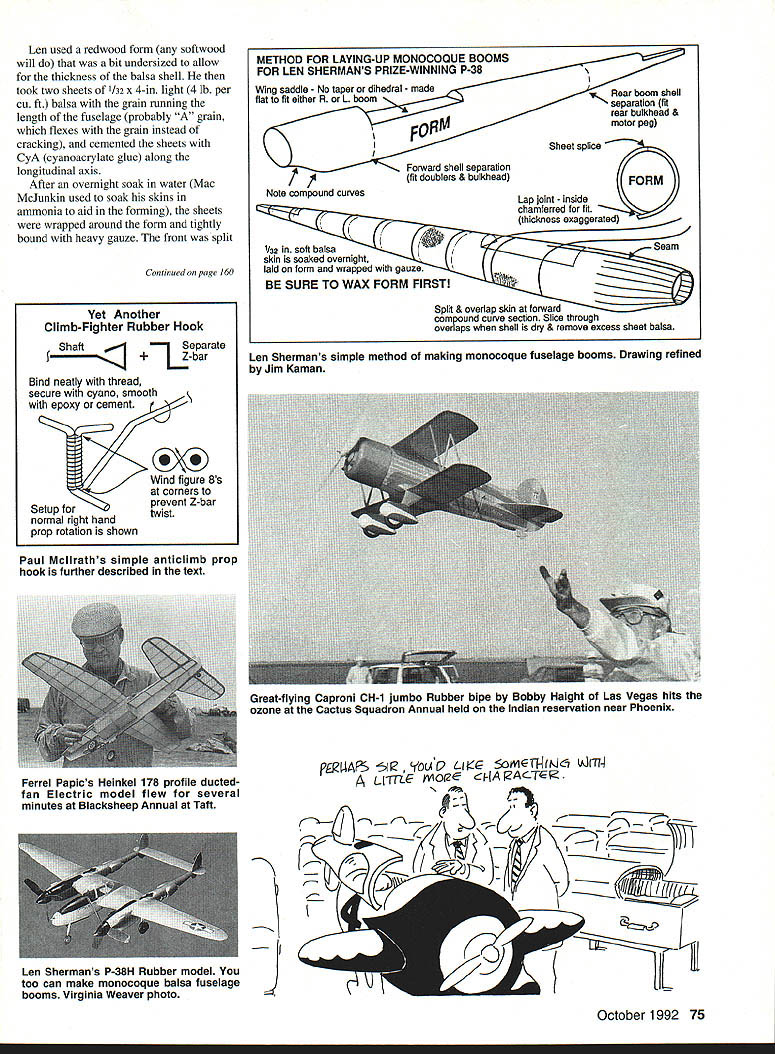
Method for Laying-up Monocoque Booms for Len Sherman's Prize-Winning P-38
Len used a redwood form (any softwood will do) that was a bit undersized to allow for the thickness of the balsa shell. He then took two sheets of 1/32" x 4" light (4 lb. per cu. ft.) balsa with the grain running the length of the fuselage (probably "A" grain, which flexes with the grain instead of cracking), and cemented the sheets with CyA (cyanoacrylate glue) along the longitudinal axis.
After an overnight soak in water (Mac McJunkin used to soak his skins in ammonia to aid in the forming), the sheets were wrapped around the form and tightly bound with heavy gauze. The front was split and overlapped before binding. Drying could be done overnight or in a microwave. When both thicknesses are sliced through with a razor blade, overlapped balsa will match up nicely.
Getting the skin off the form was done by splitting the part crosswise at the front spar of the wing. In addition, it was split at the rear peg to install a bulkhead and rear peg reinforcement.
To finish off the model, Len partially planked the cockpit fuselage with four-pound balsa sheet and covered the model with J.C.I. silver tissue. He made the three-bladed props from a plastic flower pot.
Ducted-fan FF Scale and Electric
Ducted-fan FF Scale seems to be here to stay. Ferrel Papic's profile Heinkel He 178 has been flying for a couple of years with two of Ferrel's tiny modified motors, but never with much altitude. This year he's put an Astro 02 in it, and the extra power really gets the model up there.
Interested in getting started in electric? Constant testing and refinements have made electric very attractive for single- and multi-engined scale models, and flight duration can be controlled by the length of the charge on Ni-Cd batteries. Need more power? Usually, adding another cell will do the trick. As long as you allow the motor to turn up and don't overload it with a too-big prop, your problems will be practically nil.
Three light FF systems can replace the venerable Astro 02, which has been off the market for a few years:
- V.L. Products, 7871 Alabama, No. 16, Canoga Park, CA 91304 (catalog $1) — an excellent, proven geared motor.
- Peck-Polymers, P.O. Box 710399, Santee, CA 92072 — a motor noted for low power requirements. Send $3 to Peck-Polymers for the catalog.
- HiLine, Ltd. (now owned by Dave and Marie Rees), Box 11558, Goldsboro, NC 27532 (catalog $1) — also offers a ducted-fan module for its motors.
Realistic Aluminum and Finishes
Jere Robinson, of the San Diego Scale Staffel, has an aluminum finish that is hard to beat for realism. Most scale modelers are familiar with Rub 'n Buff, a paste in a tube. It is usually applied with a finger and buffed to a metallic finish with a soft cloth. Jere uses Rub 'n Buff specially thinned for airbrushing, and the result is spectacular. Check it out the next time you're in an art supply store.
Jack McCracken, never one to skimp on realism, has taken to using really thin aluminum sheets for panels requiring corrugating or louvers. He first uses an end mill to cut the louver cavities or corrugations in a thick aluminum base, then presses the almost-paper-thin aluminum from a surplus store into it using a firm rubber mat and an arbor press.
Clubs, Newsletters, and Services
The Palmetto Aeromodellers is a Flying Aces–oriented group that puts out a newsletter two to three times a year. If you are interested, write to David G. Smith, 3013 Sigmund Circle, Columbia, SC 29204.
I have issue No. 18 in front of me, and it is fun. It includes a photo page, stall catapult, full-size Reggiane rubber-job plan, crossword puzzle, equations for changing the size of your scale model, news, a coupe plan, a (reduced) P-30 plan, and a contest calendar. It's nice, and it's certainly worth your $5-per-year support.
The Palmetto Aeromodellers promotes events for modern production aircraft since 1940 and for modern military aircraft since 1945. Too bad—legacy lovers and P-51 addicts: time to build a Bonanza or Sea Fury. Should add a little variety to the FAC scene!
Small Scale Custom Services is recommended by John Fredericksen. Owned by Lindsey and Jane Smith, the company offers vacuum-formed pilots with character, from Peanut (1/32-in. scale) to inch-to-the-foot size, made from .007" acetate sheet. Wheels, molded from .020" styrene, range in diameter from 1" to 2½". Radial seven- and nine-cylinder engines run from 35mm to 57mm in diameter.
Cockpit canopies are molded in .010" acetate and fit most Earl Stahl designs plus Veron and Keilkraft ones. Send a dollar bill for postage and they'll send you a listing. Address: Spring Meadow, Fyfield, Andover, Hants., SP11 8EL, England.
Cottage Wings List
My Cottage Wings list is still available and is constantly updated to include new clubs, suppliers of plans, information, materials, etc., that could be of interest to FF scale builders, along with any comments I can make. Send a dollar and a large SASE to 1370 Monache Ave., Porterville, CA 93257.
In Memoriam
The passing of friends is an inevitable part of our lives. We celebrate their comradeship and achievements shared with us. Good-bye to a few of the greats in our family: Eric Coates, Bill Galloway, Butch Hadland, and Burr Stanton.
Competitions and Notable Models
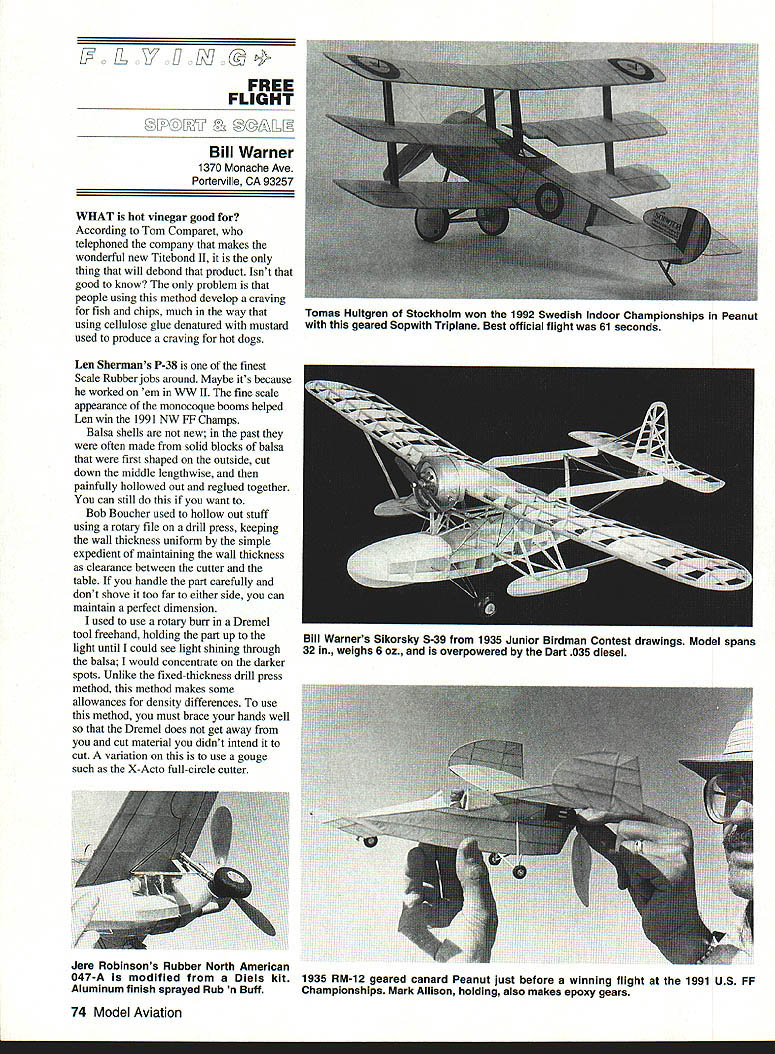
The 1992 Swedish Indoor Championships was won with Tomas Hultgren's inspiring Sopwith triplane, which is about as close to an ideal Peanut as I have ever seen. This flawless beauty was built from an enlarged Windsock Datafile three-view and uses a 1:3-ratio gearbox to drive the prop. Mark Allison's epoxy gears are the heart of the system and help keep the weight up front on the short-nose design. (You can get Mark's how-to sheet and gear list by sending a buck to him at Rte. 1, Box K-4, Bishop, CA 93514.)
The 13"-span ship weighs only nine grams without rubber, and features a sprung undercarriage and a tail skid. Can't you just picture it floating around in slow right-hand circles on its 61-second winning flight?
Tips and Tricks
- Don't throw away those disposable shaver blades. They make great tissue trimmers, says Gustave Nepper of Cincinnati.
- Dave Linstrum on microwaved wing tips: Dave says he has been doing laminated tips in the microwave oven for about five years. He makes his matboard form extra long and tapes long laminations to it at the ends—ends that will later be trimmed off. One minute on high does it for his Peanut and Pistachio tips.
- Alcohol and plastic: Gene Pierre, of Princeton, New Jersey, experimented with using diluted white glue on his model, with alcohol brushed around the edges as an activator. He tried both 91% and 70% alcohol (disinfectant and rubbing alcohols) with .003" acetate, .005" styrene, cellophane, and .002" IM-supplied sheets, and found that they all hold very well. The alcohol does not attack the plastics and does in fact clean them. Use a minimum amount of fluid; visible lines may wipe off easily, but lines on the inside can be a problem.
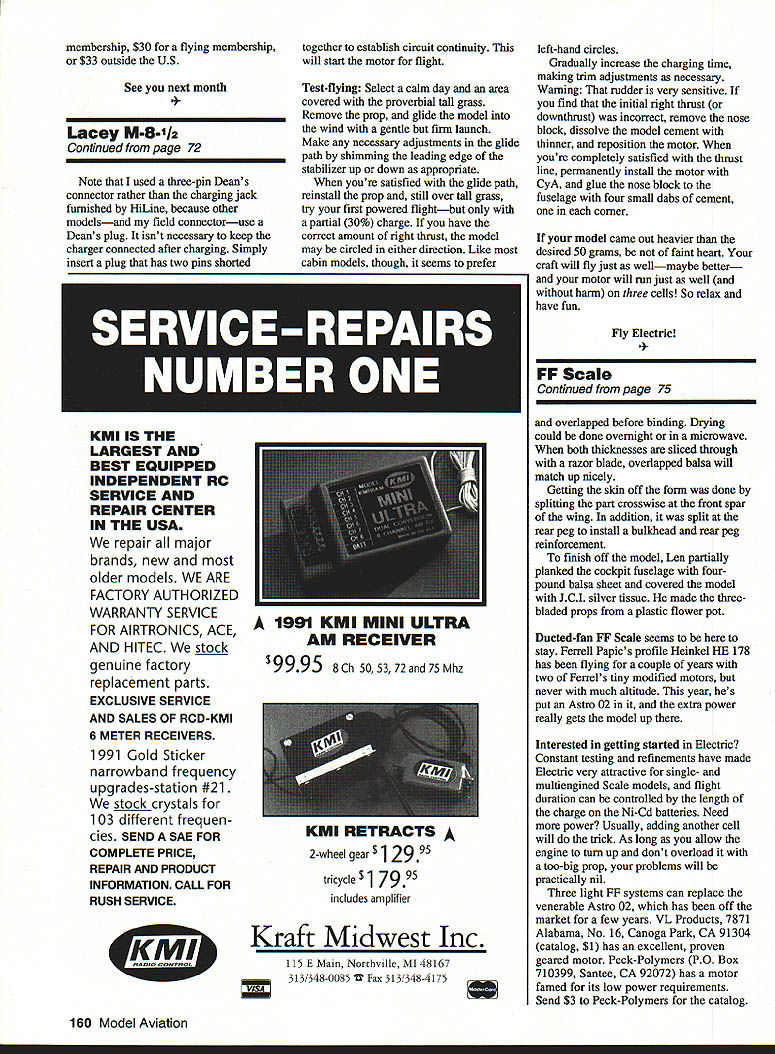
- Preventing rubber climbing off your prop hook: Paul McIlrath's Z-Bar safety device is simple and easy to bend. Paul used thread and CyA to secure this bar to a triangular hook, but thin brass wire from craft stores and Sta-Brite silver solder would work well. Paul suggests smoothing the surface that contacts the rubber by using a layer of epoxy or cement to reduce chafing. One caution: be sure to attach your Z-Bar right-handed.
Well, gang, until next time, keep the cap on your glue and your pins off the shag rug. Thanks for tuning in!
Transcribed from original scans by AI. Minor OCR errors may remain.

