
Free Flight: Sport & Scale
Bill Warner
Indoor Meets and Events
Too much. The Los Angeles area is blessed with monthly indoor meets where anyone can fly indoor scale models at four different locations. My friends in Europe and Florida shed crocodile tears whenever I complain about not being able to decide which to attend. Yes, things are tough all over!
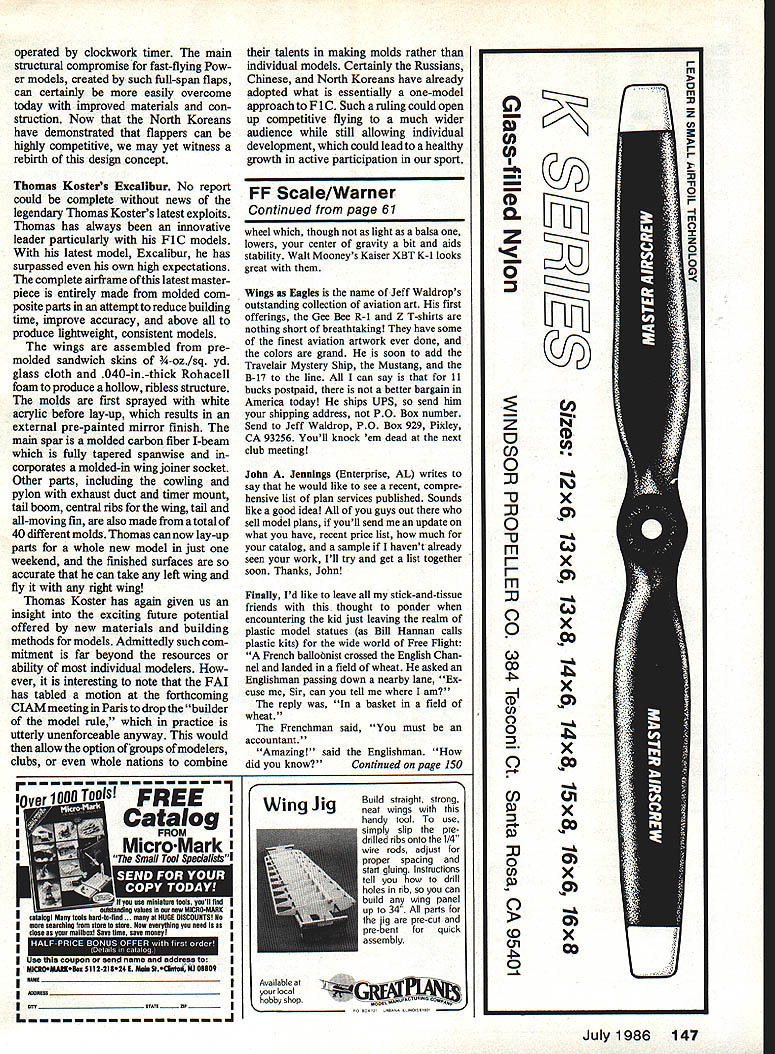
The really nice part is being able to meet and learn from many different types of modelers and talk to some of the best modelers in the business. Present indoor activity includes much fun-flying (mainly because making trophies for so many meets is tiresome), plus many specialized events run by people who wish to promote their favorite ideas. Some of these specialized events have created a lot of interest — notably the Beat Walt Mooney Event, Autogyro, Sub-Peanut (eight inches or less span), and most recently the Lympne Trials.
The Lympne Trials
The Lympne Trials, the brainchild of Butch Hadland in England, celebrate models of the British ultralights that participated in the mid-1920s contests at Lympne (say "Lim") Aerodrome. The subject aircraft have names as exotic as any ever invented. Some of the types flown include:
- Missel Thrush
- Short Satellite
- Bristol Brownie
- Parnell Pixie
- Supermarine Sparrow
- Westland Wood-Pigeon
- Electric Wren
- Gnosspelius Gull
- Vickers Vigor
- Gloucester Gannet
- Beardmore Wee-Bee
- Blackburn Bluebird
Most of the dozens of entries make good model subjects. We've started practicing for the event coming up in September in England.
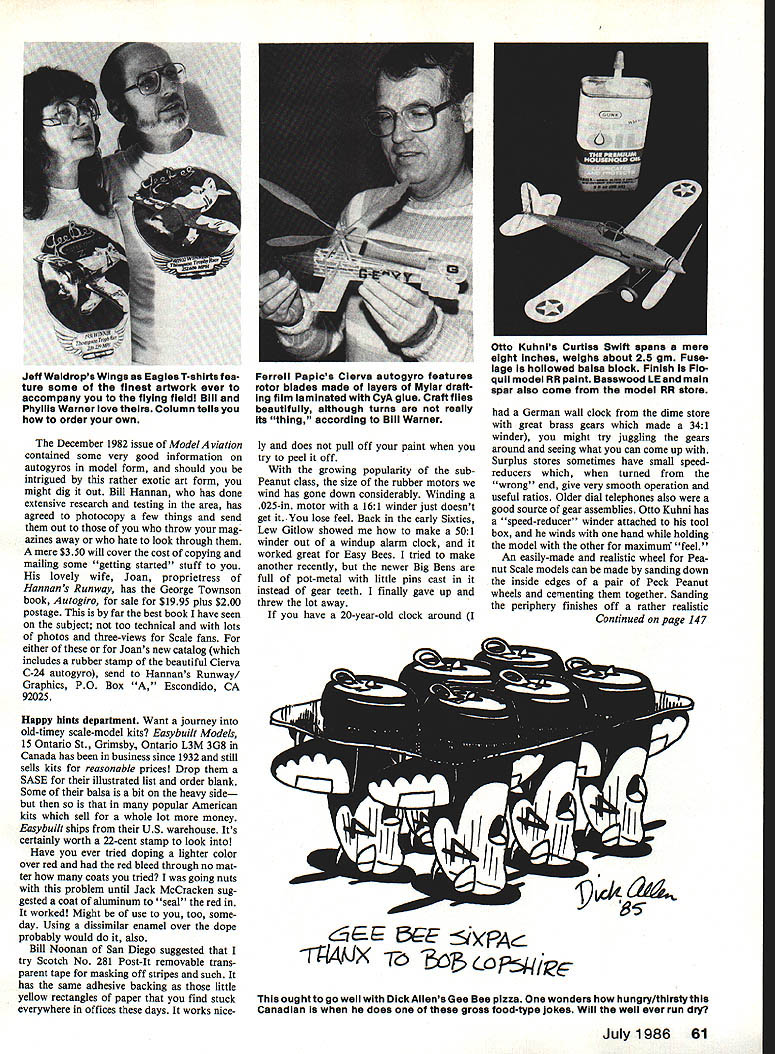
Perhaps the most difficult thing about the Lympne for models is the requirement to do two laps around pylons spaced 20 feet apart. We set up strings tied to helium balloons and invited anyone with a model to have a go. Making two circuits is possible, but some of the guys had a hard time doing it. Generally, all you think about is staying up and not hitting the ceiling or the walls — a new dimension in indoor competition.
If you'd like a copy of the latest Flightmasters newsletter (which contains plans and three-views for a number of Lympne subjects), send two bucks to me at the address at the end of this column and I'll get you a copy.
Autogyros
Another indoor challenge is the autogyro event, especially in scale. The success of Warren Shipp and Bill Hannan with their models at West Baden pointed up the possibilities of this class, though not many events have been held for it. The San Diego Orbiteers ran rubber-powered gyros back in the late Sixties outdoors and drew a fair number of entries. Recently, Flightmasters West autogyro events have drawn both scale and non-scale ships, usually with profile fuselages, that flew much better than expected. Still, no one really seems to have all the answers, and perhaps that is the appeal of autogyros.
The December 1982 issue of Model Aviation contained some very good information on autogyros in model form. If you are intrigued by this rather exotic art form, you might contact Bill Hannan. He has done extensive research and testing and has agreed to photocopy a few things and send them out. If you hate to throw magazines away and hate to look through them, a mere $3.50 will cover the cost of copying and mailing some getting-started material.
His wife Joan, proprietress of Hannan's Runway, has the George Townson book Autogiro for sale — $19.95 plus $2.00 postage. It's the best book I have seen on the subject — rather technical, but with lots of photos and three-views. Scale fans: Joan's new catalog includes a rubber-stamp of a beautiful Cierva C-24 autogyro. Send inquiries to Hannan's Runway/Graphics, P.O. Box, Escondido, CA 92025.
Resources and Suppliers
- Easybuilt Models, 15 Ontario St., Grimsby, Ontario L3M 3G8, Canada, has been in business since 1932 and still sells kits at reasonable prices. Drop an SASE for an illustrated list and order blank. Some balsa is a bit heavy and some popular American kits sell for a whole lot of money. Easybuilt ships from a U.S. warehouse — it's certainly worth a 22-cent stamp to look.
Happy Hints
- Have you ever tried doping a lighter color over red? Red will bleed through no matter how many coats.
- Bill Noonan of San Diego suggested trying Scotch No. 231 Post-It removable transparent tape for masking off stripes and such. It has the same adhesive backing as those little yellow rectangles of paper you find stuck everywhere in offices these days. It works nicely and does not pull off your paint when you peel it off.
Winders and Small Motors
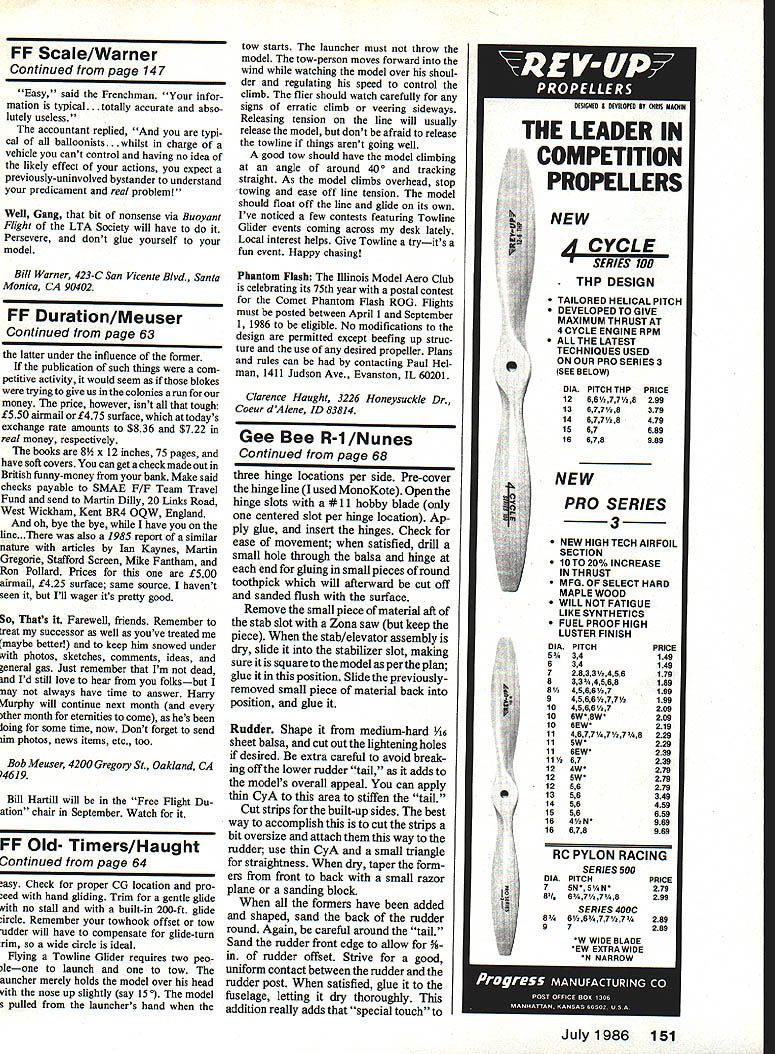
With the growing popularity of the sub-Peanut class, the size of the rubber motors we wind has gone down considerably. Winding a .025-in. motor with a 16:1 winder just doesn't get it — you lose feel. Back in the early Sixties, Lew Gilow showed me how to make a 50:1 winder out of a wind-up alarm clock, and it worked great for Easy Bees. I tried to make another recently, but the newer Big Dens are full of pot metal with little pins cast in instead of gear teeth. I finally gave up and threw the lot away.
If you have a 20-year-old clock around (I had a German wall clock from the dime store with great brass gears which made a 34:1 winder), you might try juggling the gears around and seeing what you can come up with. Surplus stores sometimes have small speed reducers which, when turned from the "wrong" end, give very smooth operation and useful ratios. Older dial telephones also were a good source of gear assemblies. Otto Kuhni has a "speed-reducer" winder attached to his tool box, and he winds with one hand while holding the model with the other for maximum feel.
Peanut-Scale Wheels
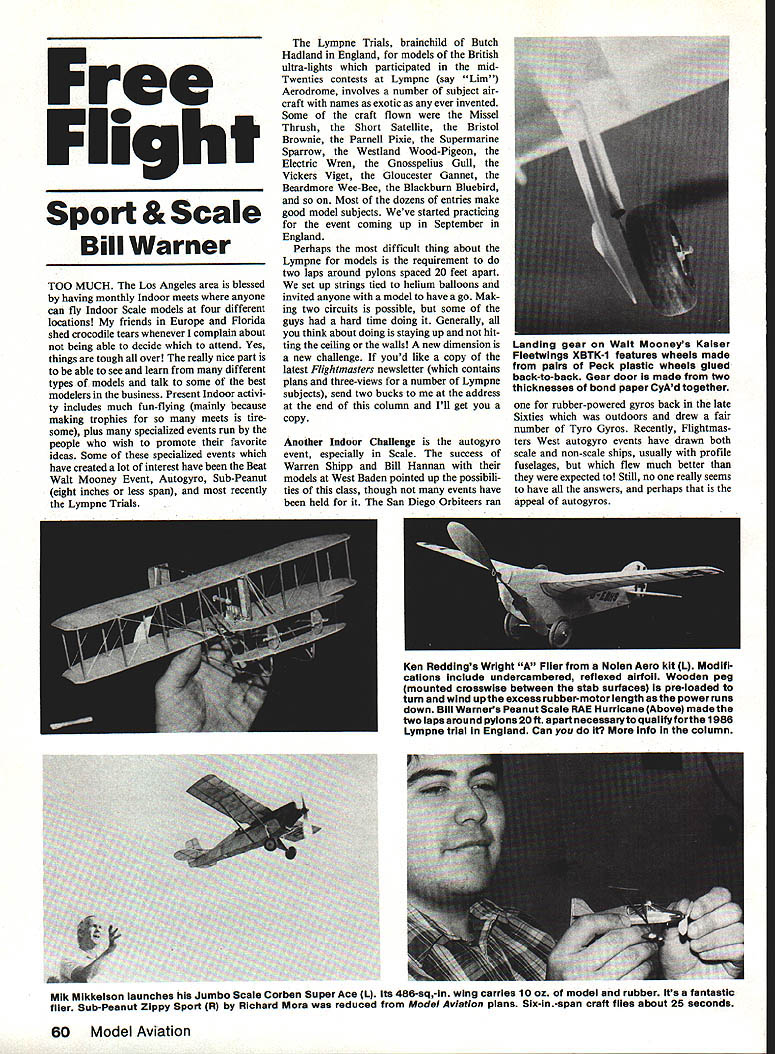
An easily made and realistic wheel for Peanut Scale models can be made by sanding down the inside edges of a pair of Peck Peanut wheels and cementing them together. Sanding the periphery finishes off a rather realistic appearance. The wheel, which—though not as light as a balsa one—lowers your center of gravity a bit and aids stability. Walt Mooney's Kaiser XBTK-1 looks great with them.
Thomas Koster's Excalibur
No report could be complete without news of the legendary Thomas Koster's latest exploits. Thomas has always been an innovative leader, particularly with his F1C models. With his latest model, Excalibur, he has surpassed even his own high expectations. The complete airframe of this latest masterpiece is entirely made from molded composite parts in an attempt to reduce building time, improve accuracy, and above all to produce lightweight, consistent models.
The wings are assembled from pre-molded sandwich skins of 3/4-oz./sq. yd. glass cloth and .040-in.-thick Rohacell foam to produce a hollow, ribless structure. The molds are first sprayed with white acrylic before lay-up, which results in an external pre-painted mirror finish. The main spar is a milled carbon-fiber I-beam which is fully tapered spanwise and incorporates a tube-and-fitting wing-joiner socket. Other parts, including the cowling and pylon with exhaust duct and timer mount, tail boom, central ribs for the wing, tail and all-moving fin, are also made from a total of 40 different molds. Thomas can now lay up parts for a whole new model in just one weekend, and the finished surfaces are so accurate that he can take any left wing and fit it with any right wing!
Thomas Koster has again given us an insight into the exciting future potential offered by new materials and building methods for models. Admittedly such commitment is far beyond the resources or ability of most individual modelers. However, it is interesting to note that the FAI has tabled a motion at the forthcoming CIAM meeting in Paris to drop the "builder of the model" rule, which in practice is utterly unenforceable anyway. This would then allow the option of groups of modelers, clubs, or even whole nations to combine their talents in making molds rather than individual models. Certainly the Russians, Chinese, and North Koreans have already adopted what is essentially a one-model approach to F1C. Such a ruling could open up competitive flying to a much wider audience while still allowing individual development, which could lead to healthy growth in active participation in our sport.
Wings as Eagles
Wings as Eagles is the name of Jeff Waldrop's outstanding collection of aviation art. His first offerings, the Gee Bee R-1 and Z T-shirts, are nothing short of breathtaking. They feature some of the finest aviation artwork ever done, and the colors are grand. He is soon to add the Travelair Mystery Ship, the Mustang, and the B-17 to the line. For $11 postpaid, there is not a better bargain in America today! He ships UPS, so send him your shipping address, not a P.O. Box number. Send to Jeff Waldrop, P.O. Box 929, Pixley, CA 93256.
Plans List
John A. Jennings (Enterprise, AL) writes to say that he would like to see a recent, comprehensive list of plan services published. Sounds like a good idea! All of you who sell model plans, please send me an update on what you have, recent price lists, how much for your catalog, and a sample if I haven't already seen your work. I'll try to get a list together soon. Thanks, John!
Final Thought
Finally, I'd like to leave all my stick-and-tissue friends with this thought to ponder when encountering the kid just leaving the realm of plastic model statues (as Bill Hannan calls plastic kits) for the wide world of free flight:
A French balloonist crossed the English Channel and landed in a field of wheat. He asked an Englishman passing down a nearby lane, "Excuse me, Sir, can you tell me where I am?"
The reply was, "In a basket in a field of wheat."
The Frenchman said, "You must be an accountant."
"Amazing!" said the Englishman. "How did you know?"
Closing
Well, gang, that bit of nonsense will have to do it. Persevere, and don't give yourself to your model.
Bill Warner 423-C San Vicente Blvd. Santa Monica, CA 90402
Transcribed from original scans by AI. Minor OCR errors may remain.

