
Free Flight: SPORT & SCALE
Bill Warner, 1370 Monache Ave., Porterville, CA 93257
New X-Acto — the Gripster
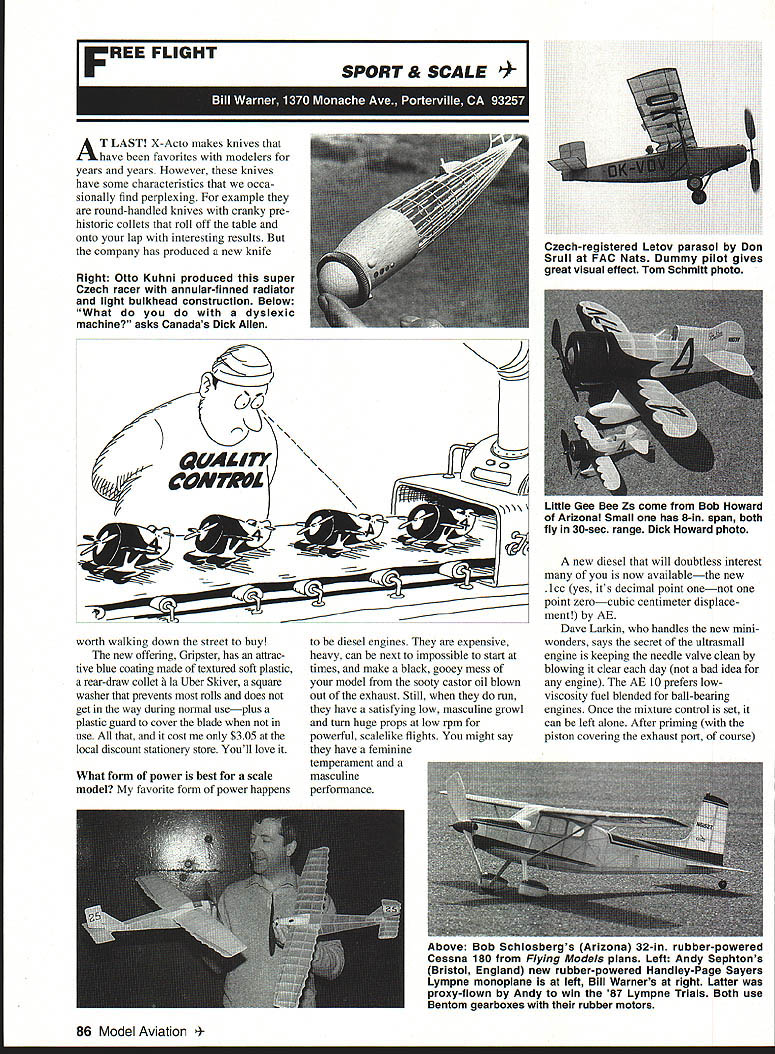
AT LAST! X-Acto's new Gripster knife addresses many long-standing gripes. It has a textured soft-plastic blue coating, a rear-draw collet (a la Uber Skiver), a square washer that prevents most roll-offs, and a plastic guard for the blade when not in use. Best of all, it costs only $3.05 at the local discount stationery store.
Diesel power and the AE .1 cc
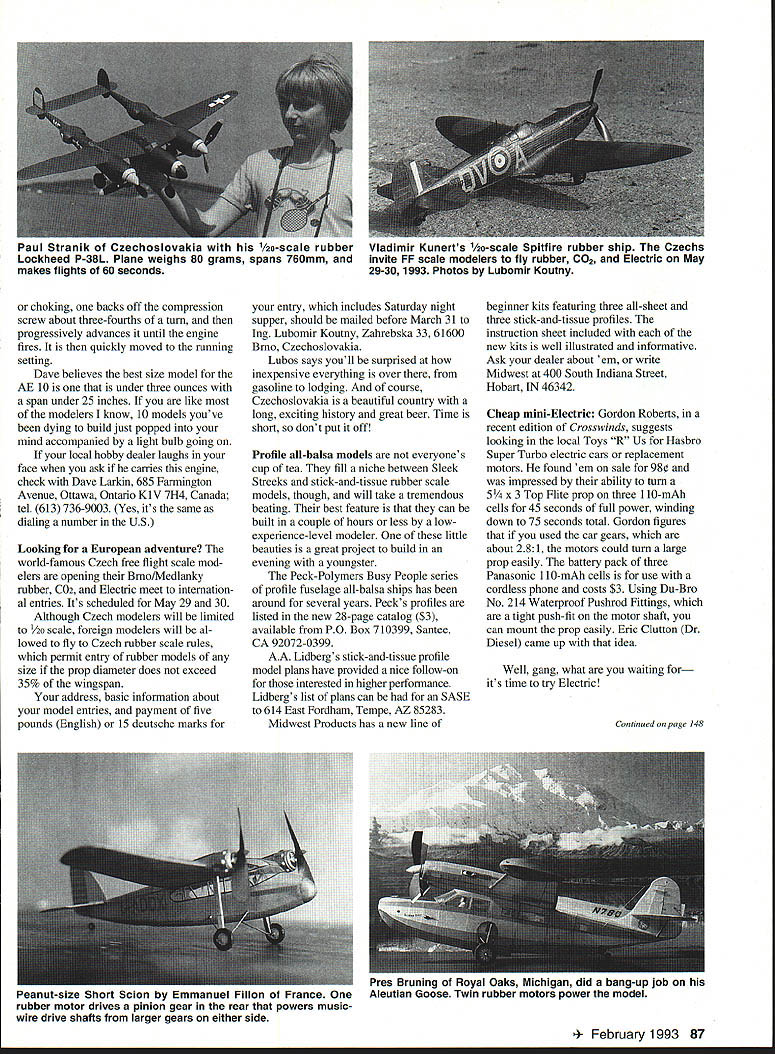
What form of power is best for a scale model? My favorite is diesel. They are expensive, heavy, sometimes hard to start, and they can leave sooty castor oil on the model — but when they run they have a satisfying low growl and turn big props at low RPM for powerful, scale-like flights.
A new diesel likely to interest many is AE's tiny .1 cc (0.1 cubic centimeter) engine — the AE 10. Dave Larkin, who handles these engines, says the secret to the ultrasmall engine is keeping the needle valve clean by blowing it clear (a good idea for any engine). The AE 10 prefers low-viscosity fuel blended for ball-bearing engines. Once the mixture control is set it can usually be left alone.
Starting procedure (recommended):
- Prime with the piston covering the exhaust port (or use choke).
- Back off the compression screw about three-fourths of a turn.
- Progressively advance the compression until the engine fires, then move quickly to the running setting.
Dave believes the best-size model for the AE 10 is under three ounces with a span under 25 inches. If your local hobby dealer doesn't carry it, check with Dave Larkin, 685 Farmington Avenue, Ottawa, Ontario K1V 7H4, Canada; tel. (613) 736-9003.
Brno / Medlanky international meet (Czechoslovakia)
Looking for a European adventure? The world-famous Czech free-flight scale modelers are opening their Brno/Medlanky rubber, CO2, and electric meet to international entries. It's scheduled for May 29–30.
- Czech modelers will be limited to 1/2-scale.
- Foreign modelers will be allowed to fly to Czech rubber scale rules, which permit rubber models of any size provided prop diameter does not exceed 35% of the wingspan.
Mail your address, basic model-entry information, and payment (five pounds sterling or 15 deutsche marks, which includes Saturday night supper) before March 31 to: Ing. Lubomir Koutny, Zahrebska 33, 61600 Brno, Czechoslovakia.
Lubos says expenses (gasoline, lodging, etc.) are surprisingly inexpensive there. Czechoslovakia is a beautiful country with a rich history and great beer — don’t put it off.
Profile all‑balsa and beginner kits
Profile all-balsa models fill a niche between sleek Sleek Streaks and stick-and-tissue rubber scale models. They take a beating, can be built in a few hours by a low-experience builder, and make great evening projects with a youngster.
- Peck-Polymers Busy People series (profile fuselage all-balsa ships) has been around for years. Catalog (28 pages) $3. Peck-Polymers, P.O. Box 710399, Santee, CA 92072-0399.
- A.A. Lidberg’s stick-and-tissue profile plans make a nice step-up. Request a list by SASE to 614 East Fordham, Tempe, AZ 85283.
- Midwest Products has a new line of beginner kits (three all-sheet and three stick-and-tissue profiles). Each kit includes a well-illustrated instruction sheet. Midwest Products, 400 South Indiana Street, Hobart, IN 46342.
Cheap mini-electric idea
Gordon Roberts (Crosswinds) suggests checking Toys "R" Us for Hasbro Super Turbo electric car motors (found as low as $0.98). One motor turned a 5x3 Top Flite prop on three 1.5V AA cells for about 45 seconds of full power, winding down to ~75 seconds total. Using the car gears (about 2.8:1) the motors can turn larger props. A three-cell Panasonic battery pack (for cordless phones) can be used; Du-Bro No. 214 Waterproof Pushrod Fittings make a tight push-fit on the motor shaft to mount the prop (idea credited to Eric Clutton, Dr. Diesel).
Well, gang — what are you waiting for? It’s time to try electric!
We need your input
We need help in the form of input from members in our region. The next few years will be critical to Free Flight’s long-term future, and we need modelers to assume an active role in deciding the direction. No one knows free flight better than free fliers — write, call, or find us at the flying field and let your voice be heard.
An .010 event — proposed rules
Several readers asked for plans for the little Grave Digger model. Bob Stalick has built (and lost) a Pee Wee B vintage model and proposed rules similar to Pee Wee 30 rules for an .010 event. I find Bob’s rules a bit harsh and propose this set for trial (unofficial at a local contest next spring):
- No model dimension larger than 25 inches.
- Ten-second engine run — no mechanical timers allowed. Overruns penalized five seconds of flight time for each second of engine run over 10.
- Two-minute max flight time (three minutes for flyoffs, with no overrun provision).
Is it better to leave model size unrestricted or to have a minimum-weight rule? Any other factors to consider? In the meantime, dig out that old .010 or buy a new one and start on a fun airplane!
Nelson / Tee Dee glow head (user reports)
Reports continue to come in about the Kustom Kraftsmanship / Nelson glow head adapter. Nat Comfort (Virginia) tested the head on three engines and found:
- None ran right with more than one plug shim (same as stock head). KK’s instructions suggest one head shim for each 5% of nitro over 20%; experience seems to align with using one shim or none depending on conditions.
- There was no appreciable increase in RPM, but more important — no drop in RPM and the smoother needle valve action. The needle works more smoothly and holds a steadier setting. Doug Galbreath suggests this is because the heat range of the Nelson plug better matches the pressures produced by the Tee Dee.
Nat also flew a 1/2A prop from Poti’s Hangar Products on an installation with the Nelson head:
- CS engine with an APC 6x2 produced 29,000 RPM.
- With Poti’s prop he got 27,000 RPM, yet the airplane went about 100 feet higher with the Poti prop.
Lesson: Static RPM figures are useful only to a point. What really matters is altitude gained. Some props show high static RPM but “fan” in the air. Others show lower static RPM but unload better in flight and give better overall performance. Fly the prop/engine/plane combo to see which works best.
Video: FAC Nats tape
A tape of the FAC Nats is available, featuring shots of full-size craft (including the Benjamin Gee Bee that wasn’t even at Geneseo) and a long talk by Cole Paten at the banquet. The tape quality is uneven, with some poor picture quality and spotty narration, but it captures a lot of fun and fantastic model airplanes. Price: $22.95. Send orders to: Swamp Squadron, FAC, 1503 Clairdale Lane, Lakeland, FL 33801.
Videos of earlier FAC Nats are also available.
Harold Towner plans / Authentic Scale
Harold Towner plans are available from Authentic Scale, 238 Kings Drive, Eastbourne, East Sussex BN21 2XE, England. Send a dollar in an envelope for a list of flying scale free-flight and rubber-power warplane plans for experienced modelers — maybe this is the year for a 37-inch rubber-powered B-17G. Thanks to John Fredriksen for the tip.
Buying balsa on the road
Walt Rozelle (Flyoff, Brooklyn Skyscrapers) recommends carrying a small postal scale (with an alligator-clip hanger) when traveling. Strange hobby, hardware, and art-supply stores can yield very nice light balsa. Most light models require 4–7 lb/ft³ balsa. Weigh a standard 3 x 36-inch sheet to spot hidden treasure.
Weights for 3 x 36-in. sheets at about 7 lb/ft³ (anything lighter is desirable):
- 1/32" = 6 g
- 1/16" = 12 g
- 3/32" = 19 g
- 1/8" = 25 g
- 3/16" = 37 g
- 1/4" = 50 g
For 2-inch-wide sheets (approximate weights):
- 1/32" = 4 g
- 1/16" = 8 g
- 3/32" = 12 g
- 1/8" = 17 g
- 3/16" = 25 g
- 1/4" = 33 g
Finding light C-grain wood is great fun. If you want Walt’s full chart, send $10 to Bob Hastekch, 316 Grosvenor Street, Douglaston, NY 11363-1011, to subscribe to Flyoff (mainly a free-flight competition newsletter but often of interest to FF scale modelers). P.S. Walt suggests checking the RC woodbin — much wood is mislabeled.
Which way the wind blows
Karl Spielmaker (Michigan Antique Modeler newsletter) discusses ways to check wind direction: toss dry grass, hold a hanky at arm’s length — and a new method: observe cows. Bill Hale interviewed pilots who noted cows point their tails into the wind. They all agreed there’s nothing like a good tail wind! (Personally, I’ll stick to dry grass.) To subscribe to this newsletter ($4), write Karl Spielmaker, 4690 Burlingame SW, Wyoming, MI 49509.
Bulletproof 9:1 rubber winder
Jack McCracken (Norwalk, CA) makes a superb winder from a Dazey knife sharpener: all-metal, indestructible gears, rubber hook where the grinding wheel used to be (ball-mount base removed). Watch garage sales and junk stores for this all-metal kitchen implement — it’s a dandy.
Cottage industries source guide
If you’d like my personal, updated and editorialized list of over 100 suppliers of plans, parts, clubs, etc., of interest to free-flight scale modelers, send $1 and a large SASE to me at 1370 Monache Avenue, Porterville, CA 93257.
Until next time, gang — don't carry indoor models in paper sacks; don't store your rubber wet; and don’t forget to get out and fly.
Transcribed from original scans by AI. Minor OCR errors may remain.

