
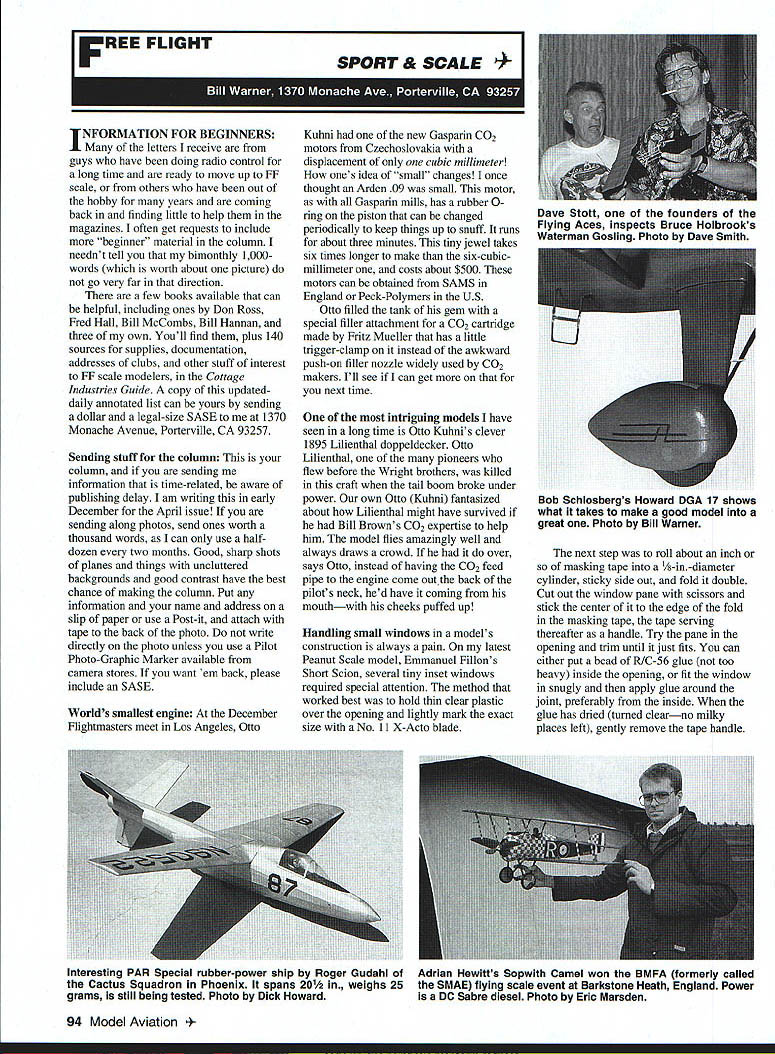
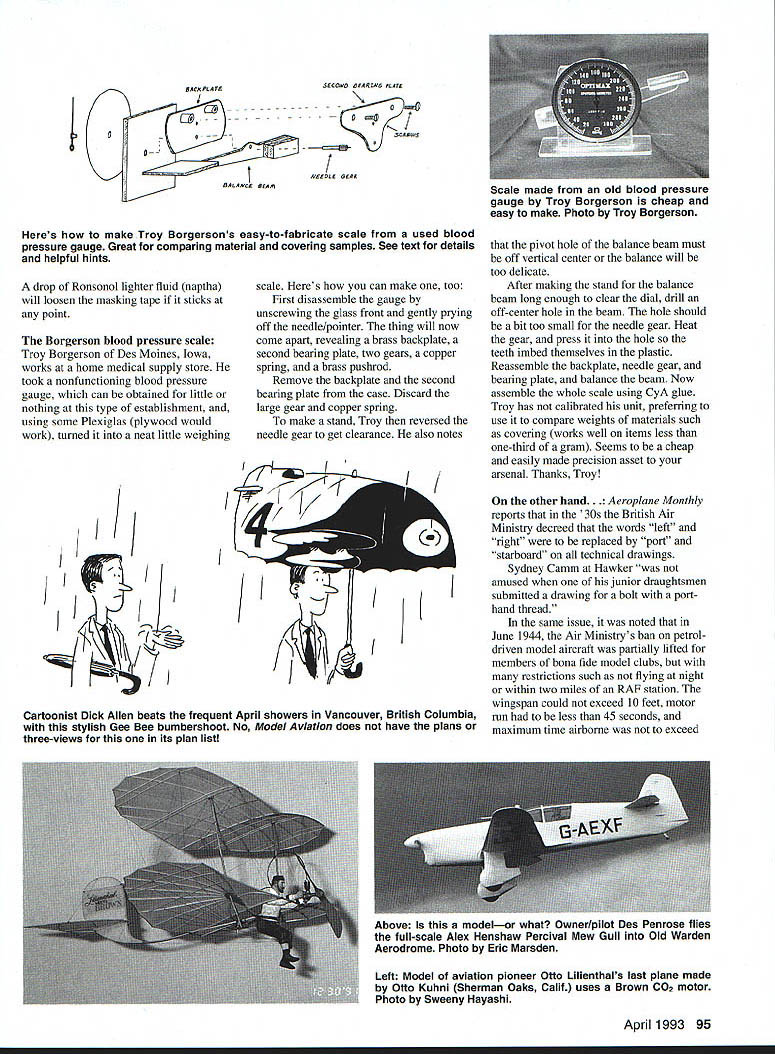
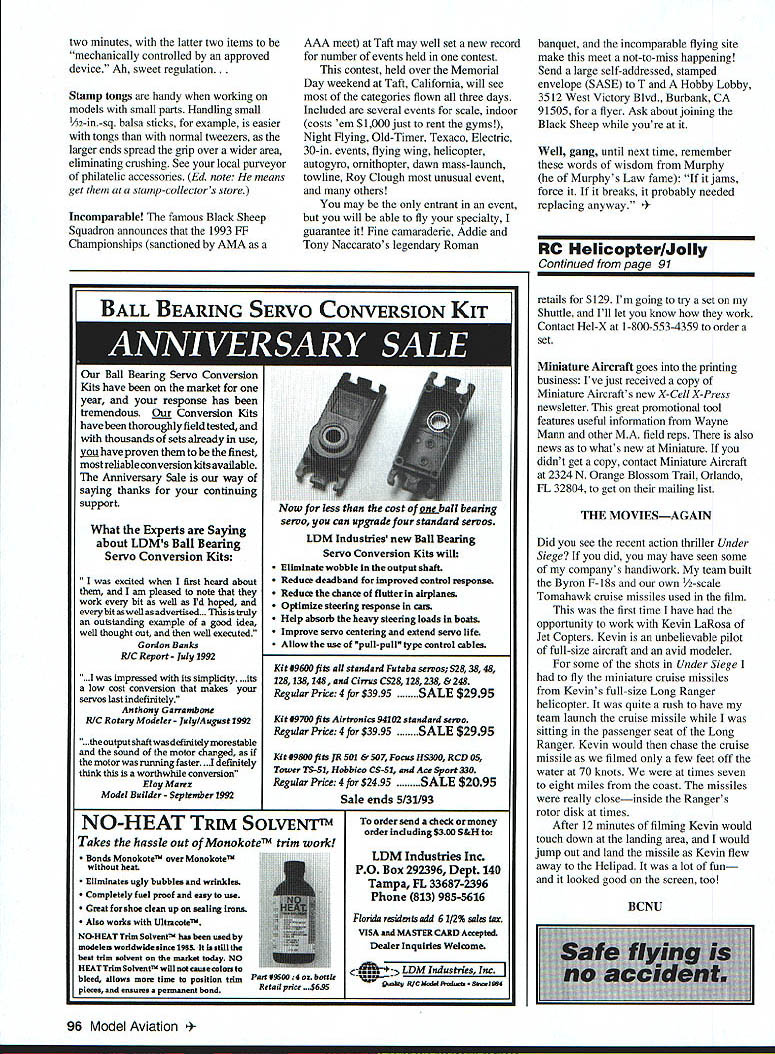
Free Flight: Sport & Scale
Bill Warner, 1370 Monache Ave., Porterville, CA 93257
Information for beginners
Many of the letters I receive are from guys who have been doing radio control for a long time and are ready to move up to free flight (FF) scale, or from others who have been out of the hobby for many years and are coming back in and finding little to help them in the magazines. I often get requests to include "beginner" material in the column. I needn't tell you that my bimonthly 1,000 words (which is worth about one picture) do not go very far in that direction.
There are a few books available that can be helpful, including ones by Don Ross, Fred Hall, Bill McCombs, Bill Hannan, and three of my own. You'll find them, plus about 140 sources for supplies, documentation, addresses of clubs, and other items of interest to FF scale modelers, in the Cottage Industries Guide. A copy of this updated-daily annotated list can be yours by sending a dollar and a legal-size SASE to me at 1370 Monache Avenue, Porterville, CA 93257.
Sending stuff for the column
This is your column, and if you are sending me information that is time-related, be aware of publishing delay. I am writing this in early December for the April issue! If you are sending along photos, send ones worth a thousand words, as I can only use a half-dozen every two months. Good, sharp shots of planes and things with uncluttered backgrounds and good contrast have the best chance of making the column.
Put any information and your name and address on a slip of paper or use a Post-it, and attach with tape to the back of the photo. Do not write directly on the photo unless you use a Pilot Photo-Graphic Marker available from camera stores. If you want them back, please include an SASE.
World's smallest engine
At the December Flightmasters meet in Los Angeles, Otto Kuhni had one of the new Gasparin CO2 motors from Czechoslovakia with a displacement of only one cubic millimeter! How one's idea of "small" changes — I once thought an Arden .09 was small. This motor, as with all Gasparin mills, has a rubber O-ring on the piston that can be changed periodically to keep things up to snuff. It runs for about three minutes. This tiny jewel takes six times longer to make than the six-cubic-millimeter one, and costs about $500. These motors can be obtained from SAMS in England or Peck-Polymers in the U.S.
Otto filled the tank of his gem with a special filler attachment for a CO2 cartridge made by Fritz Mueller that has a little trigger-clamp on it instead of the awkward push-on filler nozzle widely used by CO2 makers. I'll see if I can get more on that for you next time.
One of the most intriguing models I have seen in a long time is Otto Kuhni's clever 1895 Lilienthal doppeldecker. Otto Lilienthal, one of the many pioneers who flew before the Wright brothers, was killed in this craft when the tail boom broke under power. Our own Otto (Kuhni) fantasized about how Lilienthal might have survived if he had Bill Brown's CO2 expertise to help him. The model flies amazingly well and always draws a crowd. If he had it to do over, says Otto, instead of having the CO2 feed pipe to the engine come out the back of the pilot's neck, he'd have it coming from his mouth — with his cheeks puffed up!
Handling small windows
Handling small windows in a model's construction is always a pain. On my latest Peanut Scale model, Emmanuel Fillon's Short Scion, several tiny inset windows required special attention. The method that worked best was:
- Hold thin clear plastic over the opening and lightly mark the exact size with a No. 11 X-Acto blade.
- Roll about an inch or so of masking tape into a 5/8-in.-diameter cylinder, sticky side out, and fold it double.
- Cut out the window pane with scissors and stick the center of it to the edge of the fold in the masking tape — the tape serving thereafter as a handle.
- Try the pane in the opening and trim until it just fits.
- Put a bead of R/C-56 glue (not too heavy) inside the opening, fit the window snugly, and then apply glue around the joint, preferably from the inside.
- When the glue has dried (turned clear — no milky places left), gently remove the tape handle.
Helpful hint: a drop of Ronsonol (lighter fluid/naphtha) will loosen masking tape stuck to points.
Borgerson blood-pressure scale
Troy Borgerson, Des Moines, Iowa, works in a home medical supply store. He took a nonfunctioning blood-pressure gauge (which can be obtained for little or nothing at this type of establishment) and, using some Plexiglas (plywood would work), turned it into a neat little weighing scale. Here's how you can make one, too:
- Disassemble the gauge by unscrewing the glass front and gently prying off the needle/pointer. The gauge will come apart, revealing a brass backplate, a second bearing plate, two gears, a copper spring, and a brass pushrod.
- Remove the backplate and the second bearing plate from the case. Discard the large gear and the copper spring.
- To make a stand, reverse the needle gear to get clearance. Note: the pivot hole of the balance beam must be off vertical center or the balance will be too delicate.
- Make the stand for the balance beam long enough to clear the dial, and drill an off-center hole in the beam. The hole should be a bit too small for the needle gear.
- Heat the gear and press it into the hole so the teeth embed themselves in the plastic.
- Reassemble the backplate, needle gear, and bearing plate, and balance the beam. Assemble the whole scale using CyA glue.
Troy has not calibrated his unit, preferring to use it to compare weights of materials such as covering (works well on items less than one-third of a gram). It seems to be a cheap and easily made precision asset to your arsenal. Thanks, Troy!
On the other hand...
Aeroplane Monthly reports that in the 1930s the British Air Ministry decreed that the words "left" and "right" were to be replaced by "port" and "starboard" on all technical drawings. Sydney Camm at Hawker was not amused when one of his junior draughtsmen submitted a drawing for a bolt with a port-hand thread.
In the same issue, it was noted that in June 1944 the Air Ministry's ban on petrol-driven model aircraft was partially lifted for members of bona fide model clubs, but with many restrictions such as not flying at night or within two miles of an RAF station. The wingspan could not exceed 10 feet, motor run had to be less than 45 seconds, and maximum time airborne was not to exceed two minutes, with the latter two items to be "mechanically controlled by an approved device." Ah, sweet regulation.
Tools and tips
- Stump tongs are handy when working on models with small parts. Handling small 1/32-in.-sq. balsa sticks, for example, is easier with tongs than with normal tweezers, as the larger ends spread the grip over a wider area and eliminate crushing. See your local purveyor of philatelic accessories (stamp-collector's store).
Incomparable! — Black Sheep Squadron meet
The famous Black Sheep Squadron announces that the 1993 FF Championships (sanctioned by AMA as a AAA meet) at Taft may well set a new record for number of events held in one contest.
This contest, held over the Memorial Day weekend at Taft, California, will see most of the categories flown all three days. Included are several events for scale, indoor (it costs about $1,000 just to rent the gyms!), Night Flying, Old-Timer, Texaco, Electric, 30-in. events, flying wing, helicopter, autogyro, ornithopter, dawn mass-launch, towline, Roy Clough's most unusual event, and many others.
You may be the only entrant in an event, but you will be able to fly your specialty, I guarantee it! Fine camaraderie, Addie and Tony Naccarato's legendary Roman banquet, and the incomparable flying site make this meet a not-to-miss happening!
Send a large self-addressed stamped envelope (SASE) to T and A Hobby Lobby, 3512 West Victory Blvd., Burbank, CA 91505, for a flyer. Ask about joining the Black Sheep while you're at it.
Well, gang, until next time, remember these words of wisdom from Murphy (of Murphy's Law fame): "If it jams, force it. If it breaks, it probably needed replacing anyway."
Transcribed from original scans by AI. Minor OCR errors may remain.

