
Free Flight: Sport & Scale
Bill Warner
Mini-Electric: the new craze?
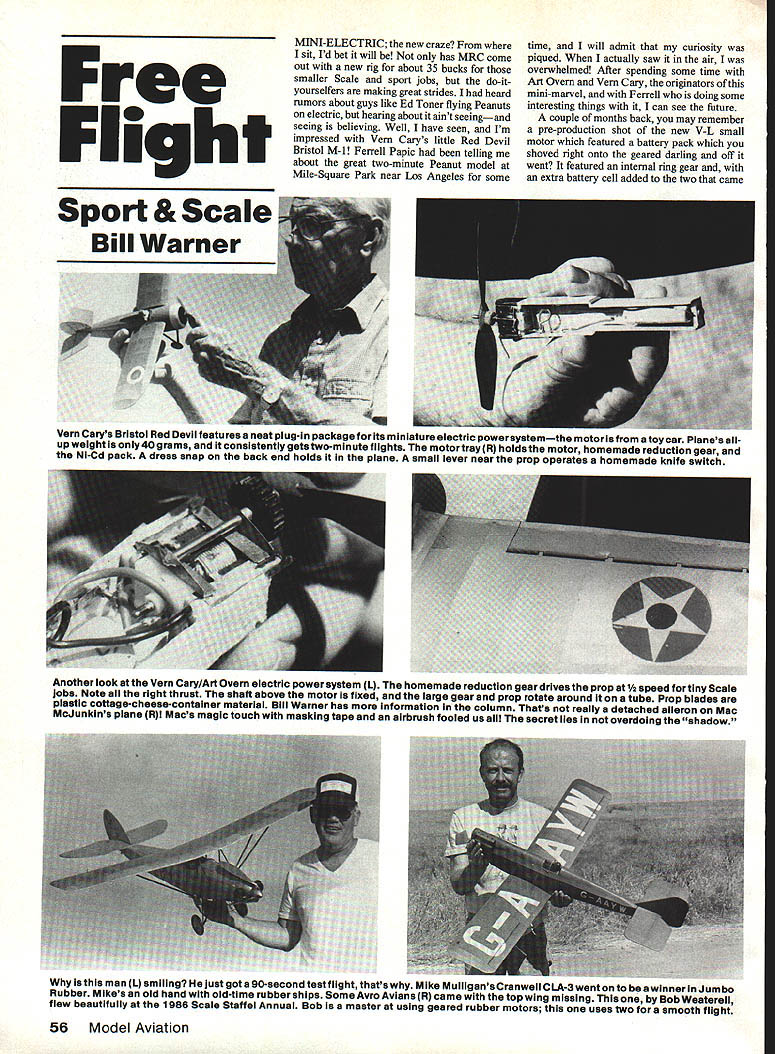
From where I sit, I'd bet it will be! Not only has MRC come out with a new rig for about $35 for those smaller scale and sport jobs, but the do-it-yourselfers are making great strides. I had heard rumors about guys like Ed Toner flying Peanuts on electric, but hearing about it ain't seeing—and seeing is believing. Well, I have seen, and I'm impressed with Vern Cary's little Red Devil Bristol M-1!
Ferrell Papic had been telling me about the great two-minute Peanut model at Mile‑Square Park near Los Angeles for some time, and I will admit that my curiosity was piqued. When I actually saw it in the air, I was overwhelmed! After spending some time with Art Overn and Vern Cary, the originators of this interesting thing, and with Ferrell who is doing some interesting things with it, I can see the future.
A couple of months back you may remember a pre-production shot of the new V-L small motor which featured a battery pack you shoved right onto the geared unit and off it went. It featured an internal ring gear and, with an extra battery cell added to the two that came stock, would turn a rather respectable prop and pull a 36-in. span model (the shorter the nose, the better—if you were to leave the batteries in the standard location). For planes with longer noses, most of the guys are moving the batteries back for balance and installing a switch. The V-L sells for $24.95, which isn't that much for a well-engineered motor. The homemade numbers offer a lot to the tinkerer, though.
Motors and gearing
The motors that Art Overn has been experimenting with—one of which is neatly installed in Cary's model—come from toy, pen-cell-operated "electric cars" available at your local toy store. The "Stomper" car is an example, though Art says there are better ones available with 2:1 gears having holes in the centers.
Small motors are also available from Edmund Scientific Co. for Peanuts (no pun intended). Radio Shack is a source of small motors and switches, too, although Bud and Vern preferred a homemade knife-type switch to the store-bought kind, since they have less current resistance than the store-bought units. Art, flying a Radio Shack motor in his Pacific Ace, suggests combining the armature from the No. 723-223 motor with the end cap and carbon brushes from the No. 723-228 motor. Many toy motors do not have carbon brushes and are not worth the trouble of messing with.
Papic took his "Stomper" motor and shimmed the magnets .010 in. toward the armature to reduce the air gap and get more zip. It awaits installation in a 25-in. Cub.
Overn runs a prop directly on the shaft of his Radio Shack motor in the Pacific Ace, but it would seem that the smaller motors profit from gearing. Finding just the right combination can take some experimentation. The Bristol, however, is about right for geared drive.
The motor drives the prop once for every two turns of the motor, with the driven gear and the prop sharing a tube which rotates around a fixed shaft attached to the motor at just the right distance to allow the teeth to mesh without binding. The Bristol has thin brass-sheet supports soldered on to do this, while Papic got the right clearance for his "Stomper" setup by filing a flat on the bottom of a brass tube and mounting it as a bearing on the side of the motor casing, with the gear and prop mounted to the shaft. Props are quick-change, being driven by a pin on the gear and held on with a bit of shrink tubing or glued thread wound around a small notch in the shaft.
Batteries and charging
Batteries pose a problem, but they are now making good, small NiCd cells which work well. The Bristol uses two 70 mAh cells (milli-ampere-hours) in tandem, while two 100 mAh cells seem to work OK, too. Overn found the best cells (made by the Gould Co.) in a surplus electronics store.
Some of the toy cars have rechargeable batteries. If you do not have a charger, you can always use a lantern battery. I used to charge my old Petit Brochet with the Mattel Superstar unit that way, using an old car tail-light bulb in the circuit to cut down the voltage. The bulb glowed brightly at first, then got dimmer as the batteries in the model "filled up." When it got pretty dim, I'd fly. If you have an adjustable charger, you can charge 100 mAh cells in about two minutes at one ampere.
Bristol tray, mounting and trim
One really neat innovation on the Bristol is the tray used to mount the whole power setup. It slides into the nose of the model and fastens at the rear with a dress snap so it can be easily popped out for charging. It also comes forward in a crash, which helps prevent damage.
The use of a strip of Velcro on the bottom of the tray is a real stroke of genius. Another Velcro strip glued to the battery pack meshes with it perfectly enough to prevent any battery movement until you want to move them in order to shift the center of gravity for trim. I tried this in my new one-inch-to-the-foot Bellanca CW with four 1/2-pen cells to take the Astro .02, and it worked marvelously, even with the extra weight. The real nice thing about electric is that you can always move the batteries rearward to balance the motor and prop weight.
The drop on the Bristol was a slotted tube with Dick Howard's famous cottage-cheese-container plastic blades glued in. They're almost indestructible.
Sources and tips for small-electrics
- Toy-car motors (e.g., "Stomper")—available at toy stores.
- Edmund Scientific Co.—small motors suitable for Peanuts.
- Radio Shack—small motors and switches; consider combining parts from different motor models per Art Overn's suggestion.
- Surplus electronics stores—for good NiCd cells (Gould Co. cells recommended).
- Homemade knife-type switches—lower resistance than some store-bought switches.
- Charging trick: use a lantern battery with a tail-light bulb in series to limit voltage for charging if you lack a proper charger.
Contest season: San Diego Scale Staffel & Taft
On the contest scene, April and May are the months when it is hard for me to keep up with all that is going on. The San Diego Scale Staffel Annual was one of the most interesting, set on Otay Mesa about a mile from the Mexican border. The place was alive with "La Migra" (U.S. Immigration and Naturalization officers) as well as illegal aliens heading north to work the fields of California. Just when the meet got going well, it had to be moved so that the Navy SEALs parachute team could make several drops onto the field. Still, there were lots of great thermals and lots of neat scale activity. A week later, it was off to Taft.
"Taft," to a Free Flighter, means space, thermals, and homebuilding with lots of people who know what they are doing. More exactly, the Memorial Day weekend meet is the U.S. Free Flight Championships—this year being number 16. It was great fun, with events of almost any type imaginable both indoors and out. A couple of non-Free-Flight types were even able to put on demonstrations of precision quarter-scale aerobatics with two Quadra-powered Laus. Both crashed. Not many Free Flight planes did that this year; the quality of the flying was excellent!
Scale at Taft is always fun because you do not have to ROO (rise off ground), and there are great booming thermals into which one can place even mediocre models and have them look fantastic. Still, many of the models were notably not mediocre.
Notable models and results
- Mike Mulligan — Jumbo Rubber Cranwell Parasol: easy flights of 1½ to 2 minutes; had directional stability problems last year but solved them by hinging the rudder so it could find its happiest position.
- Loren Williams — Rumpler Bipe: notable flights.
- Dick Seifried — 54-inch Me-109 and PT-19: easy flights of 1½ to 2 minutes.
- Peanut category:
- 1st: Clarence Mather — Parnall Pixie (Top dog in Peanut)
- 2nd: Ferrell Papic — Astro .02-powered Bleriot
- 3rd: Ian Payne — float-equipped Vee-L (third in Gas)
- Top Junior: Jeff Witt — excels at Tailwind, Contester, or Lacey.
- Ralph Cooke — many fine flights with a trio of gas jobs.
- Bill Stroman — Taube with CO2 power (top honors in its class); noted as a great flier.
Hints and small tips
- Ferrell Papic: rubber is great for removing Hot Stuff (cyanoacrylate) from your fingers. He had internal pressure in a bottle squirt Hot Stuff all over, but rubber worked to remove it afterward.
- Don Srull (D & M Ace crowd): uses baby oil for the same purpose.
- If you don't use those, a sanding block with 60-grit garnet paper also works—though it's rough on the skin.
Resources
Just received the new Repla‑Tech International aircraft catalogs, two booklets you can get by sending $3.60 to: Repla‑Tech International 48500 Kenrick Highway Vida, OR 97488
I heartily recommend them for materials modelers can use—especially Aeromodeller plans, Hirsch prop packs, and 40-cent black-and-white snaps of Golden Age racers to complement the color shots. Their Tiger Moth pack features ancient brass compass and mahogany instrument panels in both cockpits. Photo packs average about 80 cents per color snap; some have upwards of 40 pictures of the same plane—an excellent bargain if you're serious about a particular subject.
Send along any experiences you have with the tiny electric scale jobbies, and we'll try to keep the gang posted. Ciao!
Bill Warner 423 San Vicente Blvd. Santa Monica, CA 90402
Transcribed from original scans by AI. Minor OCR errors may remain.

