
Free Flight: Sport & Scale
Bill Warner
Should I?
I was going to start this month's column with the story about the American model plane kit manufacturer who was nabbed stealing logs from the Petrified Forest, but I decided that was in bad taste. Besides — who uses balsa anymore?
Some of the world's leading model builders are using more and more plastic foam in their ships, and I will even plead guilty to imitating them on occasion. The floats on my Sikorsky S-39 were shaped from styrofoam and then sheeted with 1/32-in. balsa using Goldberg's Blue Goo cement. They came out really sturdy, and even if one gets damaged, it will still float.
I have experimented with the blue insulating foam available at builders' supply stores, and it works fine on tops and bottoms of noses that have rounded or unusual shapes. Be careful, though — dope or cellulose cement will eat it up.
Make sample blocks to experiment with. White glue is handy: it will stick tissue to the foam and can be used to coat it so that dope can be applied later. Bobby Haight has been known to build on foam and then pour acetone into the fuselage to dissolve the foam, leaving the balsa shell intact — it reminds me of the lost-wax casting method for metals.
Beaded styrofoam is not much fun to work with, as the little beads often detach themselves and it is too soft. The fine-pored blue stuff sands and carves well.
I admit I can't get thoroughly excited by anything made out of plastic, since the use of balsa and tissue is so integral to FF Scale, but there are times when foam or plastic can make certain parts of modeling easier.
Hi-Yo, Silver!
Mark Fineman recently presented a nifty way to do silver finishes in the Max-Fax newsletter. Originated by Dave Stott (and used by Bob Thompson), this scheme makes a great metallic tissue job.
Steps:
- Get clear lacquer and lacquer thinner and mix a couple of ounces at a 50/50 ratio.
- Mix the same quantities of clear nitrate dope and dope thinner.
- Mix the two solutions at about 70% lacquer solution to 30% thinned dope. (Lacquer shrinks less and could be used straight on thin tail surfaces.)
- Brush two coats of this mixture onto white Japanese tissue covering the model.
For the aluminum finish:
- Buy aluminum powder at an artists' supply store and an artist's atomizer for spraying.
- Mark strongly advises using too little aluminum powder rather than too much. Dip a small amount (about enough to cover half a small fingernail) into a one-ounce mixing bottle half full of the lacquer-dope mixture.
- Fill the rest of the bottle with dope thinner, shake, and spray. A new atomizer will yield a very shiny, lightweight, semi-transparent silver finish.
- If you want an opaque finish, spray another coat.
Paper-profile pilots and cabin figures
Filling gaping holes in the tops of fuselages and in cabins of wee creations is a challenge. Paper-profile pilots have been around a long time — a quick, easy way to improve realism. Some builders populate airliners with friends' profiles cut from photos: flip the negative over, print, and reverse-copy the other side. Cement paper heads to a small balsa core.
Mounting:
- Plenny Bates (Cedar Rapids, IA) makes a little circle of .010 music wire and cements it between the halves of his profile, leaving a protruding stem to mount from the top of a cabin, from the rear, or from underneath. The springy stem keeps the "people" from being battered by errant rubber motors; they merely snap aside and spring back into place.
If you don't want to be the pilot, check the Sunday funnies for a cartoon character to put in.
Ed Toner's electric Peanut experiments
Ed Toner's electric Peanut experiments, done around 1980, used a motor, 5:1 gear, and Ni-Cd battery from a Mattel Choppycle. Installed in a Huntington monoplane from Walt Mooney's plans and turning a five-inch prop, it would fly for about a minute. It weighed about 30 grams and reached roughly 30 ft. It finally failed due to a green deposit of something around the brush/commutator area — a problem Ed has seen with similar small motors.
He has also flown a Hannan Stringless Wonder with a Mabuchi 13A motor. His present projects include deciding whether to install a new motor unit (gleaned from a 28C MRC Bellanca kit) into a Dayton-Wright Racer Peanut or into something larger like a Lacey or an F6F.
Ed is presently finishing a nine-inch-fuselage Aeronca from Indoor Model Supply which uses a Swiss servo motor from a micro-receiver, powered by three Ni-Cads and turning a 3½‑in. prop.
Small motors, repairs, and parts
Regarding the green stuff on commutators: I've been tearing apart every tiny motor I can get my hands on lately and find many have similar problems. Some come from the factory with grease on the armature; many have no true brushes, merely using spring-brass "rubbers" instead; some have such fine wire on the armatures they barely turn when power is applied.
I have found some parts interchangeable, as Art Owen suggested with the Radio Shack motors. The Spongeto toy-car motor is much improved by replacing the rear end with one that uses brushes instead of brass sleeves.
Jereyco (601 Linden Place, Evanston, IL 60204) stocks little Mabuchi motors (Stock No. 4374) at six for two bucks; these have interchangeability that fits the Mabuchi unit in Stomper-type, four-wheel-drive toy cars. The catch: Jereyco charges $3 postage and handling and has a $10 minimum order. However, if you send for their catalog you'll likely find $10 worth of gear you just have to have (from gear trains to make winders to WW II British helmets for the flying field).
Sources, plans, and kits
- John Gregg, Classic Era Modelplans, 355 Grand Blvd., Bedford, OH 44146 — will send a sample plan and illustrated plans list for $1.
- Dave Delaes Engineering, P.O. Box 101, Woodville, OH 43469 — has supplemented his plan line with a Boeing F4B/P-12C rubber kit (15-in. span) and is working on a Lavochkin La-5FN/La-7 in 1:24 scale.
- Carlo Godel, Velivoli, 5726 Case Ave., No. Hollywood, CA 91601 — has drawn eight aircraft three-views of various Fikes; send a SASE for his complete list of three-views.
- Rev. W. O. Anderson, RD 4, Box 4349, Mercer, PA 16137 — will send three-page rubber Webhopper JC-24C plans for $5 (price a bit high, but a nice design capable of good flights).
Scale alive and well in Czechoslovakia
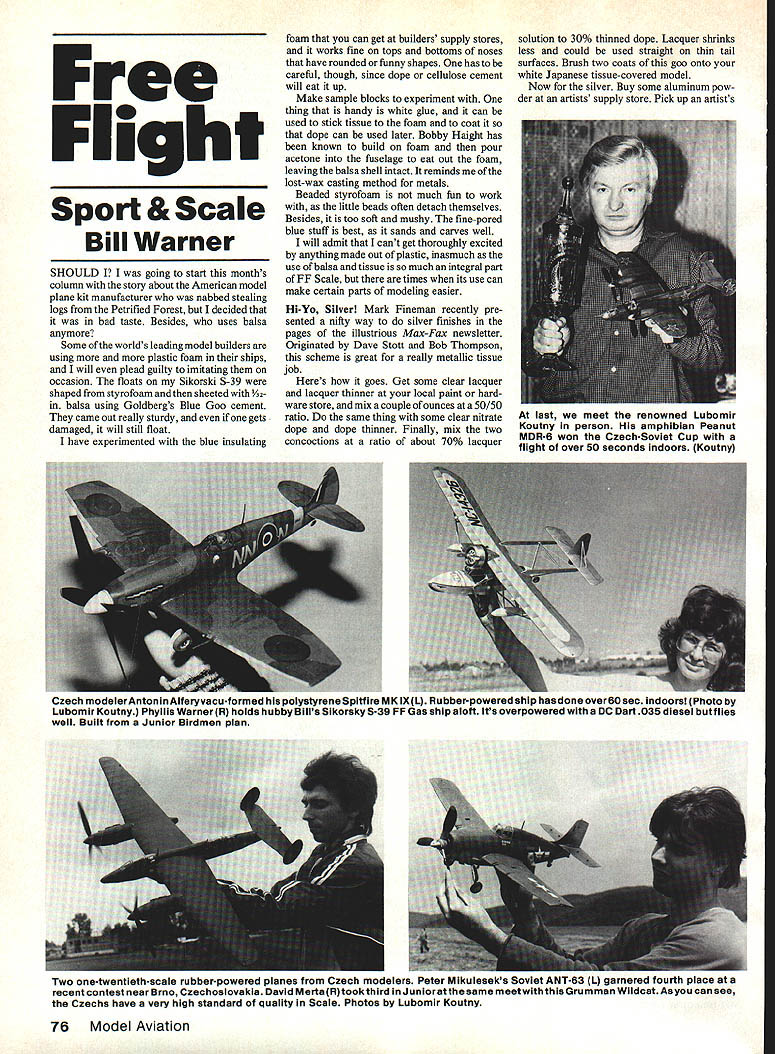
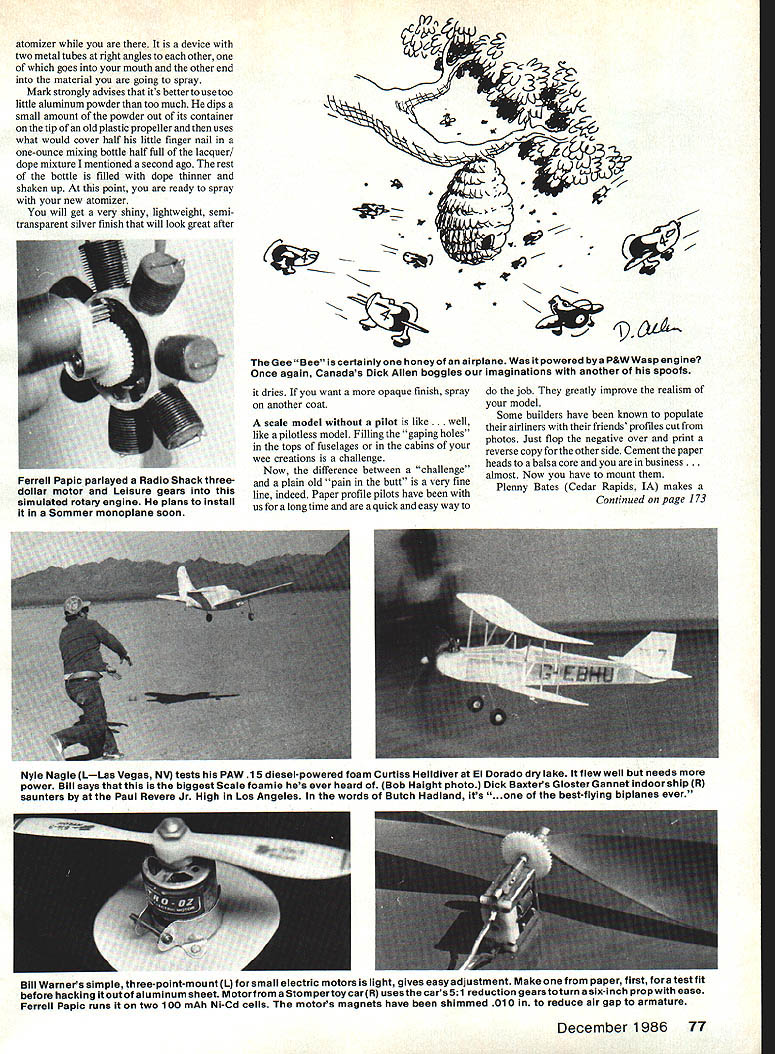
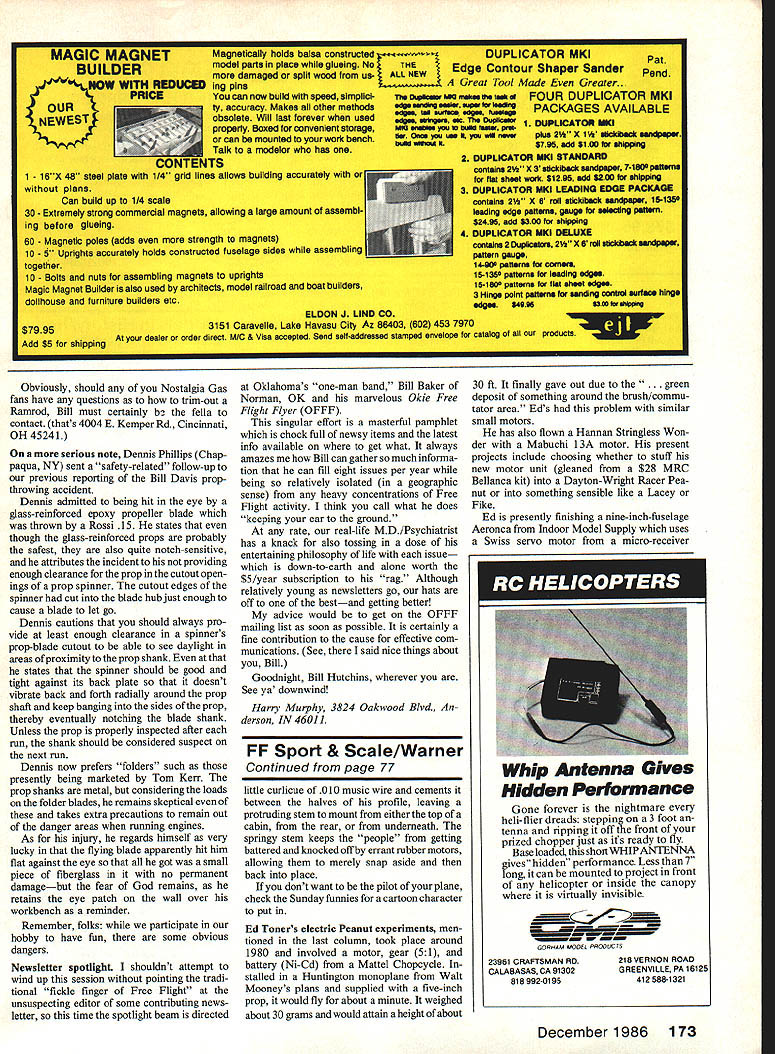
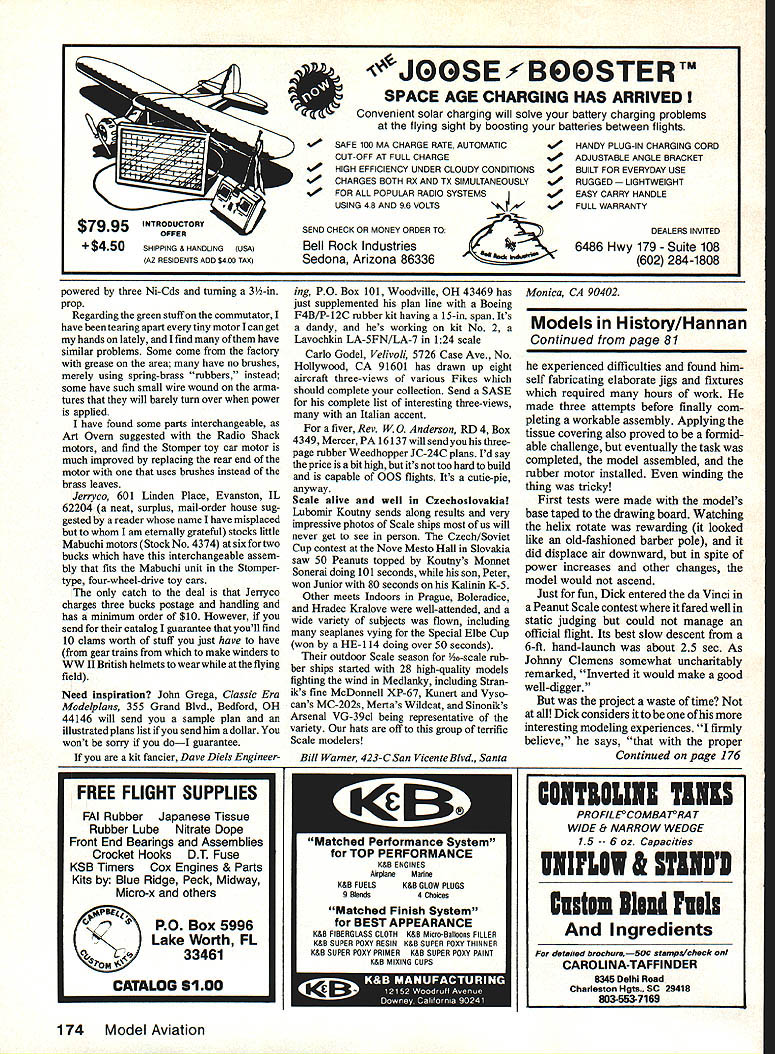
Lubomir Koutny sent results and impressive photos of scale ships few of us will see in person. The Czech/Soviet Cup contest at the Nove Mesto Hall in Slovakia featured 50 Peanuts; Koutny's Sonerai posted 101 seconds, while his son, Peter, won Junior with 80 seconds on his Kalinin K-5. Indoor meets in Prague, Boleslavice, and Hradec Kralove were well attended and included many seaplanes vying for the Special Eibe Cup (won by an HE-114 doing over 50 seconds).
Their outdoor scale season for half-scale rubber ships started with 28 high-quality models at Medalky, including Stranik's McDonnell XP-67, Kunert and Vysocan's MC-202s, Merta's Wildcat, and Simon's Arsenal VG-39c. Hats off to this terrific group of scale modelers!
Bill Warner 423‑C San Vicente Blvd. Santa Monica, CA 90402
Transcribed from original scans by AI. Minor OCR errors may remain.

