
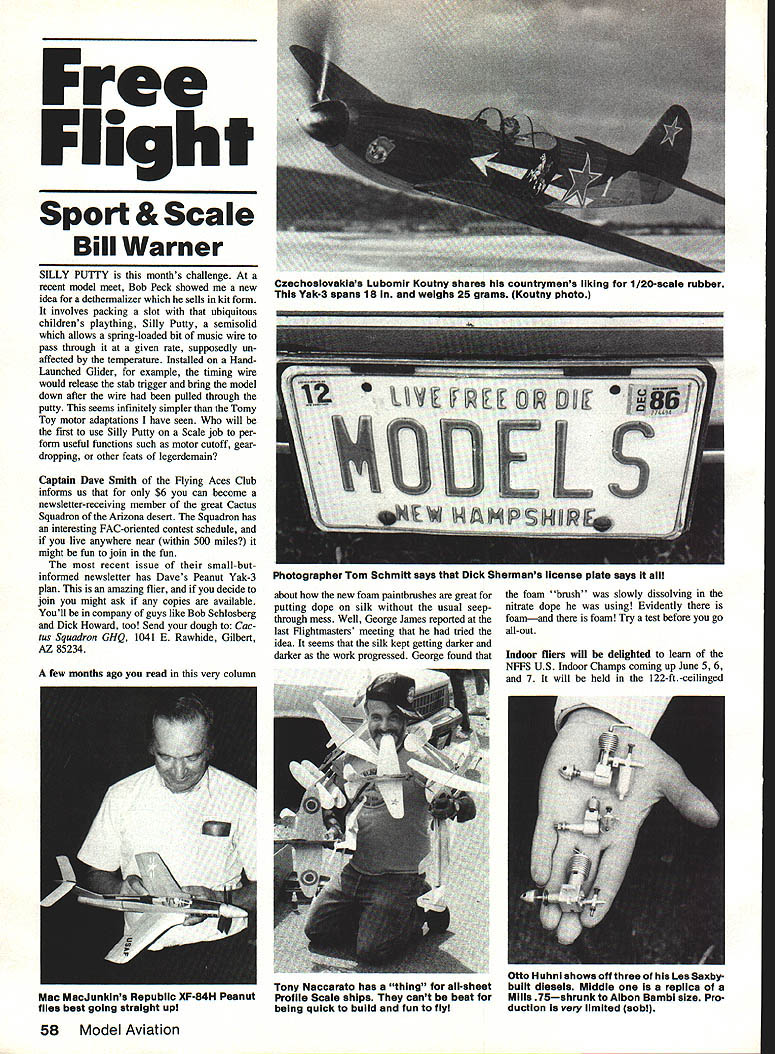
Free Flight: Sport & Scale
Bill Warner
Silly Putty dethermalizer
SILLY PUTTY is this month's challenge. At a recent model meet, Bob Peck showed me a new idea for a dethermalizer which he sells in kit form. It involves packing a slot with that ubiquitous children's plaything, Silly Putty — a semisolid which allows a spring-loaded bit of music wire to pass through it at a given rate, supposedly unaffected by the temperature. Installed on a hand-launched glider, for example, the timing wire would release the stab trigger and bring the model down after the wire had been pulled through the putty. This seems infinitely simpler than the Tomy Toy motor adaptations I have seen. Who will be the first to use Silly Putty on a scale job to perform useful functions such as motor cutoff, gear-dropping, or other feats of legerdemain?
Cactus Squadron (Flying Aces Club)
Captain Dave Smith of the Flying Aces Club informs us that for only $6 you can become a newsletter-receiving member of the great Cactus Squadron of the Arizona desert. The Squadron has an interesting FAC-oriented contest schedule, and if you live anywhere near (within about 500 miles) it might be fun to join in.
The most recent issue of their small-but-informed newsletter has Dave's Peanut Yak-3 plan. This is an amazing flier, and if you decide to join you might ask if any copies are available. You'll be in the company of guys like Bob Schlosberg and Dick Howard, too! Send your dues to: Cactus Squadron GHQ, 1041 E. Rawhide, Gilbert, AZ 85234.
Foam brushes and dope
A few months ago you read in this column about how the new foam paintbrushes are great for putting dope on silk without the usual seep-through mess. Well, George James reported at the last Flightmasters' meeting that he had tried the idea. It seems that the silk kept getting darker and darker as the work progressed. George found that the foam "brush" was slowly dissolving in the nitrate dope he was using! Evidently there is foam—and there is foam. Try a test before you go all-out.
Indoor flying — NFFS U.S. Indoor Champs
Indoor fliers will be delighted to learn of the NFFS U.S. Indoor Champs coming up June 5, 6, and 7. It will be held in the 122-ft.-ceilinged "Mini-Dome" of East Tennessee State University in Johnson City, TN. The famed MIAMA Peanut Grand Prix — with a sub-Peanut class added — will be flown as part of the festivities. Rush a large SASE to A. J. Italiano, 1655 Revere Dr., Brookfield, WI 53005 for info. They promise a football-field-sized floor area and air-conditioned dorm rooms!
Scale plans and catalogs
Harold J. Towner's plans for free flight scale models are just the thing for the modeler moving up from kit models to "do-it-yourselfers." They are nicely done and cover all the classics like the D.H. Hornet Moth, Bristol Bulldog, Tiger Moth, Fairey Barracuda, P-26, etc. He even has a B-17, H.P. Halifax, and Short Stirling for rubber! (Four-engine planes span around a yard.)
Bob Holman has his new catalog out with a few dozen Towner plans and over a hundred Aeromodeller scale rubber and gas free flight plans that he has in stock. He also sells Aeromodeller plans catalogs, including their scale-drawings catalog. Bob's own catalog is $3, with the ASP catalogs and scale catalogs going for $3.50 each. If you want to try a truly classic free flight gas job, I recommend ordering Towner's Hornet Moth biplane ($6 plus $1.50 postage). Send to: Bob Holman Plans, P.O. Box 741, San Bernardino, CA 92402.
If unusual aircraft turn you on, you might wish to get in touch with Bill Young, 8106 Teesdale Ave., No. Hollywood, CA 91605. Bill's offerings include such goodies as one-inch-to-the-foot scale drawings, a manuscript, and a dozen photos on the Northrop N9M-A, Granger Archaeopterix, Pitcairn PCA-2 autogiro, Horten IX/229 wing, etc. If you like flying wings and the like, send him $2 for a catalog of what he has. For Culver Dart lovers he also has one-inch-to-the-foot drawings, photos, and a monograph on Rod Jocelyn's (clipped-wing with sunburst decoration) Dart.
Heat, drying, and cautions
The pace of life is quickening. I remember life before CYA instant glue and hair driers for shrinking tissue. First came the oven set at 325° to speed the drying of laminated balsa prop blades on a form, and now the microwave oven has arrived.
A recent number of The Hangar Pilot gives Butch Hadland's method of drying laminated prop blades and "waxing" them. The secret in microwaving is in using forms made of plastic or other non-metal substances (a 2-1/2-in. glass jar for Peanut props) and making sure that its interior is open—or at least vented.
Butch soaks his prop faces in boiling water for 10 minutes, joins the faces with white glue, then binds them to the face of the bottle with tape. The blade, still in the mold, is placed in the microwave on low power for short bursts until the glue has set. He repeats this until the blade is dry, then sands and finishes as usual.
While on the topic of rapid drying, a well-known modeler explained why he did not have a model at the last contest. It seems he had gone to the microwave to dry some parts and, distracted, forgot them there long enough to ruin the work. Careful timing and ventilation are the keys.
Someone else tried speeding up the drying of his stab, which had been recently nitrate-doped, over the gas flame of his kitchen stove. He said that when it caught fire, the dope burned off much faster than the tissue! Somewhere there's a lesson in this.
Actually, an old AMA film, The Long Flight, showed a modeler packing his ship on a steam radiator to dry. Ken Hamilton, on seeing this, about had a fit. He opines that this is no finer way of inducing and setting in wraps than this foolhardy practice. I guess heat can be your friend or your enemy. If you are going to use heat, I suggest you use low heat—and make sure you have some sort of frame or flat surface to which your wing or stab is affixed. I prefer leaving things to dry overnight, myself.
Electronics and small electrics
Vista Labs (VL) has a modification on their earlier "on-motor" battery mount which should be a great help to those who want to make installations where the batteries can be moved rearward for balance. The new H7-10 AR, which weighs 2 grams and swings a six-inch Xtan Aero prop, has a remote battery mount with quick-disconnect leads.
This feature raises the motor's price to $17.95 (plus $2 postage) but is worth it. If you are making a Sopwith Camel, then the standard H7-10 AR setup is cheaper. The carbon brushes and a well-made gear drive with a freewheel function may be blocked or cut with the neoprene sleeve included. Batteries are purchased separately: the twin 80mA pack weighs 13 grams ($9.95), the twin 50mA pack weighs 13 grams ($12.95). The triple 50mA set, called the B-63, provides plenty of pizzazz for light models up to a 30-in. wingspan. Send a dollar for a catalog to: Vista Labs, 781 Alabama St., San Jose, CA 95110.
Ferrell Enterprise, 300 W. Lincoln No. 82, Orange, CA 92665, has also widened its line of tiny electrics. Like the VLs, they feature carbon-brush motors and gear reductions, though without the freewheeling. The top-of-the-line 007 motor outfit with a three-cell battery pack and switch weighs 33 grams and, with the same set-ups as the VLs, gives good performance, though some of this weight is a heavy Futaba charging fitting which could be dispensed with. The motor is cleverly mounted with alligator clips on the charger. The 007 motor outfit goes for $28, with the three-cell battery pack selling for $9 ($6 for the two-cell version, which saves six grams). A SASE will bring you a catalog.
Both of these small electrics setups are well-made and perform quite well indoors or out. There has been more recent interest in small electrics.
Scale modeling advice and next steps
Nearly all kits contain concise but adequate instructions on preparing the model for test flights, so follow those religiously. Wait for a calm day and hope for the best. As you'd expect, a non-scale, high-wing model will fly better than a low-wing scale model.
Your model will inevitably sustain flight damage, but because you built the plane (and saved kit scraps and extra tissue), you should be able to repair it after all but the worst crashes.
When the plane finally becomes so patched and worn as to be unflyable, start on another stick-and-tissue model or use the knowledge of materials and techniques you've gained to build a gas- or electric-powered radio control model. Perhaps you'd rather scratch-build a tiny Peanut scale flying model or move on to a gossamer-like indoor flying model. Either way, you'll have fun and develop new skills.
Addresses
- Comet Industries Corp., 3630 South Iron St., Chicago, IL 60609.
- Paul K. Guillow, Inc., Wakefield, MA 01880.
- Peck Polymers, Box 2498, La Mesa, CA 92041.
- Sig Manufacturing Co., Montezuma, IA 50171.
Many Comet kits and most other supplies mentioned in this article are available by mail order from Sig if you can't obtain them locally. The Sig catalog is $3.00.
Transcribed from original scans by AI. Minor OCR errors may remain.

