
Free Flight: Sport & Scale
Bill Warner
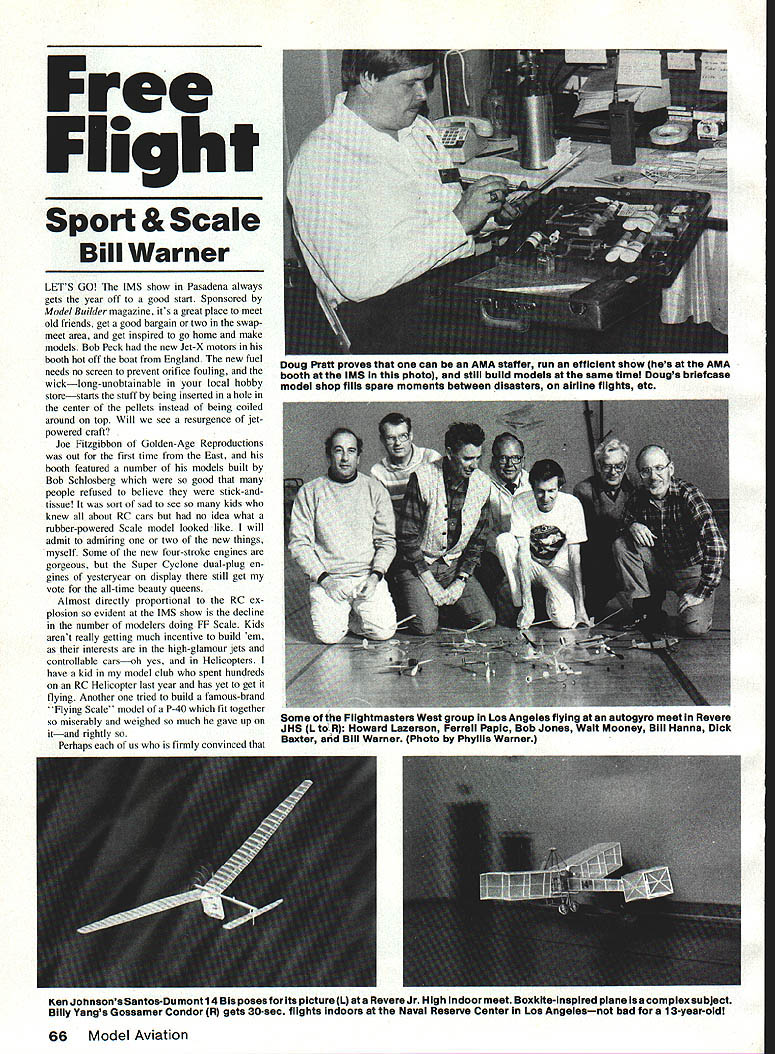
LET'S GO. The IMS show in Pasadena always gets the year off to a good start. Sponsored by Model Builder magazine, it's a great place to meet old friends, get a good bargain or two in the swapmeet area, and get inspired to go home and make models.
Bob Peck had the new Jet-X motors in his booth, hot off the boat from England. The new fuel needs no screen to prevent orifice fouling, and the wick—long unobtainable in your local hobby store—starts the stuff by being inserted in a hole in the center of the pellets instead of being coiled around the top. Will we see a resurgence of jet-powered craft?
Joe Fitzgibbon of Golden-Age Reproductions was out for the first time from the East, and his booth featured a number of models built by Bob Schlosberg which were so good that many people refused to believe they were stick-and-tissue! It was sort of sad to see so many kids who knew all about RC cars but had no idea what a rubber-powered scale model looked like.
I will admit to admiring one or two of the new things myself. Some of the new four-stroke engines are gorgeous, but the Super Cyclone dual-plug engines of yesteryear on display still get my vote for the all-time beauty queens.
Almost directly proportional to the RC explosion was the decline in the number of modelers doing FF Scale. Kids aren't really getting much incentive to build them, as their interests are in the high-glamour jets and controllable cars—oh yes, and in helicopters. I have a kid in my model club who spent hundreds on an RC helicopter last year and has yet to get it flying. Another one tried to build a famous-brand flying-scale model of a P-40 which fit together miserably and weighed so much he gave up on it—and rightly so.
Perhaps each of us who is firmly convinced that free-flight scale is the greatest hobby/art/craft on earth needs to pay some dues to keep alive the interest that can be kindled. You can't expect pied-pipers in the model industry to lead kids. I know a leading maker of great-flying scale model kits recently confided he makes about 16 cents on a seven-dollar kit—figure it out.
Threats to FF Scale
As I see it, there are really three things threatening FF Scale:
- Economic pressures that make expensive RC equipment attractive and understandable.
- Lack of suitable flying sites due to progress.
- The factors we can control regarding participation in the activity—namely, keeping ourselves active in recruiting others.
Getting Started: Overcoming Procrastination
Speaking of the keeping-active side, an equation should be noted: an aging cohort of builders and fliers sees plans collecting, kit-watching, building-in-the-mind, seeing models in dreams but putting off the actual building with various excuses. Well, the way to get somewhere is to start walking. If you want to build a model, start.
Personally, I've piddled around and done little or nothing on models for about a year just because nothing looked interesting or the projects seemed too complex. I'm a procrastinator. The day after a conversation with a fellow modeler having problems getting going, I also decided that with the years left on earth I wanted to make about a dozen models before I was out.
After picking the first want-to-build— the Cleveland Stinson Reliant Gullwing spanning some 82 inches—I cleared space on the bench and started collecting materials. The trick is: do something every day; it's just cutting out two parts. I often intend to spend five minutes and wind up spending two hours. Once you get started, it's fun. It's getting started that's somehow the tough thing.
One thing that really helps is always leaving the workbench laid out with what you can easily start the next day—making a built-up section like a fuselage side or wing, cutting out sheet parts you're going to assemble just before you quit working. Cut anything you can cut ahead of time; leave an uncluttered plan area, trundle off to bed; I am finding myself whipping parts together immediately after jumping out of bed in the morning before I even get dressed! It works wonders. I now have all the tail parts and nine built-up ribs built, which I would not have done had I not started this "nibbling" technique. Not bad for just a few minutes here and a few minutes there.
The main thing is that not a day is allowed to pass without some small dent being made in the project. Try it! You can be your own worst enemy. The temptation to become a "couch potato" is great, and it does not get models built!
Recruiting and Outreach
The recruiting business is not easy, though it can be rewarding at times. Every time Tom Arnold goes out flying he brings his card for interested kids with the invitation to come by at a certain time when he's building something out in the garage. The main thing is not to expect many to take you up on your generosity—or even to become accomplished modelers. Still, if someone doesn't do it, we'll wind up alone at the flying field.
Hobby dealers can steer kids to a succession of successful models instead of directly into the RC trainer. At least they could carry good Rubber and Gas Scale models even if they don't make much profit on them.
Teachers can start clubs at school and can invite local modelers to demonstrate and help students get started.
I apologize for the sermon. As I see my friends who have been the backbone of FF Scale dying off or slacking off, I realize that something wonderful is threatened.
Some 20 years ago the editor of a top model magazine told me that Free Flight was dead. That was just about the most ridiculous thing I had ever heard—then. Now, I see the truth in what he was saying, and each loss of a modeling friend, each lost flying field, each hobby shop which stocks nothing under a hundred bucks and which never hears of a rubber-winder saddens me. Well, gang, if you believe FF Scale needs you, you're right! Keep 'em flying!
Suppliers and Goodies
Finding goodies among the Indian beadcraft and the ARFs at your local hobby dealer is getting harder as the years go by. One bright spot is the resurgence of Old Timer Model Supply. Ken S. is the new proprietor and has just put out a new catalog which lists such treasures as pre-sawn balsa prop blanks; 1920s-style turned balsa WW I, balloon, and streamlined wheels; clear and colored nitrate dope; old-time prop fittings; Teflon and brass washers; plus lots of Earl Stahl and Paul Lindberg scale model plans. Ken promises quick service. A dollar to OTMS at P.O. Box 773, Van Nuys, CA 91409 will bring you the long-awaited new wish-book.
Events: U.S. Low-Ceiling Peanut Championships
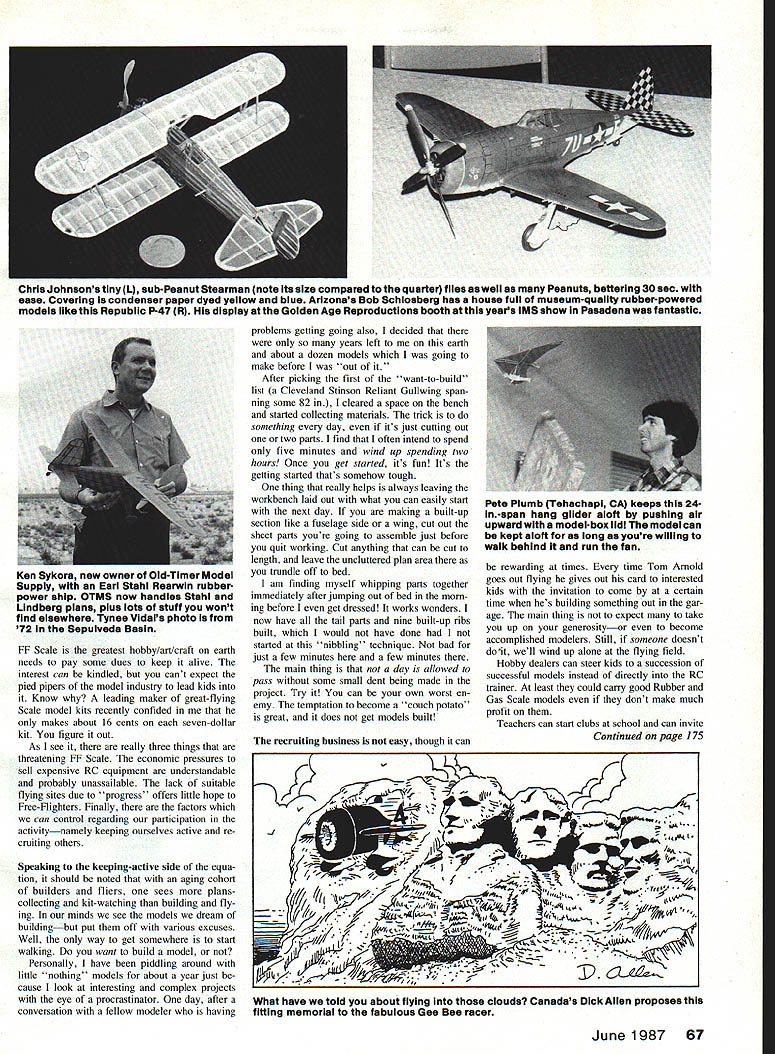
The U.S. Low-Ceiling Peanut Championships is coming June 14 in Los Angeles. Sponsored by the Nightmasters West and the Revere Jr. High Model Aircraft Society, the event will celebrate 25 years of indoor Peanut flying in L.A. It will be a low-key contest, with Mooney judging and only two classes: monoplane and biplane. Junior entries are seriously invited; the event is for kids of all ages. Arrangements for proxy entries can be worked out with individual modelers in the area. Send a SASE for information. All flights will be hand-launched in a 30-foot-ceilinged, normal gymnasium.
Handy Hints
Floquil, the model railroad paint used by many expert scale modelers, sometimes flakes off. This is remediable by using Floquil Crystal-Coat. Fernando Ramos says he also mixes Floquil with clear nitrate dope. As his finishes are first-class, I'd say this is worth trying.
Covering windows is always a pain. Uncle Carl Fries, writing in the National Free Flight Society Digest, uses Glad sandwich bags and RC-56 (clear), applied five minutes before the polyethylene. Holding a heat source several inches away will take out the wrinkles. Works well for double-crowned windshields.
Carl used those methods once 55 years ago on a Fairchild cabin job, using cellophane from a box of chocolates and Ambroid glue. The only problem was discovered when the scale judges reminded him that Fairchilds did not come with purple windshields!
Carl went on, by the way, to found the NFFS in 1920 along with Dick Black. If you are a dyed-in-the-wool FF fanatic, you should be a member. Fifteen dollars (or $7.50 if you're under 18) will get you a year’s subscription and bring you the world-renowned NFFS Digest.
New Tools
Jim Jones, 36631 Ledgestone, Mt. Clemens, MI 48043, has a new torque-meter for swing-arm and scale jobs. If you find indoor flying tedious, this could light up your life. Called the Model "B," it sells for $14.95 plus postage. The pointer is wing-nut adjustable and it has a quick-release for unwinding motors.
Well, gang, next time we're going to explore the whole world of dummy motors. Until then, keep the sand out of your nose-bearing!
Bill Warner 423-C San Vicente Blvd. Santa Monica, CA 90402.
Transcribed from original scans by AI. Minor OCR errors may remain.

