

Free Flight: Sport/Scale
Bill Warner
This month we are indeed fortunate to have with us the talented Bill Stroman, who takes time out of his duties as Contest Coordinator for the Flightmasters (District X Scale Board Representative) and as an active participant in all forms of free-flight scale modeling to give us a few pointers on the gas-powered portion of our art/craft/hobby/sport.
A beginning free-flight scaler has several power plants available: ignition or glow engine, diesel, CO₂ piston or jet, and electric. Which should you choose for contest work? About six years ago, when glow engines were in style, the "experts" said that electric power would not be able to compete due to the extra weight of the batteries, which would make it impossible to add the necessary scale detail. That year, an electric job won the Flightmasters Annual. CO₂ was thought not dependable enough to make long contest flights, then Larry Kruse won the Nats in Lincoln with a CO₂ design. Only recently the conversions turned to the advantages CO₂ and electric had over gas (due to better flight realism stemming from the gradual loss of power rather than the abrupt cutoff of the glow or diesel). About that time first place at the 1981 FM Annual went to a diesel-powered model! (BW: Yeah, Stroman's Taube.) So, you can see that they are all competitive choices, although gas engines do deliver the most power.
Designing for gas
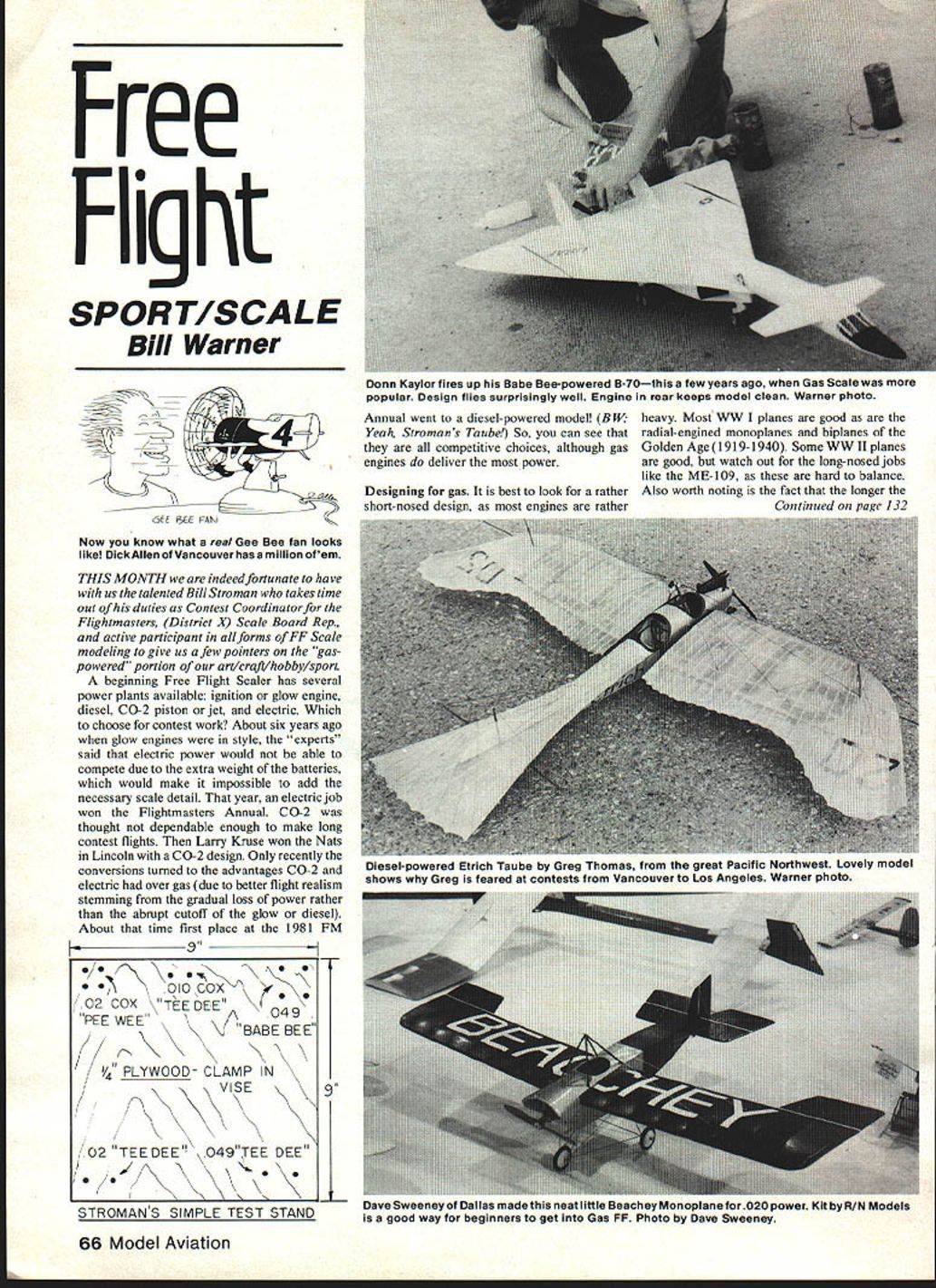
It is best to look for a rather short-nosed design, as most engines are rather heavy. Most World War I planes are good, as are the radial-engined monoplanes and biplanes of the Golden Age (1919–1940). Some World War II planes are good, but watch out for long-nosed jobs like the Me‑109, as these are hard to balance.
Also worth noting is the fact that the longer the nose length, the less down and side thrust are needed to change the flight characteristics. To make a Sopwith Pup fly in a wide left turn under power takes about three degrees of right thrust added to four degrees of down. The Pup is the all-time champ in the short-nose-moment department, with the prop just clearing the leading edge of the wing. The Stinson SM-2 Junior, with a longer nose, does the same thing on only two degrees down and two degrees right, owing to the greater distance back to the CG. Just to make things interesting, a high-wing plane will need more downthrust than will a low-winger due to the placement of the thrust line in relation to the wing.
Know your engine
You often hear that engines are hard to start. Nine times out of ten, the owner of this opinion did not take the trouble to bench-run the engine before installing it in the plane. Always run a new engine on a test stand until you know all its little tricks; and believe me, they all have them! It will take at least ten minutes of running time to break in the parts, and to learn the needle-valve setting (or, in the case of a diesel, the range of the compression-bar setting).
After the engine is installed in the plane, run it again to see if the gas tank is at the right height to get the fuel up to the engine. Is the cowl going to cause cooling problems, interfere with the fuel lines, or make needle-valve and compression adjustments difficult? Modifications are easier done at home than under the pressure of contest flying at the field!
A test stand may either be a ready-made one such as the E‑Z Adjustable for beam-mounted engines, or a simple square of 1/4‑in. plywood with different sets of holes drilled so that any of your radial-mount engines can be easily attached. Use it in a bench vise or attach it to a solid box with a brick in it.
Building for gas
When building from a kit, it is generally a bad idea to try to make a rubber-powered model into a gas job. The construction will be on the light side, and the model was probably designed with the rubber motor going past the center of gravity and on to the tail. Without this, the model becomes nose-heavy with the addition of a heavy engine. Adding weight to the tail for balance results in not only a stability problem, but will possibly add to the crash damage due to increased inertial forces.
Designing the model yourself, using the construction of the full-sized aircraft as much as possible (the amount of incidence and dihedral, and tail area) usually brings success. If the dihedral seems too low, try washing out the wing tips (bending them up at the trailing edges) about two to four degrees.
Make sure the stressed areas are well-braced. These include the wing mounts, landing gear attachments to the fuselage, and the motor mount. If these are designed well, you will have little trouble in a hard landing. Crash-resistant wings may be built rigid and strong, but this adds weight. Making a separate wing structure held on with rubber bands is a good idea, but external rubber bands look bad. The best way is to hide the rubber bands inside the fuselage. On a high-wing model, this may involve hooks on the underside of the wing center section and hooks on the bottom of the fuselage to take the stretched rubber band. Another way is to make the center part of the wing integral with the fuselage, with a rubber band holding the panels to this section via a hook on each root rib. Small-diameter tubes in the wing panels plugging into music-wire pins protruding from the center section can be used to maintain correct alignment and dihedral.
Upcoming Scale get-togethers
- Contact FAC GHQ at 3301 Cindy Lane, Erie, PA 16506 for information on the FAC Nats near Philadelphia at Johnsville NAS, July 17–18.
- In northern California, get in touch with Tom Brennan for the MAC monthly contest schedule which includes many Scale events. Their June 6 Joe One Day will even have trophies presented by the great Mr. Ott himself! Tom can be reached at 588 Cedarberry Lane, San Rafael, CA 94903.
- For information on the Flightmasters West Indoor Scale Annual in Los Angeles on June 13, contact Bill Warner.
May your head always glow and your diesel never falter!
(Written by guest columnist Bill Stroman.)
Bill Warner 423‑C San Vicente Blvd. Santa Monica, CA 90402
When writing advertisers, mention that you read about them in Model Aviation.
Transcribed from original scans by AI. Minor OCR errors may remain.

