
Free Flight: SPORT/SCALE
Bill Warner
What size is the best for a model, dear Dad? How big should a model plane be? As big as a pumpkin? As big as my dog? Or even as big as me?
Why listen, my son, lend an ear to my tale. Come listen, my nephews and nieces. Some take ten men to wind and ten more to launch, and twenty to pick up the pieces.
Then others are tiny, like wee little nuts, so small they take tweezers to wind 'em. It's often been said, you must color 'em red 'cause when they land, no one can find 'em.
So, Son, to have fun, do what others have done; try a model of moderate size. Something easily stored, cheap, and widely adored. One which strains neither purse, nerves, or eyes.
Well, the answer to the American "Bigger-is-Better" mania assumes many forms. Some modelers have foregone the pleasure of hearing "My stars! Will you look at the size of that thing!" in exchange for, "Awwwww, isn't that cute?" I refer to the opposite number of the pop monster, the Wee‑Nut Scale, which requires skills and handling techniques far beyond those of most mortals—especially those with failing eyesight!
Those of us in Free Flight Scale who wish to maximize the pleasure‑to‑frustration ratio usually choose something within the accepted 13‑in. to 36‑in. span range and take into consideration the wing‑loading, with an eye to realistic performance. Even with lower Reynolds numbers, lightly‑loaded models can do justice to realism—and often do. They seldom even frighten anyone, and the insurance claims settled by the AMA for damage caused by such models must be negligible, if even in evidence!
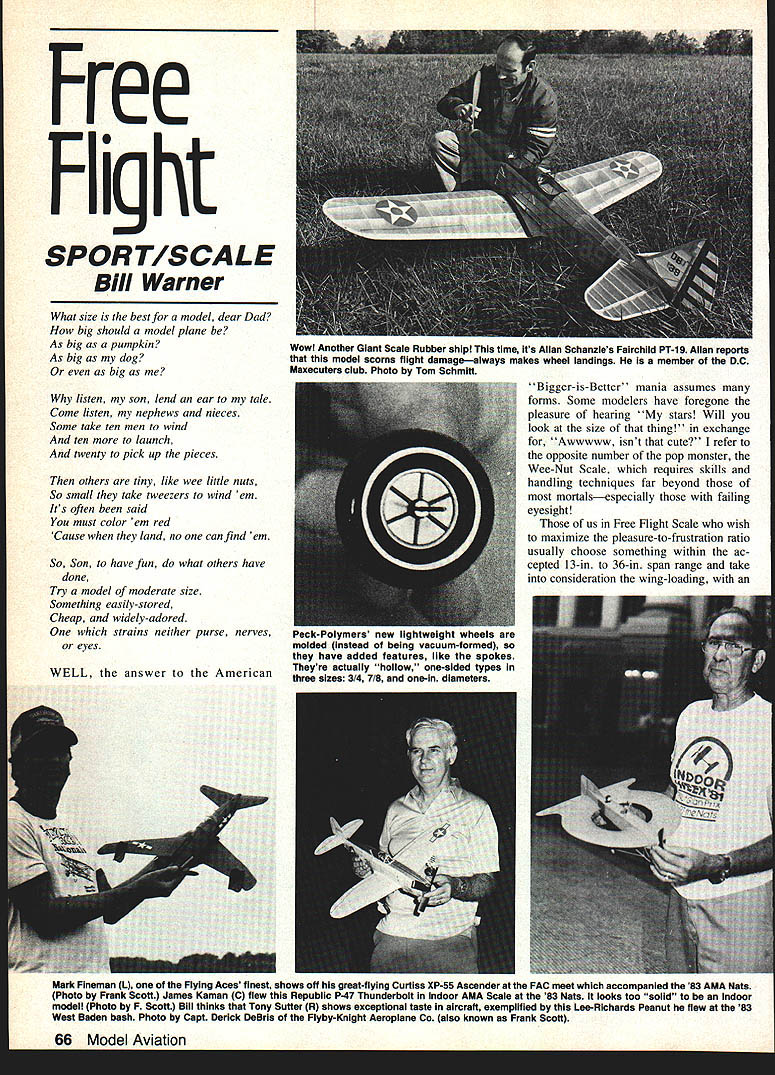
Still, if you have to get the desire to build big out of your system, what better way than to blow up an old Earl Stahl design, such as Allan Schanzle did, and impress everyone? After the '83 Nats, Leon Bennett is now a folk hero, and there are even rumors of a rubber company sponsoring him next year.
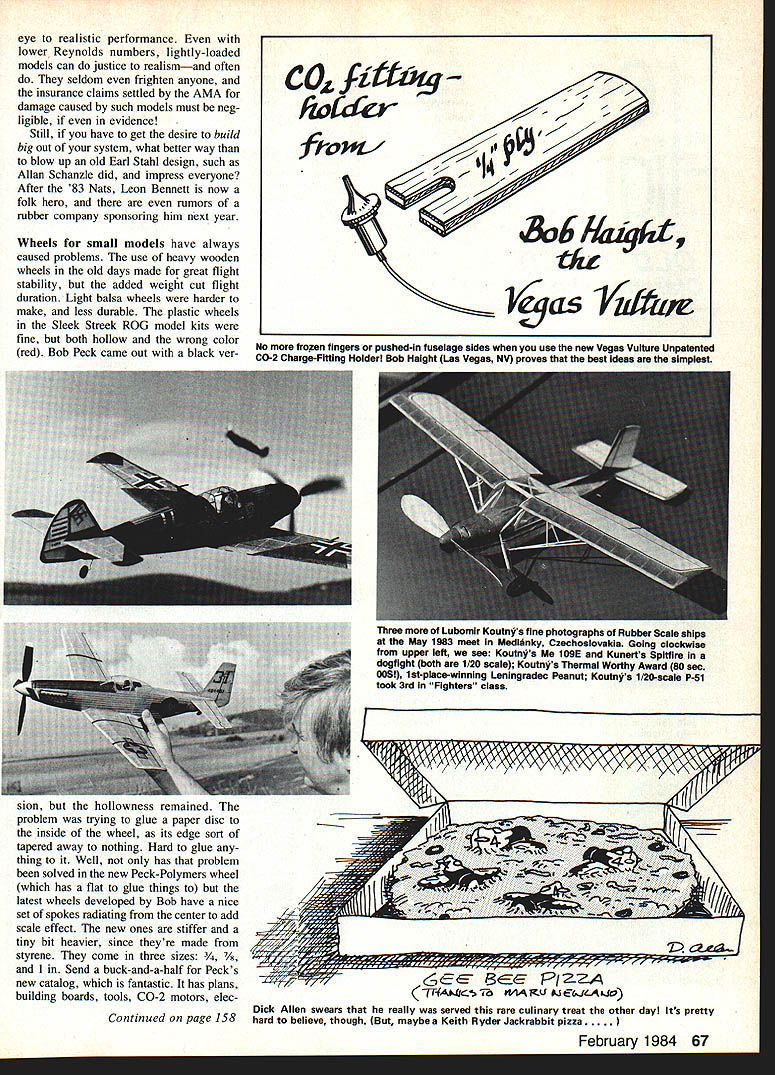
Wheels for small models have always caused problems. The use of heavy wooden wheels in the old days made for great flight stability, but the added weight cut flight duration. Light balsa wheels were harder to make, and less durable. The plastic wheels in the Sleek Streek ROG model kits were fine, but both hollow and the wrong color (red). Bob Peck came out with a black version, but the hollowness remained. The problem was trying to glue a paper disc to the inside of the wheel, as its edge sort of tapered away to nothing. Hard to glue anything to it.
That problem has been solved in the new Peck‑Polymers wheel (which has a flat to glue things to) and the latest wheels developed by Bob have a nice set of spokes radiating from the center to add scale effect. The new ones are stiffer and a tiny bit heavier, since they're made from styrene. They come in three sizes: 3/4, 7/8, and 1 in. Send a buck‑and‑a‑half for Peck's new catalog; it has plans, building boards, tools, CO‑2 motors, electric motors, blimp stuff, Hungerford spoke wheels, Golden Age reproduction kits, books, balsa, rubber, and all‑in‑all, anything you will ever need. Who else has hats and aprons that say "I'm Nuts About Peanut Scale!"? (Peck‑Polymers, Box Z498, La Mesa, CA 92041.)
We all know of the growth of activity in Free Flight Scale here in the U.S., but in England activity is continuing strong as ever. A new newsletter which looks promising is called Scale Flight and can be obtained by writing Allan Carr, 57 Carlton Rd., Glebe Park, Romford, Essex RM2 5AP, England.
In France, activity is strong in the Paris area, with a number of contests, but the significant meet is the Jacques Pouliquen contest in the sunny, mistral‑swept South. Jacques, as you may remember, was the vital force responsible for getting interest in Peanut Scale going in France and—indeed—on the continent. This year's contest was dominated by Emmanuel Fillon, who took second in "Seniors" (Open) by thermalling out two Fikes and taking both first and second in "Chasseurs" (fighters) with Dornier Do‑335 push‑pulls—one biplace and one monoplane.
Fillon, who won the 1937 Wakefield Cup and has made such oddities as the first solar‑battery‑powered Solar Challenger model and a rubber‑powered "squirrel‑cage" jet series, was set an example in all fields of modeling and deserves the title of "Master." I once jokingly asked him if he had ever flown R/C. He sheepishly replied "Yes," but hurriedly added that he had made his own radio! Roger Aime, Fillon's protégé, came to the U.S. this year and flew in the Flightmasters Annual with a very nice Bucker Jungmann Peanut and a Fournier RF‑4 which reflected the high level of craftsmanship of the Gallic modelers today.
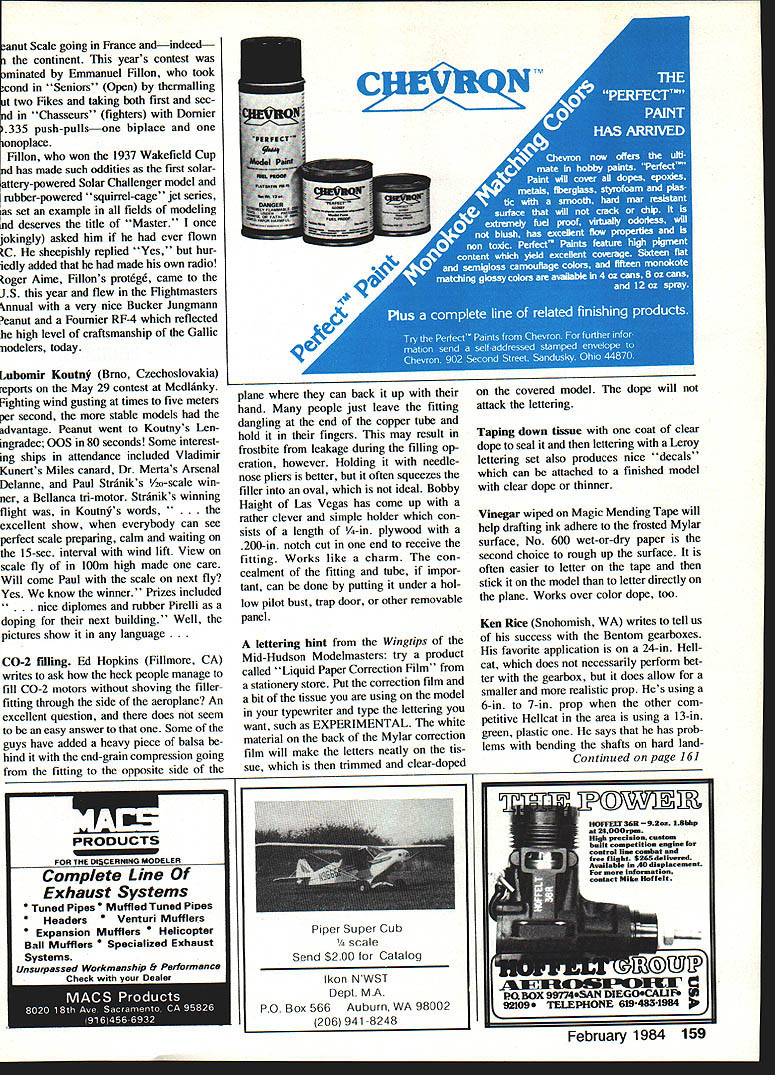
Lubomir Koutný (Brno, Czechoslovakia) reports on the May 29 contest at Medlinky. Fighting wind gusting at times to five meters per second, the more stable models had the advantage. Peanut went to Koutný's Leningradec; OOs in 80 seconds! Some interesting ships in attendance included Vladimir Kunert's Miles canard, Dr. Meratz's Arsenal Delanne, and Paul Stráník's 1/2‑scale winner, a Bellanca tri‑motor. Stráník's winning flight was, in Koutný's words, "…the excellent show, when everybody can see perfect scale preparing, calm and waiting for the 15‑sec. interval with wind lift. View on scale fly of 100m high made one clear. Will come Paul with the scale non next fly? Yes. We know the winner." Prizes included nice diplomas and rubber Pirelli for their next builds.
CO‑2 filling
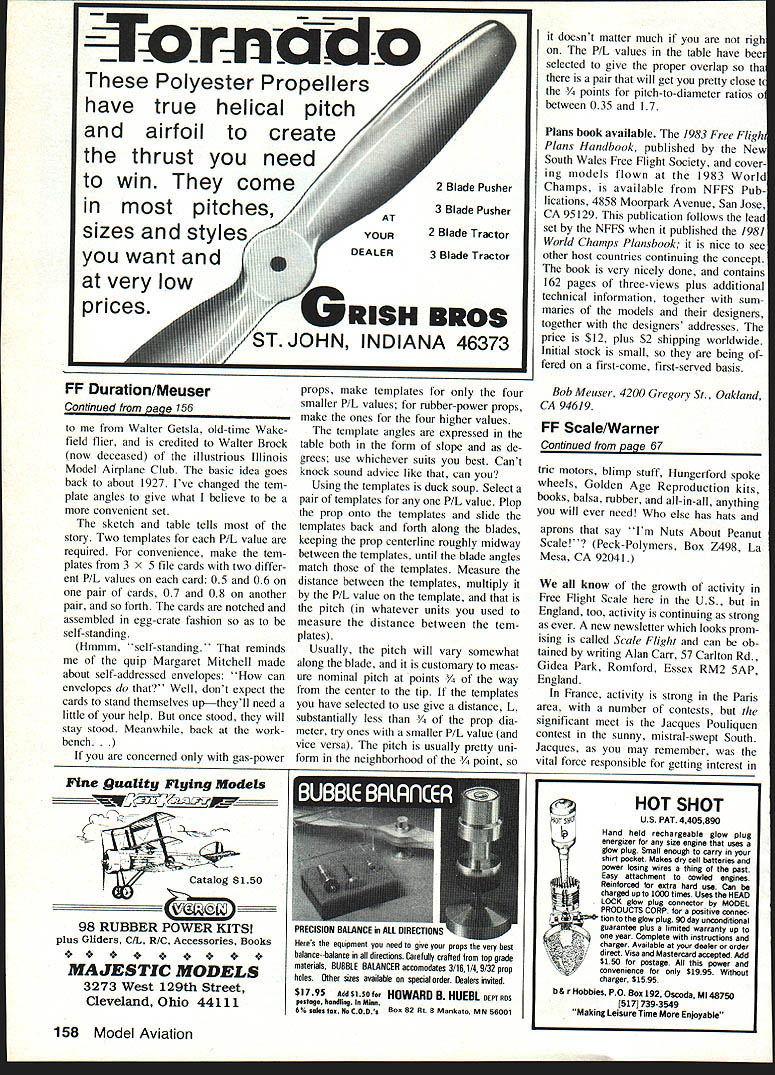
Ed Hopkins (Fillmore, CA) writes to ask how people manage to fill CO‑2 motors without showing the filler fitting through the side of the airplane. An excellent question, and there does not seem to be an easy answer. Some of the guys have added a heavy piece of balsa behind the fitting with the end‑grain compression going from the fitting to the opposite side of the plane where they can back it up with their hand. Many people just leave the fitting dangling at the end of the copper tube and hold it in their fingers. This may result in frostbite from leakage during the filling operation, however. Holding it with needle‑nose pliers is better, but it often squeezes the filler into an oval, which is not ideal.
Bobby Haight of Las Vegas has come up with a rather clever and simple holder which consists of a length of 1/8‑in. plywood with a .200‑in. cut in one end to receive the fitting. Works like a charm. The concealment of the fitting and tube, if important, can be done by putting it under a hollow pilot bust, trap door, or other removable panel.
A lettering hint from the Wings of the Mid‑Hudson Modelmasters: try a product called "Liquid Paper Correction Film" from a stationery store. Put the correction film and a bit of the tissue you are using on the model in your typewriter and type the lettering you want, such as EXPERIMENTAL. The thin material on the back of the Mylar correction film will make the letters neatly on the tissue, which, when trimmed and clear‑doped on the covered model, will not be attacked by the dope.
Taping down tissue with one coat of clear dope to seal it and then lettering with a Leroy lettering set also produces nice "decals" which can be attached to a finished model with clear dope or thinner.
Vinegar wiped on Magic Mending Tape will help drafting ink adhere to the frosted Mylar surface. No. 600 wet‑or‑dry paper is the second choice to rough up the surface. It is often easier to letter on the tape and then stick it on the model than to letter directly on the plane. Works over color dope, too.
Ken Rice (Snohomish, WA) writes of his success with the Benton gearboxes. His favorite application is on a 24‑in. Hellcat, which does not necessarily perform better with the gearbox, but it does allow for a smaller and more realistic prop. He's using a 6‑ to 7‑in. prop when the other competitive Hellcat in the area is using a 13‑in. green plastic one. He says that he has problems with bending the shafts on hard landings. The gearbox will fit into small wings, and the 2‑mm size permits use of a model‑railroad axle. A well‑stocked model‑railroad shop will also have 2‑mm taps, dies, and reamers (for props). Ken also finds slot‑car suppliers for small drivers, whom he trains to become pilots, and mag wheels which he can mount Trexler tires. In real life, Ken is the president of the renowned Strat‑o‑Bats MAC.
Well, gang, until next time, keep your pilot out of the sand and may Hung, the God of the Thermal, smile on your next flying session!
Bill Warner, 423‑C San Vicente Blvd., Santa Monica, CA 90402.
Transcribed from original scans by AI. Minor OCR errors may remain.

