
Free Flight: Sport/Scale
Bill Warner
Three cheers for Max‑Fax, the roughly bi‑monthly newsletter of the intrepid D.C. Maxecuters. It reflects the outstanding spirit of a highly talented group and deserves special recognition for services to modeling. The last two issues have been fantastic — huge full‑size plans, glossy photo pages, hints galore, fun contest information, and warm‑hearted ribbing. Dave Rees’ fine Nicholas‑Beazley and Paul Gaertner’s Gurney rubber ships on the large‑format plan sheet, along with three‑views, coloring and marking data, etc., can be considered a modeler’s dream.
Club sheets take a lot of work from editors and contributors; they don’t just happen. If you’d like to share in the Maxecuters’ experience, send $8 to the benevolent editor Allan Schanzle, 20008 Spur Hill Dr., Gaithersburg, MD 20879.
Twin‑engined Rubber‑Scale Models
Double your pleasure — and maybe your trouble — with a twin‑engined rubber scale ship. If you’re getting bored with clipped‑wing Cubs, Monocoupes, and the like, a twin can be a real challenge. Considerations when choosing a subject:
- Added weight the wing must carry.
- The difficulty of building the equivalent of a couple of extra fuselages (nacelles).
- Thrust lines near the fuselage, which can create prop‑to‑fuselage clearance problems.
- Generally short nacelles that may provide insufficient space for rubber motor storage.
- The bonus of a cockpit area free of slapping rubber motors, allowing interior detailing if desired.
A neglected problem on some twins was recently pointed out by Mike Midkiff after his B‑25 showed a diving tendency under power, even though it glided fine with the motors unwound. The culprit appeared to be the spiral propwash from the props, which forced the air into a corkscrew pattern that affected the tailplane and produced a nose‑down pitching moment. Swapping to contra‑rotating props solved the problem — a nice climb replaced the dive. Up‑thrust might also have worked; keep in mind that the corkscrew air behind the props made reversing one prop attractive — and it worked.
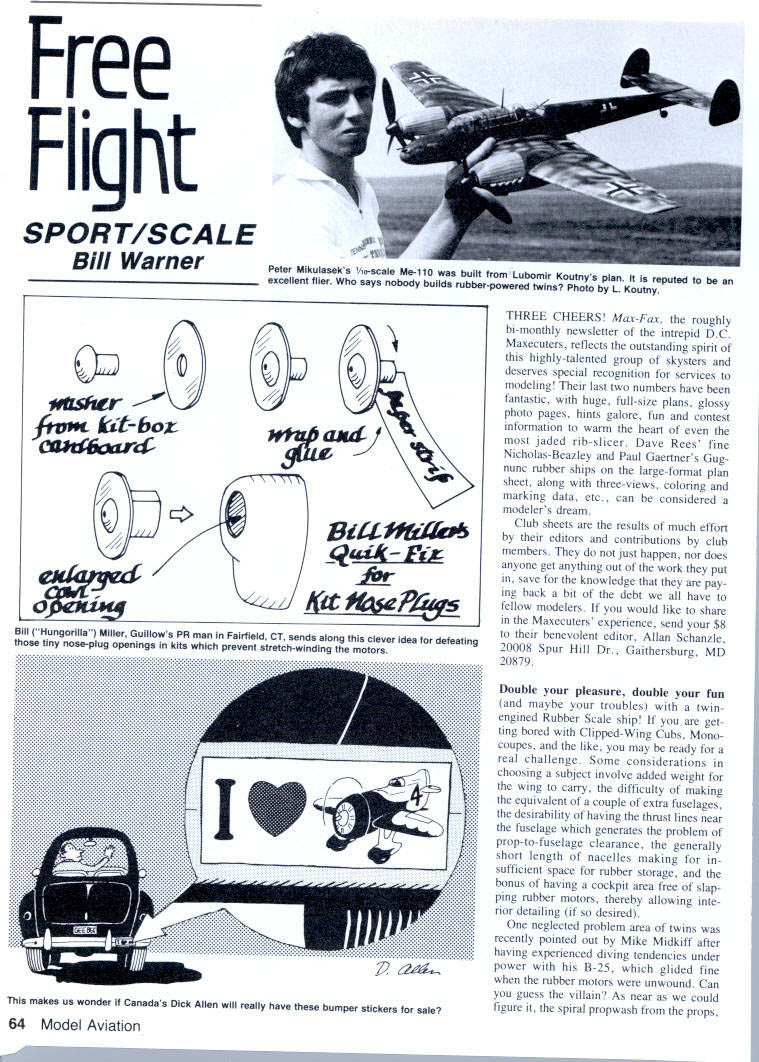
Peter Mikulasek’s 1/40‑scale Me‑110 (built from Lubomir Koutny’s plan) is a reputed excellent flier, but he notes that few people build rubber‑powered twins.
If you want ready designs, Dave Diels has a 3/4‑scale F7F Tigercat and a Westland Whirlwind (27‑in span) ready to go. Either plan can be had for $4 plus $0.75 postage: Dave Diels, P.O. Box 101, Woodville, OH 43469. Dave builds models and draws — a plus is the way he presents large vacu‑form plans. Maybe a trade could be worked out.
And don’t forget Model Aviation’s Full‑Size Plan No. 293 — F7F Tigercat ($1.75).
Hints, Tricks and Modeling Notes
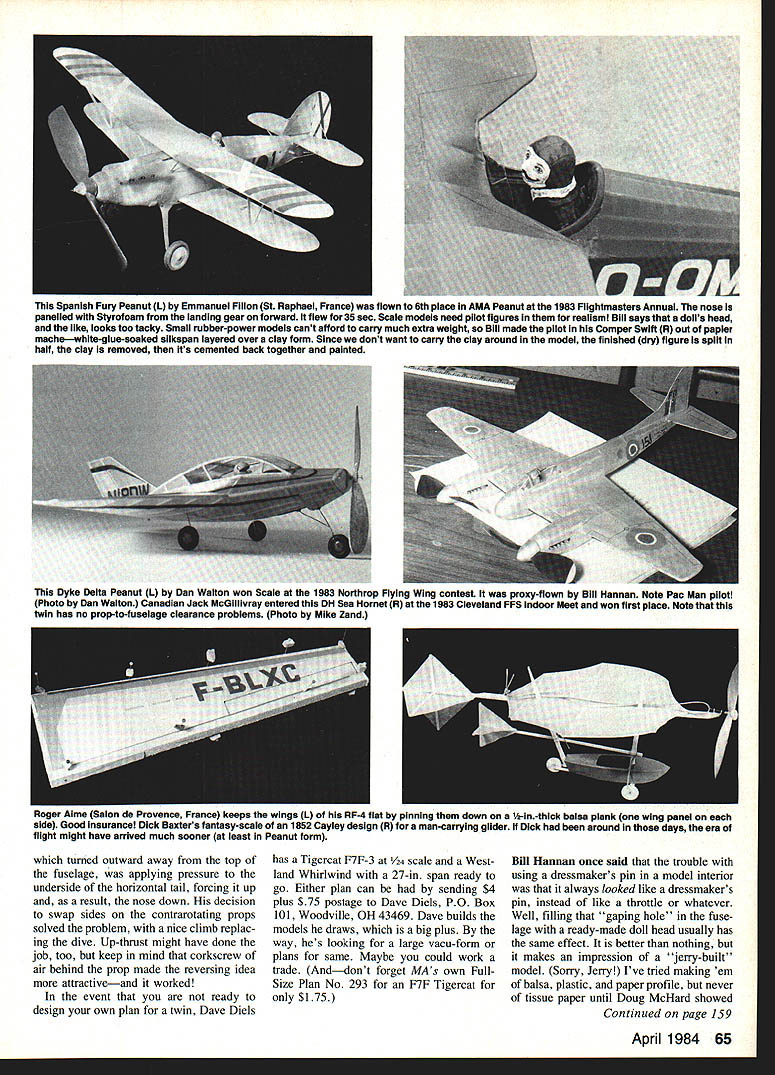
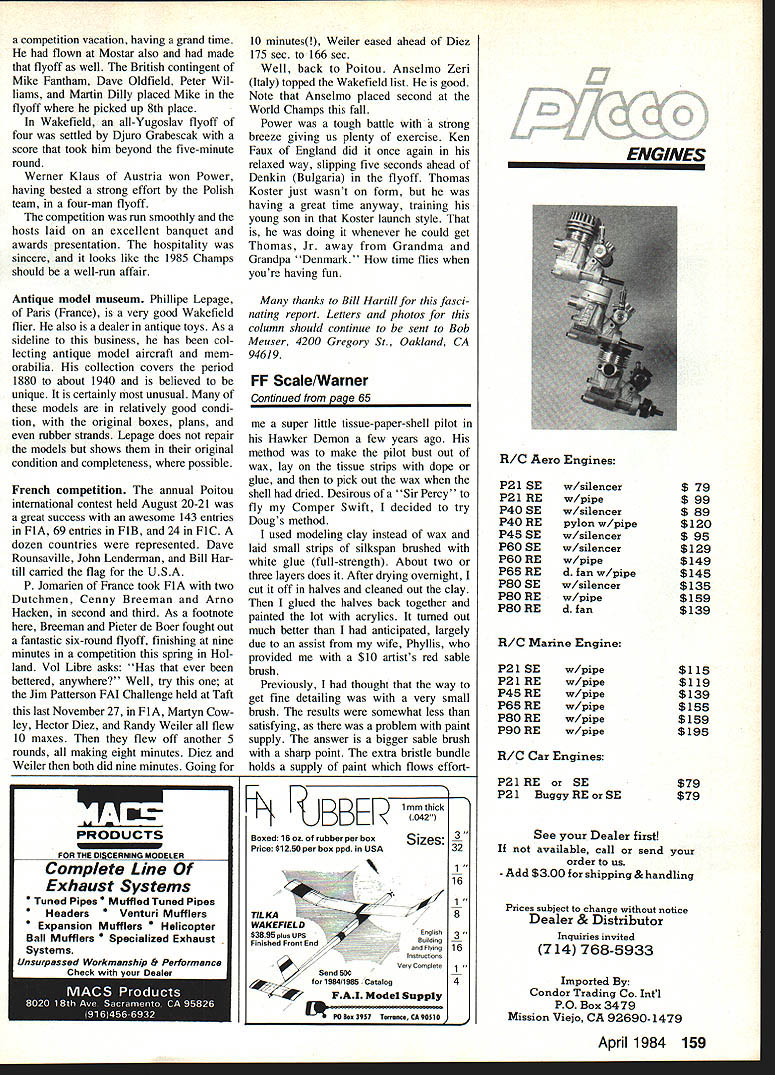
Bill ("Hungorilla") Miller, Guillow’s PR man in Fairfield, CT, sends along a clever idea for defeating those tiny nose‑plug openings in kits that prevent stretch‑winding the motors. (The description and illustration were in his note — a handy tip for those tired of tiny kit openings.) This makes us wonder if Canada’s Dick Allen will really have those bumper stickers for sale.
Bill Hannan once said the trouble with using a dressmaker’s pin as a model interior control is that it still looks like a dressmaker’s pin, not like a throttle or whatever. Similarly, filling a gaping fuselage hole with a ready‑made doll head usually has the same effect: better than nothing, but it gives the impression of a jerry‑built interior.
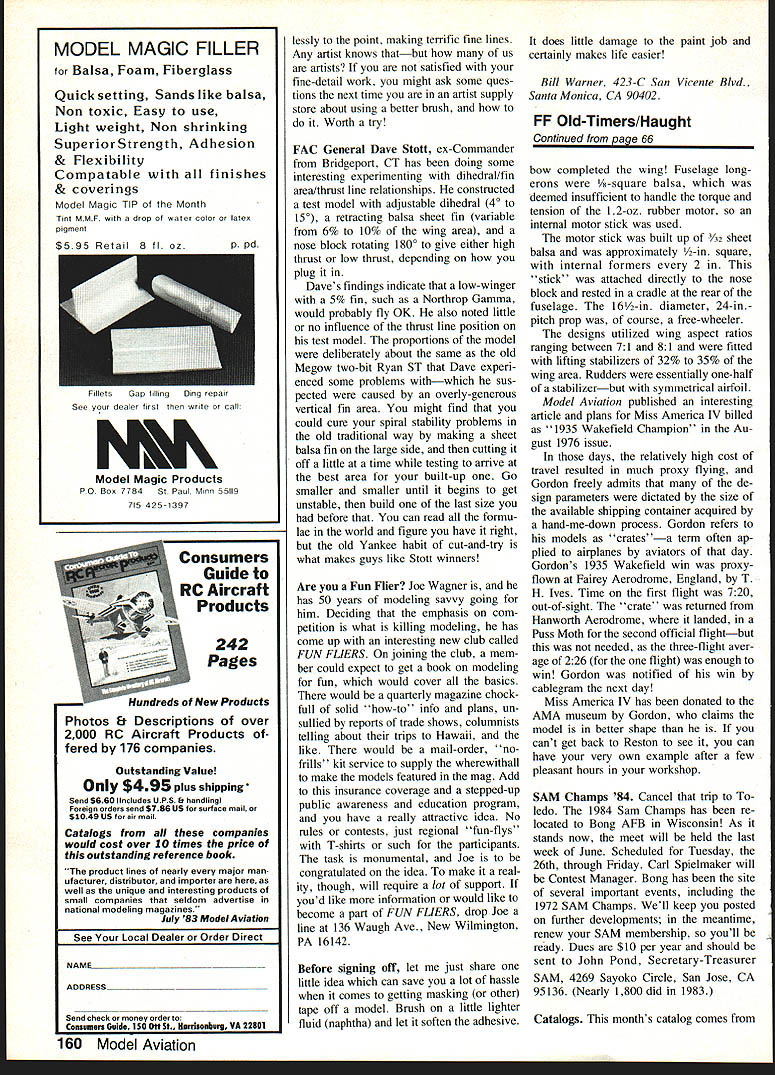
Scale models benefit from pilot figures for realism. Bill Warner describes a lightweight, low‑profile pilot figure method (inspired by Doug McHard):
- Make a small pilot bust form of modeling clay (Doug used wax; modeling clay works well).
- Lay small strips of silkspan (or tissue) brushed with white glue (full strength) over the form. Two or three layers are usually enough.
- Let the shell dry overnight.
- Cut the shell and remove the clay from the interior.
- Glue the halves back together and paint with acrylics.
Warner found the result better than expected and credits his wife for helping with painting (a $10 artist’s red sable brush set was a boon). He also learned that fine detailing is often achieved not with an extremely small brush but with a larger sable brush that has a sharp point: the extra bristle bundle holds a supply of paint which flows effortlessly, so the small amount picked up goes farther and provides smoother lines.
Transcribed from original scans by AI. Minor OCR errors may remain.

