
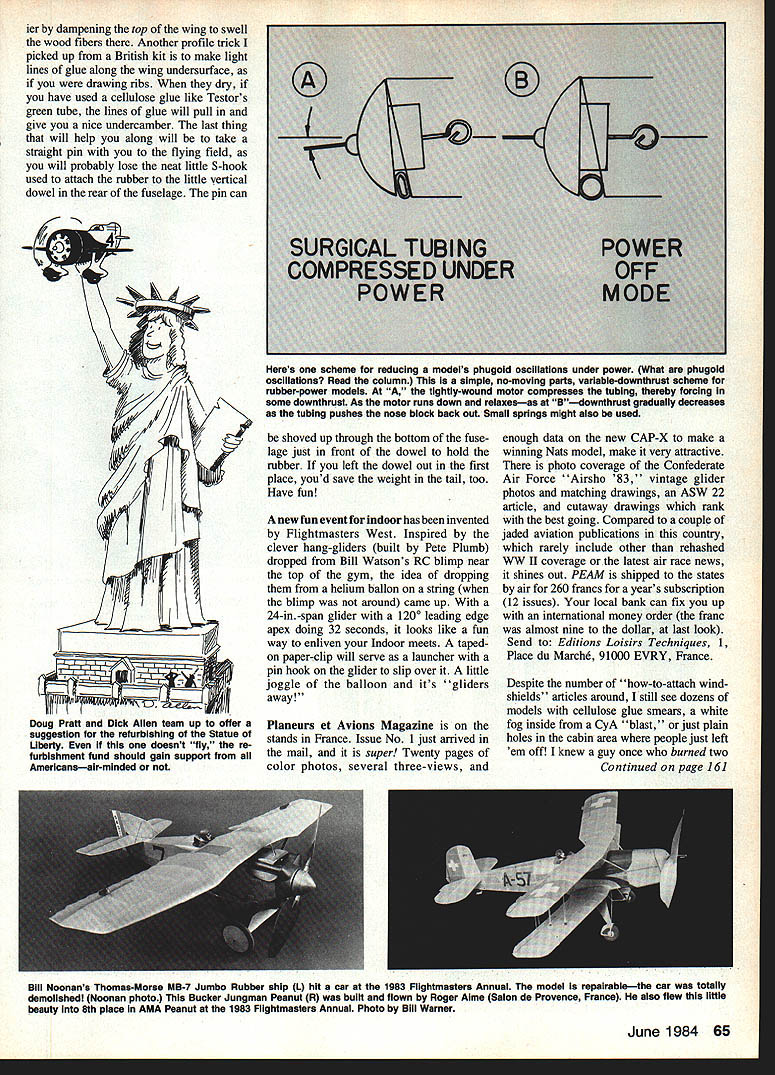
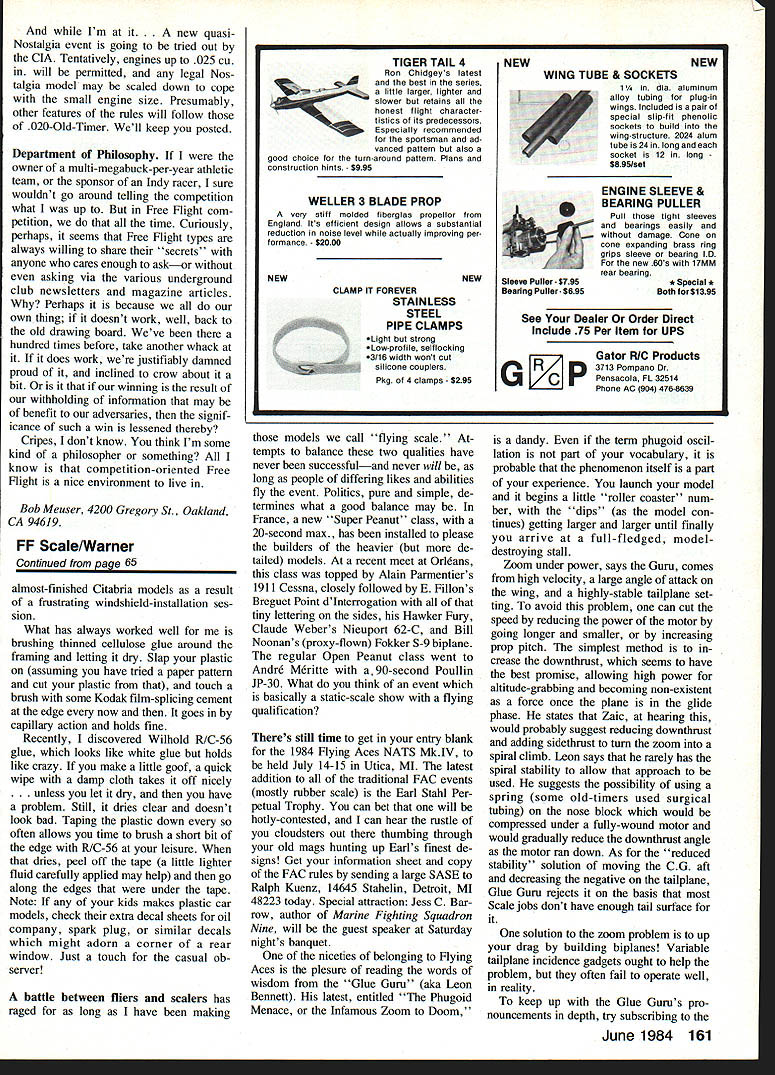
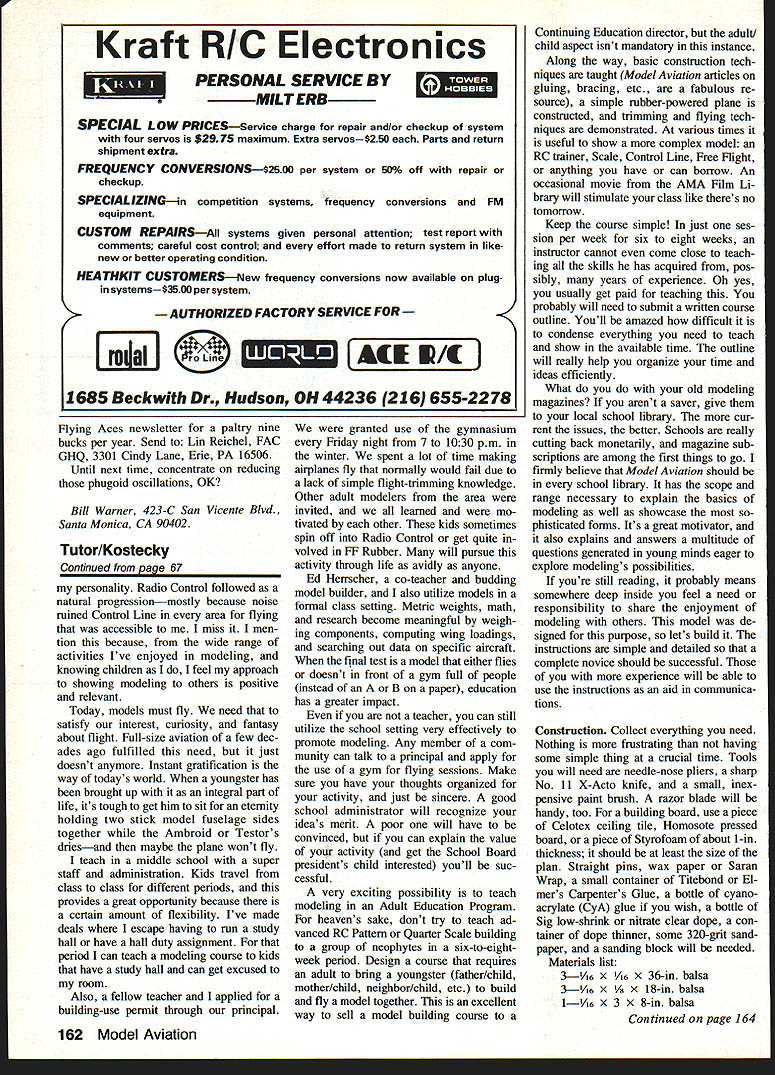
Free Flight: Sport/Scale
Bill Warner
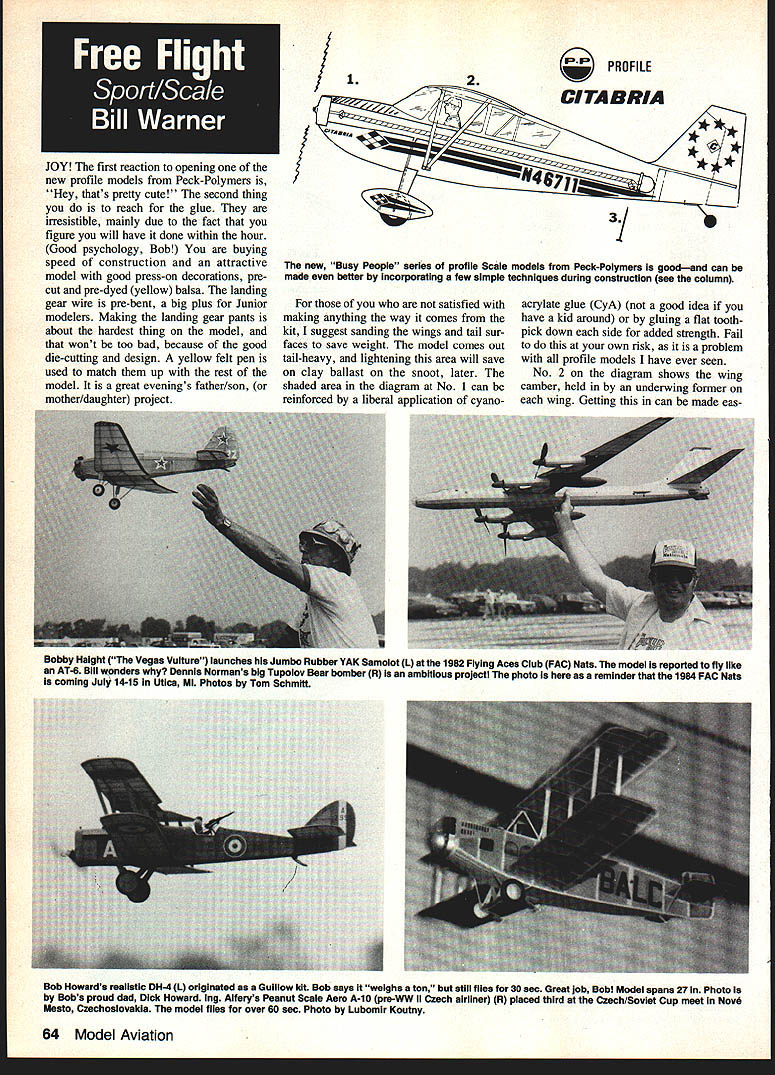
Peck-Polymers "Busy People" profile models
JOY! My first reaction to opening one of the new profile models from Peck-Polymers was, "Hey, that's pretty cute!" The second thing you reach for is the glue. They're irresistible because you figure you'll have it done within the hour — good psychology, Bob! You buy speed of construction and an attractive model with press-on decorations, pre-cut and pre-dyed yellow balsa. The landing-gear wire is pre-bent, a big plus for junior modelers. Making the landing-gear pants is about the hardest part of the model, but good die-cutting and design make it manageable. A yellow felt pen can be used to match the pants to the rest of the model. These kits are great father/son or mother/daughter evening projects.
The Busy People series is good and can be made even better by incorporating a few simple techniques during construction.
Construction tips and fixes
- Sand the wings and tail surfaces to save weight. Profile models often come out tail-heavy; lightening these areas reduces the clay ballast needed on the nose later.
- Reinforce the fuselage sides (shaded area in typical kit diagrams) with a liberal application of cyanoacrylate (CyA) glue or by gluing a flat toothpick along each side for added strength. This is a common weak spot on profile models.
- Wing camber: Diagram No. 2 in many kits shows camber held by an underwing former on each wing. To ease installation, dampen the top of the wing to swell the wood fibers. Another trick (from a British kit) is to draw light lines of cellulose glue along the wing undersurface where ribs would be; when the glue dries it pulls in and produces a nice undercamber. Cellulose glue such as Testor's (green tube) works well for this.
- Rubber hookup: The small S-hook that attaches the rubber to the vertical rear dowel is easily lost. Take a straight pin to the flying field and shove it up through the bottom of the fuselage just in front of the dowel to hold the rubber. If you leave the dowel out you save tail weight.
Variable downthrust scheme for rubber power
Here's a simple, no-moving-parts variable-downthrust concept for rubber-power models to reduce phugoid (zoom) oscillations under power:
- At "A" (fully-wound motor), the tightly-wound motor compresses tubing or a spring behind the noseblock and forces the nose down slightly (increasing downthrust).
- As the motor runs down and relaxes ("B"), the tubing/spring pushes the noseblock back out, gradually reducing downthrust and letting the model assume a more neutral or glider mode for cruise.
- Small springs or surgical tubing are possible implementations.
Indoor balloon-launched gliders
Flightmasters West invented a new indoor event inspired by hang-gliders dropped from an RC blimp. The fun approach: drop a small 24-in.-span glider (120° leading-edge apex) from a helium balloon on a string. One such glider did 32 seconds; it should liven indoor meets. A taped-on paper clip serves as the launcher; the glider has a pin hook that slips over the clip. A small joggle of the balloon and it's "gliders away!"
Planeurs et Avions (France)
Planeurs et Avions magazine is a fine new publication from France. Issue No. 1 includes:
- 20 pages of color photos
- Several three-views and data (including enough on the new CAP-X to help build a winning Nats model)
- Coverage of Airsho '83, vintage glider photos with drawings, an ASW-22 article, and quality cutaway drawings
Subscription: Editions Loisirs Techniques, 1, Place du Marché, 91000 EVRY, France. PEAM is shipped to the U.S. by air for 260 francs annually (12 issues). Your bank can help with an international money order (the franc was roughly nine to the dollar at last look).
Windshield and cabin glazing tips
Despite many how-to articles, I still see models ruined by cellulose-smear windshields, CyA fogging inside cabins, or ignored cabin glazing. What works for me:
- Cut a paper pattern first and trim your plastic to fit.
- Brush thinned cellulose glue around the framing and let it dry; slap the plastic on.
- Use a brush to touch a little Kodak film-splicing cement at the edge — it wicks in by capillary action and holds well.
- Wilhold R/C-56 glue is another excellent choice: it looks like white glue, dries clear, and holds strongly. If you make a goof you can wipe it off while wet; once dry it's permanent. Tape the plastic down while you work edges; when the adhesive has set, peel tape and finish around the edges. A little lighter fluid applied carefully can help remove sticky residue if needed.
- Tip: check leftover decal sheets from plastic car models for small oil company or spark-plug decals to add a realistic touch to a rear window corner.
Events, rules, and competitions
- A quasi-Nostalgia event is being planned by the C.I.A. Engines up to .025 cu. in. will be permitted; power-scale may be scaled down to cope with the small engine size. Rules will likely follow .020-Old-Timer in many respects. Details to follow.
- 1984 Flying Aces NATS Mk. IV: July 14–15 in Utica, MI. There's a new Earl Stahl Perpetual Trophy expected to be hotly contested. To get an information sheet and FAC rules, send a large SASE to Ralph Kuczera, 16446 Stahlien, Detroit, MI 48223. Special attraction: Jess C. Barrow (author of Marine Fighting Squadron Nine) will be guest speaker at Saturday night's banquet.
Fliers vs. scalers; Super Peanut class in France
A long-running battle exists between fliers and scalers in "flying scale" events — balancing flight and scale detail often fails because builders and flyers want different things. Politics largely determines a compromise.
In France a new "Super Peanut" class (20-second max) was introduced to please builders of heavier, more detailed models. At a recent Orléans meet the Super Peanut results included:
- Winner: Alain Parmentier — 1911 Cessna
- 2nd: E. Fillon — Breguet Point d'Interrogation (with tiny lettering)
- Others: E. Fillon (Hawker Fury), Claude Weber (Nieuport 62-C), Bill Noonan (proxy-flown Fokker S-9 biplane)
The regular Open Peanut class was won by André Méritté with a 90-second Poulin P-30. The question remains: is an event that’s essentially a static-scale show with only a flying qualification a good thing?
Department of Philosophy — sharing secrets in Free Flight
If I owned a multimillion-dollar athletic team or sponsored an Indy racer, I wouldn't publicly share technical secrets. Yet in Free Flight, people freely reveal methods and setups in club newsletters and magazine articles. Why? Maybe because most of us tinker independently; failures send us back to the drawing board, successes make us proud and talkative. Or maybe there's a sense that withholding secrets to gain a competitive edge would reduce the legitimacy of a win. Whatever the reason, Free Flight competition remains a congenial environment.
The Glue Guru and phugoid (zoom) oscillations
Leon Bennett ("Glue Guru") wrote a good piece, "The Phugoid Menace, or the Infamous Zoom to Doom." Phugoid oscillations are common: you launch, the model does a growing roller-coaster until it stalls.
Key points and remedies:
- Zoom under power stems from high velocity, a large wing angle of attack, and a highly stable tailplane setting.
- Remedies:
- Cut speed: reduce power or motor (longer, smaller motor) or increase prop pitch.
- Increase downthrust, especially early in the launch phase, then have it reduce as power decays (variable downthrust scheme described earlier).
- Some suggest reducing downthrust and adding side thrust to turn a zoom into a spiral climb, but spiral stability is not reliable.
- Avoid relying on moving the CG aft and decreasing tailplane incidence for scale models — many scale designs lack sufficient tail surface to make that work.
- Increasing drag (e.g., building biplanes) can help.
- Variable tailplane incidence gadgets might help but often fail to operate reliably.
To follow Glue Guru's writings, subscribe to Flying Aces publications or club newsletters.
Contact/Address: Bob Mezger, 4200 Gregory St., Oakland, CA 94619
Transcribed from original scans by AI. Minor OCR errors may remain.

