
Free Flight: Sport/Scale
Bill Warner
Farman Moustique Recovery
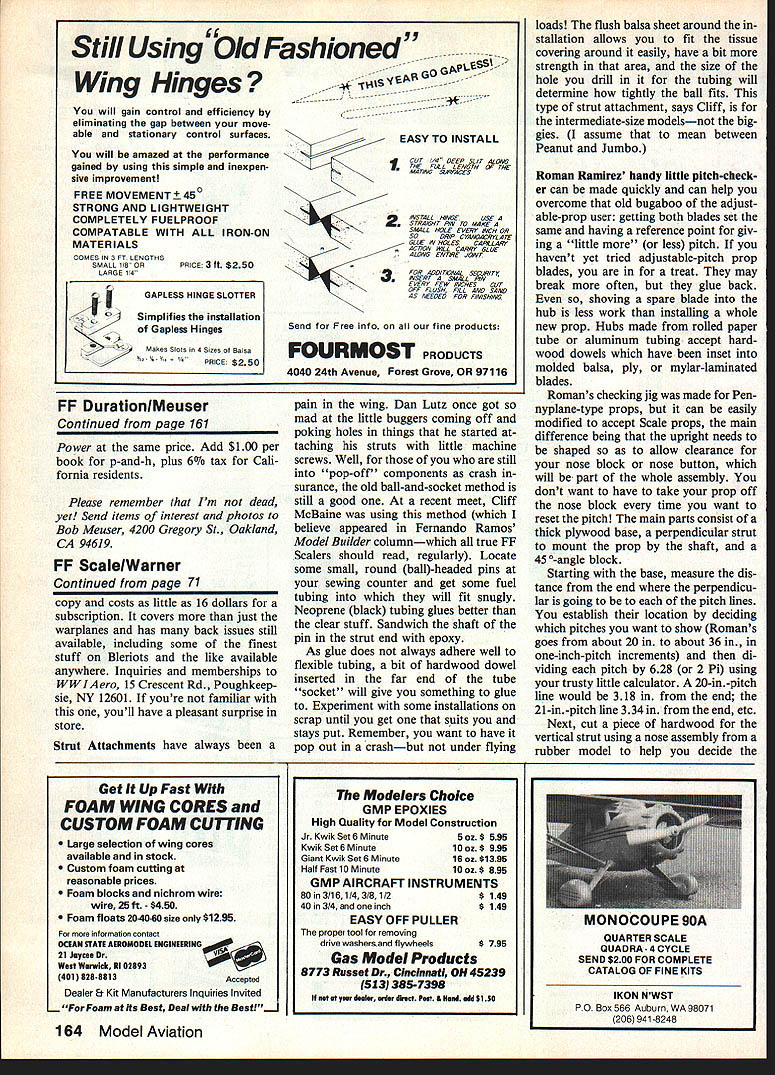
CRASH! Oh, no! Addie Naccarato runs into her office where her new 80‑in. ultralight rubber model has just been placed for safekeeping, and there it is... smashed. Of all things, a picture had fallen off the wall and wiped out a wing and the fuselage! Hardly any time was left before the big day at the U.S. Free Flight Champs (Taft, CA) where the Farman Moustique was slated to fly.
Many of us would have thrown in the towel at this point, but Addie was not about to give up that easily. She worked day and night, even missing some of the events at Taft. Her Winnebago hummed with activity into the wee hours, and when Scale Day dawned, the Blacksheep Squadron Farman Flying Team toted its pride and joy to the field.
When the Farman was fitted up, wound, and ready, all other flying stopped. A perfect launch by Addie (with son Tony steadying a wing) and the Moustique was airborne, floating on the morning breeze under low power, its 16 ounces being a mere pittance for the 12 strands of FAI rubber keeping it aloft. There was applause, for it was more than just a first flight; it was a victory over adversity of the first magnitude!
One of the features of this ship—which it will need if ever fully wound—is a clockwork‑timer‑operated dethermalizer that pops up the elevators. At the moment of this writing, Addie has the model set up for indoor flying with a radio, bringing its weight to a bit over two pounds. Besides being covered with Japanese tissue and built with sliced ribs and light balsa, a lot of free‑flight know‑how went into this ship. Personally, if I ever get hit accidentally by an RC plane (I've had lots of near misses), I certainly hope it's this one!
Safety and RC Testing
While on the subject of safety, Bill Watson—who generally uses RC in safe ways like flying slow‑moving dirigibles— is now doing testing for an ultralight maker in Albuquerque. It seems there is a certain advantage to having your test pilot on the ground when looping those things. It's also great for parachute testing (they 'chute the whole plane down). Flying 450‑lb., "full‑size" ships on R.C... I guess this is one time when Free Flight might not be the best way to go!
Nebraska Free‑Flighters
The Nebraska Free‑Flighters are a little‑known group of devotees from the land of Perry Peterson, Joe Pederson, Bob Willey, and Tom Winter. Tom, who puts out their down‑home newsletter with all the panache of an NFFS journal, invites new members. They fly indoor scale as well as outdoor subjects. For $10 you can be a member, and for $6 you can have the newsletter The Winding Stooge delivered to your door nine times a year with an original plan in each issue. There's a Bostonian on floats in the issue I'm looking at!
Plan Services
Allen Hunt Plan Service is well worth looking into. Two dollars will bring you Allen's catalog of well‑drawn plans, including many of the best of the old‑time rubber scale models by Stahl, Lindberg, Winter, etc. The plans are shown in line drawings in the margins for those of us who don't like to buy a "pig in a poke." If you never heard of a Porterfield Turner 50 or a P‑43, there they are! The drawings, some of which include three‑views for detail, show both left and right wings as well as full‑size former and rib patterns. The plans come to about $3 each, with handling added.
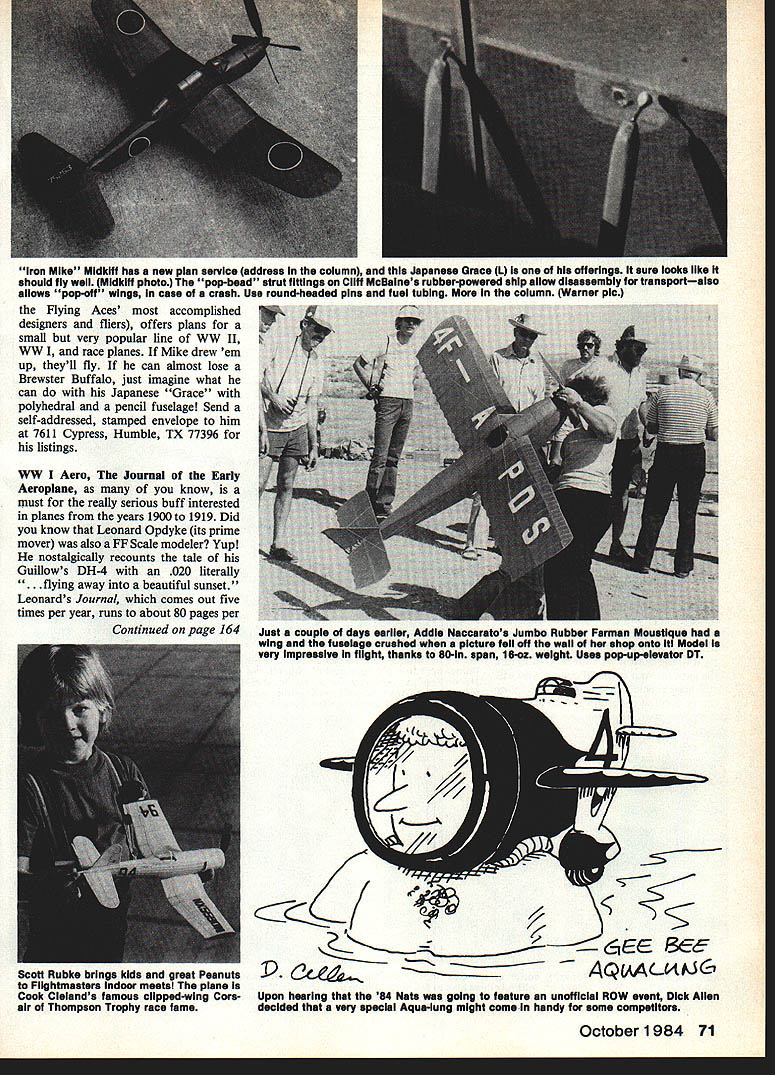
Gulfcoast Model Aviation, founded recently by "Iron Mike" Midkiff (one of the accomplished designers and fliers), offers plans in a small, very popular line of WWII and earlier race planes. Mike drew 'em up—they'll fly; you can almost lose a Brewster Buffalo.
WW I Aero
WW I Aero, The Journal of the Early Aeroplane, as many of you know, is a must for the really serious buff interested in planes from 1900 to 1919. Did you know that Leonard Opdyke (its prime mover) was also a free‑flight scale modeler? Yup! He nostalgically recounts the tale of his Guillows DH‑4 with an .020 literally "...flying away into a beautiful sunset." Leonard's journal, which comes out five times per year, runs to about 80 pages per copy and costs as little as $16 for a subscription. It covers more than just warplanes and has many back issues still available, including some of the finest material on Bleriots and the like available anywhere. Inquiries and memberships to WW I Aero, 15 Crescent Rd., Poughkeepsie, NY 12601. If you're not familiar with this one, you'll have a pleasant surprise in store.
Strut Attachments
Strut attachments have always been a pain in the wing. Dan Lutz once got so mad at the little buggers coming off and poking holes in things that he started attaching his struts with little machine screws. For those of you who are still into "pop‑off" components as crash insurance, the old ball‑and‑socket method is still a good one.
At a recent meet, Cliff McBaine was using this method (which I believe appeared in Fernando Ramos' Model Builder column—which all true free‑flight scalers should read regularly). Locate some small, round (ball)‑headed pins at your sewing counter and get some fuel tubing into which they will fit snugly. Neoprene (black) tubing glues better than the clear stuff. Sandwich the shaft of the pin in the strut and then epoxy.
As glue does not always adhere well to flexible tubing, a bit of hardwood dowel inserted in the far end of the tube "socket" will give you something to glue to. Experiment with some installations on scrap until you get one that suits you and stays put. Remember: you want it to pop out in a crash—but not under flying loads! A flush balsa sheet around the installation allows you to fit the tissue covering around it easily, gives a bit more strength in that area, and the size of the hole you drill in it for the tubing will determine how tightly the half fits. This type of strut attachment, says Cliff, is for intermediate‑size models—not the biggies. (I assume that means between Peanut and Jumbo.)
Pitch‑Checker Jig (Roman Ramirez)
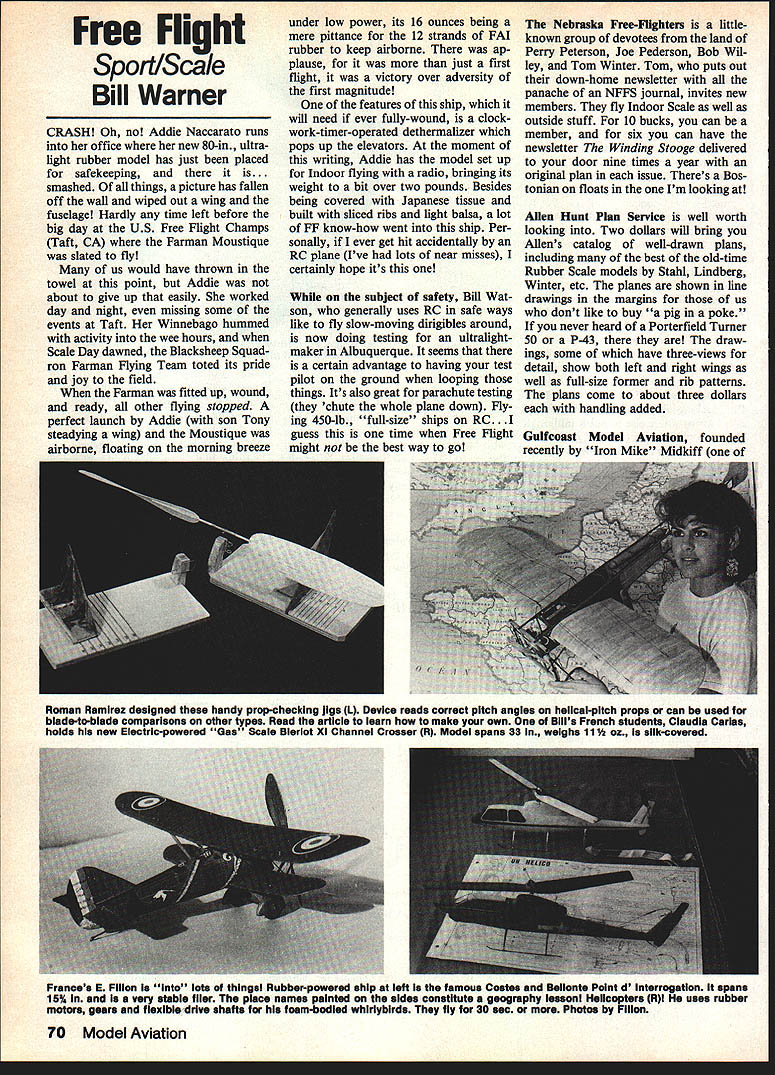
Roman Ramirez' handy little pitch‑checker can be made quickly and can help you overcome that old bugaboo of the adjustable‑prop system: getting both blades set the same and having a reference point for giving a "little more" (or less) pitch. If you haven't yet tried adjustable‑pitch prop blades, you are in for a treat. They may break more often, but they glue back. Even so, shoving a spare blade into the hub is less work than installing a whole new prop. Hubs made from rolled paper tube or aluminum tubing accept hardwood dowels which have been inset into molded balsa, ply, or mylar‑laminated blades.
Roman's checking jig was made for Pennyplane‑type props, but it can be easily modified to accept scale props. The main difference is that the upright needs to be shaped to allow clearance for your nose block or nose button, which will be part of the whole assembly. You don't want to have to take your prop off the nose block every time you want to check the pitch!
The main parts consist of a plywood base, a perpendicular strut to mount the prop by the shaft, and a 45‑degree block. Starting with the base, measure the distance from the end where the perpendicular is going to be to each of the pitch lines. You establish their location by deciding which pitches you want to show (Roman's goes from about 20 in. to about 36 in., in one‑inch‑pitch increments), and then dividing each pitch by 6.28 (or 2π) using your trusty little calculator. A 20‑in. pitch line would be 3.18 in. from the end; the 21‑in. pitch line 3.34 in. from the end, etc. Next, cut a piece of hardwood for the vertical strut using a nose assembly from a rubber model to help you decide the position of the strut so the prop will clear the nose. Drill a hole in the end of the strut for the shaft, glue the strut to the base, and put the 45‑degree block in place.
How to Fly Any Scale Model Plane
I'd like to wind up with Greg Hildebrandt's instructions on "How to Fly Any Scale Model Plane," which appeared in Fine Scale Modeler and Wing Tips.
- Grasp fuselage firmly between wings and tail. Make sure your grip is comfortable, with no obstructions; close your fingers, such as tail wheel, wires, etc.
- Lift model up high and walk forward briskly. Your plane is now in flight and can be made to do any maneuver that doesn't twist your arm.
- Never, at any time before landing, should you run and leave the model, as this can result in a loss of control usually fatal to the plane.
With that bit of wisdom, I'll bid ya' adoo...
Bill Warner 423‑C San Vicente Blvd. Santa Monica, CA 90402
Transcribed from original scans by AI. Minor OCR errors may remain.

