
Free Flight Sport/Scale
Bill Warner
Rubber-powered helicopters
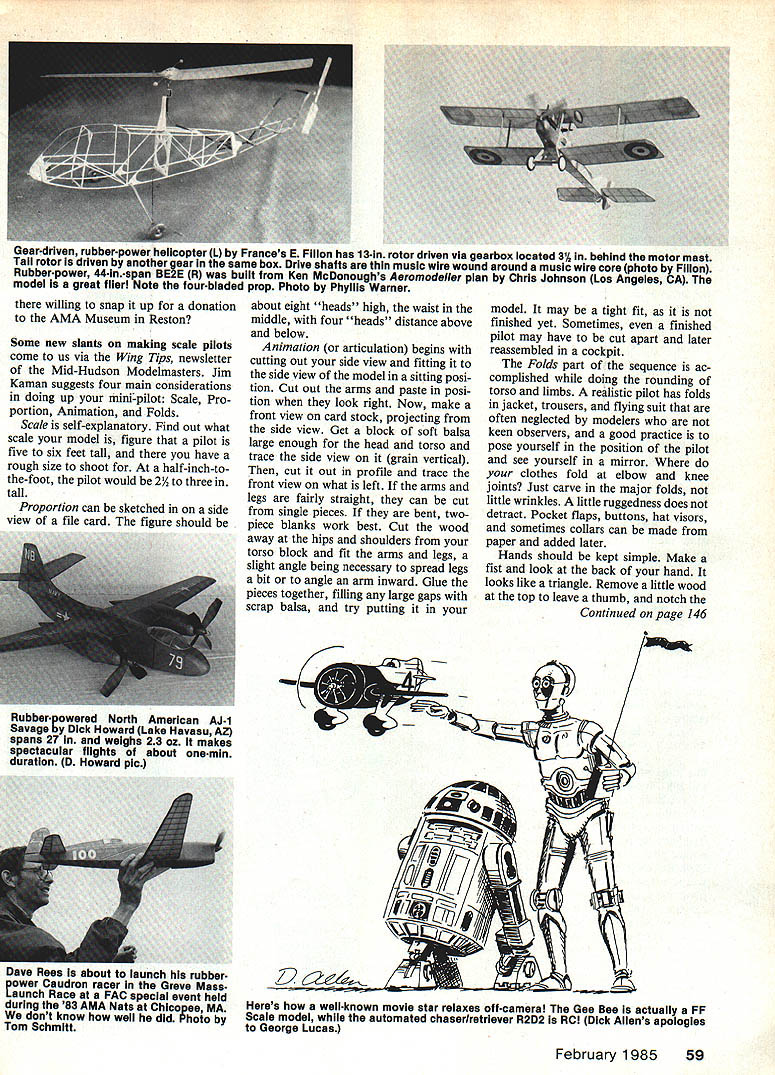
Good grief! Who'd have thought there was so much interest in rubber-powered helicopters? After the picture of one of Emmanuel Fillon's little Styrofoam wonders appeared in this column, I received a ton of mail wanting to know more about them, where plans can be obtained, etc. As far as I know, Mr. Fillon's plan is not commercially available at this time, but interested persons who write French may wish to contact him. Drop me a line to obtain his address.
His latest designs climb well, attaining heights of 10–12 meters, but the descents are not always good when the rotor loses speed. He is presently working on a free‑wheeling rotor which goes into negative pitch for the descent. The secret of the successful 'copter seems to be in the flexible wound‑wire geared drive and the super‑light construction. Note that the tail rotor blades are adjustable to obtain zero fuselage rotation.
Addresses and catalogs
Second only to the choppers in modelers' minds these days seems to be my inadvertent omission of a couple of important addresses from my last offering. To fill that void, here they are:
- To join the Nebraska Free Flighters and receive their inspired newsletter, contact Tom Winter, 1010 Eastridge Dr., Lincoln, NE 68510.
- To get Allen Hunt's neat plans catalog, send a refundable $2.00 to Allen Hunt Plan Service, Box 726, Dunbar, WV 25064-6078. Allen also offers to work with any movements promoting rubber, CO‑2, etc., and is interested in getting more young people into "our kind of modeling." Want a neat rubber ship just for fun? Try his "Red Racer." You'll also find some old favorites enlarged from the originals, such as the Stahl Waco E blown up to a 30 in. span.
Pilot-making technique (from Wing Tips, Mid‑Hudson Modelmasters)
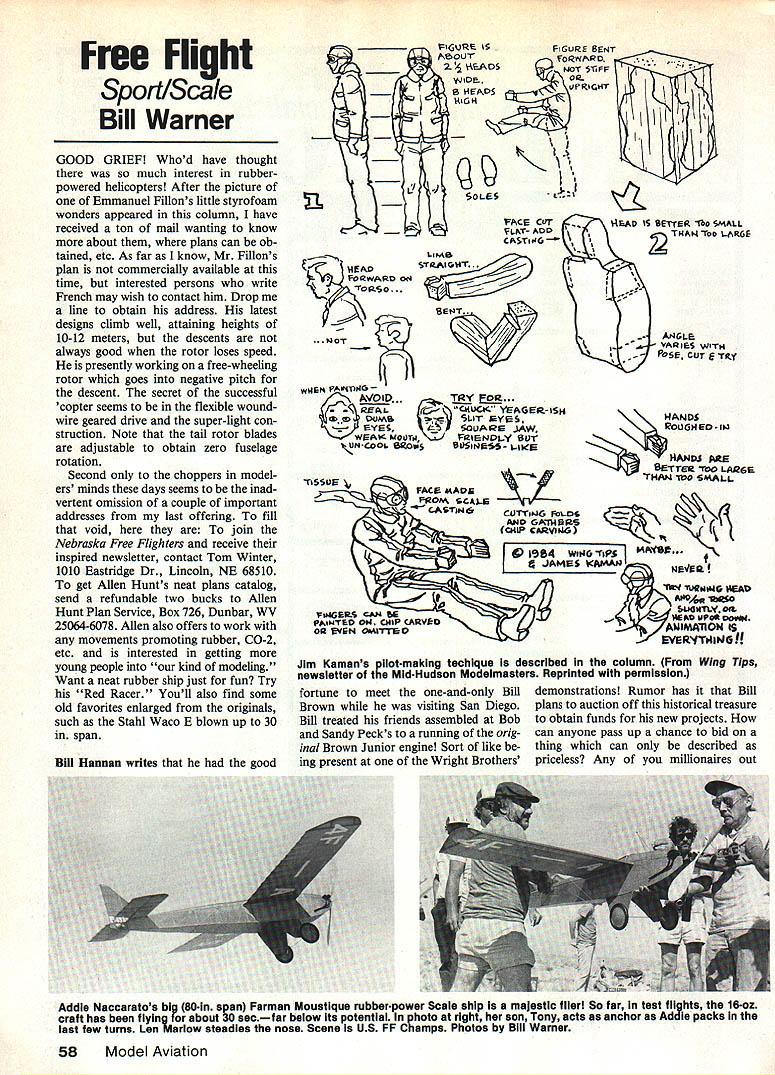
Jim Kaman's pilot‑making technique was described in the column (reprinted with permission from Wing Tips). He suggests four main considerations in making mini pilots:
- Scale
- Proportion
- Animation (articulation)
- Folds
#### Scale Find out what scale figure a five- or six‑foot tall pilot would be. A rough size to use is half‑inch to the foot — the pilot would be about 2½–3 inches tall.
#### Proportion Sketch a side view on file card. The figure should be about eight "heads" high; the waist is about the middle (four heads), giving four heads' distance above and below the waist.
#### Animation (articulation)
- Cut out your side view and fit it to the side view of the model in a sitting position.
- Cut out the arms and paste them in position when they look right.
- Make a front view on card stock by projecting from the side view.
- Get a block of soft balsa large enough for the head and torso; trace the side view on it with the grain vertical. Cut out the profile and trace the front view on what remains.
- If arms and legs are fairly straight, cut them as single pieces; if bent, two‑piece blanks work best. Cut away wood at the hips and shoulders from the torso block and fit the arms and legs. A slight angle may be necessary — spread the legs a bit or angle an arm inward.
- Glue the pieces together, filling large gaps with scrap balsa, and try putting the figure in the cockpit. It may be a tight fit when unfinished; sometimes a finished pilot must be cut apart and reassembled in the cockpit for a proper fit.
#### Folds and surface detail Round the torso and limbs while carving. A realistic pilot has folds in jacket, trousers, and flying suit — often neglected by modelers who are not keen observers. A good practice is to pose yourself in the pilot position and study your clothes in a mirror to see where folds occur (elbow and knee joints). Carve the major folds rather than tiny wrinkles; a little ruggedness adds realism. Pocket flaps, buttons, hat visors, and sometimes collars can be made from paper and added later.
#### Hands Keep hands simple. Make a fist and look at the back of your hand — it looks like a triangle. Remove a little wood from the top to leave a thumb, and notch the hand at the thumb and wrist to further define it.
#### Detailing and finishing
- Use spackling paste to touch up flaws or flesh out sparse areas.
- Faces can be carved or made from a CyA (cyanoacrylate) "casting." Some use modeling clay molds, press a doll face (e.g., G.I. Joe) into the clay, brush on gap‑filling CyA, and use spray accelerator to create a thin "mask" that can be added to a head blank. This helps those who can't quite get faces by carving.
#### Painting and accessories Painting is straightforward with acrylics or flat model enamels, but be careful not to overdo facial features. Underplay mouths and eye whites to avoid a caricatured look. Goggles sliced from aluminum tubing can be added after painting; lenses often detract, so you may wish to omit them.
Recommended reading: Making Model Soldiers of the World by Jack Cassin‑Scott (Barron's, Woodbury, NY).
Happy sculpting!
Swamp Squadron (new FAC group)
Right at press time, a new newsletter announcing the formation of a new FAC (Flying Aces Club) group arrived with a bang. The Swamp Squadron is rising from the ashes of the now‑defunct Central Florida Airplane Club, and it looks like it has possibilities. The first newsletter features reprints of a couple of fine FAC plans: Mark Fineman's Nikitin‑Schechyenko, and Bruning's Raiden and PZL‑P‑46. They plan to publish a newsletter every two months at the modest cost of $7.50 a year. Address inquiries and checks to:
Headquarters Flight, Swamp Squadron, FAC 5275 William Clark Rd. Lakeland, FL 33805
Good luck to them!
Indoor retrieval tip
At the September Flightmasters West indoor meet, Roman Ramirez showed a neat device that should be part of every low‑ceiling club's supply list. He adapted an aluminum "golf ball retriever" (sold in sporting goods stores; originally had a small basket on the end) which telescopes from 40 in. to 13 ft., and added two sections of fishing rod blank to extend another five feet. The fit was accomplished by building up the end of the retriever with shrink sleeving (tape works, too). Topping the device is a marshmallow‑sized bit of Styrofoam to dislodge models from ceilings and window areas. Total cost was about $13. Roman says an 18‑ft. retriever is available for about $20. Roger Dunn in Los Angeles carries them, but check your local supplier.
Until next time, gang, remember the old battle cry, "Shticks un Tizzu Uber Alles!"
Bill Warner 423‑C San Vicente Blvd. Santa Monica, CA 90402
Transcribed from original scans by AI. Minor OCR errors may remain.

