
Free Flight: Sport/Scale
Bill Warner
Prohibition was a flop. Americans, when told not to do something, ran out in larger numbers than ever and did it with a vengeance. Is there a lesson in this? Well, I just received an RC magazine from France, and on the back cover was a full-color ad for beer! Actually, living in a state which encourages the sales of this beverage in gas stations, I am surprised that we let the French beat us to it! What could go together better than a fast, heavy model, a crowd of appreciative spectators, and a couple of nice cool ones?
Many of us appreciate the combining of models with scantily-clad beauties on the covers of our magazines, and it doesn't lead to orgies at the flying sites. We allow the advertising of engines which can swing a prop with enough power to seriously damage anything which wanders into their territory. All the fuel cans contain dire warnings about the effects of their contents on the human body. Ever have a round X-Acto knife roll off your building board into your lap? Ever have to make a quick trip to the emergency ward with cyanoacrylate (CyA) glue in your eye? Ever get boron filament wire broken off in your finger? Well, you have guessed where this is leading, right? If you are smart enough to know that drinking and flying RC don't mix, you will not be bothered by the beer ad. We also control ourselves rather well when attractive members of the opposite sex stroll through the ROW (rise-off-water) area clad in bikinis. Very few of us drink from our fuel cans, nor do we often stick our fingers in the prop arc. Not many of us leave loaded guns, boron filament, or CyA lying about unattended for kids to get hold of.
Personally, I would like to ban all of the elements in our lives which make them unnecessarily dangerous. However, knowing enough about human nature to realize the futility of this, I am constantly searching for compromise which can make things more fun and less hazardous.
John Preston's safety column is super, and it rightly deals with the most critical areas: big engines, spinning props, and nasty chemicals. As most of the people who read my column deal with fairly benign models which seldom wreak havoc on anything but themselves, a certain carelessness regarding safety creeps in.
Kids, especially, are unaware of a number of common dangers. If you have a kid that you are teaching modeling, let me suggest a few things to stress... just once, but over and over. I have worked with thousands of kids over the years and have a pretty good idea of the types of things they do. As Preston's column often covers engines, let's just touch on some others.
Knives
- Use ones with flat sides that will not roll. The plastic-made X-Acto (and you can get cheap ones) should retract the blade when you set it down.
- Never cut towards yourself; the movement of the blade should never be in the direction of your finger, thumb, or leg if it slips.
- Never hold something up in the air while slicing away. Fingers behind wood are often forgotten—that is, until you cut into them.
- Cut on a piece of cardboard so that it takes the problems, not you.
- Keep Band-Aids near, and sit down if you cut yourself. Have plenty—kids just keel over at the sight of their own self-inflicted wound.
- Respect what a knife can do.
Cements
- I do not allow my students to use CyA, even if they wear glasses. Eyes are too precious, and kids do get as careless as adults.
- If they can't wait for the Testors "Green Tube" glue to dry, they should take a class in meditation to slow them down a bit. Expecting instant results is not one of the goals in scale modeling.
- White glue is pretty safe, though slower.
Hi-Tech materials
- Kids snap spruce tail booms and fuselages with ease. How do you think they will treat .004-in.-diameter, brittle boron filament? It can (and does) enter soft parts of the body unbidden. You can, and should, build models without it. Its size and brittleness make it appear to be safer than it is.
- Invisible fumes from many modern paints and thinners can cause serious problems—even heart, lung, and brain damage in extreme cases. Never paint or spray in a closed room or garage, even if it's cold, or windy, or whatever.
- If it doesn't say "completely safe" on the container (and it won't), you can bet the people who made it want you to use it outside or with all the windows open. There's a reason for that warning on the can or bottle. The stuff you spray on to speed up that CyA you're not supposed to be using is included.
- Wash your hands often if you are handling any chemical stuff or fuel. Kids do rub their eyes, now and then.
Dime Scale
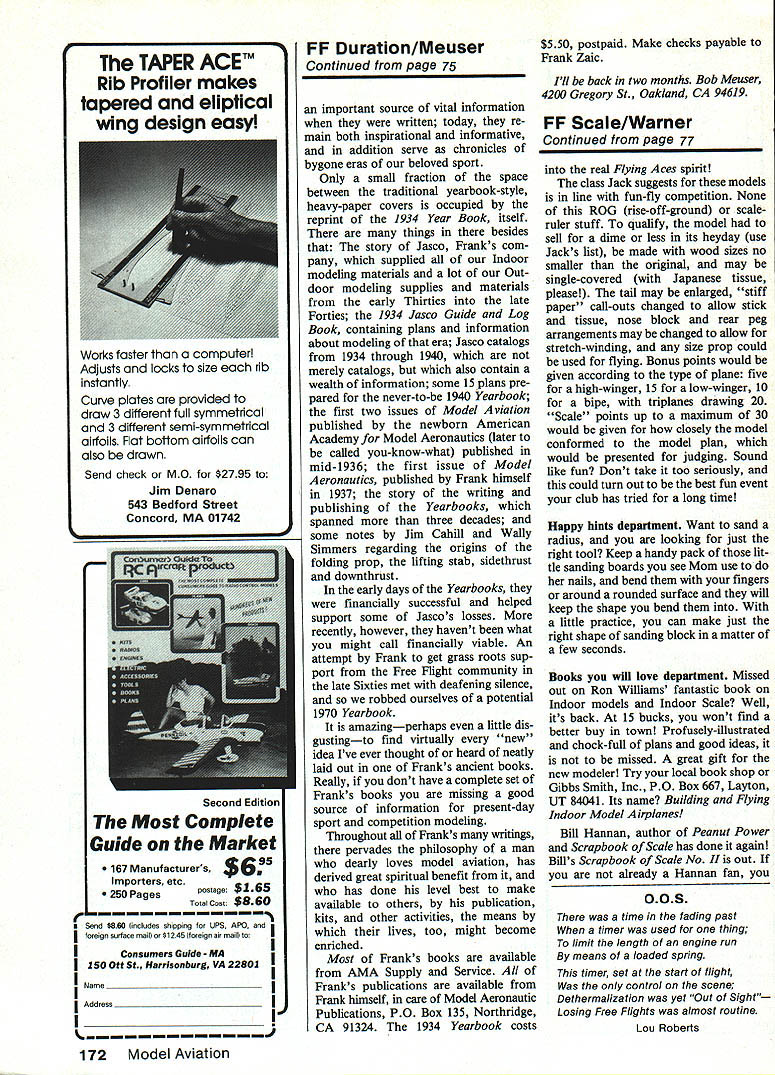
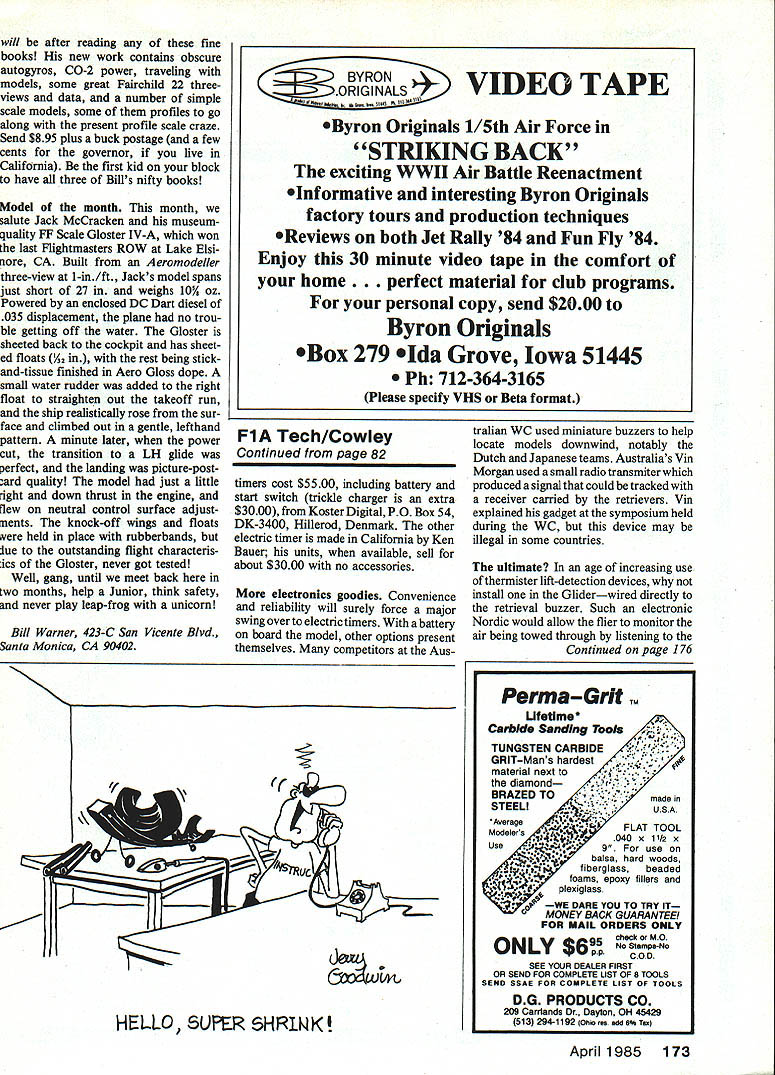
Dime Scale is a new, low-tech, and rather safe class. For those who find it easy to resist the big-bucks, high-tech end of the modeling spectrum, Jack Fike (no relation to the airplane of the same name) has the answer. His Scale Flight Model Co., 630 Fairway Ln., Bloomington, IN 47401, has a list of dozens of model plans of the old nickel-and-dime models we cut our teeth on back in the Thirties and Forties. Not only does he have a list, but he has the plans, too. Even better, most of them have printwood that you can get to go with the few bits of sticks and scrap to make the finished plane! Most of these planes were not superscale, but they had fairly light construction and made exciting models for fun-flying. With decent wood, they can really cuddle the cumulus! Most of Jack's models range from 12 in. span to 16 in. span, and the roll call ranges from Comet's Corben Super Ace to Megow's Gulfhawk. Send Jack a self-addressed, stamped envelope (SASE). His prices are quite cheap by 1985 standards, and he's into the real Flying Aces spirit!
The class Jack suggests for these models is in line with fun-fly competition. None of this ROG (rise-off-ground) or scale-ruler stuff. To qualify, the model had to:
- Have sold for a dime or less in its heyday (use Jack's list).
- Be made with wood sizes no smaller than the original.
- May be single-covered (with Japanese tissue, please!).
- The tail may be enlarged; "stiff paper" call-outs may be changed to allow stick-and-tissue.
- Nose block and rear peg arrangements may be changed to allow for stretch-winding.
- Any size prop could be used for flying.
Bonus points would be given according to the type of plane:
- 5 points for a high-winger
- 15 points for a low-winger
- 10 points for a biplane
- 20 points for a triplane
"Scale" points, up to a maximum of 30, would be given for how closely the model conformed to the model plan, which would be presented for judging. Sound like fun? Don't take it too seriously, and this could turn out to be the best fun event your club has tried for a long time!
Happy hints department
Want to sand a radius, and you are looking for just the right tool? Keep a handy pack of those little sanding boards you see Mom use to do her nails, and bend them with your fingers or around a rounded surface and they will keep the shape you bend them into. With a little practice, you can make just the right shape of sanding block in a matter of a few seconds.
Books you will love department
- Missed out on Ron Williams' fantastic book on indoor models and indoor scale? Well, it's back. At $15, you won't find a better buy in town! Profusely illustrated and chock-full of plans and good ideas, it is not to be missed. A great gift for the new modeler! Try your local bookshop or Gibbs Smith, Inc., P.O. Box 667, Layton, UT 84041. Its name? Building and Flying Indoor Model Airplanes!
- Bill Hannan, author of Peanut Power and Scrapbook of Scale, has done it again. Bill's Scrapbook of Scale No. II is out. If you are not already a Hannan fan, you will be after reading any of these fine books! His new work contains obscure autogyros, CO2 power, traveling with models, some great Fairchild 22 three-views and data, and a number of simple scale models, some of them profiles to go along with the present profile-scale craze. Send $8.95 plus $1.00 postage (and a few cents for the governor, if you live in California). Be the first kid on your block to have all three of Bill's nifty books!
Model of the month
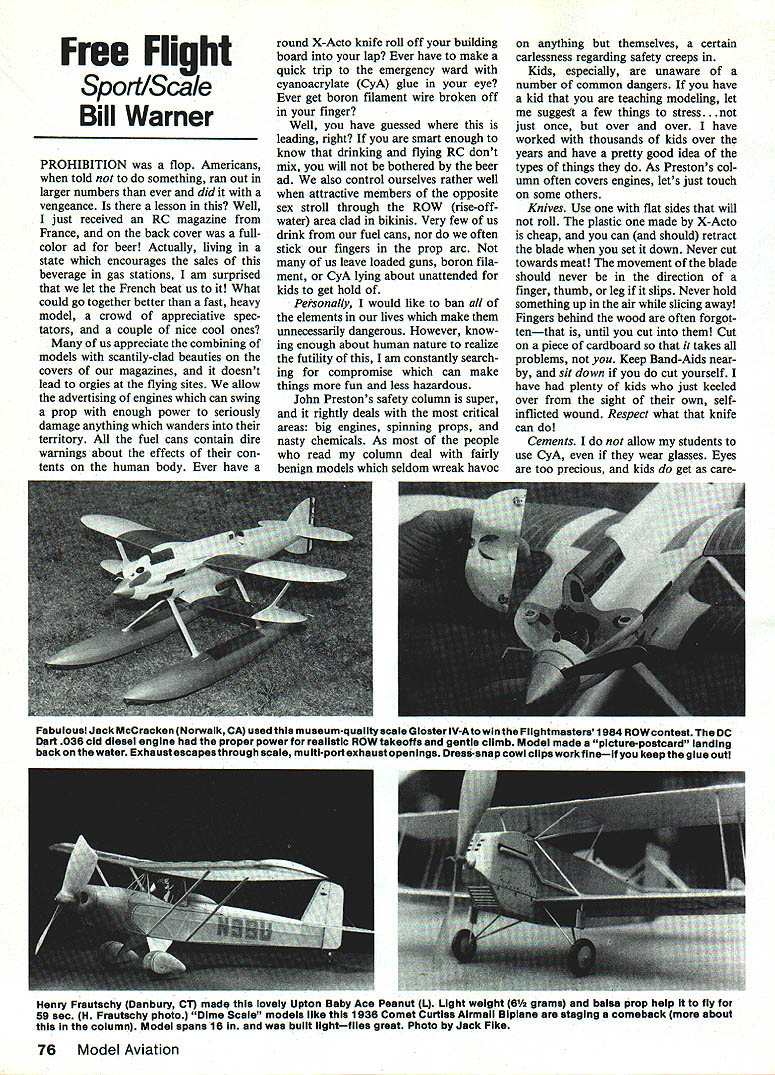
This month, we salute Jack McCracken and his museum-quality FF Scale Gloster IV-A, which won the last Flightmasters ROW at Lake Elsinore, CA. Built from an Aeromodeller three-view at 1 in./ft., Jack's model spans just short of 27 in. and weighs 10½ oz. Powered by an enclosed DC Dart diesel of .035 displacement, the plane had no trouble getting off the water. The Gloster is sheeted back to the cockpit and has sheeted floats (3/8 in.), with the rest being stick-and-tissue finished in Aero Gloss dope. A small water rudder was added to the right float to straighten out the takeoff run, and the ship realistically rose from the surface and climbed out in a gentle, left-hand pattern. A minute later, when the power cut, the transition to a left-hand glide was perfect, and the landing was picture-postcard quality! The model had just a little right and down thrust in the engine, and flew on neutral control surface adjustments. The knock-off wings and floats were held in place with rubber bands, but due to the outstanding flight characteristics of the Gloster, they were never really tested!
Well, gang, until we meet back here in two months, help a Junior, think safety, and never play leap-frog with a unicorn!
Bill Warner 423-C San Vicente Blvd. Santa Monica, CA 90402
Transcribed from original scans by AI. Minor OCR errors may remain.

